


By Roger J Kerr
The consensus view amongst the local economist fraternity and moneymarket pricing is that short-term interest rates will move across the page for the next nine months; however after that the outlook becomes considerably murkier.
The speed at which short-term interest rates increase in early 2012 will have a lot to do with how steep the interest rate yield curve becomes in the meantime.
I see the rate of increase in 2012 being particularly sharp as the interest rate markets realise that the RBNZ is too far behind the 8-ball in terms of monetary policy settings.
The steepening of the yield curve over coming months will come from US-driven long-term interest rates rising, whilst one to three year swap rates remain stable at current levels. A very steep-sloping yield curve (long term rates substantially above short-term rates) just tells you that there is inevitability about increasing short-term interest rates.
I often take my lead on where US long-term interest rates are headed from the risk management decisions of large US corporate borrowers. Currently those borrowers are issuing a stack of new corporate bonds to extend the duration of their portfolios and improve liquidity.
The better credit market conditions with investors seeking yield pick-up are attracting the corporate issuers to meet the investor demand. The US corporate borrowers also know how well their businesses are now travelling and that eventually the Federal Reserve will need to progressively remove the current monetary policy stimulus.
They are fixing their interest rates through the corporate bond issuance and fixing for long terms.
These actions tell you a lot about how they see US market interest rates moving over coming years. While the US housing market has a long way to go to restore overall economic wealth, the bond market is already starting to price the higher inflation and borrowing demand ahead.
My take is that the CFO’s and Treasurers of large US corporate borrowers are closer to what is really going on in the US economy than the Wall Street economists and Connecticut fund managers.
The corporate borrowers see US long-term interest rates higher and I don’t think they have got this wrong.
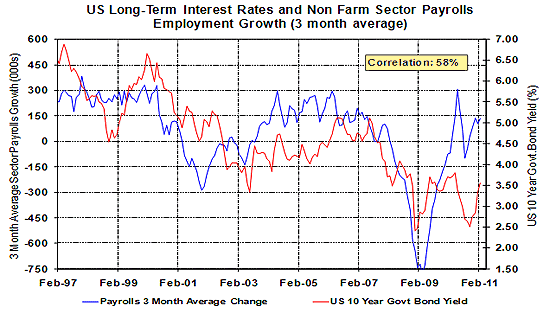
US employment data out later this week should be another strong number. After the hic-up in Japan that drove US 10-year bond yields down to 3.22%, the bond yields have already reversed to 3.44%.
We have not seen this upward move transfer through into our 10-year swap rates - yet.
The strong investor demand for NZ Government bonds last week seems to have counteracted the higher US bond yields. However, it appears to be only a matter of time before increasing US bond yields lift our 10-year swap rates back to 5.50% (currently 5.20%) and higher.
The strong historical correlation between US employment and US bond yields also suggests rising long-term interest rates.
--------------------
* Roger J Kerr runs Asia Pacific Risk Management. He specialises in fixed interest securities and is a commentator on economics and markets. More commentary and useful information on fixed interest investing can be found at rogeradvice.com
No chart with that title exists.
We welcome your comments below. If you are not already registered, please register to comment
Remember we welcome robust, respectful and insightful debate. We don't welcome abusive or defamatory comments and will de-register those repeatedly making such comments. Our current comment policy is here.