
Here's my blogroll for the week. Starting with the economics blogs (blog) this week because I missed them out last time round.
And before we get into it, I came across this government website just before advocating foreign investment in New Zealand. Why invest in New Zealand? Because it has no capital gains tax.
Perhaps that's why National doesn't want to change things...
Deregulation over the past two decades has created an open, globally competitive economy which operates on free market principles. The economy is well geared for long term international competitiveness, with other key benefits for business and investors in New Zealand that include:
- No restrictions on inflow and outflow of capital
- No capital gains tax
- Research and development is 100% tax deductible
- Tax incentives for activities including motion picture and petroleum exploration
- Raw materials may be imported tariff-free.
Economics blogs
1. Why is youth unemployment so high? Because the youth minimum wage was scrapped. Economist Eric Crampton at Offsetting Behaviour takes a look at how much lower the 27.5% unemployment rate for 15-19 year-olds might be if the minimum youth wage hadn't been scrapped. He thinks it's safe to attribute five to eight percentage points of youth unemployment to the abolition of the youth minimum wage. He has a model for his argument too.
And so it's time to update the estimate of how many kids aged 15-19 are currently unemployed because Labour, at the behest of the Greens, eliminated the differential lower youth minimum wage. And let's not forget that National, who opposed the abolition when Labour was doing it, decided that they liked pricing kids out of the labour market when they had a chance to change things.
The model expects, given the current adult unemployment rate, that the youth unemployment rate would be 19.3% if the youth unemployment outcomes were no worse (relative to adult outcomes) than in the worst quarter from 1986 to 2008. As the actual youth unemployment rate is 27.5%, the rate is 8.2 percentage points higher than would have been expected under the prior trend. That translates to 12,350 kids who don't have work who we would have expected to be in work had the prior relationship between youth and adult unemployment rates continued.
Crampton says he’s less confident about this quarter's figures because of the February earthquake.
If the earthquake differentially affected firms employing youths (compared with those employing adults), the residual for this quarter will be picking up that effect. It's not implausible that kids employed in retail were hit harder than folks whose jobs shifted location.
But it seems fairly safe to attribute five to eight points of youth unemployment to forcing employers to pay sixteen year olds as much as older workers. Hit the "minimum wage" tag for further background and responses to counterarguments.
From the left
2. What's next, a Keymobile? Can't help putting these comments in from Gordon Campbell at Scoop on the PM's protection squad budget blowout. Pic HT @lyndonhood
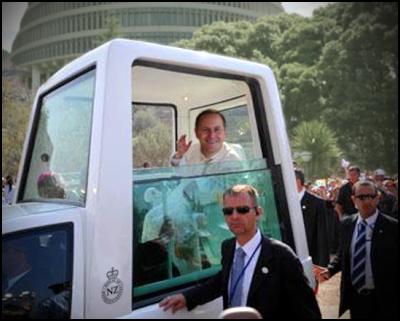
Can we assume that if the health system needs to treat more people it too, will be allowed to blow out its costs?
Isn’t that [operating within a budget] what doctors and nurses have to do almost every day of the week? Consistently, they are forced to balance the quality of care against the need to defend the health budget. Such decisions of course, affect only the lives of ordinary people though – and not the very important people who qualify for diplomatic protection squad care and protection. Just one more sign that this government believes some lives are more important than others.
3. Brash may expose the cracks between National's centre and right. Tim Watkin at Pundit wonders if Don Brash really is the saviour of the right wing or if he will produce more trouble than it's worth for Key.
Most of all, Brash will be ruthless on urging more immediate cuts to the deficit (although that may be something National will be happy to respond to). In other words, he won't be worried about frightening the horses, otherwise known as the centre votes Key has worked so hard to tie down. Brash gives Labour something to kick against, giving them hope, and will force National to issue and repeat a bunch of denials that otherwise would have been taken as read.
One of the biggest worries for National's strategists will be whether they will be forced to choose between ACT and the Maori Party. Ask yourself, how can the Maori Party, even with Tariana Turia at her most pragmatic, say it will go into a coalition arrangement with the man who delivered the Orewa speech, questioning whether Maori can even call themselves Maori these days?
Key made efforts to keep Rodney Hide in charge of ACT when the Heather Roy challenge came. He has dominated the centre and right of New Zealand politics for so long. But this he could not control. Brash and his backers, some of whom I've spoken to this week, dismiss Key as a "smile and wave man" who doesn't adhere to true National principles. Closer to the truth is simply that Key has created a National party that's true to the legacy of Sir Keith Holyoake, rather than that of Ruth Richardson.
But Brash and his backers will not stay on message as Hide did, and may even expose cracks between National's centre and right-wing. It will be a test of party discipline that Key hasn't had to face before.
4. Brownlee's campervan disaster. Against the Current takes to Eathquake Recovery Minister Gerry Brownlee and Christchurch Mayor Bob Parker over the caravan park set up for temporary accommodation, while Japanese authorities are building temporary housing.
These campervans were placed in the middle of a field (Canterbury Agricultural Park) and the Government expected people to put up with living in these campervans during the harsh months of winter.
But Earthquake Recovery Minister Gerry Brownlee also demanded that folk, already under considerable financial pressure, to pay market rents for the 'privilege' of living in cramped accommodation in a field that would quickly turn to mud once the wet weather set in.
The whole project was ludicrous and, not surprisingly, the camper van 'village' has crashed and burned. Only one person wanted to live in a crappy camper van - but only put up with it for a few days.
Despite Christchurch's urgent need for temporary homes, Sideshow Bob has kept his mouth shut about this latest Brownlee blunder. Bob is the Government's little lapdog and he won't say or do anything that risks embarrassing his mate Gerry. Expect Sideshow to be suitably rewarded for his loyalty in the New Years Honours list.
But another housing disaster is unfolding as we speak.
The Government's intention is to build just 2.500 modular homes but they won't be all be available until September at the earliest.
In stark contrast Japan started building temporary home two weeks after its quake.
Three hundred portable homes are supposed to go up this month. Although some parks have been earmarked for homes it is expected that most of them will go on people's own damaged properties - who will have to pay the installation costs.
It took Gerry Brownlee over two months to announce the contractors for Christchurch's modular homes.
Times are tough for too many people in quake hit Christchurch but the elected 'representatives' of the good people of this fair city are doing just fine, thank you very much.
Christchurch's city councillors are in line to receive a $2000 wage increase which would take their basic salary to nearly $89,000.
The increase would come at a time when many of the Council's powers have been transferred to the Canterbury Earthquake Recovery Authority (CERA).
But we're talking basic council salaries here. There are also the 'add ons' that many councillors receive.
Four councillors in particular are rolling around in a big vat of cash while the queues at the local food banks continue to grow longer.
Councillors Barry Corbett, Sue Wells, Philip Carter and Mayor Sideshow Bob are also merrily double dipping. They receive another $35,000 as directors of Christchurch City Holdings (CCHL).
From the right
6. Youth unemployment a disaster because of Labour policies. David Farrar at Kiwiblog thinks National should pledge to lower the youth minimum wage.
It is a crisis, but one created by Labour (and not changed by National). Labour made it illegal for a teenager to accept a job for less than the adult minimum wage. They abolished the lower minimum wage for youth.
A 16 year old generally has no skills, no experience and lives at home. They would love to be able to earn a bit of money for say $10/hour. But Labour has priced them off the market. If an employer has a choice of an experienced 25 year old or a novice 16 year old, of course they will not choose the 16 year old.
The fact that teenage unemployment levels are increasing, while the overall unemployment level is falling, shows that getting rid of the youth minimum wage was a disaster for our teenagers. They deserve the chance to gain employment, and National should pledge to reintroduce a lower minimum wage for youth.
7. John Banks standing for ACT and promoting fiscal responsibility is a joke. Peter Cresswell at Not PC thinks getting rid of Hide was good, but bringing in the former Auckland City Mayor would be terrible. He has some good points.
What would have been a clinical coup producing a party representing accountability and financial rectitude has been poisoned at birth by Don Brash’s bizarre insistence that Minister-of-Rhyming-Slang John Banks be given the post of Act’s anchor in Epsom.
Which will see the man who campaigned on stopping rate rises and who then raised them every year of his reign—the man who left Auckland ratepayers $887 million in debt when he left office—carrying the flag for financial responsibility.
That, ladies and gentlemen, is a joke.
8. The rich might start paying more tax...but you don't have to raise the top rate for them to do so. Roger Kerr finds an interesting chart from the US:
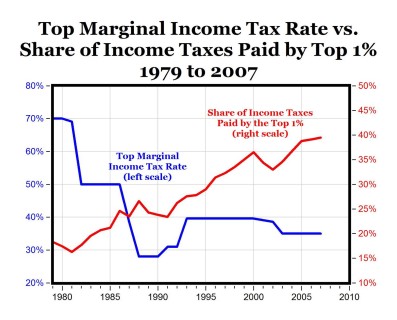
In a recent article Is ‘Tax the Rich’ Good Policy? (ODT 25 April 2011), I made the point that those in the top income brackets in New Zealand are already taxed relatively heavily by international standards.
I also noted that because cuts to high tax rates encourage economic growth and reduce tax avoidance, they may actually produce more government revenue.
And I quoted President John F Kennedy who said, when cutting US tax rates in the 1960s, “It is a paradoxical truth that tax rates are too high today and tax revenues are too low, and the soundest way to raise revenues in the long run is to cut rates now.”
This chart from Mark Perry’s blog Carpe Diem illustrates these points.
Video
9. Very funny on John Key's Kiwi accent.
10. Make your own billboard. Good fun from Labour.

We welcome your comments below. If you are not already registered, please register to comment
Remember we welcome robust, respectful and insightful debate. We don't welcome abusive or defamatory comments and will de-register those repeatedly making such comments. Our current comment policy is here.