

Here's my Top 10 links from around the Internet at 1 pm in association with NZ Mint.
I welcome your additions in the comments below or via email to bernard.hickey@interest.co.nz.
I'll pop the extras into the comment stream. See all previous Top 10s here.
The theme in today's Top 10 is 'ridiculous'. The bonus Number 11 video of 'Investorville' is hilarious in a cringey sort of way to rival the Westpac Banana Smoothies video.

1. Where have we seen this before? - Fitch Ratings has reported on the size of the Total Societal Financing in China, which includes the 'shadow' banking system there.
Chinese authorities have been cracking down on the official sources of finance to try to slow down inflation.
But many have worried in recent months that credit is squirting out through the unofficial sectors.
The curious thing about the last couple of years of growth in China is how it happened when export growth to America was so slow.
Was it created by an internal credit boom and spending on bridges to nowhere and ghost cities?
And how sustainable is that? Will those loans implode under their own weight?
This Fitch report suggests the internal credit boom is both a key for the growth and not very sustainable....
Two years after the peak of the 2009 lending boom, credit levels in China remain elevated. Although bank lending has slowed, this moderation is being offset by a burgeoning of new credit channels both within and outside the banking system. Consequently, growth of leverage continues to outpace growth of the economy.
The main components of this uncaptured financing include letters of credit (LoCs), credit from domestic trust companies, lending by other domestic nonbank financial institutions (NBFIs) and loans from Hong Kong banks. All of these are on pace to reach CNY700bn‐1trn in 2011. By end‐2011, total financing/GDP could reach 185%, up 61pp from 2007. Increases of similar magnitude have been seen elsewhere in the years leading up to banking stress, underscoring the agency’s cautious outlook on the sector.
That China’s economy is slowing while financing is still so abundant illustrates how dependent growth remains on loose financing. This is further highlighted by the continued low incremental economic return on new credit.
Pre‐crisis, a CNY1 increase in financing yielded roughly CNY0.75 in new GDP, but in 2009 this plummeted to CNY0.18. The economic return on credit is slowly rising, but still has yet to fully recover.
2. Here's what Americans think of the Debt Ceiling debate - The Washington Post asked its readers for a one word thought on the debate and then put it into a word cloud.

3. Korea buys gold - Reuters reports South Korea's central bank bought 25 tonnes of gold in the last two months in its first purchases in more than a decade.
This is what happens when America, which has the world's Reserve Currency, prints money in a beggar-thy-neighbour attempt to devalue its way out of trouble.
The RBNZ owns no gold.
The central bank of Asia's fourth-largest economy said that, with prices hovering near historic highs, gold looked less lucrative as an investment but it was the right time to buy gold because its foreign reserves had risen above $300 billion.

4. Yen's surge may wipe out Japan's recovery - Bloomberg reports on the fallout from the US dollar's slump.
This is what happens when America, which has the world's Reserve Currency, prints money in a beggar thy neighbour attempt to devalue its way out of trouble.
It will encourage yet more printing by the Japanese and Chinese.
Meanwhile, New Zealand doesn't print and our currency gains against both...
It's all nuts.
Here'swhat the Japanese are thinking:
“The strong yen is the biggest uncertainty facing Japan’s economic recovery,” said Eiji Hirano, formerly a BOJ executive director and now the executive vice president of Toyota Financial Services Corp.
“Japanese companies were doing all they could to get back on their feet, helping the nation rebound faster than expected -- the strong yen could kill all of the optimism that was built up on that.”
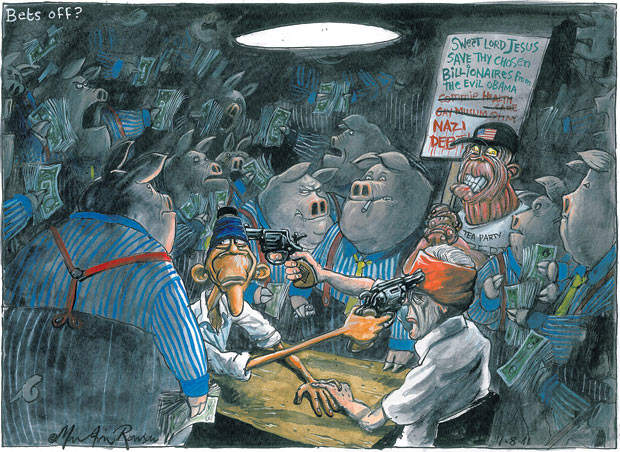
5. The Spanish example - Boston University Economics Professor Christophe Chamley writes at Bloomberg about the default of Spain's sovereign debt in 1575 and how it helped bring down an empire and poison views of Spain's creditworthiness for over 400 years.
Thanks to Philip’s expensive military adventures in the Netherlands and the Mediterranean,Spain’s debt had reached half of gross domestic product by 1573. At that point, the cities balked at paying higher taxes. For the next two years, they refused to budge in their confrontation with the king.
Finally, in September 1575, Philip took a circuitous route to outmaneuver the Cortes. He suspended payments not on the long-term debt, but on the short-term debt, which was owed primarily to Genoese bankers. The people cheered. Resentment against bankers ran as high then as now -- perhaps higher, because the bankers were foreigners. The upshot, however, was default and a full-blown credit crisis.

6. 'A parasite' on the global economy - Reuters reports Vladamir Putin saying America is now a parasite on the global economy. Couldn't have put it better myself.
"They are living beyond their means and shifting a part of the weight of their problems to the world economy," Putin told the pro-Kremlin youth group Nashi while touring its lakeside summer camp some five hours drive north of Moscow.
"They are living like parasites off the global economy and their monopoly of the dollar," Putin said at the open-air meeting with admiring young Russians in what looked like early campaigning before parliamentary and presidential polls.
7. The West Wing - Does its thing on how debt ceilings used to be increased.
8. The power of deleveraging - Carmen and Vincent Reinhart write at the FT.com that the debt deal doesn't fix the underlying problems in the US economy that are keeping stuck in a decade long (at least) period of Japanese style balance sheet recession.
Here the federal sector is on the hook for a number of liabilities. Some are well known, and based on legislated promises, such as the underfunded social safety net. Others are unacknowledged, but will soon hit the national balance sheet. In particular, unfinished business lingers from the financial crisis of 2007-09, mostly related to bad mortgages. Those are troubling for those institutions that hold the debt, as well as being a considerable burden for the one in five mortgage owners whose houses are now worth less than their debt.
This unfinished business has damaged the housing market and slowed growth, while also hitting state and local governments. Authorities splurged in the good years of the housing bubble, but did nothing to prepare for leaner times. Widespread deleveraging is thus still the order of the day. And when so many want to spend less than their incomes, an economy sputters. This poor performance is what we should expect from history, where post-crisis economies grow more slowly, and unemployment stays high, in the decade after a major financial crisis.
Economic data last week confirmed this, with the S&P/Case-Shiller home price index declining again, and gross domestic product expanding by less than 1.5 per cent over the past four quarters.

9. The old are more likely to default - IMF economist Ali Alichi makes this interesting comment in an IMF blog post.
Studies have shown that a country's willingness to repay is as important as whether it has the resources to repay. This willingness deteriorates as voters age because they have a shorter period to benefit from their country's access to international capital markets and become more likely to opt for default on current debt. Moreover, older voters generally benefit more from public resources—such as pension and health care benefits—which could shrink if debt is repaid. If the old are a majority, they might force default, even if it is not optimal for the country as a whole. Lenders will take this into account and reduce new lending to an aging country.
There is some empirical support for the notion that aging increases the probability of default on sovereign debt, but more work is needed to draw strong conclusions. Alichi (2008) uses a panel of about 75 countries that have had at least one episode of sovereign default during 1975–2003 and shows that, on average, younger countries (those with a higher percentage of people ages 15 to 59 years) are less likely to default.
10. Totally a Taiwanese animation treatment of the Debt ceiling debacle - The Tea Partists throw their toys and other things around...a lot.
Bonus Number 11 - HT Alex and Macrobusiness for this cracker. Remember Westpac Australia's cringe-making Banana smoothies video explaining to customers why they needed higher interest rates?
Now Commonwealth Bank of Australia have created a game to encourage rental property investment in Australia...
We welcome your comments below. If you are not already registered, please register to comment
Remember we welcome robust, respectful and insightful debate. We don't welcome abusive or defamatory comments and will de-register those repeatedly making such comments. Our current comment policy is here.