

Here's my Top 10 links from around the Internet at 8.30 pm (what a week) in association with NZ Mint.
I welcome your additions in the comments below or via email tobernard.hickey@interest.co.nz.
I'll pop the extras into the comment stream. See all previous Top 10s here.
My must read today is #4 from Martin Wolf. He lays it out. And it's scary.

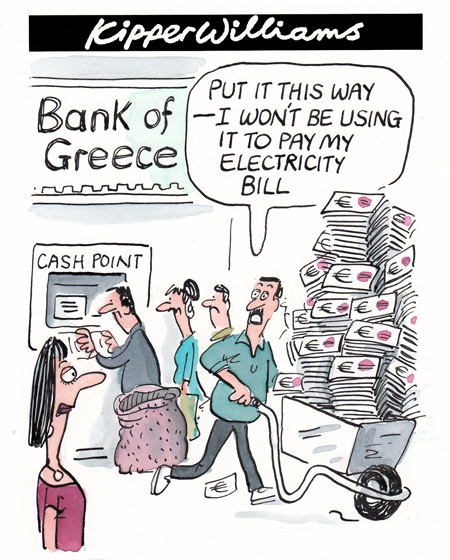
1. 'No worries. They'll bail us out again' - Banks and hedge fund investors are betting the cavalry at the European Central Bank, the US Federal Reserve and the Bank of Japan is mounting up to ride to the market's rescue with another big intervention of free money to stop a meltdown because of fears about a 'Grexit'.
Brilliant.
No wonder the peasants are beginning to revolt.
Whenever the peasants lose their jobs or their costs of living are increased (GST hike anyone?) they are told to take their austerity medicine and bear with the 'markets'.
Yet the moment the banks start wobbling and hedge funds are imploding the powers-that-be come riding to the rescue with big pots of free money to keep everyone (in the banks and hedge funds) happy (and still gambling to win their bonuses).
Until the next meltdown. Meanwhile hedge funds are now positioning with borrowed money for the next rescue injection. Is there no shame or any sense of the moral hazard being created?
Is it any wonder parties from the extremes of the left and right that aren't part of this 'deal' to rescue banks and hedge funds are now getting elected?
In the end, voters will get their way. Or rioters will. How long before we see pitchforks and burning torches brandished outside central banks and Presidential Palaces?
Here's Ambrose Evans Pritchard with the words of the experts predicting a cavalry charge from the central banks. The smugness and sense of entitlement just seeps through their words:
"We think the worst is over for the euro," said David Bloom, currency chief at HSBC. "The central banks will have to step in massively and that will be a soothing balm for the markets. The Fed is already leaving the door open for more QE. We could see quite a powerful rally."
Gary Jenkins from the bond advisers Swordfish said those betting on a market crash should be careful. "The global central banks are going to respond with the biggest flood of liquidity the world has ever seen. It will make the LTRO (the ECB's €1 trillion lending to banks) look like small change," he said.
"They have to act. We have reached the point where the peripheral bond markets are going to implode unless the ECB and EU politicians show they have deep pockets and start buying the debt on the secondary market. It is a quasi-fiscal union or bust at this stage," he said.
Bob Janjuah from Nomura, `Bob the Bear' to global fans, said the EU will not dare to push Greece out. "The Europeans will blink and renegotiate the bail-out terms. Whatever happens we think the Fed and the ECB will respond over the next week or two and trigger a short sharp rally," he said.

2. Hundreds of billions of euros - Reuters reports that's the likely cost of any 'Grexit' would be hundreds of billions of euros, enough to wipe out the capital of the European Central Bank, which now owns most of the Greek government's bonds. And the other central banks. And many of France's banks. And that's before any run on Italy, Spanish and Portugese banks.
Even once Greece had left the currency club, the costs to the rest of the euro zone would continue to mount as it would probably be compelled to avert a complete Greek collapse and wider contagion.
"Large-scale ECB intervention would be necessary to stabilize the system, along with intervention from Germany, the European Stability Mechanism (ESM), its predecessor the European Financial Stability Facility (EFSF) and the IMF, potentially costing hundreds of billions of euros," said Georgios Tsapouris, investment strategist at Coutts.
The ECB, which has its own paid-in capital of 6.4 billion euros, is essentially a joint venture between the 17 euro zone national central banks (NCBs). Combined, the Eurosystem of euro zone central banks has capital and reserves of 86 billion euros.

3. Deja Vu - Reuters reports the British government may lose a further 2 billion pounds from Northern Rock, the building society that collapsed at the beginning of the Global Financial Crisis and was then bailed out by British taxpayers.

4. Eurotoast - The FT's Martin Wolf says a 'Grexit' would shatter confidence in the euro forever and spark a financial crisis worse than the Lehman collapse.
He says Germany must capitulate and effectively guarantee all of Europe's debts.
No pressure then...
The eurozone either is an irrevocable currency union or it is not. If countries in difficulty leave, it is not. It is then an exceptionally rigid fixed-currency system. That would have two dire results: people would not trust in its survival and the economic benefits of the single currency would largely disappear.
These perils are not of concern to the eurozone alone. Taken as a whole, this is the world’s second-largest economy, with the largest banking system. The risk that a bigger eurozone upheaval would cause a global crisis is real. As frightening is the likelihood that eurozone crises would become permanent features of the world economy.
A Greek exit, particularly a disorderly one, is likely to trigger bank runs in Portugal, Ireland, Italy and Spain, and even further afield. It could also cause collapses in the prices of financial and other assets. A flight to safety, to Germany or beyond the eurozone, could accelerate. The doom loop in which several other nations are caught could worsen substantially.
If Greece leaves, the eurozone will have to change fundamentally to make survival less painful and therefore more credible. If that is impossible, as many suppose, irrevocability must be seen as a mirage, which would in turn guarantee the repetition of large crises. It also destroys the economic arguments for the currency union by undermining financial integration and rendering long-term investments dependent on access to the entire eurozone economy far riskier. It is a nightmare.Greek exit then would create a choice between big moves to a stronger union and a future of endless crises. It is a choice the dominant creditor nation, Germany, must make – among big steps to integration that horrify many of its people, a future of horrible crises or a horrible break up right now. No good choices exist. But the eurozone must become a stronger union or it will disappear.
5. The drums of trade war beat again - AFP reports America has slapped big anti-dumping duties on China's solar cell exporters.
The Chinese are very grumpy about it.
The Commerce Department said it had found that Chinese solar cell producers and exporters had been selling solar cells into the United States at artificially low prices, meriting anti-dumping duties of between 31 percent and 250 percent.
It named Suntech Power, the world's largest maker of solar cells, and another large producer, Trina Solar, as key offenders, but said at least 59 other Chinese companies would also be hit with anti-dumping charges.
The ruling follows a March decision that China was unfairly subsidizing solar cell exports and set counterveiling duties of 2.9 percent to 4.7 percent.

6. Apocalypse fairly soon - So says Paul Krugman in the New York Times.
He says the ECB and Germany need to encourage inflation to rise to 3% or 4% in Europe, and higher than that in Germany if Europe is to survive in anything like its current state.
Italy and, in particular, Spain must be offered hope — an economic environment in which they have some reasonable prospect of emerging from austerity and depression. Realistically, the only way to provide such an environment would be for the central bank to drop its obsession with price stability, to accept and indeed encourage several years of 3 percent or 4 percent inflation in Europe (and more than that in Germany).
Both the central bankers and the Germans hate this idea, but it’s the only plausible way the euro might be saved. For the past two-and-a-half years, European leaders have responded to crisis with half-measures that buy time, yet they have made no use of that time. Now time has run out.

7. Jamie Dimon knew about it all - JP Morgan boss Jamie Dimon thundered this week about how bad the management of JP Morgan's loss making synthetic credit trade was. Several weeks earlier he dismissed reports of the 'London Whale' as a 'tempest in a teapot'.
The WSJ reports that Dimon knew about this montrous trade all along and actually personally approved it.
This story will run and run.
Mr. Dimon personally approved the concept behind the disastrous trades, according to people familiar with the matter. But he didn't monitor how they were executed, triggering some resentment among other business chiefs who say the activities of their units are routinely and vigorously scrutinized.
Blessed by Mr. Dimon, the activity originally was designed to provide an economic hedge for the bank's other holdings, executives say. It expanded, particularly after J.P. Morgan in 2008 bought troubled lender Washington Mutual, which held riskier securities and assets that required hedging.
In recent years, some of the group's trading morphed into what essentially amounted to big directional bets, and its profits and clout grew. Last year, Mr. Macris dropped risk-control caps that had required traders to exit positions when their losses exceeded $20 million. Ms. Drew and Mr. Macris declined to comment.
Mr. Dimon was unaware of the risk-control change, according to colleagues. Indeed, he had appeared to have started paying less attention to details of the group's trading activities amid the hefty profits, colleagues say.

8. A dog that doesn't bark - Robert Reich has a go at fellow Democrat Barack Obama and his lack of reaction to the JP Morgan mess.
The dog that didn’t bark this week, let alone bite, was the President’s response to JP Morgan Chase’s bombshell admission of losing more than $2 billion in risky derivative trades that should never have been made.
“JP Morgan is one of the best-managed banks there is. Jamie Dimon, the head of it, is one of the smartest bankers we got and they still lost $2 billion,” the President said on the television show “The View,” which aired Tuesday, suggesting that a weaker bank might not have survived.
That was it.
Not a word about Jamie Dimon’s tireless campaign to eviscerate the Dodd-Frank financial reform bill; his loud and repeated charge that the Street’s near meltdown in 2008 didn’t warrant more financial regulation; his leadership of Wall Street’s brazen lobbying campaign to delay the Volcker Rule under Dodd-Frank, which is still delayed; and his efforts to make that rule meaningless by widening a loophole allowing banks to use commercial deposits to “hedge” (that is, make offsetting bets) their derivative trades.
Nor any mention Dimon’s outrageous flaunting of Dodd-Frank and of the Volcker Rule by setting up a special division in the bank to make huge (and hugely profitable, when the bets paid off) derivative trades disguised as hedges.

9. A personal tribute to Donna Summer - I'm a bit of a disco chick at heart.
Here's the Blue Man Group with their version of 'I feel Love'. This rocks. For a disco tune.
10. Totally Clarke and Dawe - A member of the Australian public comments on public events.
79 Comments
Next to many other problems - trade wars.
China-based solar firms have been complaining to the government over polysilicon dumping by US- and South Korea-based firms. This harsh tariff levied by the US government may cause China to retaliate by starting similar investigations. A trade war between the two giants can cause negative impacts around the world.
Thanks so much for these wonderful cartoons, the highlight of my week!
"Der Spiegel" in Germany:
Greece Can No Longer Delay Euro Zone Exit
http://www.spiegel.de/international/europe/why-greece-needs-to-leave-th…
Krugman keeps missing the point. It's not about getting inflation up. It's about clearing out the bad debt and replacing it with new money (monetary dialysis). Even with all the commentary over the last few years, they have still not diagnosed the real problem.
Plus ca change.
In the meantime, here's this for you Bernard:
Cheers raf.
agree there's something backward looking about krugman. He's still thinking we can create growth despite the limits and the debt load.
love the link. I'm smitten.
cheers
bernard
What Krugman and nearly everybody else doen't get is that the current welfare state model of every OECD country is bust. Countries simply cannot keep spending more than they receive in taxes. Either taxes go up or welfare spending is reduced. Neither option will be pretty, but that's what happens after so much reliance on debt.
Actually they can, the USA has been doing it for 40 years:-P The entire reason they went off the gold standard was so they could do this. They do have the advantage of being the reserve currency mind you, and that the rest of us are ignorant suckers. The deeper problem is the physical limitations of resources. Welfare is ulitimately backed by cheap energy. My pick is they will keep prining money in various ways to hide this problem, well until they can't any longer that is.
Good point Scarfie.
Printing money (and I mean printing it and spending it directly into the economy as public spending, not QE via the banks) is not an issue as long as it goes on productive assets (infrastructure) and there are enough available resources (labour and materials). You have to keep an eye on base money but in a debt-based deflationary environment, this is easily managed.
The main issue, in the end, as you note, is that at some point we run up to resource constraints (in a tech dominated globalised world, there is never going to be a shortage of labour - according to ILO estimates, some 200m people are unemployed globally).
We will, at some point, run up against resource limits, whether its energy or base material. Of course, it may be that we are smart enough to improve the productivity of energy creation and use (solar conversion rates for example) and make more with less (better production processes and less non-product output). That's all possible.
Bloomberg: Treasury Sells Inflation Notes At Record Low Negative Yield
http://www.bloomberg.com/news/2012-05-17/treasury-sells-inflation-notes…
More information on Fukushima - a real worry !
Former ambassador to Japan to Switzerland has warned of basically a civilization ending event for Japan.
According to the infinitely wise DavidB there isn't any problem Walter.
Richard Duncun trying to flog his book, but a useful passage from it is quoted here.
Ivan: I can confirm that. From personal experience. Over a number of years in business in AU, dealing with many people of many nationalities, there are two mediteranean nationalities that I will now only do business with on a "cash-up-front" basis. If they don't like it they can take a hike. The Greeks are the worst of the two. They are dishonest. It doesn't matter whether they are 1st, 2nd, or 3rd generation AU's
Good to see you thinking about energy Hugh, and how it drives everything. I have read a couple of your links and they all fall short in one particular way.
The rate of growth in population has been falling since 1961. Every year it continues to fall signals failure to find another source of cheap energy (water and minerals also). Until the growth rate heads up again, or is at least stabilised, then all the talk about other sources of energy is just an unrealised fantasy.
Yep - it's a step forward, he's engaging.
It's a long path, though, even with an open mind. I'm still learning, and I started in '75 on the energy/resoures track.
Malthus was absolutely correct - staved off only by exponentially-increasing quantities of fossil fuels, first coal then oil - and has never been 'disproved'.
What nobody is linking, is the energy underwrite of repayment of current debt by the future. The expectation by all those 30-year mortgages currently-held, represents a a physical demand many times the present.
Won't happen.
Sir Paul was a good fellow - but I'm not sure whether his urging us to up-tech ourselves was the best message he thought was palatable (tell them to don lifejackets but don't mention the ice) or whether he actually thought growth finance could outlast energy retraction.
There is one consolation PDK. Even though it might seem like it if you read these forums, sustainability is part of the curriculum in universities, well at least as Architecture School. So really those who don't accept the need are old school :-P Funny thing is there are lecturers (architects retired from professional practice) in their 70's relaying this information, so it isn't necessarily a generation thing.
500,000Kw/Hrs to build your average house is nuts and has to change, considering 100 years ago it was almost nil. Even for an optimist you would have to say that energy could be better expended more productively.
Nobody disagrees with pdks view on building more efficiently, what people can't understand is why he supports current regs and practice that is far from efficient.
It would be nice if property developer kilmog area could explain that contradiction.
"Property developer Kilmog area". A very rare beast!
I don't know why you quote Sir Paul Callaghan, Hugh. Sir P is saying he wants NZ to stay attractive and a special place where people would want to remain and work in niche manufacturing. You appear to be pro population growth as a goal.
recall: "a picture says a thousand words", he's against mining National Parks and has praise for the bicycle. While he doesn't specifically address population I doubt he was one who equates progress with population growth as youself and phil Best do ("NZ could and should have 40million people").
Ha ha , Hugh ...... welcome to the " peak energy zone " ...... there is no escape for you now , buddy ....... trapped as mastadons of old were , stuck in the tar pits of a fossil fuel .....
..... hey , while I've gotcha Hugh ... a bit of " left-field " thinking from the Gummster , that another bridge be constructed over the Waimakariri River , linking Eyrewell Forest with the area to the back of the Chch Airport . Construct a new town , a'la Pegasus , on the thin stoney ground around the old forest .....
Bridging the Waimak isn't the issue, its the Johns/Russley road 'BS' stop start stop start thats the problem...all we want to do is travel from Kaiapoi to Dunsandel without touching the clutch pedal...don't want to go anywhere near chch city thanks very much.
Sorry Hugh, I'm a Pig Islander who travels to Canterbury regularly and i love to drive the route, ferry crossing and all, Tory channel, Kaikoura coast is just magic no matter how many times you travel it but getting around chch city is just a pain in the arse. I have to see clients in North and Mid Canterbury so pass through chch and back ... the bypass is just a mess and it was that way before the quakes....Signage is non-existent and is the slowest part of the trip.
You may have noticed that the first stage of Russley/Johns 4 laning is underway. I would hardly complain about congestion on those roads! It's bad at rush hours but there are alternatives if you get out the map (I always shoot down Waimakariri and Stanleys if I need to get to the airport in the morning rather than sitting in traffic on Johns).
Transit removed the bypass signs (for Pound Rd) many years ago due to problems turning right onto Main South Rd at Templeton and the Yaldhurst/Pound intersection (the latter is now fixed with a roundabout).
Turning right onto Main South is impossible at peak times at Templeton without having a long delay. Whenever I head south I avoid Hornby by continuing from Russley onto Masham, then turn right into Buchanans then left into Gilberthorpes and can then turn right into Main South at the lights without delay while still avoiding Hornby.
ChCh traffic is decidedly mild especially compared to being caught in Wellington or stuck in a convey along the Kaikoura coast!
The extra bridge would offer West Eyreton / Cust & Oxford a quicker trip into the city .
.... it would be an insurance against the main north motorway bridge being shut down for any reason .
And a new town on the edge of the Waimak , on the unproductive stoney Eyrerton soils ,would be a haven for fishers & watersports folk . Plus it'd have a near limitless supply of potable water for house use .
..... it seems a shame to me , to build upon productive soils ( such as Marshlands ) when there's low grade soil galore in other locales ... good solid greywacke rock , earthquake resistant .
Long term there is logic in that plan, but there isn't a shortage of land right now in ChCh! If everyone's insurance issues were sorted tomorrow, probably another 20,000 would be gone quick as look at you!
A river crossing is actually a project a large scale developer could do as a joint venture with the Government.
Only problem is ... that in my humble opinion (not my field of expertise but just a feeling) based on the geological evidence and known faultlines it seems pretty likely that there is a major faultline in the area (like Greendale).
Why? We know that the Waimak has tracked north over time, yes the unusual phenomenon of the Waimak gorge terraces and the change in flow can be explained by high magnitude floods (Speight Lake etc) but as postulated much earlier by Haast and co (I think?) that the movement could be due to an uplift in the south (I also recall reference to evidence of an uplift on the south side of Banks Peninsula of about 3m being mentioned in early geological papers).
Of course seeing how easily the Selwyn was diverted on Sept 4 it is entirely plausible.
Also seeing the creation of new (or addition to the height of existing) banks of river terraces in Avonside and Avondale, it seems plausible that the river terraces are not only caused by floods but earthquake events. Evidence of cracks in the asphalt on Old West Coast Road past Courtenay after September 4 along the lines of river terraces suggest that it may be the case that some of the terracing at least is due to subsidence of the land rather than just erosion.
Also is it beyond consideration that the large sandhills (supposedly wind blown) around Courtenay could be due to liquefaction during a colossal earthquake event? Photos of huge boils metres high created during the Murchison quake suggest that it is not implausible.
Geological evidence will exist of large sand blows if such major events did occur. Should we be looking for it?
I have every confidence humans will innovate their way to energy abundance.
Why?
Well, no, he didn't talk about being 'saved' by something we are completely unaware of - but instead said this;
Energy? America's natural-gas and shale oil boom will bridge us to 2030 or so when solar energy and algae-based fuels will be closer to market parity and begin to make a real contribution. As long as I'm on the topic of the natural-gas boom, what key technology made this happy surprise possible? High-tech horizontal drilling. Who knew? We were all too busy fiddling with our iPhone apps to see it coming.
Not sure what type of 'real contribution' he's referring to but they certainly won't 'power' us such that we can carry on business as usual;
http://www.smartplanet.com/blog/energy-futurist/what-eroi-tells-us-about-roi/361
Sorry to point this out, Hugh, but the tomorrow's problems you refer to ... well they're already here today.
The International Monetary Fund (IMF) recently issued a new working paper called “The Future of Oil: Geology versus Technology” (free PDF), which should be of interest to people who are following “peak oil” issues. This is a research paper that is being published to elicit comments and debate; it does not necessarily represent IMF views or policy.
The paper considers two different approaches for modeling future oil supply:
- The economic/technological approach, used by the US Energy Information Administration (EIA) and others, and
- The geological view, used in peak oil forecasts, such as forecasts made by Colin Campbell and forecasts made using Hubbert Linearization.
The analysis in the IMF Working Paper shows that neither approach has worked perfectly, but in recent years, forecasts of oil supply using the geological view have tended to be closer than those using the economic/technological approach. Since neither model works perfectly, the new paper takes a middle ground: it sets up a model of oil supply where the amount of oil produced is influenced by a combination of (1) geological depletion and (2) price levels.
This blended model fits recent production amounts and recent price trends far better than traditional models. The forecasts it gives are concerning though. The new model indicates that (1) oil supply in the future will not rise nearly as rapidly as in the pre-2005 period and (2) oil prices are likely to nearly double in “real” (inflation-adjusted) terms by 2020. The world economy will be in uncharted territory if this happens.
Kate is wrong, It takes 8 years years to bring an oil field to full production to tomorrow is actually 7 years ago.
regards
Hugh do the math, as a developer this should be right up your street, tell me how long you think it would take to build an oil refinery say at 200,000 barrels per day output?
5 years?
and the cost?
Even at a 2% decline we would need 8 such plants per year...every year and the expected decline is 4%+
and when I say "refinery" I mean a production capable unit that hasnt been invented yet but you are sure someone, engineers, scientists will invent.
Do you know what the average time frame from a university project to a production capable offering is?
5+ years
When Forbes say 2030 they as typical only think in terms of USA...nothing else matters...the problem with that is, the rest of the world will be hungry...USA cant supply a significant amount of this fracked energy abroad for long, ie multi-decades...
regards
wow...you missed me, to make it clear its all about energy and cheap energy.
"confidence" sorry but you refuse to listen to engineers such as myself...keep going myabe eventually you will geta second opinion you like, better drop straight down to quacks and witch doctors and faith healing, will save you a lot of money.
If we had a true abundance of energy the size of Govn should be of a concern to you....there would be plenty for all.
Maybe its time you stopped worrying about that doesnt matter and spend it "innovating" abundant energy.
regards
There's a couple of things that intrigue me about the JPMorgan story :
1 : They made over $US 26 billion in profits last year , so the $US 2 billion derivatives trading loss is no big deal to them ... . So why all the fuss , the hoopla .... the sage advice of Barack Obama .. why ?
2 : JPMorgan's traders were no dum dums , smart cookies , and yet they blew a cool $US 2billion in one month ...... so who was it that was even smarter than them , who pocketed the $US 2billion on the other side of the trade ( derivatives being a zero sum game , sans transaction costs ) ...... ?
....... no one in the media has sought to locate & to interview the extra smart traders who now have $US 2 billion of JPMorgan's money in their pockets' . How did they do it ?
CNBC interviewed a couple of counterparties about 4 days ago. 2 Bill doesn't go far, when spread amongst a lot of smaller hedge funds. Everyone takes a loss at some stage, even JPM.
Perhaps Mr Zuckerberg will kick in a bit, he made19 Bill yesterday, let him buy a mansion here, well who knows, he could pay off a large swag of NZ National debt if he felt like it.
Still, the underwriters of FB had to spend some unexpected cash on the IPO, too greedy, upping the price & number of shares. Serves them right.
The first point is was rather more than 2 billion loss and the second... word got out on the position and a number in the market bet against it.
On every side of a position GBH........now your'e talking sunshine.
It's time to give something back....!
Well , just in case Bernie ( and the rest of the worldwide media ) forgot to mention that the JPMorgan money wasn't " lost " , in his zeal to get a gloomster story out ......
.... it's just all warm & fuzzy in someone else's account , snuggly-buggly , safe as sound ...
Hugh, land supply just isn't an issue in ChCh.
The rate at which people are leaving will eventually create thousand of properties in excess supply.
Building costs will determine values more than land costs. Sections are already being sold for a fraction of their pre earthquake value in quite buildable locations (as good as much of the liquefaction prone land being developed in Kaiapoi and Halswell!). Anyone paying subdivision prices in the belief they have purchased something superior are sadly mistaken. The big subdivision newcomers are destined for bankruptcy yet don't know it!
In Auckland at open days I ran into a number of ChCh people, most were just using their insurance to buy and hanging on to the land until things settle down. Eventually all these people will sell their land. One agent we are dealing with in Auckland reckoned they were getting 2 new ChCh buyers a week coming into their office alone.
Have you been through the reduced CBD cordon? You will see that little has progressed and in many locations nothing has changed in 12 months. In fact between Armagh and Gloucester on Manchester only 1 building has come down since Sept 2011 and that should have been demolished immediately after Feb (was demolished in June 2011) - yet the street is only opened now! Only a handful of tall buildings have been demolished and much of the cordoned area could have been opened much earlier as was the west side up to the river.
The cordon has just destroyed the will of those to get on and get any repairs done and achieved very little except send ChCh to the dark ages.
It is completely inexplicable how CERA and the Govt have hindered recovery.
National and Key are goneburgers as soon as the rest of the country realises the mismanagement and failure to address the primary issue of getting peoples' insurance sorted so they can move on. The process so far has been a colossal waste of time and resources.
Its wrenching to see people leave their CBD work and walking through the demo sites, a greyness like old East Berlin.
Moving on, is so often meaning moving out.
Hugh, you know I've been buying in Auckland. Compared to the north, land is being simply given away down here.
Land values in a very good (not spectacular) location is about $2000/m2 for a 500m2 site ($1m). Spectacular locations can be several times that!
In a modest location expect $1000/m2. In a grotty location it's still $700/m2.
Compare to ChCh where in a good central location $300/m2 is now the going rate ($150k). Or in a top location where perhaps $800/m2 is the new norm ($400k).
People are paying 500k for a nice however basic plan home and land package out in Rangiora - simply as the insurance has been sorted for them and a perceived safer zone. Hugh is right this is a crazy price for what they get however most is build and not the land price.
Not surprised Rolloston cosents are much lower they like to shout how great they are because they are always trying to catch up.
Places like Pegasus still struggle, when in town I play golf there and use the gym... we have the place to ourselves during weekdays with limited sign of life until fridays. Would never find that overseas..understand weekday players are lower at most Canterbury courses..relates to people not able to take time off work/business...the place is grim.
I really think the people with a clear choice have already left. Will more leave.... only if they can secure employment.
Just as many have moved to Otago as the the Auckland Region. What I find curious is no one here mentions taking their insurance money overseas...just property in Auckland. It may be easier to get you head around Auckland investing but really is that the compelling investment case compared ..me thinks not. When you have millions in insurance money you do have a world of opportunity.
...... does anyone seriously think that there'd be less mismanagement if NZ Labour / The Greens / Winston were the government right now ?
Neither National nor Labour understand ( yet ! ) that individuals should have more power over there lives , and the right to re-build their houses and businesses .....
....... anybody from overseas would assume that Kiwis are a part of the EU , given how little control citizens have over their own destiny....
Hmmm. Well, Winston wouldn't have been there for a start if not for National and neither would Act and likely not Dunne.
So let's say Labour and Greens had formed a coalition (although had the Nats just worried about their own house, then it might have been we'd have got them anyway!).
But let's say Labour/Greens had the front benches at the time of the disaster. Phil Goff would have been at the helm and so, who do you think would have been given Gerry's job?
And would she have been more effective than Gerry?
And had Phil Goff's overall management of the crisis been so appallingly incompetant - do you reckon his Labour collegues would have left him in charge?
...... it is hardly a fair comparsion : Jolly Kid has been enormously popular with both the public , and with his own party colleagues ...... Phil Goff was neither ... and he did not fight for his party leadership , it was gifted to him after Helen Clark quit ...... not Goffy's fault of course , that neither Cunliffe nor Parker chose to contest the leadership , after the 2008 election thrashing ..
Phil Goff was polling less popular for PM than Helen Clark , and she'd already left NZ for a brighter future in NYCity !
..... the 2008-11 years were wasted by NZ Labour . They did not rejuvenate themselves . They did not look closely enough at why the country had so overwhelmingly rejected them in 2008 .
Short of actually committing a murder or burning down an orphanage..... the Nats won't be deposing their golden boy , JK .
But GBH - I didn't ask for an equivocal song and dance - what are you, a politician? :-) Just two simple yes/no answers to two simple questions!
The point being that Phil Goff could never have been in a position to be in charge of the crisis .....
.... but your blog is noted . I'm sorry that I replied to your comment .....
Silence from me ........ not another word from the Gummster ....... nope ! ...
... silence ...... sssshhhhhh .....
You posited the question/possibility in the first place;
...... does anyone seriously think that there'd be less mismanagement if NZ Labour / The Greens / Winston were the government right now ?
Intrigued that you now want to duck for cover.
1 : Yes
2 : No
I agree! :-)
Thankyou , Hugh .... if Kate permits me to go beyond a mere " Yes / No " answer ...... the great shame of NZ politics 1999-2008 was that National were a complete joke , a rabble of headless geese ...... and that weak opposition gave Clark & Cullen a free reign , seriously dopey legislation was passed , alongside some good stuff ....
... the worm has turned , and from 2008 , we have an equally useless opposition , this time Labour . ...... how can they hold the National government responsible for such monumental screw up as the Christchurch re-build , when they still havn't rebuilt their own party . All the " old hands " are clutching tightly to the party list .....
.... [ .. back into the Gummy Bear cave ! ........ ssshhhh .. ]..
Hugh, it's likely they would have done better. Brownlee was only first appointed a Minister of anything in 2008 - he's a greenhorn politican from a woodwork teaching background no matter what side of the political divide you sit on. Dalziel is a seasoned Minister and bureaucrat with a law degree. She's a campaigner for the oppressed from way back - and the citizens of Chch are one of the most oppressed in NZ at the moment. Similar comparisons can be made relative to the party leaderships and hopefuls. Labour had the depth of bureaucratic expereince at the time the country most needed it. The whole community has been utterly shafted by the model of neoliberal corporatization which this whole crisis has been run under. Private sector experience just doesn't translate to success in bureaucratic governance during crisis - witness the ex-AXA CEOs inability to handle the ACC organisational crisis and Roger Sutton's less than effective performance heading CERA. I've worked at senior levels on both sides of the ledger - I feel so sorry for Chch that it has panned out the way it has politically. The crisis was so enormous, so critically important for New Zealand - that had Goff been in power, perhaps Helen Clark would have returned on secondment from the UN and taken the role Roger Sutton got under National. To me, she'd have been the most capable bureaucrat NZs got - and that was what was needed.
Hugh : If Kate's bottom is anything like her " skinny anorexic " top , I'm staying well away .... back to the Bear Cave me ole chum !
Lots of laughs here. Dalziel would be better because she is a lawyer and a seasoned bureaucrat. Oh God, are you for real?
- The world as seen by ex bureaucrat Kate.
Yup, which reminds me of another major advantage over the woodworker :-).
MUD's "there's no such thing as a free lunch:
Denton County municipal utility districts are good for developers, bad for residentsTag: Developer welfare.
Re Grexit - Reggie Middleton called this some time ago, and supplies lots of links to formerly subscription-only, now just archived predictions. Check out his Sovereign Contagion model, f'rinstance...but you might have ter bet the farm to make a bob or three...
even 50,000 may be unrepayable if not paid now.
Why folk don't grasp the shortfall between what is collectively owed (future mortgage dues) and wht the planet can underwrite, beats be.
The same goes for you, Hugh. Tell me one thing to do with 'development which doesn't require energy?
There isn't one. Period.
How, then, can you form any view as to relative 'worths', without understanting the driver?
That's Boolian algebra, done blindolded. Pointless.
Greece will stay in the Eurozone , Barry Obama said so ...... if for no other reason , than to kill off this idiotic term , " Grexit " ........
...... thankyou , Mr President .
Zerohedge does the forensic on the Facebook IPO;
http://www.zerohedge.com/news/facebook-complete-forensic-post-mortem
This is my favourite blog comment;
I agree. It looks like this IPO was all about trying to discern how many suckers are left in the retail space. The answer is: none.
And then this one;
The banksters that continue to prey upon the suckers that are no longer there then become the suckers themselves.....the most ironic twist of fate indeed.
How about putting it this way for you Hugh. The only thing that has allowed people to receive money for doing nothing ie:bureaucrats (& students :-P), is cheap energy. Without it the bulk of people have to be involved in primary production. Remember civilisation always starts with a surplus.
So you can't have it both ways. More cheap energy means the status quo will get worse not better. It is the nature of bureacracies to grow not to contract. Contraction usually only happens when they are forcefully broken. Peak oil means the bureacracies will become unsustainable and will have to die.
I wouldnt have said [new-]keynesian economics was making much headway....given the high degree of austerity govn packages in the world quite the opposite, voodoo economics is alive and well.
I think you [partially] do PK a dis-service. I think he's trying to steer a path between a rock and a hard place, ie voodoo economic leaders and $s make nationalising the US big banks impossible at the moment which I would guess he accepts.......I think really the USA is so steeped in its "freedom, america is the greatest" mantra that it cannot escape...against the back drop of real hardship many americans face.
His/Keynes theory of spending out of a liquidity trap is I think sound and proven, however the assumption is and one keynes never faced was that you cant recover this time and pay it back....expensive energy precludes that result.
Really even if energy wasnt an issue its pretty clear that the system is no so corrupt that nothing will work but the destruction of those corrupt entities and that means huge misery.
regards
So first we had,
1) complaining about short selling which led to a ban on short selling as its damaging the EU "recovery".
2) Now we have "Dangerous voices are what the British Prime Minister called those who criticised austerity in a speech on Thursday"....so whats next, ban any voice that is considered "dangerious"?
http://mainlymacro.blogspot.co.nz/2012/05/dangerous-voices-and-macroeco…
Really, really dangerous things seem to be happening to democracy and freedom as we move forward. We see the rise of the extremists but worse the extremes so called middle of the road govns will go to in the name of....um.....something or other <insert here>. More and more those in charge seem to be unfit to hold office and seem determined to take away information investors and ppl need to make sound decisions.....oh dear Moral hazard anyone?
regards
oh dear,
Really, really dangerous things seem to be happening to democracy and freedom as we move forward. We see the rise of the extremists but worse the extremes so called middle of the road govns will go to in the name of....um.....something or other <insert here>. More and more those in charge seem to be unfit to hold office and seem determined to take away information investors and ppl need to make sound decisions
Is this a satire/comment on your own posts, steven??
No amount of new 'money' from the Fed BoE BOJ or the ECB will solve the 'too much debt' problem. At best it will delay again the very same crisis brewing right now. That will be good news to pollies who are happy to kick the can and lie like blazes just to stay in office.
Steven - isn't it "democracy" that is one of the big reasons that the western world is where it is today....i.e. almost up against the wall ? We voted for the politicans that provided us with the most entitlements, and in the case of Greece, even when they hit the way they're still trying to vote for someone that makes life the easest for us, ignoring the realities and consequences.
I don't know the answer to it as democracy still has the better record, but how do we overcome the long-term consequences ? Legislated controls on how much large a Govt deficits can get...yeah like the the US debt ceiling, or the EMU rules that didnt work...I have no answers
I think the answer is to implement more of a swiss style direct democracy under a cantonal system of government. The key feature is it creates a competition between the various cantons and people are free to move to other areas if one area decides to implement poor policy. Of course this requires taxation to be collected at the cantonal level rather than federal which provides for far greater oversight by the citizen. The beauty is not all areas would have an identical policy mix, and people can chose to live or start business where conditions best suit.
All legislation can be subject to referendum with ~50000 signatures etc.
No reason NZ couldn't have such a system. Of course you would have to have robust discussion as to how many cantons would be appropriate for NZ.
Labour had the depth of bureaucratic experience at the time the country most needed it.
I see, so Kate's idea of improving the wealth and opportunity of New Zealand during these difficult economic times is better bureaucrats and better bureaucracy!
No wonder she loves Morgan’s the Spotted Dick or whatever it’s called so much. The command economy awaits!
Unbelievable!
And you wonder why we are living in such a poor and underperforming country when this is the depth of thinking of the people we have in it.
No , it wasn't the " Spotted Dick " plan ..... Gareth re-invented the " Speckled Gladys Scheme " ...
.. ... or was it " the Big Crap-ola " ?
Do we really require more " bureaucratic experience " ? ...... when the nation seems to be so sadly lacking in " individual citizen taking responsibility for his/her/its own freakin' life " experience ..
Whether we want or need it, Bill has prescribed and defended it.
While the non-elected bureaucrats run rings around the elected ones.
http://www.stuff.co.nz/dominion-post/news/politics/6950783/Former-staff-rehired-as-consultants
Well said, gummy, I couldn't agree more. It's that type of thinking which has lead to a real inertia in New Zealand's economic thinking and productivity. Don't just blame the politicians for the failure of Christchurch. What about the bureaucrats? They draw up and administer many of these utterly stupid rules in the first place, like limits on urban growth.
Yeah I think you're right! It was the "Speckled Gladys Scheme" lol. I think he wrote it with that Indian economist and well known drag artist, Iona Deery.
Yeah lets get the cost structures out of the way so we can have products priced like our competitor nations.
anyone ever shop at aldi's. wow incredible prices. gallon milk $1.89
1 US gallon = 3.78541178 litres
Milk @ USD 0.4993 cents per litre > NZD 66 cents per litre @ 0.7546 FX conversion.
C'mon John Key start downsizing the overhead - put them on the street if need be.
On second thought - no chance.
DavidB, Tell me about it, sad thing is though we have gotten to the stage where people can't imagine a world where the state might only make up 3-5% of the economy.
Next thing we'll have quangos deciding when its OK to take a sh*t. Can't have peak sewerage outflow now can we, these things must be managed by a govt department.
Another 4.8 in Christchurch this evening.
It is interesting still, how the “Honshu Coast” Japan earthquakes are connected to the Christchurch ones.
http://tsunami.geo.ed.ac.uk/local-bin/quakes/mapscript/demo_run.pl
Just a little rumble Hugh - we have had 74 of at least that size.
The 4/6 month ones are more than slightly bigger! (7.1, 6.3, 6.4, 6.0)
We'll see if that sequence is broken in the next few months, I suppose!
Not convincing Kunst unless you were predicting the mag 6 an hour twenty after you posted the comment!
There are virtually constant small EQs around Japan remember.
Chris – disregard the small earthquakes of 5.0 and below along Honshu coast in connection with the Christchurch ones.
http://tsunami.geo.ed.ac.uk/local-bin/quakes/mapscript/demo_run.pl
Worrying also is another earthquake of 6.0 tonight.
Arnie Gunderson is saying:
http://www.ctv.ca/CTVNews/TopStories/20120518/fukushima-dai-ichi-risk-r…
Connected in the sense it's the same earth I presume.
We welcome your comments below. If you are not already registered, please register to comment
Remember we welcome robust, respectful and insightful debate. We don't welcome abusive or defamatory comments and will de-register those repeatedly making such comments. Our current comment policy is here.