

Here's my Top 10 links from around the Internet at 10:00 am today in association with NZ Mint.
Bernard is on his summer break and will be back on January 22, 2013, from Wellington.
As always, we welcome your additions in the comments below or via email to david.chaston@interest.co.nz.
See all previous Top 10s here.
1. Betrayed by Basel
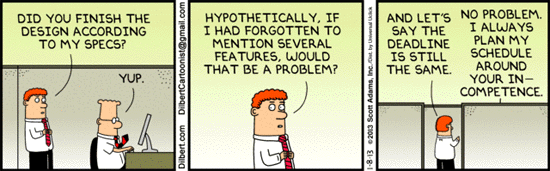
British-American economist and critic Simon Johnson is spitting tacks about how and why the Basel III regulations got watered down.
He is now calling for the US to go its own way.
The deeper problem with the Basel Committee is it overrepresents the euro-zone Europeans. Not only is the euro zone in great difficulty because of economic mismanagement, but its leaders are hoping to get out of their current predicament in part by relaxing bank regulation.
The idea that the Basel process is all about expertise – or smart people working out the right answers – is exploded by Sheila Bair’s book, “Bull by the Horns.” Read Chapter 3, in which she describes in convincing detail the fight over the Basel II agreement during the mid-2000s (and Chapter 4, which is more about how some United States agencies play against in each and on behalf their clients, the big banks).
What we saw before 2007 and what we see now is not officials applying some sort of optimization procedure or sensible independent thinking. Rather, this is about an industry that wants to take more risk because that is how it gets larger subsidies. And this industry is expert at playing the regulators off against each other, including across borders. The Europeans are again the patsy.
We need a financial sector that works for the real economy – not a continuation of the dangerous, nontransparent government subsidy schemes that have brought the Europeans to their knees.
2. 'Typical' housing
Do you have a mental idea of what the "typical American home" looks like? Well, they do a big survey every two years, and the latest data is out for 2011.
The answer is that it is 170 m2, three bedrooms, 2+ bathrooms, two stories, on a quarter acre, built in 1974, with gas heating, air conditioning, and a garage. Details here » I wonder how a "typical New Zealand home" would compare. Anyone have our data?
3. Its war
Iran is retaliating for the sanctions imposed on it by opening a new batttle front - by attacking American banks. More from the NY Times:
The attackers hit one American bank after the next. As in so many previous attacks, dozens of online banking sites slowed, hiccupped or ground to a halt before recovering several minutes later.
But there was something disturbingly different about the wave of online attacks on American banks in recent weeks. Security researchers say that instead of exploiting individual computers, the attackers engineered networks of computers in data centers, transforming the online equivalent of a few yapping Chihuahuas into a pack of fire-breathing Godzillas.
The skill required to carry out attacks on this scale has convinced United States government officials and security researchers that they are the work of Iran, most likely in retaliation for economic sanctions and online attacks by the United States.
4. Today's raw market data ...
A quick holiday update:
| as at 11:10am | Today 9:00 am |
Thursday | Four weeks ago |
One year ago |
| NZ$1 = US$ | 0.8439 | 0.8398 | 0.8431 | 0.7940 |
| NZ$1 = AU$ | 0.7971 | 0.7988 | 0.8012 | 0.7700 |
| TWI | 75.60 | 74.64 | 75.31 | 70.92 |
| Gold, US$/oz | 1,658 | 1,656 | 1,696 | 1,660 |
| Dow | 13,467 | 13,387 | 13,151 | 13,149 |
| Copper, US$/tonne | 8,059 | 8,051 | 8,048 | 7,690 |
| Volatility Index | 13.67 |
13.81 |
17.06 | 26.04 |
5. Trying to be a banking disruptor
An Aussie software engineer is trying to wean people off having to use banks and is pitching his service to people fed up with them. He has discovered that you can do an awful lot with the transaction data being collected from your shopping, and this is the basis of his "better service".
Mr. Reich and a co-founder, Shamir Karkal, created Simple, an online banking start-up company based in Portland, Ore., that offers its customers free checking accounts and data-rich analysis of their transactions and spending habits.
Few entrepreneurs dare to set their sights on industries as large and entrenched as banking and expect to flourish. But Mr. Reich, 34, a professed data nerd who has built computers and tinkered with the innards of sophisticated cameras, holds a master’s degree in business and has a robust background in financial data analysis. He is confident that Simple’s minimalist approach — it promises not to charge any fees for any services — will draw fans and customers.
“Banks make money by keeping customers confused,” Mr. Reich said. “There’s no incentives to make the experience better.”
6. Will this give you confidence in their currency?
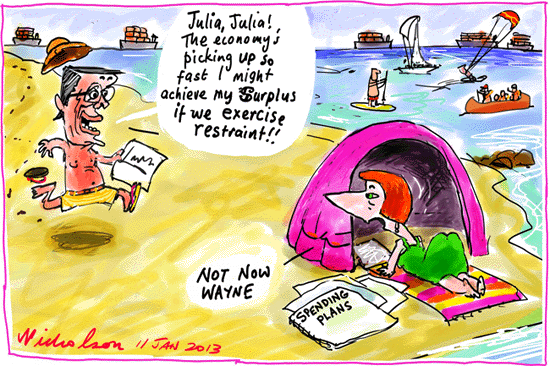
The new US Treasury Secretary will be Jacob Lew. As such, his signature will be on all their currency notes. Now I have no doubt he is a very smart man, but really, he's got to be able to do better than the one he is currently using. This one is what he uses in his White House role.

7. Cost and return
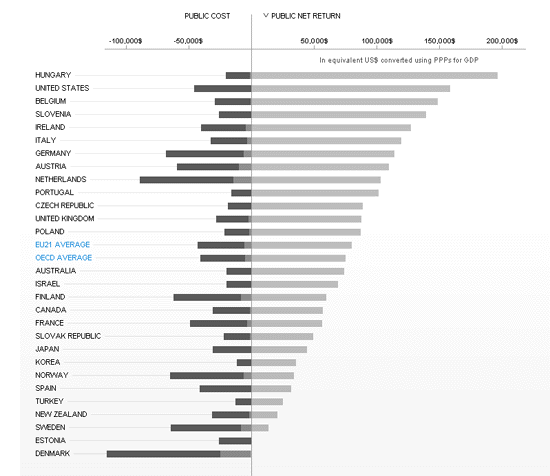
The OECD has a truly huge database on education costs and benefits across almost all first-world countries. But how to make sense of it? To solve the problem it ran a competition and this is one of the finalists. The winner is here »
This is intriguing for New Zealand - it suggests we have a low cost, low benefit system. Based on this data, we are not really getting our money's worth. Your view? Click on this graphic and explore. You can look at many things, although it does just focus on senior secondary, and teriary.
8. The price of certainty
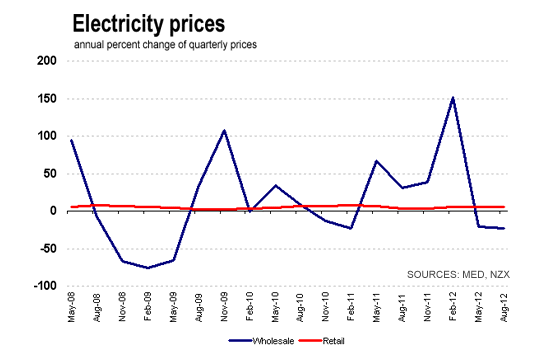
Retail electricity prices rose 5.6% pa in Q4 2012 according to the MED monitoring of all New Zealand power retailers. Lines charges rose 8.6%. Seemed high to me. We also monitor wholesale electricity market pricing on a daily basis, so I though a compaison between the two was in order. This is what I found.
9. Pigovian taxes
Adam Davidson would happily pay a congestion charge if it would only get other people off the road so that he could enjoy a less stressful journey. He explains on the NY Times:
According to an influential study by the I.M.F. economist Ian Parry, my hours on the road cost society around $10. Add up all the cars in all the traffic jams across the country, and it’s clear that drivers are costing hundreds of billions of dollars a year that we don’t pay for.
This is how economists think, anyway. And that’s why a majority of them support some form of Pigovian tax, named after Alfred Pigou, the early-20th-century British economist. Pigou developed the idea of externalities: the things we do that affect others and that the market is unable to price. A negative externality is like the national equivalent of what happens when you go to dinner with three friends and, knowing that you’ll pay only a fourth of the bill, decide to order an expensive entree. Pigou argued that there are so many damaging things that we do — play music too loudly, drive aggressively — and that we’d probably do less if we had to pay for them.
The idea of raising taxes to help society might sound like the ravings of a left-wing radical, or an idea that would destroy American industry. Yet the nation’s leading proponent of a Pigovian gas tax is N. Gregory Mankiw, chairman of President George W. Bush’s Council of Economic Advisers and a consultant to Mitt Romney’s 2012 campaign. Mankiw keeps track of others who support Pigovian taxes, and his unofficial Pigou Club is surely the only group that counts Ralph Nader and Al Gore along with leading conservatives like Charles Krauthammer, Alan Greenspan and Gary Becker as members.
10. Today's quote
"Your net worth to the world is usually determined by what remains after your bad habits are subtracted from your good ones." Benjamin Franklin
No chart with that title exists.
We welcome your comments below. If you are not already registered, please register to comment
Remember we welcome robust, respectful and insightful debate. We don't welcome abusive or defamatory comments and will de-register those repeatedly making such comments. Our current comment policy is here.