

This article was first published in our email for paid subscribers this morning. See here for more details and to subscribe.
By Gareth Vaughan
The Reserve Bank has effectively given New Zealand's banks the green light to decouple their floating mortgage rate changes from Official Cash Rate (OCR) moves, as the ANZ Group has done in Australia, opening the door for out of cycle mortgage rate hikes or cuts smaller than any OCR cut.
In an article entitled 'Bank funding - the change in composition and pricing' in the June edition of the Reserve Bank Bulletin Jason Wong, the Reserve Bank's head of financial markets intelligence, says it's no longer appropriate to proxy bank funding costs through a simple observation of the 90-day bank bill rate for a floating mortgage or the 2-year swap rate for for a 2-year fixed rate mortgage.
Wong's comments follow Australia's ANZ Group, owner of New Zealand's ANZ and National banks, controversially "decoupling" its housing and small business floating interest rate reviews late last year by deciding to review them on the second Friday of every month, independent of what the Reserve Bank of Australia (RBA) does in its monthly rate setting meetings on the first Tuesday of the month.
Announcing its move in Australia, the ANZ Group said the new policy provides "a measure of predictability" for customers on when rate changes will occur and provides the bank with "the flexibility to reflect movements in funding costs across the full spectrum of funding sources," not solely in response to the OCR. The policy saw the ANZ Group increase its floating mortgage rates in February, and subsequently other banks, even though the RBA had left the OCR unchanged. Both retail and business customer satisfaction with the ANZ Group has been declining since the new policy was implemented.
'The game has changed'
Wong, meanwhile, says the game changed as the global financial crisis (GFC) took a grip in 2008-09. He notes that before the GFC short-term wholesale debt - mostly from the US commercial paper market - was the biggest source of bank funding comprising about half total funding in the five years preceding the GFC. But from 49% of total funding in early 2009, short-term wholesale debt had dropped to 34% by April this year with banks stepping up their use of retail deposits (47% of total funding at the end of April this year) and long-term wholesale funding.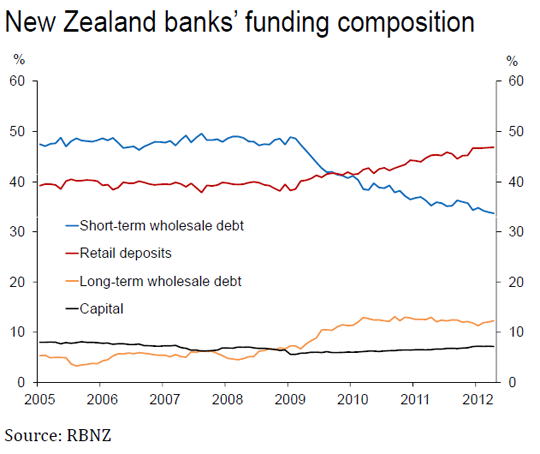
This has come about with the GFC highlighting the vulnerability banks faced when relying on short term wholesale market funding, pressure from investors and ratings agencies over the merits of a more stable funding base, and regulatory changes such as the introduction by the Reserve Bank of the Core Funding Ratio, says Wong.
What all this means, he says, is pre-2008 banks could fund at a rate cheaper than the OCR but no longer can. Reserve Bank estimates suggest banks could fund at an average rate of 60 basis points below the OCR between 2002 and the Lehman Brothers collapse in September 2008.
"Our model suggests that from mid 2009 until May 2012, indicative marginal funding costs have averaged 110 basis points above the OCR, or an increase of 170 basis points from the pre-GFC days," Wong says. "Our estimate as at the end of May for overall indicative marginal funding costs was about 130 basis points over the OCR."
Breaking down the three major forms of bank borrowing, Wong estimates that at the end of May this year the cost of short-term wholesale debt was about 20 basis points over the OCR, the cost of retail deposits was about 120 basis points above the OCR, and the cost of issuing long-term debt domestically or in the United States was about 240 basis points over the OCR. Wong does note, however, that bank funding is a "highly technical and intensive process" meaning the Reserve Bank calculations should be seen as indicative of the trends rather than as a true and accurate measure of actual bank funding costs.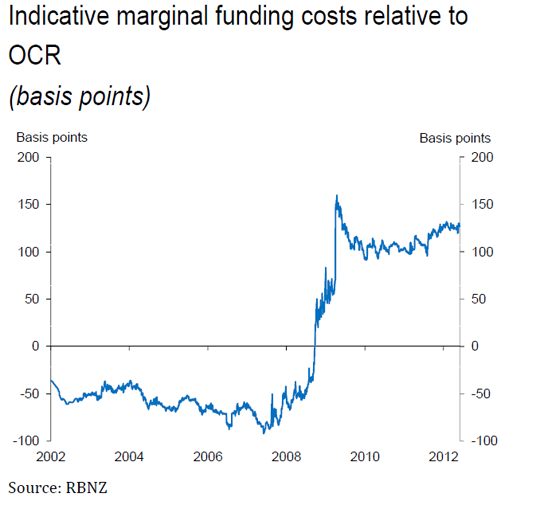
Wong also points out that when banks issue long-term debt, such as covered bonds, overseas, the cross currency basis swap agreements they reach in order to convert the money into the New Zealand dollar, effectively adds another 100 basis points to the cost of the money borrowed.
Despite the increases to funding costs, in its latest Financial Stability Report the Reserve Bank said the recent round of fixed-term mortgage interest rate cuts was evidence banks are currently well funded and "reasonably comfortable" with funding cost pressures.
'Higher bank funding costs mean the OCR has been lower than it might otherwise have been'
Wong says that in implementing monetary policy, the Reserve Bank has attempted to take higher bank funding costs into account.
"Thus the OCR over this period has been lower than would have been the case if previous interest rate relationships had persisted," says Wong.
So far none of the New Zealand banks have moved to emulate the ANZ Group's decoupling in Australia. In March ANZ NZ CEO David Hisco told interest.co.nz the subsidiary's funding profile was different to that of its parent. And an ANZ NZ spokeswoman said the bank had no plans to move to monthly floating interest rate pricing announcements. ASB CEO Barbara Chapman told interest.co.nz in February: "I’m not saying we’re going to decouple like they have, but it’s certainly an interesting twist to the market, I believe."
However, BNZ CEO Andrew Thorburn told interest.co.nz last October that even with the OCR at its record low of 2.5% for an extended period, floating mortgage rates would probably rise because banks' cost of funding was increasing.
Floating mortgages have gained in popularity over the past couple of years with NZ$108.816 billion worth, or 63%, of the total NZ$172.571 billion worth of mortgages floating as of the end of April. This is the highest percentage, by value, floating since the Reserve Bank started tracking floating versus fixed-term mortgages in 1998.
We welcome your comments below. If you are not already registered, please register to comment
Remember we welcome robust, respectful and insightful debate. We don't welcome abusive or defamatory comments and will de-register those repeatedly making such comments. Our current comment policy is here.