
The comment stream

Join the Interest community to be a registered commenter so you can:
- Edit your comments
- Avoid the CAPTCHA
- Vote on comments
Register Here

Already registered? log back in here ..

Forgotten your password? No problem! Click here

Finance sector jobs

Senior Liability Underwriting Manager
Lead from the front utilising your strategic, technical and leadership qualities within th...more
New Zealand
Senior Liability Product Underwriter - Product Management
Lead from the front utilising your technical expertise in this highly attractive senior li...more
New Zealand
High Performing Senior Liability UnderwriterHigh Performing Senior Liability Underwriter
Customer focus, high performance, exceeding client expectations and achieving profitable g...more
New Zealand
Head of Retail Credit -Wellington, NZ
Key leadership position in the bank. Be a part of one of the fastest growing banks in New ...more
New Zealand
efinancialcareers.com

Reader poll

Should you fix your mortgage now or stay floating?

Choices

Property values rise in 3 months to July, but new boom unlikely, QV says

Posted in News

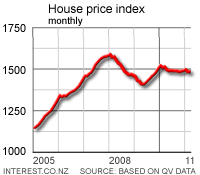
New Zealand property values rose 0.7% in the three months to July from the three months to June, their third consecutive rise, Quotable Value (QV) said.

But despite the marginal rise over the previous quarter, it was unlikely that this marked the beginning of another boom, with rising unemployment threatening to drive the market down again, QV said.

Values were up 1.3% from their low in April, according to QV's national residential property index. Values were still down 5% from a year ago, but this was better than in the three months to June, when values were down 7.1% year-on-year.

House values are down 9.9% in July from the peak in January 2008, which is slightly better than the 10.7% down in June and the trough at 11.2% down in April.

QV said the average nationwide sale price was NZ$382,758 in the three months to July from NZ$378,535 in the June period.

"(S)ales activity remains at solid levels, particularly given the time of year, QV Valuation Manager Glenda Whitehead said.

"There are also signs that more vendors are putting their properties on the market. This is perhaps in response to reports of shortages of listings, signs that values have stopped declining, and increased buyer optimism and activity," Whitehead said.

"Although activity has increased at the lower end of the market, values are increasing more in the middle value range of the market. In some areas there is a shortage of quality properties for sale, resulting in increased competition amongst motivated buyers. This may be driving a short term increase in sales prices," she said.

"The market seems to have returned to some form of normality. Buyers are making rational, carefully considered decisions based more on fact than emotion. Obtaining finance continues to be crucial to many deals moving forward, with banks continuing to screen borrowers and property details carefully."

"While values have increased marginally over the past quarter, it is unlikely that this marks the beginning of another boom. Low interest rates and a shortage of quality houses for sale in some areas may keep the market active. Rising unemployment could drive the market down again. These factors are finely balanced, and to what extent the coming spring shows an increase in market activity will determine whether prices continue to rise modestly."

"All the main centres are now showing property value growth over the last quarter. This has led to further improvement in the annual change in all areas. Across the Auckland area values are now down 3.5 per cent on the same period last year, up from the -5.9 per cent reported last month. Hamilton has improved further to be at -2.9 per cent, Tauranga is now at -6.6 per cent, the Wellington area -4.0 per cent, Christchurch -5.5 per cent and Dunedin -1.4 per cent."

"All of the provincial centres are now showing less annual decline than was reported last month. Whangarei now has values down 9.4 per cent on last year, Gisborne is at 10.5 per cent, Rotorua -8.0 per cent, New Plymouth -1.4 per cent, Wanganui -5.4 per cent, Palmerston North 4.7 per cent, Queenstown Lakes to -5.7 per cent, and Invercargill -6.6 per cent."

Here are the full commentaries by QV on the various regions.

Auckland

Property values in the Auckland region declined by 3.5% over the past year (calculated over the three months ending July 2009 in comparison to the same period last year), a considerable improvement on the 5.9% annual decline reported in June. The average sale price for the region increased from $489,444 to $500,315.

Glenda Whitehead of QV Valuations said; "What a difference a year makes! This time in 2008 the Auckland residential market was in a steep decline, with increasing volumes of property appearing on the market from July to December, and taking prolonged periods to sell. Now the contrast is significant. Values have stabilised over recent months and have even begun to show upward movement in some areas. Listings this winter are light, but are attracting healthy interest, resulting in properties selling relatively quickly by comparison. This is reflected in the year-on-year value change for Auckland, which is now moving quickly back through the negatives toward zero".

"The North Shore in particular has seen positive activity in recent months. While low listings are still being reported, buyer interest is strong with firm and realistic offers being made to vendors. Most properties put on the market now appear to be realistically priced, and are consequently selling quickly. The properties performing well on the North Shore include moderate to medium priced residential properties presented in reasonable condition, and those in popular school zones. For example Forrest Hill, Milford and Mairangi Bay." said Whitehead.

"In Auckland City the traditionally sought-after suburbs are performing well. Again, properties within popular school zones and those close to desirable amenities are attracting attention. General sentiment is that the market has stabilised and people are just getting on with their lives now" said Whitehead.

"Reported low levels of listings this winter may be prolonged further if vendor sentiment holds true. That is, vendors who can afford it seem to be waiting for a further upturn in the market to realise their price expectations. For those who are listing properties now, we are sensing a much lower degree of desperation than six to twelve months ago. There are many people actively looking to purchase, but buyers actions continue to have an air of caution about them." said Whitehead.

"There also seems to be more activity in the re-finance area. Some home owners are prepared to borrow a little more to undertake minor improvements such as decks, re-decorating, or upgrading a bathroom or kitchen. Many owners acknowledge the cost of changing homes and would rather put that money towards adding value to their current dwelling" said Whitehead.

Hamilton

Property values in Hamilton declined by 2.9% over the past year (calculated over the three months ending July 2009 in comparison to the same period last year), a further improvement on the 6.6% annual decline reported in June. The average sale price for the city increased from $337,851 to $344,081.

Mr. Richard Allen of QV Valuations said; "For the fifth consecutive month year-on-year values for Hamilton City recovered slightly. The 3.7% improvement seen in July is further evidence that the residential market in the city continues to stabilise. In fact all four areas in the city experienced healthy improvements".

"The continued recovery in Hamilton's declining values confirms that house prices in the city have at least flattened out. Although some areas of the country are showing positive signs, I am still of the opinion that this stabilisation may only be an aberration, at least in Hamilton. I think a lack of demand caused by poor regional economic factors and the reduced dairy payout will put more downward pressure on the residential property market in Hamilton and the Waikato later in the year" Allen said.

Tauranga

Property values in Tauranga declined by 6.6% over the past year (calculated over the three months ending July 2009 in comparison to the same period last year), an improvement on the 8.0% annual decline reported in June. The average sale price for the region decreased from $427,927 to $415,156.

Mr. Shayne Donovan-Grammer of QV Valuations said; "The average sale price has fallen in the Tauranga region which is reflecting what I am seeing at the coal-face. This fall can also be attributed to the bulk of the activity coming in the $350,000 and below price bracket. Although value recoveries have been evident over the last few months in some parts of NZ, this is not the case in Tauranga. Talk of a widespread and continued recovery at this stage I think is premature".

"In saying this, a lack of stock in some property categories and locations has stabilised values in those areas recently. At the moment the market appears to be finely balanced. It will be interesting to see what direction it will take leading into spring with rising unemployment and subdued dairy payouts" said Donovan-Grammer.

Wellington

Property values in the Wellington region declined by 4.0% over the past year (calculated over the three months ending July 2009 in comparison to the same period last year), a substantial improvement on the 6.5% annual decline reported in June. The average sale price for the region decreased slightly from $430,939 to $429,571.

Kerry Buckeridge of QV Valuations in Wellington said; "Residential property values have moved in a positive direction for the third consecutive month in Wellington. If this is an aberration before another down-turn, it certainly is an extended one. I have noted good attendance at open homes with buyer attention focused on most parts of the market. We have seen an increase in mortgagee sales, but given market sentiment and the current shortage of listings these are often attracting good buyer interest".

"We have recently noticed a decreased number of valuations being requested out of the residential market. This could possibly be driven by the school holidays and the recent bad weather, so is probably more a seasonal trend. This may give some indication that actual sales activity is slightly more subdued, despite heightened buyer interest" said Buckeridge.

"A significant number of relatively cashed-up expatriates are returning to New Zealand and are all in need of housing. Countering this, and of particular importance in Wellington's property market, is the effect of public sector restructuring. Already there have been a reasonable number of redundancies and government contractors are getting less work. If people's incomes are under threat they are less likely to be strong participants in the property market" Buckeridge said.

"I think most people believe we have seen the worst of the residential market downturn in Wellington, but of course it is impossible to say at this stage. The value recovery experienced thus far has been off the back of some very finely balanced economic forces and a small shift in any of these could change the current trend. The foreseeable future presents a standoff between immigration and unemployment, which could tip the scales either way" said Buckeridge.

Christchurch

Property values in Christchurch declined by 5.5% over the past year (calculated over the three months ending July 2009 in comparison to the same period last year), an improvement on the 7.3% annual decline reported in June. The average sale price for the city increased slightly from $339,962 to $342,993.

Jess Maher of QV Valuations in Christchurch said; "For the fourth consecutive month the rate of annual decline in the Christchurch region's housing market has recovered slightly. Once again suburban Christchurch has held well, the hill suburbs have shown the greatest recovery and are closely followed by the southwest suburbs".

"There is a great deal of positive feeling out there in the residential market at present, particularly in the traditional first home buyers market where properties are selling under $350,000. We are hearing from a number of people that it is a good time to be selling property in this price bracket due to a shortage of listings and increased number of buyers. Real estate agents are reporting good results at auctions and multiple offer situations. However, there are still many underlying economic factors such as job security, which are influencing purchaser's decisions" said Maher.

"It is not unusual in winter for there to be a shortage of listings, as traditionally vendors wait until spring to place their properties on the market. With building consents are still at low levels and net migration rising, it is expected that pressure will come onto existing housing stock. However the effect of this will possibly be mitigated by an expected increase in listings heading into spring" said Maher

Dunedin

Property values in Dunedin decreased by 1.4% over the past year (calculated over the three months ending July 2009 in comparison to the same period last year), a substantial improvement on the 4.5% annual decline reported in June. The average sale price in Dunedin increased slightly from $256,493 to $258,813.

Mr. David Paterson of QV Valuations said; "The month's figures point to a continued improvement noted in last month's report, and confirm our predictions earlier this year that the values would move into positive growth later this year in Dunedin. What has been surprising is the speed with which this change has occurred over the last few months".

"Discussions with local agents indicate there is a shortage of listings, particularly in the upper price brackets. There appears to be plenty of buyers which would indicate that it is now becoming more of a sellers market. The Dunedin market has always been price sensitive and that still appears to be the case today, with correctly priced properties selling quickly" Paterson said.

"While it is good to see some positive trends, there is still concern by some that the improvement we have seen over recent months is not sustainable. One can point to concerns about long term job security, the wider economic factors and international market trends to support these views. It is difficult to predict what might happen over the next few months given the uncertain economic times we are facing. There is however positive sentiment out there which is supported by our statistics. The feeling is that this will continue into spring, as this would be expected in a normal sales cycle" Paterson said.

We welcome your help to improve our coverage of this issue. Any examples or experiences to relate? Any links to other news, data or research to shed more light on this? Any insight or views on what might happen next or what should happen next? Any errors to correct?

We welcome your comments below. If you are not already registered, please register to comment in the box on the right or click on the "'Register" link at the bottom of the comments. Remember we welcome robust, respectful and insightful debate. We don't welcome abusive or defamatory comments and will de-register those repeatedly making these comments.

Don't they ever tire of

Don't they ever tire of that old chestnut?

said Buckeridge.

"A significant number of relatively cashed-up expatriates are returning to New Zealand and are all in need of housing"

Relatively being the weasel word here. Anyone cashed up and buying will be looking for a good discount.

The fact is the people

The fact is the people listened the gurus(like KT, BH) and didn't buy at the begining of the year or last year have to pay over $30k more.
But, we still need to think about the "IFs", lots of "IF".

"The market seems to have

"The market seems to have returned to some form of normality" By which QV mean to say the residential property market remains stuck close to the height of the credit fuelled 5 year bubble of insanity where average home prices remain the most unaffordable in the western world for average families but which are likely to please the govt and many MPs who hold overleveraged residential investment positions in the market and are hell bent on keeping the bubble from imploding. So there you are Kiwi Joe, you and the family are stuck between a rock and a hard place. Either fork out heaps to the landlords, many of whom are mps!, or fork out heaps to the banks if you want a roof over your heads, or settle for a sheet of plastic in the bush. Of course you could emigrate. Probably the best option for the kids to be honest. Where to from here? Well, expect an enormous amount of spin and BS from the govt to ensure the peasantry hold on to the belief that Noddyland has survived the recession and yes it's that BS word again "normality" has returned. Like Canute holding back the tide of depression era debt and rising unemployment, of higher taxation and rising mortgage rates, of increased family suicides and accidental factory fires. It's the Kiwi's finest hour when never before have so many owed so much to so few for so long!

For any incisive commentary of

For any incisive commentary of the point of nsanity that the housing obsession & relative advantages of landlording has brought NZ, check out another excellent piece from Brian Gaynor in the Herald:
http://www.nzherald.co.nz/business/news/article.cfm?c_id=1501241&objecti...

He comments about the reasons why the Oz banks are fixated with housing loans, while squeezing out (non-farm) business lending. Also the relative size of our stock market compared with Oz is instructive:

"The NZX/GDP ratio is only 24 per cent, compared with the ASX/GDP ratio of 92 per cent. By contrast, total housing values have increased dramatically in New Zealand and our housing stock is now worth 13 times the NZX, compared with 4.2 times a decade ago. Housing values have also risen in Australia but the housing/ASX ratio is only 3.0, compared with 2.3 in mid-1999."

Those figures are staggeringly scary, & its not as tho Oz was the best peer example to compare with.

His conclusion: "This lopsided growth is unsustainable and will inevitably lead to continued low GDP growth and another recession in the not too distant future."

So to Pres of Property & those who seem to have won the debate over whether house prices would crash or not, its a case of "congratulations Sir, that nasty cough you have isn't swine flu, its only cancer".

What an opportunity we appear

What an opportunity we appear to have missed! When better to have altered our economic prioroties than when the competition, the rest of the world, had difficulties of its own, and we could have used the recession to channel our savings into productivity. Now NZ gets to stagger on, Citibank like, as New Zombieland....

expat - for most of

expat - for most of last year and earlier this year the cashed up buyer would indeed have done well - in many cases, in my area at least, they were able to buy a home between 10% and 15% below the peak achieved in 2007.

On the 15th of January there were 56 home for sale in Pt Chevalier whereas today there are only 8 homes available in the entire area. A very different environment!

As a result this house www.realestate.co.nz/1120049 has had over 800 hits on realesate.co.nz and over 40 people through the first weekends open homes. It is the only home currrently available on a large full site in the area yet we have demand for at least another 25 to 30 similar homes, but no sign of these becoming available.

One indicator that points to the future is that the number of appraisals we are doing is down compared with any other July/August - usually we are inundated with appraisals at this time of the year with people thinking of listing for sale in September when the weather is better.

Fear of being able to find an alternative is putting many off selling and there is another large group who refinanced at less than 6% for 5 years fixed earlier in the year and who do not want to lose that rate so will simply not sell unless we can find them a replacement.

With regard to where the market is heading I have no idea what the future holds. In the medium term higher interest rates and unemployment may indeed indicate it is just a DCB but the next 6 months look like being very firm on the price front as it appears stock levels are going to remain low this spring and summer.

With regard to Brian Gaynors article I was interested to note that our sharemarket is 39% overseas owned and has a total value of $44 billion compared with the NZ housing stock which is valued at $568 billion. It is no wonder far more bank lending is to housing than business if that's the ratio.

Many small to medium size businesses use the director's family home to secure funding and it would be interesting to know what percentage of housing loans are for that purpose rather than the initial funding required to purchase the home in the first place.

@ Philly hey that's a

@ Philly

hey that's a bit rough - i guess you are saying it's not pandemic, only isolated cases that need to be zapped, cut or doomed and the rest of us can rest easy. phew... nice to see the positive somewhere in your commentary

@ Bernard

Good you swayed over to reality - kinda saved your bacon just in time, landing on your feet and all that. Full credit to you, and shame on KT and his silly publicity stunt for book sales - guess he is standing tall not realizing his height is all to do with his dunces hat...

well, the property buffs will

well, the property buffs will be cheering "told you so", but lets wait and see what has happened at the end of the year.
As QV says, rising unemployment threatens to drive the market down again.

"The fact is the people

"The fact is the people listened the gurus(like KT, BH) and didn't buy at the begining of the year or last year have to pay over $30k more.
But, we still need to think about the "IFs", lots of "IF"."

Prices are up 1.3% from there all time lows in April this year. Unless your buying 2.3 million dollar house then don't worry you wont be paying anywhere near 30k more than at the lows. More like $3k more.

QV year on year change

QV year on year change DESIGNED TO FOOL DUMB PEOPLE.

If prices fall very sharply during mid 2008, then the % change from last year that we are seeing HAS TO improve dramatically.

A much more useful figure would be the raw QV index values. Then you could look at NZ housing as you would share prices, and then you'd see that current prices are not 'rebounding' and 'turning around' as the QV % figures deceptively show.

I know most people on here won't get fooled by it, but the average home buyer in NZ is a different story

Pres of Prop: Swine flu

Pres of Prop: Swine flu is pretty nasty, but quickly over. Once u r over it, u have relative immunity & can start getting on with living.

Cancer is slow, but eats away at your vital systems.

Read Gaynor's article to put this into perspective, so far as the likely impacts of building a housing-dominated economy.

This analysis of sales by

This analysis of sales by price decile from QV is fascinating: http://www.qv.co.nz/propertyinformation/KnowledgeCentre/thechangingnzpro...

In particular:
1. The "recovery" has seen no improvement in volume in the upper 6 deciles ($347k up), indeed sales volumes fell Q1-Q2.
2. The "recovery" has seen continued price falls or minimal increases in the upper three deciles ($427k up), so if you were holding off buying a house in this price bracket, you were right.

Of course things may be different in your region.

Philly, I think a lot

Philly, I think a lot of people who have done there research are along your lines of thinking.

The problem is most NZ'ers looking at buying a house have been hard-wired/conditioned over the last 10 years to think house prices go up, and go up fast, so buy as soon as possible. The concept of a 'property ladder' is common among these people. There idea's on housing are from there next door neighbour, or mate down the road who brags about how his house is worth so much more than what he paid for it in 1994.

Cancers a great analogy, and yup serious enough to be well suited to whats going on here.

Overgrowth of one aspect of the country without growth of the whole to support it leads to death of the whole. I've been buying shares in foreign currency while the dollar is high, not sure when the collapse will come, but it will come, and the longer we wait the worse the correction will be

Dave, the first home buyers

Dave, the first home buyers 'welcome home loan' means you can buy a house with no deposit. Couple that with the low interest rates, and thats where the activity at the lower end is coming from. Just hope these people that were not able to save a deposit are able to cope with higher interest rates as NZ becomes less and less attractive to foreign investors

Dave, That is a fantastic

Dave,

That is a fantastic link. Hadn't seen it before. Well worth reading.
http://www.qv.co.nz/propertyinformation/KnowledgeCentre/thechangingnzpro...

cheers
Bernard

We need a boom so

We need a boom so we can all get back in on the bust,cannot have a bust without a boom.

QV: "The number of house

QV: "The number of house sales each month has risen from the very low levels of last winter, and are now approaching long term average levels."
So QV believe in upward long term averaging principles for supply/demand, but not downward for price? Talk about selective information !

0.7 % over 3 months,

0.7 % over 3 months, probably is a boom, in Godzone................Beats our GDP growth rate over the last 10 years by a handy margin..............Weeeeeeeeee, let the good times roll !

"“The market seems to have

""The market seems to have returned to some form of normality" By which QV mean to say the residential property market remains stuck close to the height of the credit fuelled 5 year bubble of insanity where average home prices remain the most unaffordable in the western world" - Very well said Wally.

Either we are going to see a very long slow grind back to long term trends in house values (far cheaper in real terms than they are now) or something very drastic has to happen to shock values quickly down to the long term trend. I.e., A credit downgrade, drastic rise in inflation, massive rise in interest rates, far higher unemployment etc etc. The risks are there for any number of these shock events to happen but only time will tell. You can bet however that once houses are "affordable" again (3-4 times average income), then the real estate bugs will be screaming about how cheap prices are when infact that will just be at the long term trend and nothing special. I personally think that the correction is going to take another 5-6 years or perhaps even longer with no real fall in nominal value but a steady erosion of real value as our incomes slowly creep up. Its going to be a boring ride.

as i've said before on

as i've said before on this blog , i see all this recent flicker of life as a total positive for those waiting to buy!

it's a suckers rally, in the more basic vernacular, but it does bring more properties onto the market , ergo more choice .

languishing sales and poor fundamentals will be the drivers in the near future.
there's no doubt that the world has stabilised to the point of not sinking into the abyss but a negative trickle- down effect seeping into the nz economy will carry on like chinese water torture for some time yet.

migration figures are largely being shown as increasing 'cos less kiwis are leaving, so there's no major housing turnover action there.

if you must buy now , make sure you do your repayment sums on the basis of your ability to maintain an income stream sufficient to sustain an 8% mort. rate....that's what the banks do when you apply for a loan right now....and that's where rates will be within 18months to 2 years....back where they were in 2007!
and be sure your employment is secure.

rock on elves!

Rob of the north: "it’s

Rob of the north:

"it's a suckers rally, in the more basic vernacular, but it does bring more properties onto the market , ergo more choice ."

Not only more choice but more supply. In the face of what is likely to be static / declining demand, that is a recipe for price falls

keep holding onto that hope

keep holding onto that hope Matt, keep saving more for your deposit while you see prices slowly but steadily move up - doesnt have to move much to eat away what you can save in terms of a deposit.

Interesting quote from Westpac this

Interesting quote from Westpac this morning:

"A clear risk beyond near-term recovery is that households resume their "˜borrow and spend' habits before bringing their debt levels back to more prudent levels. A premature resumption of strong growth in household spending could be triggered, for example, by renewed moderate house price inflation. This needs to be avoided."

Haven't they just dropped their L/V ratios requirements?

Doesn't have to fall much

Doesn't have to fall much either to make your deposit worth much more.

Unemployment is taking out 4 times the number of net immagrants from the demand side of the equation. NZ's heavily skewed lower income earners who can all get loans at these very low interest rates will be the next group to be taken out of the demand side as interest rates edge higher and higher.

Property cycles are SLOW, when prices start falling, give it 5 YEARS before another decent and sustainable increase in prices

Bad News only be realistic,

Bad News only
be realistic, the sale prices in central Auckland middle range areas has increased 10% from the begining of the year. It is much more than $30k.

@ Matt from Auck Told

@ Matt from Auck

Told you so!

intersted follower, Someone who purchased

intersted follower,

Someone who purchased at the beginning of the year has still probably made a loss due to the relative costs of ownership v renting. This is the whole reason why housng is overpriced - you NEED a big Cap gain to break even ie the price paid is no justified by the income derived.Big gains are impossible however going forward as we are now a highly leveraged society (as opposed to the last 30 years where we started at low leverage and then geared up to the hilt until 2007 when consumers hit a wall). You can not expect big gains in the future, it is mathmatically impossible. Which prompts the next question - why gear up heavily on something that is losing money when the gains arent enough to offset the loss?? Once people cotton on to the fact that the best case scenario is no net gain I would expect the general momentum to be down.

In any event, as I've said before - lets reserve judgment until AFTER interest rates are back at normal levels (8-9%). Interest drops over the last 2 years have effectively handed mortgage owners a 40% drop in repayments. In this regard, the GFC has actually benefitted the housing market.

Jimmy - well said. However,

Jimmy - well said.

However, another unknown is how much inflation we are going to see down the track. If we do enter into a high inflation environment then although property would do worse than commodities and shares and will struggle to post gains in real terms it will probably be better than cash in the bank.

Open the doors to immigration

Open the doors to immigration and then we can inflate ourselves into housing recovery so we can all get rich.

This is the only prudent way to keep house prices going up and the people calm.

I detect your sarcasm, Faifax.

I detect your sarcasm, Faifax. But on a serious note, just fathom where our dollar would be ( pick any rate north of here !) with the flood of funds into the country to buy the net result of 30 years GDP, our houses. Then what? Even more householders and an extinct export sector.

It's all gone back to

It's all gone back to normal......Thx, Bryan. !!!

marky mark, that is a

marky mark,

that is a common argument re inflation and property. I dont think it applies to a high debt environment however because very few people could afford to pay existing prices if rates go through the roof. The mortgage payments would quickly double or triple, many would hit the wall. At this point the cashed up investor would be much better off.

Wally, unlike our leaders today,

Wally, unlike our leaders today, I think you will find King Canute was a man of great modesty. That is why he led his courtiers to the waters edge - specifically to demonstrate that, as a mere mortal, he could not hold back the tide. He admonished them for their sycophancy:

"Learn how feeble is the power of earthly kings. None is worthy the name of king but He whom heaven and earth and sea obey."

Pity that guy is not running the show today, he'd probably understand that nothing is going to hold back the tide of debt from overwhelming us!

Here’s an interesting idea. On

Here's an interesting idea.

On income V prices in a bull property market with easy debt.

Could it be that households were able to survive with 60% plus income used for mortgage by borrowing against the house as there house grew in value to the tune of 40k plus a year??

Now with negative to flat house price growth, this 'special' way of funding there lifestyle is gone, and so we get back to historical income: price ratio's, where if you want a holiday you save a portion of your weekly wage for it!

Maybe this is why housing cycles are so predictable. When going up, they feed themselves, when going down they facilitate that also. A natural system based on underlying human psychology. Beautiful really.

I wonder what would happen

I wonder what would happen if we enter a high inflation scenario? If rates were to jump up into double digits, a lot of people would default on their mortages, or cut all spending bar food altogether. The government probably wouldn't allow that because of systemic risk, so that would leave us with runaway inflation since rates can't be hiked enough to contain it... nasty.