
In this section
Offers for readers
Follow the news from interest
The comment stream
Recent comments
- 1 of 20817
- ››
Editors choice
- 1 of 295
- ››
Finance sector jobs
Lead from the front utilising your strategic, technical and leadership qualities within th...more
New Zealand
Lead from the front utilising your technical expertise in this highly attractive senior li...more
New Zealand
Customer focus, high performance, exceeding client expectations and achieving profitable g...more
New Zealand
Key leadership position in the bank. Be a part of one of the fastest growing banks in New ...more
New Zealand

The news stream
Latest news
Most commented
- Fonterra to tighten TAF rules 67
- Govt eyes NZ$1.4b revenue grab 58
- English defends current account blowout 54
- 90 seconds at 9 am 51
- BNZ cuts most fixed mortgage rates 48
- 90 seconds at 9 am 43
- Thursday's Top 10 with NZ Mint 38
- Budget 2012 reactions 36
- Budget tax moves to target high income NZers 29
- Wednesday's Top 10 with NZ Mint 24
Most viewed
Have your say: Why aren't the banks passing on the OCR cut?
Almost 4 days have passed since the Reserve Bank cut the Official Cash Rate by 50 basis points to 2.5% and the banks have cut virtually nothing.
Westpac cut its 6 month mortgage rate by 40 basis points to 5.39% on Thursday morning and Rabobank cut its farming variable rate by 50 basis points shortly afterwards. Our Mortgage rates table, which would normally show a sea of rates changes after an OCR cut, shows only a few changes by small institutions. Wholesale interest rates known as swaps rates for 1 and 2 year terms fell by around 20 basis points on Thursday and Friday. The interactive charts for this are below. Banks watch these wholesale rates closely before announcing cuts.
Since Thursday there has been an ominous silence from almost everybody.
What are the banks waiting for? Or have they decided not to pass on the rate cuts?
Adam Bennett in the New Zealand Herald has reported that anger is building about rates not being cut in the wake of the move.
Meanwhile, readers' views posted on Herald Online suggest many people believe banks are not passing on OCR cuts sufficiently.
That view has been backed by bank workers' union Finsec, whose general secretary Andrew Casidy on Thursday called for the banks to open their books so customers can see how much their bank is making from home loans. "Banks should disclose their costs of borrowing and the interest rates they charge to the Reserve Bank, who could then publish this information in a comparative table," said Casidy.
"Customers could use this information to decide if their bank is being fair in what they charge and how this stacks up against other banks."
Related Topics
What I think
It's possible the banks are hoping they won't have to cut rates and are waiting for someone else to jump first.
They're doing this because their profits are under intense pressure from falling profit margins on borrowing and lending both locally and internationally, and because they face higher bad debts.
Contrary to the kneejerk reaction from some unions and lobby groups, including Federated Farmers, banks are not gouging profits. Adam Bennett's story, and the comments from Casidy, suggest that the banks do not disclose enough data on their profitability to know whether they are gouging.
This is simply not true.
I am so definite on my views on this because I have researched the banks general disclosure statements and the two bank results through so far from the March quarter.
I wrote an analysis on this two weeks ago called "Bank profits on interest rates are falling, not rising". The table here shows profits on interest rates are falling for all the major banks except Kiwibank.
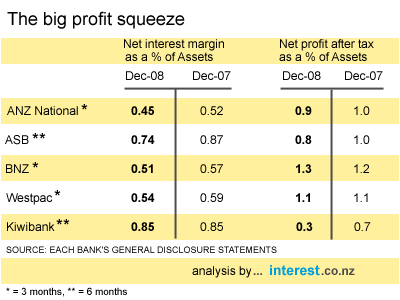
Last week BNZ said its net interet margin fell 12 basis points to 2.23% in the first half of the fiscal 2009 year to March 31 from 2.35% in the previous half year and 2.49% in the same half a year ago. BNZ CEO Andrew Thorburn told interest.co.nz in an interview that margin pressure was focused mostly on the deposit margins, where banks were competing hard for domestic deposits. The cost of the retail deposit guarantee scheme also squeezed margins slightly.
See the full BNZ results and commentary in this PDF presentation (NZ material pages 30-34)
Last week ANZ National reported its net interest margin for its New Zealand businesses fell 24 basis points to 210 basis points in the six months to March 31 from the same period a year ago. It was down 9 basis points from the September half. Here is the full presentation from those results. The New Zealand pages are 63-66 and 85-91. Also see here in this presentation pages 68-69, which detail the margin contraction.
The next question is: should the banks be sacrificing profits to improve the New Zealand economy?
Finance Minister Bill English said last month banks should accept lower profits and they owed New Zealand because of the deposit guarantee. Reserve Bank Governor Alan Bollard has said the banks should be "playing their part".
Anyone taking a view on this has to decide whether the banks are an arm of government because of the guarantee or whether they should be sacrificing profits to protect their brand and their customers in the long term. The brand and customer protection line could be argued. The 'defacto government ownership' line is much harder to argue. The banks already pay for that guarantee.
But it can't be argued that banks are not passing on the OCR cuts on the grounds they are padding their profits. This is simply not true.
However, I can't see any reason why the banks have not passed on the OCR cut for variable mortgage rates. If they are matching their funding costs with their lending costs and not cross subsidising across their sources of funding then they should pass on the cuts to floating mortgages. One reason may be they can't pass on the rate cuts to term depositors, who will simply not accept lower interest rates.
It certainly looks like we've hit the bottom for interest rates, whether the Reserve Bank or the Government or the bank unions like it or not.
Your view?
Bernard, My heart bleeds for
Bernard,
My heart bleeds for them. If they made better loans in the first place we wouldn't be in this mess at all.
So what if their profit margins are lousy that's what happens when you make bad decisions.
The people at the top get paid mega salaries to make good decisions, they made very bad decisions and now the economy gets screwed.
To make it worse the bankers now want to tighten lending and keep interest rates at a high level to make their profits look good. All this does is slow down any recovery.
You can't defend them Bernard, no matter what statistics you throw at us. The Banks need to accept that in this recession, which is their own making, they will have to live with the consequences. If this means a few years of low or no profit then so be it.
Everyone else is suffering. it's time these clowns got off their corporate yachts and did it tough like the rest of the Country.
It would be highly amusing
It would be highly amusing if Bollard, in his attempts to further penalise savers and reward debtors, has now lost control of the short term part of the rates curve (he lost/never had much control over the long term end).
I guess you could simplistically rationalise it like this.
a) Our banks can access money overeseas but the overseas lenders will only lend at rates considerably higher than where Bollard would like them to be (and the existing longer term rates reflect this).
b) That leaves domestic sources of funding for the banks to re-cycle. There is only a limited pool of this in the form of depositors/savers money and they have responded to Bollards attempts to slash their income by jumping into into corporate bonds and other related vehicles (and in some instances by the look of things investment property bought with cash). Billions has been locked away in these vehicles. Of course this pool has was also depleted last year anyway by the failure/suspension of various Finance company entities - this pulled probably close to $5 Billion out of circulation.
What will be fascinating to watch is how quickly mortgage interest rates have to jump as soon as inflation re-appears/recovery takes place. If longer term rates are now on their lows at just below 7% with an OCR at 2.5% what does that tell us where they will be once Bollards hyperstimulatory regime is forced into reverse? Folks loading up with extra mortagage debt now had better calculate whether they can sustain that debt with double figure mortagage interest rates 2/3 years out from here....
as mentioned at the end
as mentioned at the end of last week, there was no dipping and diving of rates leading up to the OCR, indicating the unofficial price fixing was in place, i.e. no need to out do each other, just an unspoken agreement not to move (at bit like the petrol stations and dollars per litre)
also mentioned was that the banks will wait until last Friday was over as many new loans are finalized on a Friday afternoon, and any movement was more likely to be in the first few days of this week - let's give them a chance to move...
and that one lending institution had raised its long term rates, maybe a bit of a dare to the rest of the banks, certainly not something that would have already lower rates at competing banks drop again.
IF THIS is the end of the road for interest rate drops, this is also the time it's going to get very interesting as panic sets in, and the hopeful few waiting for a drop in house prices have that as their only chance of getting in to the market... and except for the completely and fully disillusioned followers of Bernard Hickey's, then it is also a time when people will need to understand that Bernard Hickey is just Bernard Hickey, just another individual amongst the many sharing his own opinion, and making lots of noise about it, but that in itself is not enough to swing the balance as the buyers market is disappearing, soon it is neutral, it will stay that way for a while longer before off it goes again, although the rates will be higher, the prices more stable and/or reaching higher.
the banks are not passing on the rates to increase demand, they do it to raise the value of property, to raise the values on their books, it is not about how many cents they are making on each dollar they are lending out, it is about global equity, and the banks that do survive will continue to have the world by the short and curleys... and no amount of doomsdayerism is going to change that.
i suggest if you want to buy, or need to or prefer to, and you can truly afford to, then for goodness sake grab a bargain while they are there. nothing is more disappointing than having to pay more than someone else that picked up a cheapy before the sale was over, or to find out sale stock is strictly limited and no rain checks apply.
Recovery appears to be on
Recovery appears to be on track for the second half of the year as evidenced by rising commodity prices, especially copper,and rising NZ export prices. the Baltic Dry index is also showing signs of life.The Nz dollar and aud are well off their lows.Bollard got it wrong on the up and he,s got it wrong again. When he recently talked about the looming inflation problem down the track, then he was closer to the mark. If he keeps interest rates down at the short end for 18 months I for one will be extremely surprised.
These rates are like a
These rates are like a sleeping grizzly. You just don't want to be there when the bugger wakes up. Fast forward to mid 2010 and the headlines will be;
" Bollard forced to raise ocr as inflation takes hold"
" Mortgage rates hit 10% and expected to go much higher"
" What happened to the promise of low rates"
" property prices continue to fall"
" Banks force mortgagee sales rise as they demand property investors stump up with
more equity"
" Inflation heading for 4% at a fast gallop"
" Oil hits $100us for the first time since...."
" Zimbabwe money nightmare stalks NZ "
" Standard and Poors downgrades NZ soverign rating"
" IMF help sought by English"
" unemployment blows through 9%, expected to become entrenched"
" investment bonds fall in value"
" company collapses continue"
LOL POP - that smacks
LOL POP - that smacks of desperation. If this is indeed the low point in mortgage rates, with the reality that rates can only go UP from here then that is a massive negative for the housing market. Rising interest rates are a profound negative for any housing market (and judging by your post you know that full well). The 'bounce' in sales volume in Feb/March (and probably to a more limited extent April) is purely a knee-jerk response to Bollard slashing rates. Now it seems Bollard may be a busted flush in his ability to force rates lower. Now what happens?
Well i must say i
Well i must say i noticed the" PEOPLES BANK " Kiwibank drop the term rates for short periods and that took place 2days before BIG AL dropped the OCR.Maybe they should increase them again ,and stop playing silly buggers with investors deposits.
Pres. of Property said "i
Pres. of Property said "i suggest if you want to buy, or need to or prefer to, and you can truly afford to, then for goodness sake grab a bargain while they are there. nothing is more disappointing than having to pay more than someone else that picked up a cheapy before the sale was over, or to find out sale stock is strictly limited and no rain checks apply."
I would imagine being underwater on your mortgage and worried about your continued employment would be pretty "disappointing". All comes down to perspective I guess.
Wally , You mentioned that
Wally ,
You mentioned that " Bollard forced to raise ocr as inflation takes hold" but then say that house prices continue to fall.
I thought that it inflation kicks off this will actually start pushing the price of property up again.
Has anyone got any thoughts on what level on inflation we would need to see for this to happen.
Cheers Matt
Fast forward to mid 2010
Fast forward to mid 2010 and the headlines will be;
'another 4000 real estate agents leave the industry'
The banks have normally operated
The banks have normally operated on a 2% margin on floating rates, now it is near double that at 4%. It seems they have plenty of room to reduce floating rates. Why don't they? I've been 100% floating since mid 2007, when my fixed rate expired. So the current stickiness in reducing rates doesn't impact too badly. I feel sorry for those who were persuaded to pay high break fees in the expectation of riding a falling floating rate. The banks are subject to competition law like other businesses, perhaps the Commerce Commission should be investigating whether they are engaging in tacit collusion to maintain very high floating rate margins.
This is all make believe.
RBNZ make believe thay can control interest rates to the public/debt junkies.
Kiwi borrowers make believe RBNz can call the shots and tell Banks what to do, just as US Fed believes they can force interest rates down by QE. (by the way, it seems 30yr US interest actually started going up WHEN Fed started QE)
Banks make believe by cutting less than RBNZ cuts and hope borrowers don't notice. (an claim they are being nice by even cutting if anyone complains)
In the end it's the market that decides...and the market says there is no more money to be lend....less supply ....higher price.
It's time Reserve Bankers stop playing make believe.
Bernard said at April 16th,
Bernard said at April 16th, 2009 at 10:56 pm
"You may be right about gouging some sectors and not others. The numbers I refer to for the whole of the banks. I believe, for example, that banks have increased their margins sharply for business loans but have left them reasonably low for mortgage lending, creating a cross subsidy."
Questions to answer:
http://www.interest.co.nz/ratesblog/index.php/2009/04/16/special-report-...
Maybe yes, maybe no?
Maybe it could be a lot worse...
Matt- Kapiti Its hard to
Matt- Kapiti
Its hard to see why increasing inflation would push up house prices, since the interest rates must go up in response to rising inflation. What I think you mean is that most prices go up in times of inflation, so presumably that includes house prices?
Well, in the mid 1970s, after a housing boom, inflation was about 15 - 18% pa. For 3-4 years, house prices didn't change at all in nominal (dollar) terms. At the end of the period, house prices were the same as before - but actually down about 30-40% in real terms (ie, what the equivalent amount of money would buy elsewhere).
Pres of Property: Hilarious! "The threat of rising interest rates pushes up property prices"! Now I've heard it all - really creative thinking, in a strange way it almost makes some strange sort of sense! On some planet far away, perhaps. Good one, mate!
Bollard is creating a run
Bollard is creating a run on funds from deposits into the bond market. Forcing the banks to pay more for their deposits, and charge more on the mortgages.
People just love to play the blame game when they are in a pickle, and its never their fault!
Alex, how is the research into those Rabo rural rates goin?
clarification, yes folks, i understand
clarification, yes folks, i understand the economics, although i can see why you could sense otherwise, but i am pressing the point of the thought of the threat of increases in mortgage costs = sense of urgency for time to act, if not frenzied, at least cautiously...
many a people have been putting off buying until the time is right, and that time may just feel like it has arrived, don't you think???
i am personally keeping a quiet eye out on behalf of the family trust for an upgrade for the home we currently occupy, whilst thoughtfully considering any cashflow positive investment properties i happen to stumble upon in the process for a property investment company i operate.
i do not consider that overly silly, as long as it all stacks up.... i just know at some stage i will not be able to be so time casual as the good ones will soon go quick. some properties sit for 100 days or more unsold, some are listed and sold on same day, that is where we get average days to sell a house from... it is the good buy home purchases verus the good bye money purchases that determine those statistics
Colin, Can you share with
Colin,
Can you share with us what "Bad decisions" our NZ Banks have made?
I would observe their sensible lending policies have stood them well and they will suffer less than their counterparts overseas. Any lending is of course risky but our Banks are well provisioned to cover losses.
There are couple of ideas
There are couple of ideas banking system should consider to improve it for customers:
1. Interest margins should be based on risk. I'm a sensible customer, I work hard to pay off my mortgage and I don't own flashy consumer goods I don't need etc. There are other people like me, I don't see why we should have to pay an extra margin to cover bad debtors. Customers like myself should receive a discount, and at risk customers should pay a premium.
2. Customers should be able to change their bank as easy as changing their power company (even to the point splitting their mortgage over different financial intuitions). What stops this working is solicitors fees and bank fees for setting up a new loan. IMO changing the financing on a house should be as easy as any other financial transaction (like buying shares, FX, commodities etc).
Also as another idea, although I'm not sure what the effects would be though "“ what would happen if good mortgage holders were rewarded in bank equity? That way some of the profits could come back to mortgage holders. Personally do not like that idea, because I would rather have the two transactions separate (I'm not a fan of package deals), I'd rather buy the shares myself on my own time. But for say non-publicly listed banks how would it go?
Hi Matt, Inflation is here
Hi Matt,
Inflation is here now, 3%, yet property prices are falling 1% a month!
When inflation hits 15%+ the cost of refi on debt will destroy highly indebted property owners and the debt available will be cut yet again. So 80% mortgages will be history.
Mortgage rates have been to 20% before. They can easily go there again. Toss in rising unemployment and you have a recipe for a massive property price fall.
So there is no conflict in writing that the OCR will rise chasing inflation while property will keep falling. It may well collapse all the way back to below pre bubble levels!
I agree with Bernard, I
I agree with Bernard, I think too many ppl have rushed to fix, what's left is fairly minimal, Kiwibank is short of funds? so cant go for more growth....now its down to waiting for one of the big ones to blink.....
Next Q is at 2.5% to 6% that's a 3.5% spread so if the banks are net only about 2% (ish) where are they losing money? or making little? CCards? ppl arnt paying off, but are they not making much as its small amounts? ie the big ticket items that get what 4% off the retailer are dropping? Its rather sad that the floating wont be dropping much if any, in which case going fixed might be sooner than I thought....
Banks have roughly maintained their
Banks have roughly maintained their profit margins in the midst of carnage in every other industry. That's gouging. More than that, it a naked expression of market power that makes a complete joke of claims of 'competitiveness'.
Watch for the fallout for the big banks over the next five years. They may come to regret this oligopolistic gouging. It's not as if they are starting from a good PR position. The banks need to wake up and realise that there will be lots of votes in bank-bashing, if they carry on as they are. They are sending their own political risk through the roof. Silly boys.
Bernard, (anyone) what's going on
Bernard, (anyone)
what's going on here?
Firms hard hit by bank rates stance
http://www.nzherald.co.nz/business/news/article.cfm?c_id=3&objectid=1057...
http://www.interest.co.nz/ratesblog/index.php/2009/05/04/have-your-say-w...
Bernard, (anyone) Is it, "fair
Bernard, (anyone)
Is it, "fair that three major Australian-owned banks made a combined profit of more than $2 billion last year, while keeping business lending rates way above those that should have applied if they had matched wholesale rates set by the Reserve Bank, and what does he say to the decent, hard-working Kiwi businessmen and women who are paying too much for their business loans?"
Answers here:
http://www.parliament.nz/en-NZ/PB/Business/QOA/e/2/2/49HansQ_20090506_00...
Good link Les. The Labour
Good link Les. The Labour ministers forgot that their party introduced the guarantee scheme. I am surprised that Bill English did not remind them of this fact.
The Labour members did nothing for the hard working Kiwi businessmen and women - and that was in a time "prosperity".
Why don’t we all say
Why don't we all say it as it is. "Banks are screwing the public as hard as they can and not lose them at the end of their fixed mortgage, but actually don't care if they lose Farmers or Business customers. Banks pleading poverty!!...Have a look at their operating profits not their pre-tax as they are very different numbers.
The margin spread that has happened with the OCR reduction will continue for as long as the banks can get away with it. After all someone has to pay for ANZs behavior with the likes of their ING investors. The provision ANZ has taken in their accounts to buy back ING shares speaks volumes about their own behavior on this one.
Anyway if you are in business and have tons of equity you are probably okay but if you are a "newbie" businessperson or farmer then I wish you luck as equity is not something you will know much about. It's this group of hardworking decent people that I feel for most. They put their money into plant and machinery and wanted to make a go of producing a product or service and helping repay national debt.
Macroeconomic events where not on their radar and neither was an OCR / Bank fueled inflation bubble. They have committed their lives (and their savings) to participating in the productive economy but the cash outflow from New Zealand will see many of them die a premature death.
The sad thing is many will not try again and on lookers will say.... "why bother doing that, look what happens"
Trev - my understanding is
Trev - my understanding is that the guarantee scheme had to be introduced, and had that requirement come about after the recent election the present government would have had to introduce it.
I agree, the last government could have and should have done a lot more for business, and it does seem rich, in my opinion, that the present opposition should fire at government as they do, sure it's good that they challenge, and we need that, but let's not forget it's only a matter of months since they were in power, and after a long period of time and in what were perceived as prosperous times. So Bill E et al have their hands full dealing with a lot of problems that originated with the opposition. It's not as though Bill E is ignorant of the problem business lenders have at present and is trying to do something about it - we'll see. The point is, there is a problem and it needs a solution.
I'm confused since New Zealand
I'm confused since New Zealand banks get their funding from overseas the NZ OCR isn't important, so why is everyone expecting the banks to pass on these cuts???
So shouldn't you guys be berating the Japanese houswives and not the NZ banks.
Yes the previous government could
Yes the previous government could have and should have done better. There were 135 odd submissions to the select committee on monetary policy and some great ideas on solutions but Labour did nothing. Partly I suspect as the sting had already gone out of the inflationary bubble and no one wanted to be accused of causing a recession and partly because we (both major parties) seem to pander too much to the opinion of foreign bankers. It is a sad fact that our current monetary policy is a license to print money for banks as soon as inflation gets going.
We know that Dr Bollard wants more tools to deal with inflation and has hinted that includes CGT, we know that Treasury wants more tools (and likes CGT) and we know the productive sector wants to break this inflationary cycle that kills the real economy and wants a level playing field with regard to tax incentives for property investment . Sooooo why doesn't it happen? Ponder that thought?
I am sure that both sides of the house know we need it (if not let's sack Treasury Officials and Dr Bollard) and so we need a bipartisan approach. I am sure all it takes is one deep breath from Bill English and its done.
David C - see my
David C - see my input May 4th, 2009 at 12:31 pm above.
As for "Japanese housewives", I could sort em' out, see Number 6 here:
http://www.interest.co.nz/ratesblog/index.php/2009/04/15/opinion-how-tou...
Or, do the Singaporean style national, complusory, variable-contribution super scheme, or, Don Brash's idea of varying fuel excise duty - either way Suki and her mates would find it harder to get the kettle on, and Bill E, Alan B et al wouldn't have to be quivering in terror in the face of the Aussie banks.
Selwyn - we live in hope...