
In this section
Offers for readers
Follow the news from interest
The comment stream
Recent comments
Editors choice
- 1 of 295
- ››
Finance sector jobs
Lead from the front utilising your strategic, technical and leadership qualities within th...more
New Zealand
Lead from the front utilising your technical expertise in this highly attractive senior li...more
New Zealand
Customer focus, high performance, exceeding client expectations and achieving profitable g...more
New Zealand
Key leadership position in the bank. Be a part of one of the fastest growing banks in New ...more
New Zealand

The news stream
Latest news
Most commented
- Fonterra to tighten TAF rules 67
- Govt eyes NZ$1.4b revenue grab 58
- English defends current account blowout 54
- 90 seconds at 9 am 51
- BNZ cuts most fixed mortgage rates 48
- 90 seconds at 9 am 43
- Thursday's Top 10 with NZ Mint 38
- Budget 2012 reactions 36
- Budget tax moves to target high income NZers 29
- Wednesday's Top 10 with NZ Mint 24
Most viewed
Analysis: Why it's now almost cheaper to buy than to rent
By Bernard Hickey
The common refrain from potential home buyers for years has been that it is cheaper to rent than to buy. The sharp rise in house prices from 2003 to the end of 2007 combined with a rise in the 2 year fixed mortgage rate from 6% to almost 10% over the same period seemed to be the death knell for many dreams of home ownership. But that picture has changed dramatically in the last year as interest rates have fallen, house prices have fallen, rents have remained broadly stable and after tax pay has improved because of wage growth and tax cuts. We have extended the work we at interest.co.nz have done on home loan affordability to look at the question of affordability of renting versus the affordability of buying. Our analysis shows that it is now cheaper for a typical first home buyers' household to buy than to rent, as long as the cost of rates, maintenance and insurance is excluded. It also excludes the opportunity cost of interest earnt on a deposit that has been sunk into a property.
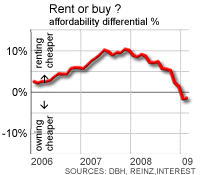
Measuring these 'extra' costs of home ownership is important, but we haven't yet found the 'typical' meaures, given the variances in rates bills, insurance and maintainance, depending on the type and location of property. But the picture is very clear. The major cost of home ownership, interest costs on an 80% mortgage, were around 1.5% less than the rent on a similar sized house in January and February. This is the first time since we started collecting the data back at the beginning of 2006 that it was cheaper to buy than to rent and is a major improvement on the 10.3% premium for buying over renting back in November 2007. We are assuming that household is made up of two 25-29 median salary earners who are considering moving into a median 3 bedroom rental house rather than buying a 1st quartile priced house (ie the midpoint between the lowest priced houses and the median house price). This is the 'classic' couple at that point where they are considering starting a family.
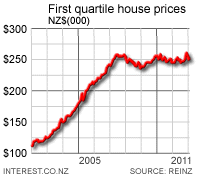
This is where the dream of home ownership is most potent and we think the decision-making point is most concentrated. We have heard in recent years again and again where couples in their mid to late 20s have come to this point and decided to leave New Zealand because there was no hope they could buy a home and start a family. I'm sure it was one of the driving factors in the exodus of young New Zealanders (and their parents) to Australia in the last three years.
Now that gap has narrowed to the point in February where it has gone negative for the first time. It now takes 23.7% of after-tax pay to afford the rent on a three bedroom house, while it takes 22.3% to afford the mortgage. Obviously, the costs of maintainance, insurance and rates will mean it is still more expensive to own a home, but it is now within that margin of error where the heart can conquer the head. Another way of describing it is to say the foot-loose and fancy free husband no longer has any good excuses to put off the nesting instincts of the wife. In other words, it's time for another baby boom. Complaints please to bernard.hickey@interest.co.nz. So what might this all mean for the property market and New Zealand's demographics?
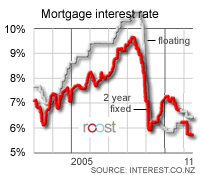
Real estate agents have said to first home buyers for years that rent was 'wasted' money that could be put to better use in 'compulsory saving' on the mortgage. Of course, this isn't strictly true and pointing out the the obvious extra expense of a home loan made for an easy rebuff. Not for much longer. But it may not contribute to a rebound in house prices. Banks are now much tougher with their lending criteria, particularly for those wanting to borrow more than 80% of the value of a home. The lure in days gone by of easy capital gains has also evaporated, discouraging the sort of highly leveraged first home buying seen through 2005, 2006 and 2007. Sales volumes, however, are already picking up as first home buyers dip their toe back in the real estate market to snap up bargains from distressed sellers. This shift in the rent vs buy calculation is also great news for New Zealand's population trends, discouraging migration of New Zealand-born citizens and encouraging family formation with all the social benefits that entails. It all depends on house prices continuing to fall, interest rates staying low, rents not falling too much and incomes continuing to rise. This analysis also excludes the effects of rising unemployment. That may be the variable that renders this structural change in our economy redundant for now.
107 Comments
Unfortunately with the economic turmoil
Unfortunately with the economic turmoil those two incomes have a rapidly increasing chance of becoming one, or even zero. So a rational purchaser (and they are becoming more so) will delay until job security is higher.
Meanwhile as you've pointed out before the house prices have a bit more froth to be removed, so that poor couple would be buying an asset that loses value.
Add in the other costs and the opportunity costs and you are really stretching to make this make sense. I think you know it isn't.
But rent/mortgage is a ratio I also watch very closely. For me it is still way off base, but it is good to see it start to improve, and better to see the banks start to behave.
a 20% deposit put down
a 20% deposit put down on a house today is, in effect, a 100% mortgage in two years time when prices are down 20%.
rent to mortgage ratio is not as important at the crest of a slow, gradual, and lengthy fall.
No-one is going to buy
No-one is going to buy an asset that is going to decrease in value so quickly. If equity lost is taken into account then mortgage repayments would need to be near zero to make it worth buying a house now.
Hey! Heres hoping rental income
Hey! Heres hoping rental income will drop in line with house purchase costs and continue the property price freefall!
Bernard, Please give your article
Bernard,
Please give your article some balance by adding analysis of medium and long term costs and risks. Include at least the impacts of: Significant drops in house values; Falling rents; Increases in interest rates e.g the 23% interest a neighbour with several rentals paid on his first property; Lower incomes; Higher unemployment and; Children.
"C Says: April 12th, 2009
"C Says:
April 12th, 2009 at 12:58 am
No-one is going to buy an asset that is going to decrease in value so quickly. If equity lost is taken into account then mortgage repayments would need to be near zero to make it worth buying a house now."
That is what should be the case but at the moment the opposite is happening. People are diving back into the market as the latest stats show.
Doesn't this point to rents
Doesn't this point to rents being way too high rather than your average half a million dollar house being "affordable again"?
Bernard, looks like you wrote
Bernard,
looks like you wrote this in a rush. When you get to update4 is there any possibility you could include some recommendations on whether to fix the loan? And how long to fix for? And what that does to the affordability / unaffordability calculations?
What is not clear in your article is the interest rate you have used. Was it floating? Fixed? If so for how long?
There does not appear to be a mention of whether you allowed for a deposit. And, if so, what was the deposit size.
There is no mention of the total mortgage taken out. was it 100%,, 80%.? Did that influence the affordability of the loan?
At this stage, reads more like a draft.
Great story. First home buyers
Great story. First home buyers should grab the opportunity and get on the property ladder now. Something like 80% of net wealth has been historically generated through property and being the owner your own house underpins the fabric of NZ's family unit.
To all first home buyers, get on while you can because it won't be long until the door is shut again. Who cares if the market changes +/- 10% at least you'll be in your own home and as sure as the the world turns property prices will cycle back up eventually.
If you're worried about your job then buy a your first investment property - buy based on return and you'll be cash positive day one given todays interest. Home and income in a major city. A bit of hard work with the bank and you have an income producing asset.
Good luck!
Yes a very encouraging sign....Stats
Yes a very encouraging sign....Stats are just that, indicators....notice you still do not say "it is time for 1st home buyers to buy" and add the appropriate qualifications as why not..rates, maintenance, continued reduction in value of the asset
Now lets wait and see who starts to mis quote, take things out of context....
A well balanced article Bernard...for those who actually read the full 'opinion'
As long as mortgages are
As long as mortgages are written into existance out of freshair by the privately controlled banking network as part of the "base" of the debt "based" monetary system then loaned out at compounding interest, there will never be a good time to buy. Those that are seeking a home to reside in longterm, not to trade for profit are having their efforts and resources stolen.
All loans of credit/money should be at simple interest. All loans for those seeking a longterm residence should be supplied at low cost by the government as a means of entering into circulation our own low cost money supply "base", borrowed from no-one, owed to no-one. Its been done successfully before, it can be done again.
http://www.mortgagesexposed.com/Book_Contents/Compound%20Rate.htm
http://socialcreditorbust.blog.co.nz/successful%20alternatives/
"excludes the opportunity cost of
"excludes the opportunity cost of interest earnt on a deposit that has been sunk into a property".
Not to mentioned, the opportunity cost on future equity paid into the house. This element of home ownership is ALWAYS overlooked by people who argue that renting equates to "wasted money".
Home ownership should be an emotional investment, not a financial one.
Might be hard to beat
Might be hard to beat all the ex pat kiwis buying off the internet and huge numbers heading back from overseas to take shelter from the recession in the UK.
http://www.nzherald.co.nz/business/news/article.cfm?c_id=3&objectid=1056...
And this also talks of
And this also talks of the surge of expats heading home http://www.nzherald.co.nz/business/news/article.cfm?c_id=3&objectid=1056...
Bernard, Can you please clarify
Bernard, Can you please clarify some points?
-Are you saying this is it? The the market has bottomed?
-The article in NZ Herald titles "Time to Buy - Bernard Hickey". This is sending shock waves coming from you, esp when you kept saying the market will fall further.
-The article doesnt mention about rsing interest rates, thus when those who buy now at lower interest rates, will find themselves having to much more. Shouldnt your article mention those points?
-From being a follower of your site, this article doesnt seem like you. Have you been drinking too much? :)
-Has the motgage holiday made you rethink the effect on the market?
cheers
Richard, <blockquote> Something like 80%
Richard,
Your numbers may be correct, but I think you forgot to mention that the wealth accrues to those providing the credit to finance the property and not to the property owner.
Bernard by not including rates,
Bernard by not including rates, insurance etc.. because you can't find 'typical measures' makes your analysis totally worthless for real life couples contemplating the choice. Rates+insurance are $30 a week minimium. Also the deposit needed for a $240,000 first quartile house is $48,000 so at 5.5% interest thats $50 a week oppurtunity cost. $80/week is a significant amount of money for first home buyers, not including it makes your analysis a waste of time. These costs would be taken into account in the real world.
Lara, <blockquote> And this also
Lara,
Your statement is not supported by the link you provide:
http://www.nzherald.co.nz/business/news/article.cfm?c_id=3&objectid=1056...
This arcticle http://www.realestate.co.nz/blog/more-information-
This arcticle http://www.realestate.co.nz/blog/more-information-is-valuable-in-assessi... and the accompanying graph comparing UK house price decline with NZ shows we are nowehere near as badly off as the UK http://www.realestate.co.nz/blog/wp-content/uploads/2009/04/uk-and-nz-pr...
PeterR try this link 10,000
PeterR try this link 10,000 predicted to come home http://tvnz.co.nz/national-news/kiwis-returning-home-oe-dreams-turn-sour...
More New Zealanders are turning their back on the great OE, as the tradition becomes one of the casualties of the recession. Up to 10,000 expatriates are expected to come home this year because they are struggling to find jobs and make ends meet overseas.
This should put pressure on rents and property prices as the ex pats pour back into NZ
The article would have been
The article would have been much better had it improved public awareness of this tool;
http://www.consumer.org.nz/topic.asp?category=Money&subcategory=Banking&...
If we want to teach the general population to become more financially literate, it does them a disservice to ignore, or discount these important fundamentals of investment;
"... as long as the cost of rates, maintenance and insurance is excluded. It also excludes the opportunity cost of interest earnt on a deposit that has been sunk into a property."
It is because people ignored (or were ignorant of) these fundamentals that the housing bubble inflated to the degree it did - and for that same reason, the pain associated with its deflation will be so crippling in the long run.
Lara Economists have been expecting
Lara
Economists have been expecting a surge of expats since spring last year, where are they all? net migration figures show a gain of only 9600 since spring with the majority of them coming from Asia. This is chicken feed when compared to 2002 when the gain was 40,000+
Lara, Again, your link: http://tvnz.co.nz/national-news/kiwis-re
Lara,
Again, your link:
http://tvnz.co.nz/national-news/kiwis-returning-home-oe-dreams-turn-sour...
hardly supports your assertion:
Westpac economists have been talking up property prices and rents without supporting data for over two years. Their predictions are hardly convincing.
Yes, the world is in recession and in those circumstances some people go home. That movement works in both directions, but the net effect will depend on the relative severities of recession. In timing we are probably 12 months behind the UK, so things are set to get much worse here. I expect increased emigration at that point.
You must be having a
You must be having a great Easter chuckle to yourself, Bernard! You've provided the alternative arguement that you felt was needed by the masses to balance your views. Journalism at its best.
Good luck to all those who want to become rich without actually working for it. I hope it works for you. Pork belly futures are making a come back, I hear......
While it is interesting to
While it is interesting to see that there appears to be a surge of expats returning and considering to return - can someone point me in the direction where there is likely to be the growth in job opportunities with sufficient income to support them and the prices they are prepared to pay for property?
In Bernards earlier article "10 reasons why it is an indian summer" - particularly POINT 2 - regarding morgaging capacity, it is my view that Bernard is likely significantly overstating how tight lending criteria is in this country. The Squirrel website points out the reality of the situation here in this country - where - by working around the deposit requirments - purchasers can still borrow 4 and 5 times annual household income.
My underrstanding is that mortgage lending criteria is currently a lot tougher in the United Kingdom - where prospective buyers would have their work cut out borrowing more than 3 times household income currently.
It needs to be borne in mind too - that the State of Victoria in Australia released land sufficient for a firther 250,000 lots / sections last year - and starter house / land packages can be bought on the fringes of Melbourne at between $A230,000 and $A260,000. The $A21,000 First Home Owners Grant (FHOG) is available there for new homes - $A14,000 for existing ones.
New South Wales and Queensland are currently "tanking".
It would be much appreciated if UK expats could provide us with details of the actual current mortgage lending criteria in the United Kingdom.
Kate - your link through
Kate - your link through to the Consumer Institute Calculator is most helpful.
There is just one point I have difficulty with - in how it incorporates a 3% annual lift in property values going forward. Take this out of the picture - and the rent buyer option changes quite dramatically.
Readers will need to assess in their own minds - whether or not more affordable new housing stock will be coming on the market going forward. The days of strangled and grossly inflated new supply - are coming to a close in my view.
I agree Kate the majority
I agree Kate the majority of the New Zealand public are financially illiterate and wouldn't even know what oppurtunity costs means.
Bernard is doing a major disservice to first homebuyers by not including his prediction on house prices, just 3 days ago he said:
"I am sticking to my forecast for a 30% fall in the REINZ median from its November 2007 peak of NZ$352,000 to around NZ$250,000"
The reality is most people would rather buy than rent even if it does cost more, but most can't afford to. How many 25-29 year olds are there in a stable relationship earning $1307 a week with $65,000 in the bank? I would say not many and the few who are in this position will not want to lose all their hard earned deposit buying a overpriced deflating asset.
Mario - regarding Bernard -
Mario - regarding Bernard - its likely not the drinking - just the Irish coming out in him - so its in the genes.
Did you hear about the Irish immigrant arriving in this country - asking the first guy he met on the dock -
"Is there are Government in this country?"
To which the Kiwi on the dock said there was - and the Irishman said (likely one of Bernards forebears) -
"Well Im agin it".
Keiran - you say 40,000
Keiran - you say 40,000 people poured into NZ after 9/11 so at a guess a very serious recession would surely see more people come home than ever before compared with the New York incident. Imagine if we had 60,000 net migration gain!
Of course very few will now be planning a working holiday in the UK so more people staying put in NZ and decide to buy a house while interest rates are low and prices have fallen 5%. Probably a lot less going to Oz too!
I notice not much activity lately at http://www.interest.co.nz/joblosses.asp
It's all in the last
It's all in the last paragraph which should have been at the start of the article.
Once you take account of the true state of this economy and the rest of the world, only a fool would risk their savings on a sure bet they will lose it. The banks are telling us all they see a 20% fall in property and that's why they demand the 20% deposits.
This is a time to be in cash and to be able to move it quickly offshore before Mr Bollard sets about destroying the value of the Kiwi$.
Property is in decline and will be so for a decade minimum. There will be no escape from the worst of the depression. There will be no wave of wealth immigrating here to pork the property market. The rich have an abundance of options elsewhere.
The triple deficits are here for the duration, especially the fiscal deficit which looks set to explode in size and bring about the demise of the Kiwi$ if the RBNZ fails to achieve it. The 180 plus billion household mountain of debt is a legacy of greed that will never go away.
Hugh, <blockquote> can someone point
Hugh,
Lets be more specific and ask "Are these returning Kiwis going to help the Current Account Deficit or make it worse?".
Lara's TVNZ link referred to an unemployed builder in the UK returning to NZ to work. In all probability that suggests no funds being repatriated on return, more imports to support living here, more imports in his work building houses, and nothing being contributed towards exports. The last thing the economy needs.
I suspect this story was
I suspect this story was written solely for the NZ Herald, because it fails to mention that the writer believes that housing will drop by 30% from it's 2007 peak. This means that what the writer has writen, contradicts with what he has previously written, as buying now will mean that the writer believes that they will actuallly end up owing more than they paid for the house when the property prices have dropped further.
Perhaps the sponsors want some good news stories to written, as ASB makes money from selling mortgages. I normally enjoy Bernards articles, but I thought this was was very unbalanced.
Bank manager,Imagine if we had
Bank manager,Imagine if we had 60,000 net migration gain!
Imagining it is all you will be able to do because its not going to happen. Our net migration always drops during winter even in 2002.
Of all the 25-29 year olds I know none are in a stable relationship, none have any more than $10,000 saved. They would all rather spend their money on laptops, mobile phones, MP3s, clothes and traveling. First home buyers are now in the 30-40 age bracket.
I see that Tony Alexander
I see that Tony Alexander believes a year-end total of 15,000 to 30,000 new immigrants is an "easy call", meaning there will be more buyers in the market.
Tony Alexander, who has pointed to three fundamental indicators of the housing market migration, housing construction and interest rates. All were pointing towards the right time to buy.
Could a bank economist be wrong in his thinking
Bernard, did you have any
Bernard,
did you have any say over the headline "The time is right to buy" in the NZ herald article of today??? Surely this is completely at odds with your prediction of a 30% fall in prices. even if it is almost as cheap to buy as rent (before allowing for rates, maintenance, insurance, future interest rate rises etc) it will continue to be a bad time if your capital loses value over the next few years.
I can only assume you are equally surprised/shocked as I was.
Lara, <blockquote> Could a bank
Lara,
Yes, and Tony Alexander as much as anyone.
Hugh - that's the really
Hugh - that's the really good thing about the calculator - those variables can be adjusted in accordance with one's own prediction and circumstances.
I use the calculator as an over the next 5 years for the variables (as who can predict over a 20 year term) and the question really is should I invest now in housing over the next 5 years or go for a term deposit for the same period?
Here are the variables I would use for a 5-year type scenario:
Mortgage interest rate - 7%
Inlfation rate - 3%
Real growth in house value - 2%
Real interest rate on savings - 4%
I assume that our currency will devalue substantially in the near term - likely faster than house prices will deflate - hence the real growth in house value of 2%.
But, it's all just a best guess!
jamess, I suspect the story
jamess, I suspect the story was written.commissioned for the NZ herald. The NZ herald are in thh business of selling advertising, and a lot of that advertising revenue comes from property. Any story (including that misleading title of the NZ herald version) that could potentially create additional activity in the hosuing market, can only benefit teh NZ herald.
Kate, Your 2% real growth
Kate,
Your 2% real growth in prices is not a best guess - surely a worst guess. Timing really does matter when it comes to investment (even long term), and you cant expect long term capital gains in the short term when we are in the down cycle of the biggest bubble in history.
Rob, i have no doubt
Rob,
i have no doubt it was written for the herald - I would just be interested to hear from bernard whether he had any say over the title as it is clearly at odds with his general views and certainly not implied by the article.
Peter R - you make
Peter R - you make a very good point - in essense saying - where is this boost in incomes and employment going to come from to get the bubble reinflating again?
What economists tend to overlook is the "elasticity" in the market - where the people per household number can move around quite dramatically with respect to the existing usually occupied housing stock.
Moving household occupancy overall from say 2.6 to 2.8 per household - can have a dramatic impact.
Note the recent article one poster put up (was it the UK Telegraph) where some one million more young people were staying with their parents.
In addition to this is the second home market (roughly 10% of the total 1.6 plus million existing housing stock) - some of which coverts to usually occupied stock throuh an economic downturn. Parents retiring to the house by the sea for example - to let younger family members have the old family home. And mobile homes as well.
Hugh, <blockquote> where is this
Hugh,
Fundamentally, what are we going to produce and export to pay for imports to support our existing population let alone an increasing one? The alternative is a 20+% drop in our standard of living. That amounts to a depression, and in those circumstances you get the response you suggest - housing occupancy rates go up, holiday homes are sold, and the young stay at home longer.
There is no bubble inflating but ongoing deflation of asset values until they reflect productive values.
"Lara- Could a bank economist
"Lara-
Could a bank economist be wrong in his thinking"
The country Chief Economist who has more power over us than any bank economist, Allan Bollard stated in the famous RadioNZ
http://podcast.radionz.co.nz/ntn/ntn-20090313-0910-RBNZ_on_Official_cash...
"No no that's just straws in the wind, and gets built up, often by estate agents in whose interest it is to do that, but you're going to get some pockets of positive news, but our view is you would be very unwise to rely much on that. House prices have come off 10% and they have another 10% to go."
There you go that's a prediction 20% fall from their 2007 value. Also check out ANZ weekly report, where they state the something similar.
With regards to people saying Bernard sold out or is contradicting his previous position
http://www.interest.co.nz/ratesblog/index.php/2009/04/09/opinion-10-reas...
"Bernard-
I say buying is now almost as affordable as renting now (before rates, insurance and maintenance) but that isn't the same as saying buy now."
jamess, I agree with you
jamess, I agree with you - it's all guess work - and I'm not saying my numbers are right for everyone. Whether one can hold onto one's capital in residential housing and/or make a minor gain over the next 5 years depends on what you buy now and what price you pay now.
I have a question, does
I have a question, does anyone know how much unoccupied housing there is in the country at the moment, holiday houses, second houses and the like?
I'm an Options & Currency
I'm an Options & Currency trader and I know from experience how dangerous it is to assume market bottoms. I follow closely the economic situation overseas, and this downwave is far from over. The conventional wisdom is that Keynesian theory, ie massive government spending and financial bailouts is going to work this time round. In a normal recession, yes, but this one is different. The loss of wealth globally has been catastropic, tens of trillions, leaving huge numbers of people shellshocked. And it's not over. There is another factor I rarely hear mentioned : the giant highly leveraged derivatives market, some nearly $700US trillion in size globally. It is almost completely unregulated where some very risky investments have been going on. Only a fraction needs to go bad and the global situation gets infinitely worse. I refer in particular to interest rates bets - this part of the market is enormous, far exceeding the credit default swaps of which there has been some publicity. It was Warren Buffet who in 2002 talked about derivatives as the financial weapons of mass destruction. Indeed.
Now a good time to buy property?
For me, certainly not.
Lara - "can economists be
Lara - "can economists be wrong?" Oh yes they can, very wrong!!!! for example almost none seemed to see the massive housing bubble coming, how wrong was that???!!!
Tony ALexander has been very wrong a number of times, including his prediction late last year that the NZ dollar would be around 40 US cents and hang around that point for much of this year...at last glance the kiwi dollar was about 57 US cents!!!! You would be fuming if you based your business planning on that sort of advice!!!
Also you lead us to this link which you think supports your idea that expats are surging home:
http://www.nzherald.co.nz/business/news/article.cfm?c_id=3&objectid=1056...
It doesn't support that view at all!! It just says there has been more interest shown on employment websites, and many expats seem to be checking out Australia as well!!!
Its one thing for expats to show interest in coming home, another for them to find employment here and actually come home!
Many firms like my own are simply bunkering down at the moment with no thought of hiring new staff, no matter how skilled some expats may be
Sorry I still think this flood of expats returning is a myth. Infometrics are talking about net migration of 10K this year, which I think is about right, rather than 15-30K.
Re: Bernard's Herald article - I think he needs to have a serious word with the Herald editors, the bastions of that amateurish rag, who once agian seem to have flown off on their pro-real estate fancies. I'm sure Bernard will be having a word as the heading is clearly misleading in terms of the content of his article
Kate - I missed your
Kate - I missed your post earlier in how you adjust the Consumer Institute Calculator - thank you for that. I admire your optimism!
As you will be aware from the last Demographia Survey - NZs major urban markets average Median Multiple was 5.7 - but 6.3 in the previous year Survey - where Australia still sits. These are well above those in the UK and Ireland - something expats in Ireland and the UK need to check carefully - prior to considering buying in Australia or New Zealand.
There is a saying in real estate (as with any asset class really) - that its only worth the income thats supporting it.
Jeff - as a currency & options trader - your comments are most helpful. People here in New Zealand simply have'nt grasped the significance of the bubble wealth wiped out globally. And most importantly - still to be wiped out.
Without getting in to the finance sector potential losses (outside my area of expertise) my view is that there is likely the equivilent of 2 to 4 times Gross World Product to say goodbye to in asset bubble values. I covered this within an article soon after Christmas.
Whats going on globally - is really Japan 1989 (a 16 plus years exercise) repeating itself - but on a global scale. They dug themselves in to a deeper hole with massive fiscal stimulus.
This most certainly isnt your usual garden variety recession.
Roger Witherspoon - hopusing states
Roger Witherspoon - hopusing states - may I suggest you go to the Statistics NZ website - where this information ios available.
I might have done Mr
I might have done Mr Alexander a disservice - sorry Tony ! - I think it might have been Westpac that were picking the NZ dollar to possibly get to US 40 cents
But those guys change their view quickly:
Check out their exchange rate forecasts in the two links below (only one week apart) to see how they went from predicting the NZ dollar to be US 46 cents in June 09
to US 52 cents in June 09:
http://www.westpac.co.nz/olcontent/olcontent.nsf/content/FM_Weekly_20090323/$FILE/NZWC2303.pdf?Open
http://www.westpac.co.nz/olcontent/olcontent.nsf/content/FM_Weekly_20090330/$FILE/NZWC3003.pdf?Open
Any way the point is economists do frequently get forecasts wrong
Its important to also note
Its important to also note re: Bernard's article that he said it was more affordable for a median income household to buy a "lowest quartile house" than rent a "median rent" house.
Its not exactly comparing apples with apples, although I'm sure Bernard was implying that first home buyers realistically need to start lower than the median house price.
But for a median income household it would still be significantly cheaper to rent a median rental property than buy a median price house.
the fact is something is still way out of whack when a median income household can only afford buying a scungy house in the lowest quartile prices
In Auckland buying in the
In Auckland buying in the lowest quartile will mean getting an ex state house in the middle of a suburb like Glen Innes
These sorts of areas often have very poor schooling and most median income households with young children that I know would still rather rent in a better area with better schools than buy in an area with crap schools
I guess it might be an option for a median income household to buy in an area like GI if they haven't had kids yet, but with capital gains likely to be minimal over the next 2-3 years in such areas surely it would be better to rent, save a bigger deposit then buy in a slightly better area with better schools?
Matt in Auck - that's
Matt in Auck - that's a very important point that Bernard doesn't compare apples with apples. My motto - never rent above your means. If you can't afford the mortgage on the place you're renting - you'll put off buying because the compromise is too hard.
Better to live grotty while renting and move up in comfort when you get the deposit in behind to purchase. And better to make a first purchase with a goal to sell it and move up in 2-3 years time, than not to make the purchase at all.
I think many first home buyers think for their kids sake they need the perfect house and perfect neighbourhood from the word go.
That said, the worst thing one could do in this (i.e. a bad) market is pay market rate for a less than desireable neighbourhood.
Kate = good points However
Kate = good points
However realistically in Auckland a 25% price house will get you a house in a suburb like Glen Innes
I'm not saying that median income households should be looking to buy in remuera, Mission Bay etc - ie the perfect house in the perfect suburb - but surely middle income households must be able to aspire to a lower middle income suburb like Mt Roskill, Mt Albert, etc which have reasonable schools????
I think the fact that median income can only afford Glen Innes is very symptomatic of how out of whack things have got
other point is....how many 25-29
other point is....how many 25-29 year olds can afford to have saved up a 20% deposit on the house - ie. 70-80K minimum?
Many have significant student loans to pay off, and the first few years of their careeers earning power will be fairly low
My colleague at work is 26, he is an junior engineer and his partner is a starting teacher. Combined they would be slightly over median income
They've still got large-iesh student loans and he implies that they are only saving a very small amount per week
at best they would be saving $5000 per annum
Assuming average salary increases the next few years they'd be pushing to get the necessaty deposit together within 7-8 years
Iain you say a loan
Iain you say a loan at simple intrest, who do you think is going to do that Robin Hood or Rob Muldoon, this is the real world even the Govt owned Kiwi Bank likes to trade profitably, lets say that to raise capital costs between 4.5- 7.5% the simple loan needs to pay its way so has to be lent at say 6-9%, (a 1.5% Margin) and you reckon this makes it more affordable, yeah right, you suggest the Govt provide the loan, wake up they are getting the money off-shore at the rates I stated above, or do you think they should subsidise with tax payers money, most tax payers would tell you to get lost, so would the voters in respect to your socialist views at election time, wake up my friend this is the real world.
Renting is a great idea for those that can save more for a deposit, but if you want to buy now go for it, as property is still viewed as a safe investment, I wouldn't listen to what all the economists have to say as someone pointed out, none predicted when the property crash was going to happen let alone to what extent, so all their prevado as to its future is purely speculative, historically property is favourable, as the share market has dropped to the 1980's to 1990 level but property is at the 2006 level, so hello to all the experts. Happy property buying.
A LEFTFIELD VIEW ON IMMIGRATION
A LEFTFIELD VIEW ON IMMIGRATION AND NZ HOUSE PRICES 2009 -2011
Several high profile economists have recently offered the view that with deteriorating economic conditions in labour markets in the UK, young New Zealanders will postpone the traditional "OE", instead favouring hunkering down in NZ for a couple of years until the global economy improves. Such economists have also stated that there will be a significant surge in the number of expats returning to NZ. The net result, they argue, is that net immigration will increase and this will help to lift NZ's housing market out of the doldrums.
However, like all things in life, there is always an alternative view.
Whilst these factors may have a minor short term bolstering effect on the housing market, there will also be negative implications.
With many young kiwis deciding to forego the OE over the next 2 years, they will remain in NZ earning NZ wages (if they are lucky enough to keep their jobs). As a result of significantly less OE departures, we will also get significantly fewer OE returns in 2-3 years time. The OE returns have often been a fuel to the property market, as young kiwis go to the UK to work for 2-3 years, return with pounds, and perhaps buy a house.
Although some expats wil return home in these trying times, it is my view that more young Kiwis will put off leaving NZ for their OE than young kiwis deciding to come back early. This is due to the fact that many expats in the UK will retain their jobs, however conversely it will be harder for jobless prospective OE participants to find jobs in the UK. In additon, where kiwi expats in the UK CAN hold on to their jobs they may decide that is a safer option than coming back jobless to NZ,provided they can extend visas.
Therefore the main contribution to short term increases in net migration will be fewer kiwis leaving NZ rather than more kiwis returning. Such a trend is unlikely to bolster house prices significantly as many of the young kiwis who might have left will not have the necessary deposits to purchase a house. Of course, some pressure may be placed on rentals which indirectly have some bolstering effect on house prices, however such effects are likely to be minor, especially as in times of rising unemployment more younger people may live at home with their parents or cram in at their mates' places .
All in all, it is the author's view that the impact of likely migration changes on housing has been exaggerated, and in fact the anticipated shifts may have negative ramifications for NZ house prices, especially in 2 or 3 years time when NZ property does not benefit from the "boomerang effect" of expats returning with UK pounds .
Ok Matt, here is an
Ok Matt, here is an anecdote for you. Just for fun and just ONE true story- so I'm NOT saying it is indicative of any trend! We had supper last night with the visiting sister and bro-in-law of good Scottish expat friends of ours. When the sister of our friends heard that my husband was from NZ, she raved about how beautiful it was. Her husband, an Englishman from Yorkshire, agreed. We beamed. Then, apropos of nothing, the sister told us about some friends of theirs from Yorkshire who had gone to NZ on holiday. The wife fell in LOVE with NZ. When they returned to England, they immediately set about immigrating to NZ. They sold their house, packed up and took their 3 kids. Upon arrival, they settled in (the sister didn't know where) but after only 3 months became intensely homesick. They moved back to the UK before they even received all of their shipped goods!
I can add, anecdotally,that I
I can add, anecdotally,that I know of several UK couples who bought in our area have gone back after months/years. One couple sold up for close to $100,000 less than they bought for, a 25% loss. Its too quiet here for some Brits, they miss family and the houses are often of disappointing quality.
M - yes I've heard
M - yes I've heard of that sort of thing plus heard of a few immigrants who've come to NZ as a stepping stone to Australia (I believe thats quite common)
Also there's the story of Taiwanese and Korean immigrants who came here in the 90s essentially for their chidlren's education but then emmigrate back once their kids have finished school, because they don't have much english (they came here in the pre-English proficiency test days) and most of their families are back in Asia. A few of my workmates have parents like that and they say its quite common, and getting more common as the children who were say 4 or 5 in the mid 90s are now reaching university age.
As you say though not necessarily indicative of a trend. Of course there are plenty of immigrants who come here and live here happily for ever.
Hmm. I lived in Taiwan
Hmm. I lived in Taiwan during highschool. My father was expat-ed there. I think it depends on the wealth of the immigrant? In my experience, wealthy Asians quite often acquire citizenship in English-speaking countries and use it as a base for the kids to get a good education. The family business, however, is back home. When the kids finish university and/or business or law school, they get pressure to return and run the business. Less well-to-do immigrants can be a better investment - they are motivated to stay, work hard and their kids stay too. As a side note, one trend here in Manila is a huge influx of S. Koreans. The moms come with the kids who attend cram schools for English language and then they apply to any one of a handful of excellent international schools here. In their home country, they wouldn't be able to attend an international school without a foreign passport - this is a common standard in international schools. Having obtained the diploma from an international school, they can apply much more easily to American universities. This is the end game for competitive S. Koreans.
M - yep good observations
M - yep good observations there. I've too noticed it tends to be the wealthier Koreans and Taiwanese who do that. It also seems quite common that the mother will be here with the kids through their school days ,the father stays in Asia to run his business, and doesn't come down to NZ much
not sure if we'll see a surge of these people returning to Asia, more likely to be dribs and drabs here and there
interesting social phenomenon though!!!!!
Readers are urged to read
Readers are urged to read The Australian article of April 11 "Easy lending to hurt young home buyers" - where the Banks there are still lending out in Australia at an astronomical 5 to 7 times household earnings - with the extraordinary First Home Owners Grants ($A21,000 new - $A14,000 existing).
The Banks are telling us how "sound" they are - and their economists are generally full of good cheer as well.
Interesting...eh.
Im obviously just too old fashioned.............
Matt in Auck, Agree re
Matt in Auck,
Agree re the so called ex pat impact. I think the other thing to consider is that those who return because of the recession will actually have a COMPARATIVE deflating impact on the market compared to similar returnees over the past 10 years.
WHY?? because most kiwis in the end do return home and have been returning home over the past 10 years. I think the impact of these high earners returning to our shores has probably already been largely priced in. I know cos I returned from teh UK in 2001 and at that point it was easy to find great paying contract work in the city of london and many were caning it relative to NZ salaries. Many of my friends were in the uk for 4-6 years and returned with anything from 100,000 to 1,000,000. ALL except 2 have returned to NZ (from a group of about 20 I mixed with over there). When I returned property seemed easy to afford for most returning, but increasingly less so as prices rose.
So fast forward to today. I believe we need a continuing supply of returning ex pats who have been overseas 4-6 years to MAINTAIN (not grow) the "ex pat" premium currently built into NZ prices. If less are going overseas AND more are cutting the OE short because London is no longer a gravvy train then surely the "ex pat" premium is reduced enormously because the bottom line is that over the next 5 years we will see less and less pounds brought into NZ.
Some anecdotal evidence. My younger sister, moved to london a year ago. She is a fully qualified accountant, has a job but not in the city (dried up) and not earning the big money that my accountant friends were earning 4-8 years ago. Likewise her boyfriend a graphic designer has been out of work for 8 months and is likely to retun home. I know for a fact that their collective impact on the NZ market will be far less than my friends when they returned. Just one example, but probably indicative of many.
Hi Matt in AUck, M
Hi Matt in AUck, M and others
New immigrations hardly push new immigrattion numbers up as many people talked here. Instead less kiwis going abroad is always push new immigration numbers up. That s anecdotal facts.
Matt in Auck - re
Matt in Auck - re the 25-29 year old couple - she's a teacher; he's an engineer. I assume, as a teacher - she will earn the same dollars whether living in Auckland or living in a provincial city where rents (and houses) are much cheaper. As for the engineer - again work prospects are likely good in many provincial cities, perhaps not quite so much money, but a company like Fonterra will pay very good salaries to engineers in many of their provincially located processing plants. Then there are local and regional councils all over the country looking for water/wastewater engineering skills.
If I were young, recently qualified and still with student debt - I'd get out of Auckland as it's just the most expensive place in the country to live. And you'd be amazed at how much more relaxed life is without the traffic/population.
For those that are interested
For those that are interested I have put together a graph comparing the NZ house price growth since 1989 with USA and UK also with Japans housing bubble in the eighties. I was suprised that our housing bubble is the biggest. Also I am currently doing a chart comparing the Auckland housing bubble with London and New York and will put it on there eventually also.
Here is the link:
http://www.geocities.com/nzeconomy/Graphs
Kieran - congratulations on your
Kieran - congratulations on your efforts in putting that excellent graph together.
IIs worth bearing in mind too - that through the 1950's and 1960's - it was rare for the wife / partner to get outside employment once the children arrived on the scene.
So once this factor is taken in to account - this illustrates that the housing situation is even worse than the "household income' basis would suggest.
In fact - through that era - if a guy wasnt seen to be financially supporting his wife and children - he was seen as a bit of a loser by the rest in the community. Its changed today of course - where the working mother is financially supporting the children and too often the infantile husband as well !!!
Some see this as "social progress" no doubt - particularly the infantile blokes.
You might like to read the "Levitt story" and Dr Barbara Kelly's book on these issues.
The sad reality today is that most overworked mothers are really "bank slaves" - because of the exorbident house prices.
Yet - the rather remarkable thing is that we havent heard a "peep" out of the professionall do gooders like the Churches and social agencies, to these very serious issues.
The reason for that is because these outfits are now so dependent on State Welfare themselves - housing issues are a "taboo subject" as it could put at risk the taxpayer welfare they are reliant on from their political owners.
Jimmy - thanks for your
Jimmy - thanks for your observations, they tie in nicely with mine.
Its amazing how simplistic economists often are, they really do not look beyond the crude figures!!!!!
That is a very scary
That is a very scary graph Kieran, very interesting.
Hugh I agree although usually
Hugh I agree although usually the hours worked drop when children come along down to part time rather than fulltime.This is another reason why first home buyers shouldn't base their buying potential on 2 fulltime incomes. But this is what the feminists wanted wasn't it? You are right the church should be more vocal about the issue.
Matt Interesting point, if there is a drop in the numbers going on OE they won't be bringing home a bit of extra money. it will definatly have a impact on their buying potential in the future compared to the past. One of my brothers also went to London in the middle of last year he has just graduated as a Lawyer but couldn't find any work and ended up runing out of money and coming home broke. he is now on the unemployment benefit because he can't find work here either.
Kieran - thanks for the
Kieran - thanks for the graph, a great resource!
great graph The scary part
great graph
The scary part is what created it and whats holding it up. Created by DEBT, held up by DEBT that the interest is compounding on, until people start defaulting, then it comes down like a house of cards.
Most income in cities looks to me to come from Govt where do we expect our Govt to get the funds to continue the present levels of state spending. Increased taxes? Fonterra must at some stage drop a bomb shell on our export potential. Then the $ falls,inflation climbs even higher and interest rates go through the roof. House prices fall due to defaults on mortgage repayments. Spiral starts, that begins to destroy debt through bankruptcy= more pressure on asset values.
Kate you are right life
Kate you are right life is so much better (and more afordable) in the provinces, I have got no idea why people want to stay in Auckland. I live in Wanganui (without the h) My wife 2 daughters and 2 dogs and I rent a tidy 3 bedroom villa within walking distance to the city centre for only $250/week. Our house is currently worth around $210,000 so a 80% mortgage at that price would be $370 + rates etc $420. It also means our landlord is only getting 5% yeild which is effectivly wiped out by falling house prices. While I get to put my money in a business earning 20% return on equity and enabling me to be my own boss and choose my own hours. Although we would still much rather own our own house again we are not silly enough to buy at the peak of the biggest assett bubble in history.
Kieran, thank you for that
Kieran, thank you for that information.
You know, apart from our disagreement on one particular aspect of housing bubbles and their causes, I really like your contributions.
One thing really must be pointed out about any graph of house values "in the US market".
There are huuuge variations within the US from one State to another, which are concealed in any graph that lumps them all together.
http://www.newgeography.com/content/00621-case-shiller-housing-price-ind...
The reality is that NZ is much, much more like California than like "the USA"; and certainly not at all like Texas.
As I have been saying for a long time, I wish someone would produce graphs for a lot more countries, and get at the underlying reasons WHY some countries have managed to avoid having a housing bubble. Alan Moran in "The Tragedy of Planning", does the best job I have seen so far. All the usual suspects like Capital Gains taxes, really have no correlation with the formation of housing price bubbles.
Kieran - thanks. Please excuse
Kieran - thanks. Please excuse me if I came across in rather harsh terms with regard to the social agencies and the Churches - but it is a topic that needs to be discussed within these organisations and outside of them.
I am aware of instances within Church organisations where members with a genuine concern about these issues and a desire to speak out on them, have been told by those in authority to "shut up".
This (shall we call it) "political apprehension" was a real concern and one I can understand, prior to the election. But there should be no reason for concern now - and I do hope the Churches and social agency people, now start participating effectively assisting in restoring housing affordabillity in this country.
And clarifying one other point - if women with children wish to work one or ten jobs - good luck to them. But if they are forced to - simply because of exorbident house prices and mortgages..........thats an entirely different matter.
I was a tad angry when I put through the last comment.......but there is such a thing as justifiable anger.
K + K Re: the
K + K
Re: the provinces...
I think some people can live there and some can't. I lived in Marlborough once, it was nice for a couple of years but not permanently!!!! I think I'd go cuckoo!!!!
whilst you make good points about the comparative affordability of the regions, I'd come back to the point that people SHOUDN'T HAVE TO leave the bigger cities for a more affordable lifestyle. There should be a range of affordable housing choices in cities to accommodate most people's needs. Unfortunately in NZ's largest cities at the moment this isn't the case.
Hugh and Philbest have done good jobs illustrating the role of planning on housing affordability. I don't fully agree wth them on the solution - although I think the urban limit could be relaxed in a few strategic locations (rather than total abolition of the limits), I think planning regulations need to be relaxed within the urban limits. But whilst I don't fully agree with Hugh and Philbest ,whilst Philbest is spreading the love (hey its Easter!) I also really enjoy their contributions. Hugh is clearly a likeable maverick on a mission!!!!
Hugh I dare say Churches
Hugh
I dare say Churches are in a quandary. Half the congregation wants cheap houses, the other half risk having all their equity wiped out by falling house values.
But what we are still
But what we are still confronting here is a denial that NZ has the same problems with a housing bubble that will render monetary policy impotent and destroy our economy just like it is doing to other countries, if we do not work out what the problem is.
Hugh P., have we not convinced Bernard Hickey yet, what is he doing talking house buying up again?
NZ desperately needs a "First Home Buyers Association", with tens of thousands of members pledged to boycott the market until prices are "affordable" again.
Interest rates set by the central bank are a trap. Interest rates should be set by the "fundamentals" of the economy. House prices should ALSO be set by the "fundamentals" of the economy. Where house prices are enabled to bubble by the free market not working as it should, monetary policy control is lost. Interest rates that would keep house prices down, would destroy business and productivity. But lower interest rates to stimulate the market, and you will get a bubble blowing out and eventually it will burst simply because of the disconnect with the fundamentals and because the bubble itself is sucking away the productivity that should enable the fundamentals to catch up. Even the most productive business investments cannot match the temporary gains of property bubbles.
We are certifiably mad in this country if we think that we are going to avert the same mechanisms that are destroying all the other economies around the world. It is not because of derivatives, it is because of house price bubbles and the household debt that underlies them. NZ is already the worst in the world after Iceland, for net household debt.
Matt in Auck - the
Matt in Auck - the likable maverick (with PhilBest no doubt) is hugely heartened as you are inching over our way.....quietly!
I have said quite often
I have said quite often guys that New Zealand is actually the leader of the 6 countries covered by the Annual Demographia Survey, in addressing these issues.
Yeh - sure - I have had some part to play in stimulating the "public conversation" with respect to these issues. But take it from me - I sure am impressed with the progress currently being made at Central Government level - where before long Im sure I will be steamrolled in progressing these issues, by the CG people and more and more from other sectors in the community.
Thats great, The sooner that happens - the sooner I can go back to my usual day job.
# Andrewj Says: April 13th,
# Andrewj Says:
April 13th, 2009 at 2:27 pm
"Hugh
I dare say Churches are in a quandary. Half the congregation wants cheap houses, the other half risk having all their equity wiped out by falling house values."
AndrewJ, you SAID it, but that goes for most of NZ, not just the church-goers.
My solution, though Hugh doesn't like 2); is for the National government to announce:
1) that they are going to bring property prices down by abolishing urban limits and getting land onto the housing development market at the price it is worth for farming (not 30 times as much)
and various other measures that Hugh has recommended to get $140,000 new homes onto the market.
and 2) existing property owners will be shielded from the impact of this by simple, blunt, tax rebates on their repayments of mortgage principal. Complexity might bring fairer results in theory but administrative costs would kill it.
I think that Hugh is underestimating the negativity of opinion that will come from the undermining of existing property owners positions. But if 1) can be sold to the public without 2), fine. I also think Hugh is underestimating the predictability of our mainstream news media's reaction - I sincerely wish him all the best with getting them on board, they are crucial. NZ political history is littered with the ruin of good ideas that have been shot down in flames by the media, at appalling cost to the whole country and its economy.
So as to not be
So as to not be painfully repeating myself, I have just posted a collation of my arguments on housing bubbles on this otherwise non-commented thread: (please excuse me taking this liberty, Bernard and Co)
http://www.interest.co.nz/ratesblog/index.php/2009/04/09/housing-special...
Hugh Pavletich Says: IIs worth
Hugh Pavletich Says:
IIs worth bearing in mind too - that through the 1950's and 1960's - it was rare for the wife / partner to get outside employment once the children arrived on the scene."
I just about choked on that!!! That is a huge load of rubbish....The concept went out the window early 1900s.
Sure we are given to believe such things of the 'perfect society' back then but the reality was totally different...keep in mind there where th days where female workers where limited to what type of job they had...female wages where about 40% of male, newspapers had separate sections for female and male job seakers...and advertised the hourly rates... hey they even had the 37 1/2 hr week for office/retail workers because they where all female and had to get home for children etc...And a huge proportion worked 'under the table' in local dairys, haberdasheries, tomato picking.
And do not forget, to get a mortgage back then, the female income, legal or not, was not included as part of the family income to qualify.
Dont believe what is protrayed in Amerrican movies TV programs...they are not respentive nor real
Nice graph Kieren,hows that old
Nice graph Kieren,hows that old regge song go? the harder they climb,the harder they fall,one and all!!
re the expats returning issue
re the expats returning issue I know/know of people:
Leaving for the uk now- they are recent grad's and can't get jobs in nz
People coming back from OE as they've lost their job - not sure what jobs they'll get here
People that are in the UK in secure jobs - they're your teachers/nurses police - in demand everywhere
I don't think we'll see the rush some economists are talking about until there is massive riots, huge unemployment etc. etc. Which is of course a possibility, but none of the people i've mentioned can afford a house anyway.
Hugh- Im an expat working for a residential builder in oz, i think the fhog is the only thing stopping the bubble bursting in oz. It is due decrease in june, i think the aussie budget is in may and already deficits are being talked about, im not sure if the government can afford to extend the bonus with all the money they've been handing out lately.
Danielle - many thanks for
Danielle - many thanks for your perspective on the Australian housing market. I think the fhog is running at an astronomical 10,000 a month - likely costing taxpayers / government around $A170 million a month. In reality it is really a "gift" to existing land and home owners - and propping the bottom end bubble up.
Hugh / Danielle - I
Hugh / Danielle - I totally agree re: the fhog
I hope they never introduce it here, the best thing for first home buyers is for the market to correct itself!!!!!
If inflation in the States
If inflation in the States in the late 70 reached nearly 14%, where is it going to get to?
Surely this is the elephant in the closet ready to burst out and squash all that gets in its way!
What chance that we have hyper inflation while property prices keep declining for four more years?
As part of the demographic
As part of the demographic that will supposedly be rushing back from London to NZ this year to buy houses and prop up the property market I thought I'd share my 2 cents worth.
I'm an early thirties lawyer working in a top end commercial law firm in London. There are about 8 other Kiwis and aussies in my team. Recently our firm decided to make approximately 100 lawyers redundant and asked everyone if they were interested in voluntary redundancy. Once you take into account the tax free portion the package was worth about 9 months gross UK salary (more than I could earn in 1 year in NZ working in the best law firm in Auckland). And for doing nothing more than signing a bit of paper and walking away from my job.
A number of English lawyers took the voluntary offer to try other careers. But not one of the kiwis or aussies did. And the reason for this is that there are no quality legal jobs at home. Not in Auckland, Wellington, Sydney or Melbourne. We're all monitoring the situation out of prudence. But there are hiring freezes everywhere. So while it does interest me I can't come home and further my career right now.
Even if I could get a new job in NZ in the next 3 to 6 months the move poses a number of risks in the current global climate:
- Many of those who own property here cannot liquidate their investment without making a loss in the current UK property market. And if they can't liquidate they can't buy at home. I personally don't know too many expats over here who have built up material savings over the past few years that are not invested in property or equities.
Those in banking/trading have seen their stock options wiped out and their bonuses substantially linked to toxic assets or substantial share price recovery of their employer.
- Contrary to a number of uninformed postings the £ has slumped against the NZD in recent weeks and is currently trading near its one-year low meaning less dollars for my pound.
- Firms are saying that that the medium term transaction pipeline is either non-existant or highly contingent
- In my present job I can save more NZD in the bank than the p.a. gross salary I would receive in a top NZ firm. If I move to an NZ firm now for substantially lower pay, I believe I would also be at greater risk of redundancy as 'last in the door' given NZ's slowing economy.
- In the UK house prices have fallen further in absolute and relative terms than in NZ. In London the rental market is much stronger than in Auckland. The mortgage interest rates are lower. And London is further through the property deflation cycle than at home (and not at bottom yet). Unless buying for non-financial reasons, such as having a "home" Auckland doesn't stack up as a relative investment proposition.
If I had a young family and had lined up a good job in NZ through a contact it would have been an option to take the voluntary redundancy handout as a windfall payment, return home and either buy a place at a price that builds in future falls in property value, or rent till the falls happen anyway. And there will be people in this position. As well as a few who cashed out between 2005 and 2007. But I believe these people will be the lucky minority.
My friends in law, banking and trading are, for the most part, now intending the ride the recession out. The feeling is that the door closed to new jobs about 6 to 9 months ago. And that means that our cash is staying put.
I will be interested to see if those increased viewing stats on the internet property sites lead to sustained growth in property prices. I doubt it.
Anyone heard of a concept
Anyone heard of a concept called " opportunity cost ". You could max out on buying a house, to save on rent ( which is "dead money" according to some chowder headed real-estate agents ) or you could do something else with your money. From where we are now, extrapolate forward a decade : where will house prices be/ where will the sharemarket stand/ what will be the return on commercial property ? The opportunity cost, being that you may have grown your nest egg much more by taking a different path to residential housing.
I heard that beach resorts in Fiji are going cheap now. Wait 10 years, and be rich !
Holiday on the mortgage holiday;
http://www.nzherald.co.nz/property/news/article.cfm?c_id=8&objectid=1056...
Matt - I do like
Matt - I do like it for one selfish reason.... i think its the only thing keeping me in a job, but of course only time will tell.
Its quiet sad really how little money the fhog is compared to what the total size of the mortgage people are rushing out to get, for the bigger borrowers especially it won't take much of a fall in house prices over here for their bonus (hmmm or is a a bank bonus) to disappear, its a recipe for negative equity.
Kiwi Expat in London -
Kiwi Expat in London - Your comments are most helpful.
As I see it - the focus of the New Zealand Government must be on dealing head on with the "growth blockers" across the board - so that increasingly, New Zealand is seen as offering better opportunities than its competitors.
According to Statistics New Zealand, there are approximately 600,000 Kiwis living overseas - near 477,000 of them in Australia, 58,000 of them in the UK and 23,000 in the United States.
There is a lot more to this than just "numbers" - in that its often the ones prepared to travel and live in other countries that are the go getters. My understanding is that the highest income earning group in Australia for example are Kiwis.
As this country is increasingly seen as offering better opportunities going forward - and attracting say 100,000 to 200,000 of these people back to these shores - their skills and entreprenurial ability will be a massive boost to the New Zealand economy.
The greatest resourse we have is our people.
Hugh, I have always felt
Hugh, I have always felt that until such time as NZ wages move more in line with the rest of the world - it will be very difficult to entice the highly skilled/highly educated/highly sought after professionals back to these shores. The Government can't do much about private sector pay rates, but it certainly is going to have to look very seriously at government sector ones - as this article illustrates;
http://www.nzherald.co.nz/nz/news/article.cfm?c_id=1&objectid=10566482
We certainly don't want to be opening up more fringe land in that area until this type of shortage is brought under control. Same goes for areas with GP shortages. Despite having submitted to a number of Plan Change proposals which sought to significantly increase population numbers in areas with substantial GP waiting lists - all those proposals went through with Hearings Commissioner's noting that local Council's were working on ways to attract local GPs. The problem I have with this approach is that "looking at ways" does not guarantee success of the recruitment program. IMO many of our plan change and consent processes simply add to the unsustainability of our social/environmental approaches.
Kate : if our wages
Kate : if our wages were to line up with the rest of the world, we would have to accept a 75 % slash in our pay. The GDP of India is a tick over $US 1000 per person, per year. In China the figure is $US 3000. Here in Godzone, we the chosen few, luxuriate in a figure of $US 20 000 per head each year.
We in the "West" have had it so good for so many years. As we've gotten complacent and over-regulated, the Emerginig Markets countries have closed the distance on us. Unless we stop whining and piffling on about trivalities, and get on with actual production, these newbie tiger economies will steam-roll us within a generation.
Well Roger, you are not
Well Roger, you are not wrong there - but my comment assumes we want to avoid becoming a third world economy ... and I admit such aspirations are perhaps futile.
Kate - thank you for
Kate - thank you for the points you raise. its interesting to get a lawyers perspective on these matters.
May I suggest you google search an excellent article by Professor Ed Glaeser of Harvard in the NYT "Houston; New York has a problem" - where Ed compares the costs of living in New York to Houston.
Then you might like to check out real estate prices in Houston at the Houston Association of Realtors website www.har.com - and click through "Finding a Home" to the latest Monthly Report on the right side. I note too - the Houston Chronicle has superb detailed statistic information on house price trends within the Houston market of 5.8 million people. Well worth reading that closely as well.
Following that - I would suggest you go check out the Texas Medical Center in Houston - which comprises as I recall eleven hospitals / research institutes with a staff of around 140,000. It is the biggest hospital system in the world - and a global leader in cancer research.
I have yet to hear "complaints" about how they are unable to attract medical staff to Houston (its population growth is in excess of 2% a year) - even though no doubt they pay higher wages in New York. But due to the higher housing / other costs in New York - people are likely to have a better standard of living in Houston with its substantially lower housing / living costs.
So there is a lot more to all this than just the wages paid.
The most important way to assist in solving these staffing shortages - is by restoring housing affordability and from that stimulating lower living costs in New Zealand. You will find then that by focusing on these issues - "miraculously" the sort of problems you are alluding to will be solved to a significant degree.
It needs to be borne in mind that New Zealand has a lot going for it. Its really just a matter for Governments at all levels to deal head on with the "growth blockers" and structural issues.
What will help us significantly in the comparative sense - is that Obama US, Brown UK, Cowan Ireland and Rudd in Australia in avoiding the real srtructural issues and throwing money around the place like there is no tomorrow - are creating massive short / medium term problems for themselves.
Our PM John Key spelt it out clearly within the recent Wall Strett Journal article the direction this country is heading.
Kate and readers - its
Kate and readers - its well worth checking out the Texas Medical Center website at www.tmc.edu to get a sense of the scale of this Institution . there is an excellent Video on this website as well - with a wealth of other information available.
Its well woth checking out the massive range of cultural institutions in this city as well. Around 40 of them.
We spent a couple of weeks in Houston last year - to meet up with my comtacts there and establish new ones. It is hoped at some stage we can arrange a Study Tour of this great city for policy / property / construction people from Australia and New Zealand at some stage in the near future.
We will be watching with interest how things play out in Wellington over the coming weeks - to see if as part of the change process - a Study Tour can be arranged.
Hugh - so opening up
Hugh - so opening up fringe land will sort out everything!
Well, that's a relief.
Wonder how Kiwis that own
Wonder how Kiwis that own Fijian property are feeling right now?
Didn't some of our NZ finance companies have "investments" in Fiji like the Hilton resort etc?
Kate - you are just
Kate - you are just being provocative!
Up to November 8 last year - those Kiwis girls made my life "a living hell" (borrowing what Michael Joseph Savage on his deathbed said about John A Lee) - and now.....as a Kiwi male.......with John and the guys "saving us".....I feel liberated.
"My God Almighty - we are free at last!'
I do hope you are spending a very pleasant evening wading your way through all that reading material I have "inflicted" on you. With the current downturn - lawyers should have oodles of time to immerse themselves in urban economics.
If you dont come up to speed pretty quickly Kate - you too could be sent in to exile in New York as well - or offered a jobon the NZ Post Board.
You have been warned!
Kate - I agree and
Kate - I agree and disagree with you re: your comment about public sector staff needing to get paid more.
In my opinion the public sector bureaucracy has grown criminally large these past 10 years and many of these paper shufflers, otherwise known as "policy analysts", are ridiculously overpaid. So thats where I disagree. There needs to be huge cutting of workers in these areas.
But I do agree that people who actually do meaningful work on the ground need to get paid more - doctors, nurses, teachers etc.
If they slashed around 50% of the policy bureaucracy then they could divert those funds to government workers who actually contribute to society, rather than continue to produce wishy washy dross.
Matt in Auck - that's
Matt in Auck - that's exactly what John Key told us he was proposing to do in pre-election promises. However, if you have a look at the Government jobs vacancy website - you'll see that the job type "Policy and Analysis" presently accounts for 25/292 jobs - around 10% of all jobs, and "Administration" accounts for 33/292 - slightly more than 10% of all jobs.
Check out "Science and Environment" - 5 jobs, yes 5.... and believe it or not, they need the same number of "Chief Executives and General Managers" (yes another 5 head honchos) plus another 6 "Communications, media and marketing" types!
Oh and by the way, they don't need any "Primary industry, trade and marketing" types.
Read it and weep.
New South Wales and Queensland
New South Wales and Queensland are currently "tanking".
Can you please provide support of your claim, Queensland is "tanking" Hugh P
<a href="http://www.seagullhoist.com/category/electric-hoist-541
electric hoist
chain hoist
chain block
snatch block
Lever Block
Lifting Clamp
Manual Trolley
Hand Winch
Steel Pulley
Rigging Hardware
Permanent Magnetic Lifters
G-80 Hook
JIB Crane
Rack Jack
Shenzhen nodinson
Shenzhen nodinson electronics Co,LTD is manufacturer of batteries for Sony camera,Canon camera,Casio camera,Nikon Camera,Olypus camera,Fujifilm camera,JVC camera and Koda camera from China. We have advance equipment to test lithium battery pack in our factory to ensure quality.