

In this section
Offers for readers
The comment stream
Recent comments
- 1 of 19105
- ››
Editors choice
- 1 of 276
- ››
Finance sector jobs
Successful applicants will have the opportunity to work with this leading Australian Advis...more
Australia
Think Global Recruitment is working with this exceptionally respected Australian Boutique ...more
Australia
Sought after opportunity to move to one of the most beautiful westernised countries in the...more
Australia

The news stream
Latest news
Most commented
- 90 seconds at 9 am with BNZ 116
- Wednesday's Top 10 with NZ Mint 78
- Friday's Top 10 with NZ Mint 28
- The problems with NZ's energy use 20
- Amanda's Take Five for Wednesday 19
- More bank mortgage rate cuts 16
- Govt lifts minimum wage 50 cts to $13.50 an hour 16
- Thursday's Top 10 with NZ Mint 15
- 90 seconds at 9 am with BNZ 14
- Full time jobs fall 13,000 in Dec qtr 14
Most viewed
Interest on Twitter
RBNZ calls on banks again to pass on lower interest rates
Reserve Bank Governor Alan Bollard has called on banks again to pass on lower wholesale interest rates to consumers and businesses to "play their part" in reviving the economy. Bollard issued the call as he cut the Official Cash Rate by a bigger-than-expected 150 basis points to 3.5%.
"To ensure the response we are seeking, we expect financial institutions to play their part in the economic adjustment process by passing on lower wholesale interest rates to their customers," Bollard said in the statement with the rate cut.
"This will help New Zealand respond flexibly," Bollard said.
His comments echo criticisms last week by Federated Farmers, which accused the major Australian-owned banks of profiteering by passing only half of the recent cuts in the OCR to farmers. Federated Farmers said farm overdraft rates had only been cut to 10.4% while the OCR had been cut to 5%.
Businesses have seen even smaller reductions in their base lending rates. Reserve Bank figures show the average business base rate has fallen 65 basis points to 13.25% while the OCR was cut 325 basis points to 13.25%.
Later in a press conference in Wellington Bollard said he would not direct banks to set certain rates, adding: "This isn't the Muldoon era".
He also argued the banks had complex balance sheets and faced increased funding costs from overseas, but it was still appropriate for them to pass on cuts in wholesale rates.
What I think
Related Topics
This is a tricky one.
Bollard is right to point out that banks are increasing their lending margins and aren't passing on most of the cuts in domestic wholesale rates to some customers.
Businesses in particular, and farmers to a lesser extent, can feel justifiably frustrated that they haven't seen all the cuts reflected in their overdraft rates.
Banks are, however, passing on the cuts to home buyers in the form of lower variable and fixed mortgage rates, but not to credit card borrowers. Variable mortgage rates have been cut by around 300 basis points since the middle of last year and short term fixed rates have fallen even further.
But the banks would argue back that they are simply adjusting their margins to reflect the greater risk of lending to businesses in particular during the worst recession since at least the early 1990s. More businesses are likely to go bankrupt. Many farmers have overloaded on debt. Banks will have to make provisions for extra losses.
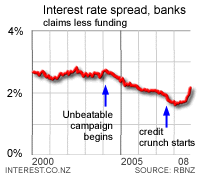
There is also difficult area of access to cheap funding.
In the past our banks obtained around 30-40% of their funding from overseas financial markets, which have been either shut down or have become prohibitively expensive.
Banks report having to pay 150 basis points or more above baseline wholesale rates to issue longer term bank bonds, even when they are government guaranteed. On Tuesday Treasury cut the fee it charges to banks for the wholesale guarantee to 90 basis points from 140 basis to reduce that cost.
This increases their overall cost of funding.
It is debateable that banks are profiteering once their increased actual funding costs and the increased provisions are taken into account. However, Bollard and Federated Farmers are right to keep the pressure on.
Your views?
19 Comments
So I am confused... The
So I am confused...
The banks have all picked up loan insurances from the NZ government - yes even the Aussie banks, so hopefully this is only for accounts in NZ and that it will be heavily audited to ensure this.
Who pays for this - The NZ taxpayer. Who wears the risk for this, the NZ taxpayer.
As I understand it (in simple terms), interest is charged to offset the opportunity costs lost by not being able to invest that money elsewhere. There is also a risk factor attached to this as well.
So my confusion is that the NZ taxpayer is wearing more risk on behalf of the bank, yet the banks still maintain interest rates which are not reducing at anywhere near the same rate as the OCR. This to me is clearly profiteering at the expense of the taxpayer.
One could argue that the banks have played a large part in starting this financial crisis (who else thought 95-100% finance was a dangerous thing?) and should be feeling some pain from the error in their ways. Yet I am sure that the balance sheets will continue to show high levels of margin.
I for one will be interested in the year end reports and would hope that the days of huge profits are rapidly slowed.
I have a question. If
I have a question. If the aim is to stimulate the economy, why isn't the government doing a deal with the banks to release customers from long term fixed interest rates without the exorbinant fees? Surely this would have a flow on effect of consumers having more money to spend.
One of the ladies in the office here has a mortgage of $630,000 fixed for 4 more years. The bank told her that the fee would be $62,400 to break the fixed interest rate and because the market was affecting house prices, she wouldn't have the equity in her house to pay that fee. If she was able to break that fee, that would give her hundreds of dollars more per fortnight to put into the economy. If everyone had this option, wouldn't that achieve part of the objective of stimulating the economy?
Tash, they signed up to
Tash, they signed up to that deal, so why should they be allowed to break it, without a large break fee. A contract is a contract, and why should the bank lose hundreds of dollars a fortnight because of that. The economy isn't nessessarily going to benefit either, becuase they may just use that money they are saving, to pay of the mortgage quicker.
I keep hearing of people
I keep hearing of people with mortgages of more than 500-600K, and am amazed by the stupidity of people to take on such large amounts of debt! Unless you have the ability to pay it down/off rapidly without penalty, why on earth would you take on such a large financial risks? It's simply beyond my comprehension...
There's a lot talked about
There's a lot talked about break costs for understandable reasons.
The fact is they are a real cost not just one the banks are passing on as a way of making money. If you have a 5 year loan that was taken a year ago the chances are that the bank will have written that loan at a skinny margin as the market was far more competitive then. So a bank has a loan on it's books that it's earning say 0.70% from for 5 years and they've hedged that funding so are stuck with. Of course they would love to be able to take that customer out of that loan for free and put them into say a 2 year one now and make a return of around 1.50% or more, but they can't as they're stuck with their contract.
Break fees are a real cost and Rob is spot on.
Why should borrowers be helped
Why should borrowers be helped at all? The vast majority of borrowers took on the large loans in order to make a capital gain. Unfortunately that game didn't work so now they are all complaining. It is savers like myself and many others who now have to pay for their mistakes with very low deposit rates. At these rates of interest I might as well keep my money under the mattress, at least it will be safer than in the bank!
Anyone with any nous should
Anyone with any nous should have broken their fixed rate last October or November and gone floating then fix later on. You can't blame the banks for charging break fees.
Shuttle you should be looking at high dividend yield shares, gold and maybe even a cashflow positive rental property.
Tash, Sounds like you are
Tash,
Sounds like you are suggesting taxpayers subsidise and/or bail out people who chose to lock in long term interest rates on mortgages.
Banks have obligations to fixed term deposit holders. Bank Break fees go some way to covering that cost.
Bernard Can the banks really
Bernard
Can the banks really pass on these manipulated low local rates when in fact wholesale foreign lenders refuse?
Read more here at Alert: 29/01/09 -
http://www.omo.co.nz/
Similarly, why should other mortgage
Similarly, why should other mortgage holders at the bank have to pay for those that break contracts. It is a contract, there is a risk and cost to the bank, and therefore an associated fee - accept it.
The reason I say risk associated with it, let us imagine the fee for breaking the fixed mortgage was low (just the bank's cost of refinancing at that point in time). Now let's say there was a sudden change in the state of the economy, there could be the possibility of a large number of mortgage holders breaking mortgages all at the same time (and probably from longer terms to shorter terms), this could potentially change the health of the bank's loan book in a short time.
However, in saying that, banks could consider offering additional mortgage products that have a lower break fee but charge a slightly higher rates to cover their risk.
(Btw, I have a similar view on those that don't pay off credit cards, run over their overdrafts and get charged for bouncing cheques etc, why should those that save and manage their finances have to subsidise those that don't. Personally my choice for a bank is one that penalises those that break to rules, because I know if they don't it is the good customers that will pay for it).
Crikey everyone wants to be
Crikey everyone wants to be bailed out.
A fixed rate is exactly that. They lower than a floating rate for good reason. Surely people take on a fixed rate because they know they can afford the repayments and don't want any interest rate risk.
The biggest lesson of this whole sorry mess is that people have little clue about financial matters.
Stephen Hulme The RBNZ says
Stephen Hulme
The RBNZ says it influences wholesale rates by lending at an unlimited manner at the OCR. If that is taken at face value any bank here can borrow at the OCR. I think then the issue then becomes what happens for the longer time frames? Given the current situation, what is the problem with allowing banks to reduce their rates by lending in an unlimited manner to them? If inflation picks up again all of this money can be recovered by lending at a rate above the wholesale rate for as long as it takes to recover that money.
Can you clarify please? I appreciate you know more about this than me but what is the nature of your concern?
Personally i very much fear deflation and see no good coming from it whatsoever. Are you advocating a beneficial cleansing? As per Austrian Economics?
"One of the ladies in
"One of the ladies in the office here has a mortgage of $630,000 fixed for 4 more years. The bank told her that the fee would be $62,400 to break the fixed interest rate "
There are real issues here i think.
The banks never expected rates to go this low. The banks did everything to lend this money out - even to the point of total stupidity. There is room for negotiation there and some kind of outside party needs to be involved. Given the support of the NZ tax payer the largely foreign owned banks can now rebuild their balance sheets to support lower share prices which must influence their capital requirements and lower security from falling house prices which must also influence their lending requirements while still enjoying absolutely the same profits they got before with very few losses to date *while* also getting greater profits via lower OCR rates they are not passing on.
Many NZers never wanted the banks to lend so insanely to the population. And those NZers who took on those loans dont deserve all of the blame for it in my view.
On the other hand those who worried about debt and who were prudent are being punished. Even so some kind of negotiation must be in order.
10% penalty to break a loan when the ocr is at a record low?? You have to be kidding me surely??
You have to realise these
You have to realise these are highly unusual moves in markets.
Remember how serious things really are. For all the talk about the property market, the real issue is that the banking system nearly went under in the US. In the UK it was just was 3 hours away from completely shutting down.
Everyone (well 99%) of people never saw this coming. That includes all the bank economists. Remember Westpac advocating rates to keep going up? You can't expect banks to suddenly break what are market contracts for nothing.
Japan offers, and always has, the only solution. Rates to sod all, steepen the yield curve, close your eyes and pray like mad.
Andrew - you have hit
Andrew - you have hit the nail on the head as to why the banks deserve to offer relieve here. There intentional overlending of created credit massively increased the money supply in circulation. This increased money supply ended up in the hands of an insider few due to a lack of integrity of regulation in almost every market sector. When the few had monopolised the money supply they then set about monopolising the necesities of life of the masses. This distorted the market fundamentals of supply/demand and what the market can bear. This oversupply of money in circulation concentrated in the hands of the few saw the few paying inflated prices for markets they sought to monopolise. This caused hyper inflated prices and an ever increasing disparity for those in the realsector who sought those assets for more traditional purposes.
International banking practice as handed down by the BIS most definitely had the major part in the greatest inflation bubble in recorded history and they now must give up their fraudulent gains and assists those of the realsector that are now sitting paying exorbitant interest rates, that were after all originally increased under the guise of fighting the inflation. Also those of the realsector sitting in positions of negative equity well beyond the historical norm.
It is time for debt relieve and the control of debt to be put in the hands of people who can be held to account by the people.
To go with Raf's comment:
"The biggest lesson of this whole sorry mess is that people have little clue about financial matters."
I agree - If someone has $630k to invest, they would be just crazy not to get financial advice, however it seems many people do little on no research when it comes to considering mortgage options (or even buying the house in the first place!).
I never thought I'd say
I never thought I'd say this, but I now believe Tony Alexander will be right - house prices will only fall another 5% before flattening out then starting a slow rise
Lots of people in the same position as me (early 30s and looking to buy our first house) are now talking about it nearly being time to buy with interest rates dropping lower and lower and prices already down about 10%. Just one more drop and lots will start to jump in.
So, sorry to Bernard and the other doom merchants, I can't see 30% drops happening (not that I ever thought that would happen - I always thought 20% drop max)
But still, another 5% will bring it close to a 15% drop, and at least Bernard was a provocateur in a time when no one thought prices would ever drop even 1%
Matt, just out of interest,
Matt,
just out of interest, what price range would you be comfortable buying in and at what Loan to Valuation Ratio? In other words, what percentage of the buy price are you able to kick in.?
The Aussie banks have a
The Aussie banks have a mandate to return a profit for their shareholders so they will take any cut in the OCR and only reflect a small percentage of that to borrowers.
Like wise with Kiwi Bank.
A prudent borrower should be able to play off a couple of banks for the best deal, and, at least the borrower knows that there should be some margin to play with.
Do, or will the banks play ball.