
Federated Farmers has attacked the main trading banks, saying it was "extremely disappointing" the banks were building profit margins at the expense of New Zealand's productive sector. Federated Farmers made the comments as it released results of a survey of farmers showing overdraft rates have fallen just 78 basis points to 10.4% since the Reserve Bank cut the official cash rate by 150 basis points to 5%. "Federated Farmers is extremely disappointed in the trading banks that the average overdraft rate for farm businesses is 10.40 percent, or over twice the current OCR. That's a massive margin banks have and continue to build at the expense of the productive export sector," said Philip York, the Federation's economics and commerce spokesperson. "We think Dr Bollard was mindful banks were dragging the economic chain when he warned financial institutions on 4 December to "˜do their bit', by passing on OCR savings to their customers. Banks seem to have interpreted this as meaning their retail, rather than business customers," York said. "The banks are literally farming the farmers to keep their profits high. They know farming in particular is relatively low risk yet have built up fat margins nonetheless. With the last cut in the OCR, bank margins have grown by 72 basis points alone and this is unacceptable," he said.
"By cutting overdraft interest rates by only around half that cut from the OCR last December, there appears to be a degree of profiteering. The banks are price gouging farmers who generate most of New Zealand's export wealth. This is money being sucked out of the provincial economy." York said the banks' refusal to pass on the OCR must be of great concern to the Reserve Bank and the new National-led Government. "Federated Farmers feels a rocket needs to be put under the banks to get these critical business overdraft rates down," he said. New Zealand's biggest rural bank, the National Bank, responding by saying it sought to help its farmer customers by cutting costs where possible and that the market was competitive. "However the reality is that we are operating against a backdrop of an unprecedented global credit crisis," National Bank said in a statement. "In setting rates banks have to take more than just the OCR into account. The OCR is certainly one indicator, but it's not a "one-for-one" measure. An important factor is the cost to the bank of accessing funding from the wholesale market. These costs have risen dramatically in the last 12 months," National Bank said. "Equally, when we contemplate accessing offshore markets using the NZ wholesale guarantee we will be paying an additional fee of 1.4% (or 140 basis points). As for all our commercial lending, rural lending is evaluated on a case-by-case basis," National banks said. "Our overall pricing also reflects our assessment of risk and the security being offered. We are operating in a challenging economic climate and we're working hard to support our rural customers while managing our business in a prudent, sustainable way to suit the current - and changing - market conditions." What I think 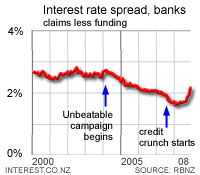 Federated Farmers are right to point out that farm overdraft rates have not fallen as fast as the Official Cash Rate and that mortgage rates appear to have received more of the rate cuts than business and farm overdraft rates. But farmers are not right to accuse the banks of profiteering. Farmers should be grateful they have received more of the OCR cut than other businesses and have still been able to borrow an extra NZ$4.6 billion more from the banks in the last six months, double the new lending into households. Overseas, business lending has slumped. However, it is true that bank profit margins on lending have risen sharply. Reserve Bank statistics (RBNZ table C10) show that the combined spread or profit margin for the New Zealand banks has risen from a record low of 1.63% in January last year to a three year high of 2.17% in November. This takes the difference between what it costs the banks for their money (funding costs) and what they receive in interest payments from their customers (claims receipts). This figure takes into account the total cost of funding, including cost of retail deposits, local wholesale deposits and foreign wholesale deposits versus the total receipts in interest payments. Federated Farmers is also right to point out that banks have given more of the 'benefits' of the cut in the OCR to home owners in the form of lower fixed mortgage rates and lower overdraft rates. Reserve Bank figures show (RBNZ table B3) that since July the variable mortgage rate (a weighted average compiled from the banks) has fallen from 10.90% to 8.05% as at the end of December. That implies the banks have passed on 285 basis points of the 325 basis ponts of cuts in the Official Cash Rate since July. Our data shows that the average 1 year fixed mortgage rate (which should be less connected to the OCR than the variable rate) has fallen 299 basis points from a high of 9.86% in April to 6.87% at the end of December. Kiwibank has just announced a 5.99% 1 year rate. Meanwhile the weighted average base lending rate charged by the banks to businesses has fallen just 65 basis points to 13.25%. Federated Farmers says its survey of 385 members found their average overdraft rate dropped by 78 basis points to 10.40% between the 150 basis point cut in the OCR on December 4 and the survey period from January 5 to January 12. There was no Federated Farmers survey in July so we can't tell the total size of cuts. So Federated Farmers is right. Home owners have gotten almost all the OCR cut. Farmers and businesses have received about half to a fifth of the OCR cut. Credit card holders have gotten nothing. Reserve Bank Statistics show the average credit card interest rate is unchanged at 20.2% since May. But is the Federated Farmers right to say the banks are profiteering? The banks are making a judgment about the relative risks and returns. They are essentially saying they think home mortgages are now much safer than business loans, farm loans and credit card loans. That may or may not be true. I think risks of dairy farm default in particular have risen sharply in recent months as the expected dairy payout has collapsed and the outlook for exports deteriorates. Credit card loans are riskier. I'm not so sure business loans are that much riskier given corporate balance sheets are stronger than farm or household balance sheets, although business earnings are much more volatile than salaries and profits are being squeezed hard. There is an argument that the last thing people will not pay is their mortgage and the bank effectively has a tithe over a borrower's salary when they have a mortgage, regardless of the value of the asset, whereas a mortgage over a farm is wholly dependent on a much more variable farm income. The other question worth asking is whether banks increasing their profits is a bad thing. I'd like my banks to well capitalised and strong rather than weak and vulnerable. Compared to the UK and the US right now, our banks are a model of stability and generosity. Farmers should not forget that banks lent an extra NZ$4.161 billion or 10% to farmers between May and November, while banks lent an extra NZ$2.027 billion or 1.2% to households in the form of mortgages over those same 6 months, according to Reserve Bank figures (Table C5). Lending to business has also increased sharply since May, rising NZ$5.771 billion or 7.8%. Lending to businesses and farmers has not dried up to the same extent it has either overseas or to the household sector. Credit card lending has also grown slower than for farming and businesses. It has risen just NZ$179 million or 3.5% to NZ$5.291 billion by November. Farmers should be a little more circumspect before accusing banks of profiteering. The credit risk of farming has risen and the banks have supported farmers heavily over the last 6 months with a massive increase in lending. Farmers are also taking much less of the pain than other businesses, who have seen just 20% of the OCR cut passed on to them. Farmers should also put their situation in the context of what's happening internationally, where banks are actually refusing to roll over loans and actually reducing their lending and leverage to businesses. As Fred Dagg might have said: "They don't know how lucky they are mate...they don't know how lucky they are."
We welcome your comments below. If you are not already registered, please register to comment
Remember we welcome robust, respectful and insightful debate. We don't welcome abusive or defamatory comments and will de-register those repeatedly making such comments. Our current comment policy is here.