
 Some developments overnight reinforce that the Credit Crunch is far from over despite an apparent lowering of wholesale interest rates on domestic markets. This may mean big cuts in the Reserve Bank's Official Cash Rate may not all be passed on in lower mortgage rates. It may also mean we see larger cuts in term deposit rates as banks try to recover lost profits from the term deposit side of their balance sheets. Overnight the US Federal Reserve confirmed it is pumping significant volumes of extra cash into the US banking system to restore confidence after another wobble in recent days.
The Fed decided to lend an extra US$25 billion to banks late on Monday and gave them 84 days to repay the loan instead of the usual 28 days. It received twice as many bids as the amount offered. Overnight it pumped an extra US$50 billion into the market and over US$75 billion of bids were received for the 28 day loans. Also, Merrill Lynch downgraded fellow banks Goldman Sachs, Lehman Brothers, Bank of America and Morgan Stanley, arguing investors were "significantly underestimating" the fallout yet to come from the problems in the sub-prime and near prime mortgage markets. And in the so-called agency market for bonds (in particular Fannie Mae and Freddie Mac guaranteed debt) spreads between these bonds and 'safe' US Treasuries have blown out to 212 points, according to Bloomberg. This is their highest levels since the March crisis when the Fed had to bail out Bear Stearns. This suggests increasing nervousness in US financial markets about the fallout from the housing market collapse spreading out from sub-prime mortgages to prime mortgages.  Meanwhile, Commonwealth Bank of Australia (which owns ASB here) decided to pull out of talks to buy ABN Amro's Australian and New Zealand operations. CBA Chief Executive Ralph Norris (former CEO of ASB and Air NZ) said the deterioration in investor sentiment towards Australian banks in recent weeks was partly to blame for the decision. He referred to National Australia Bank's shock announcement in late July of an A$830 million writedown, including the writing off of 90% of the value of its CDOs (Collateralised Debt Obligations) over US residential mortgages. "We were told the day after NAB's revelation that we might have had difficulty getting the funds, and that certainly we would have had to pay more -- around 20 basis points," Norris said. A profit warning days later from ANZ National that was linked to slowing housing markets and economies in Australia and New Zealand had further spooked international investors, he said.
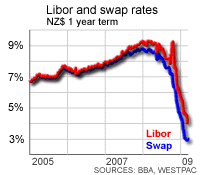
 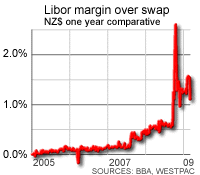 Before these warnings, international investors had viewed Australian banks (which own our big 5 banks) as relatively immune from the sub-prime Credit Crunch. This will make it difficult for New Zealand banks to raise funds on international markets cheaply. ANZ National, BNZ and ASB have all said in recent weeks that the cost of raising longer term funds on international markets had risen significantly. Last month before the NAB and ANZ warnings, ANZ National had to pay 240 basis points over the local benchmark to borrow US$2 billion for a five year term. ASB Chief Executive Hugh Burrett told interest.co.nz ASB was seeing a similar increase in international funding costs for longer term debt, with spreads of 38-40 basis points over swaps for 1 year debt and 220-240 basis points over swaps for 5 year debt. ASB funds about 40% of its loan book from wholesale markets, including international investors. New Zealand's banks owe foreign investors NZ$136 billion, which includes NZ$61.1 billion that rolls over every 90 days. They owe about NZ$52 billion in maturities of 5 years or longer. Information on how much banks pay for longer term debt in these wholesale money markets is scarce. At the moment it's fairly anecdotal. But we monitor the difference between interbank rates for one year debt (LIBOR) and the underlying swaps benchmark. This is one proxy for the level of nervousness in banks offering each other money. There are also questions about the accuracy of Libor, but it's the best we can see. The chart at the top left shows the actual rates and the chart just above shows what's happen to the difference between these rates. It shows the big jump in mid 2007 when the Credit Crunch began and another in March when the Fed had to fund the bail out of Bear Stearns. The gap does however appear to have dropped sharply in recent weeks, indicating an easing of interbank lending stress. So what might all this mean for New Zealand mortgage and term deposit rates? Despite some initial reluctance, New Zealand banks did pass on most or all of the 25 basis point cut from the Reserve Bank on July 24 to their new fixed mortgage rate customers, thanks largely to ASB's surprise decision to cut its 2 year fixed mortgage rate on the evening of July 24. But none have yet cut their variable mortgage rates after the OCR cut. It's been noticeable that most of the big banks have cut their term deposit rates by more than their fixed mortgage rates. Cuts for 1 year term deposit rates have ranged from 20 to 50 basis points while cuts to mortgage rates have beeen around 10-25 basis points. Some banks (ASB excepted) are therefore helping to recover some of these higher international funding costs by reducing their domestic term deposit funding costs, in part because there is still strong inflows into bank term deposit accounts because of the "Flight to Quality" in the wake of finance company and mortgage trust freezes and collapses. See our definitive "Deep Freeze" list here. The big question therefore is will the banks pass on an expected September 11 cut in the OCR to fixed mortgage rates? ASB's Hugh Burrett reckons he will look to pass on further cuts, but will others? The issue may revolve around how big the cut is. If it's 25 basis points as most expect then that makes a full pass-on more likely. Some expect a 50 basis point cut. That will be much more difficult for the banks to pass on in full to either variable or fixed mortgage rates. This will become a bigger debate in months to come. It is already a huge issue in Australia, where the Reserve Bank of Australia Assistant Governor Philip Lowe told the banks that local wholesale rates had fallen in recent weeks and any cut by the RBA would therefore have to be passed on. "That means there is no reason for the banks not to pass through any change from the cash rate," Lowe said. Australian Prime Minister Kevin Rudd has also warned the banks to pass on any cuts in the Australian rates. The issue is not on the political agenda here...yet. It may well do as get closer to the election in November. There are two opportunities for the RBNZ to cut the OCR between now and mid-November. The first is on September 11 and the second is on October 23, right in the middle of the election campaign.
We welcome your comments below. If you are not already registered, please register to comment
Remember we welcome robust, respectful and insightful debate. We don't welcome abusive or defamatory comments and will de-register those repeatedly making such comments. Our current comment policy is here.