
 By Roger J Kerr
It appears to me that there is more to the recent rally downwards in two to five year wholesale swap interest rates than the market just re-assessing and recalibrating of when the RBNZ will lift the OCR this year.
Since early January the three-year swap interest rate has declined from 5.15% to 4.50%.
The extent of this pull-back is telling us that more market participants (large investors and borrowers; not the banks as they are mere intermediaries) are perhaps buying into our view that there will be a paradigm shift downwards in the RBNZ “monetary policy neutral” interest rate from 6.50% to 5.00%.
The comment about the banks being mere intermediaries is not strictly accurate however - these days they are large buyers and holders of liquid securities (e.g. NZ Government Bonds) as they comply with new RBNZ funding ratio regulations.
What this also tells you is that the banks are doing very little new household and business lending; the cash is just piling up on their balance sheets.
The slowdown in credit growth right across the economy is the major reason behind the RBNZ’s more relaxed outlook on inflation risks in 2010/2011.
Expect to see the RBNZ highlight this lack of credit growth as the major factor for them delaying OCR increases until later in the year, when they deliver the Monetary Policy Statement this Thursday.
The decrease in two to five year swap rates also tells us that more investors/borrowers are now questioning the high 3% and 4% GDP growth rates the RBNZ and some bank economists have for their 2010 forecasts. Market pricing suggests a lower GDP outcome and thus annual inflation very comfortably around 2%.
My view remains unchanged in terms of the domestic economy - retail and housing - continuing to be “flat” this year.
However the continuing increases in export commodity prices to new record highs is very positive news for the business economy. It will be even more positive for rural incomes and exporter’s profits when the NZD/USD exchange rate falls a bit further.
The real unknown and challenge in accurately forecasting our GDP growth for this year is the impact of the global economy. However, maybe on reflection the offshore influence will not change matters too much here in NZ. If global growth is stronger than expected, it should help our GDP growth - under this scenario global commodity prices increase further and the NZD value stays higher.
If global growth is weaker than expected, commodity prices decrease and that will drop the NZD value to compensate. Net result is that GDP growth may be closer to 2% this year, but lift to over 3% next year.
Steep upward sloping yield curves (2-year swap rates significantly below 10-year swap rates) have always been accurate precursors to rising short-term interest rates. The gap between two and ten year rates peaked mid last year when two-year rates hit rock bottom. Current pricing suggests the 90-day rate moving up to 4% and then onto to 5% when the 2/10 year gap closes to 1%. The chart below confirms how accurate the 2/10 year gap has been as fore-runner to changes in the 90-day rate over the last 20 years.
By Roger J Kerr
It appears to me that there is more to the recent rally downwards in two to five year wholesale swap interest rates than the market just re-assessing and recalibrating of when the RBNZ will lift the OCR this year.
Since early January the three-year swap interest rate has declined from 5.15% to 4.50%.
The extent of this pull-back is telling us that more market participants (large investors and borrowers; not the banks as they are mere intermediaries) are perhaps buying into our view that there will be a paradigm shift downwards in the RBNZ “monetary policy neutral” interest rate from 6.50% to 5.00%.
The comment about the banks being mere intermediaries is not strictly accurate however - these days they are large buyers and holders of liquid securities (e.g. NZ Government Bonds) as they comply with new RBNZ funding ratio regulations.
What this also tells you is that the banks are doing very little new household and business lending; the cash is just piling up on their balance sheets.
The slowdown in credit growth right across the economy is the major reason behind the RBNZ’s more relaxed outlook on inflation risks in 2010/2011.
Expect to see the RBNZ highlight this lack of credit growth as the major factor for them delaying OCR increases until later in the year, when they deliver the Monetary Policy Statement this Thursday.
The decrease in two to five year swap rates also tells us that more investors/borrowers are now questioning the high 3% and 4% GDP growth rates the RBNZ and some bank economists have for their 2010 forecasts. Market pricing suggests a lower GDP outcome and thus annual inflation very comfortably around 2%.
My view remains unchanged in terms of the domestic economy - retail and housing - continuing to be “flat” this year.
However the continuing increases in export commodity prices to new record highs is very positive news for the business economy. It will be even more positive for rural incomes and exporter’s profits when the NZD/USD exchange rate falls a bit further.
The real unknown and challenge in accurately forecasting our GDP growth for this year is the impact of the global economy. However, maybe on reflection the offshore influence will not change matters too much here in NZ. If global growth is stronger than expected, it should help our GDP growth - under this scenario global commodity prices increase further and the NZD value stays higher.
If global growth is weaker than expected, commodity prices decrease and that will drop the NZD value to compensate. Net result is that GDP growth may be closer to 2% this year, but lift to over 3% next year.
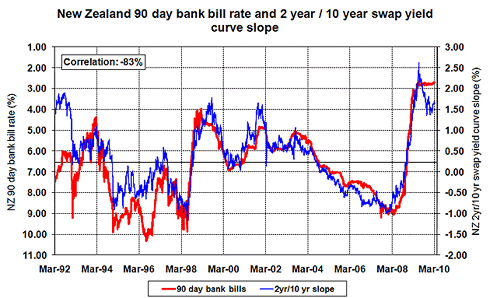
Steep upward sloping yield curves (2-year swap rates significantly below 10-year swap rates) have always been accurate precursors to rising short-term interest rates. The gap between two and ten year rates peaked mid last year when two-year rates hit rock bottom. Current pricing suggests the 90-day rate moving up to 4% and then onto to 5% when the 2/10 year gap closes to 1%. The chart below confirms how accurate the 2/10 year gap has been as fore-runner to changes in the 90-day rate over the last 20 years.
 Moral of the story:
Don’t rely on economist’s forecasts for future interest rate movements, instead trust what the investors/borrowers are telling you in their expectations of the future, via market pricing of the slope of the yield curve i.e. the 2/10year swap rate gap.
—————-
* Roger J Kerr runs Asia Pacific Risk Management. He specialises in fixed interest securities and is a commentator on economics and markets. More commentary and useful information on fixed interest investing can be found at rogeradvice.com
Moral of the story:
Don’t rely on economist’s forecasts for future interest rate movements, instead trust what the investors/borrowers are telling you in their expectations of the future, via market pricing of the slope of the yield curve i.e. the 2/10year swap rate gap.
—————-
* Roger J Kerr runs Asia Pacific Risk Management. He specialises in fixed interest securities and is a commentator on economics and markets. More commentary and useful information on fixed interest investing can be found at rogeradvice.com
We welcome your comments below. If you are not already registered, please register to comment
Remember we welcome robust, respectful and insightful debate. We don't welcome abusive or defamatory comments and will de-register those repeatedly making such comments. Our current comment policy is here.