

Here's my Top 10 links from around the Internet at 10 am in association with NZ Mint.
I welcome your additions in the comments below or via email to bernard.hickey@interest.co.nz.
I'll pop the extras into the comment stream. See all previous Top 10s here.
Today is a first. I have a Colin Meads video at number 9.

1. Is Capitalism doomed? - Seriously. It's worth asking the question and Nouriel Roubini is now asking it over at Project Syndicate.
His diagnosis of the current problems for global capitalism is spot on.
He was one of the first to predict the crisis we've been in for three years.
Roubini's summation is pithy and realistic.
He is saying the current system is broken.
He's not arguing for socialism.
But he certainly thinks the laissez faire version of capitalism we have is broken.
This is today's must read, I reckon.
To Karl Marx, it seems, was partly right in arguing that globalization, financial intermediation run amok, and redistribution of income and wealth from labor to capital could lead capitalism to self-destruct (though his view that socialism would be better has proven wrong). Firms are cutting jobs because there is not enough final demand. But cutting jobs reduces labor income, increases inequality and reduces final demand.
Recent popular demonstrations, from the Middle East to Israel to the UK, and rising popular anger in China – and soon enough in other advanced economies and emerging markets – are all driven by the same issues and tensions: growing inequality, poverty, unemployment, and hopelessness. Even the world’s middle classes are feeling the squeeze of falling incomes and opportunities.
To enable market-oriented economies to operate as they should and can, we need to return to the right balance between markets and provision of public goods. That means moving away from both the Anglo-Saxon model of laissez-faire and voodoo economics and the continental European model of deficit-driven welfare states. Both are broken.
The right balance today requires creating jobs partly through additional fiscal stimulus aimed at productive infrastructure investment. It also requires more progressive taxation; more short-term fiscal stimulus with medium- and long-term fiscal discipline; lender-of-last-resort support by monetary authorities to prevent ruinous runs on banks; reduction of the debt burden for insolvent households and other distressed economic agents; and stricter supervision and regulation of a financial system run amok; breaking up too-big-to-fail banks and oligopolistic trusts.
Over time, advanced economies will need to invest in human capital, skills and social safety nets to increase productivity and enable workers to compete, be flexible and thrive in a globalized economy. The alternative is – like in the 1930s - unending stagnation, depression, currency and trade wars, capital controls, financial crisis, sovereign insolvencies, and massive social and political instability.
2. The magic 147 - Science News reports a study of economic relationships between over 43,000 corporations globally found just 147 controlled 40% of the monetary value of all those companies.
HT Johanna via email
Researchers aren’t sure what to make of the core’s interconnectedness. On the one hand, it could expose the whole network to risk.
“Imagine a disease spreading,” says Aven. “If you have a high school where everyone’s sleeping together and one person gets syphilis, then everyone gets syphilis.”
Here's the graphical representation of this.
3. A crisis of legitimacy - George Friedman at Stratfor has a nice overarching analysis of the global financial and political crisis now gripping America, China and Europe. HT Jason via email.
This, then, is the third crisis that can emerge: that the elites become delegitimized and all that there is to replace them is a deeply divided and hostile force, united in hostility to the elites but without any coherent ideology of its own. In the United States this would lead to paralysis. In Europe it would lead to a devolution to the nation-state. In China it would lead to regional fragmentation and conflict.
These are all extreme outcomes and there are many arrestors. But we cannot understand what is going on without understanding two things. The first is that the political economic crisis, if not global, is at least widespread, and uprisings elsewhere have their own roots but are linked in some ways to this crisis. The second is that the crisis is an economic problem that has triggered a political problem, which in turn is making the economic problem worse.

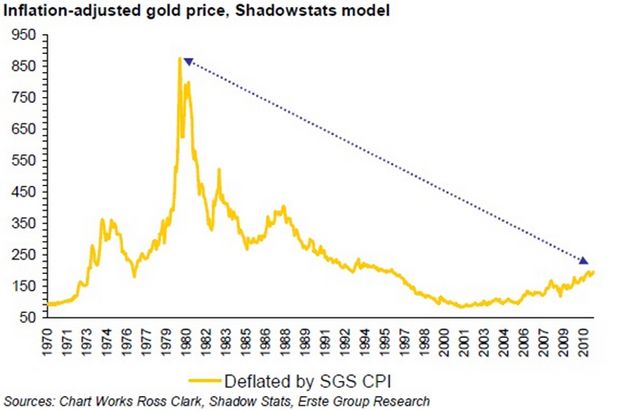
4. This is a system ready to blow - Larry Elliott writes well at the Guardian about the problems in the global economic system. He partly blames the collapse of Bretton Woods in 1971 when Nixon took America off the gold standard.
HT John via email.
Here's Elliott:
A crisis that has been four decades in the making will not be solved overnight. It will be difficult to recast the global monetary system to ensure that the next few years see gradual recovery rather than depression. Wall Street and the City will resist all attempts at clipping their wings. There is strong ideological resistance to the policies that make decent wages in a full employment economy feasible: capital controls, allowing strong trade unions, wage subsidies, and protectionism.
But this is a fork in the road. History suggests there is no iron law of progress and there have been periods when things have got worse not better. Together, the global imbalances, the manic-depressive behaviour of stock markets, the venality of the financial sector, the growing gulf between rich and poor, the high levels of unemployment, the naked consumerism and the riots are telling us something.
This is a system in deep trouble and it is waiting to blow.


China is likely to follow an S-Curve-shaped path of slowing growth as key internal and external challenges—including pollution, corruption,chronic diseases, water shortages, growing internal security spending, and an aging population—feed off of one another and exact increasingly large costs.
7. The old 'business needs certainty' line - Yves Smith does a nice job of dismantling the current meme doing the rounds in America about too much regulation stopping investment.
So why aren't businesses investing or hiring? "Uncertainty" as far as regulations are concerned is not a major driver. Surveys show that the "uncertainty" bandied about in the press really translates into "the economy stinks, I'm not in a business that benefits from a bad economy, and I'm not going to take a chance when I have no idea when things might turn around."
The "certainty" they are looking for is concrete evidence that prevailing conditions have really turned. But with so many people unemployed, growth flagging in advanced economies, China and other emerging economies putting on the brake as their inflation rates become too high, and a very real risk of another financial crisis kicking off in the Eurozone, there isn't any reason to hope for things to magically get better on their own any time soon. In fact, if you look at the discussion above, we actually have a very high degree of certainty, just of the wrong sort, namely that growth will low to negative for easily the next two years, and quite possibly for a Japan-style extended period.

8. He said this - Here's what Republican Presidential Candidate Rick Perry said about the US Federal Reserve Chairman Ben Bernanke and more money printing. It gives you an idea how the Tea Party is thinking and how monetary policy is becoming increasingly politicised. HT Joe Weisenthal.
Perry appears to be suggesting some sort of violent civic unrest...
“If this guy prints more money between now and the election, I dunno what y’all would do to him in Iowa but we would treat him pretty ugly down in Texas. Printing more money to play politics at this particular time in history is almost treasonous in my opinion.”

9. What was Colin Meads thinking ? - An outfit called NZ Carbon Farming has set up an operation to buy carbon credits off farmers with forests planted before 1990.
Here's the details on NZPre1990ForestCarbonProgram.
And they're using Colin Meads to sell it.
Didn't he learn anything from the Provincial Finance debacle. The government is putting in place legislation to punish celebrities who mislead the public. I'm not suggesting that's the case here, but one of the reasons it was put in place was the concern around the promotion by Meads and Richard Long and John Morrison of finance companies Provincial Finance, Hanover Finance and St Lawrence.
Colin Meads was a great rugby player and he's an excellent after dinner speaker. But I think he should stop reading scripts promoting quite complicated financial products.
10. Totally Jon Stewart pointing out rightly how well Ron Paul did in the Iowa straw poll and asking why the punditocracy ignore him. Here's some similar, if less funny, from Paul Harris at the Guardian.
Here's my wild pick for next year's Presidential election: Ron Paul vs Obama.

We welcome your comments below. If you are not already registered, please register to comment
Remember we welcome robust, respectful and insightful debate. We don't welcome abusive or defamatory comments and will de-register those repeatedly making such comments. Our current comment policy is here.