

Here's my Top 10 links from around the Internet at 10:00 am today in association with NZ Mint.
Bernard will be back with his version tomorrow.
As always, we welcome your additions in the comments below or via email to bernard.hickey@interest.co.nz.
See all previous Top 10s here.
1. 'Crime of the century'
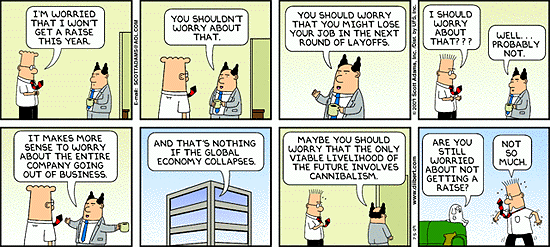
"Forget Bernie Madoff and Enron’s Ken Lay - they were mere amateurs in financial crime. The current Libor interest rate scandal, involving hundreds of trillions in international derivatives trade, shows how the really big boys play. And these guys will most likely not do the time because their kind rewrites the law before committing the crime." Robert Scheer is one angry man. Count me with him.
Modern international bankers form a class of thieves the likes of which the world has never before seen. Or, indeed, imagined. The scandal over Libor - short for London interbank offered rate - has resulted in a huge fine for Barclays Bank and threatens to ensnare some of the world’s top financers. It reveals that behind the world’s financial edifice lies a reeking cesspool of unprecedented corruption. The modern-day robber barons pillage with a destructive abandon totally unfettered by law or conscience and on a scale that is almost impossible to comprehend.
2. Adjusted reality?
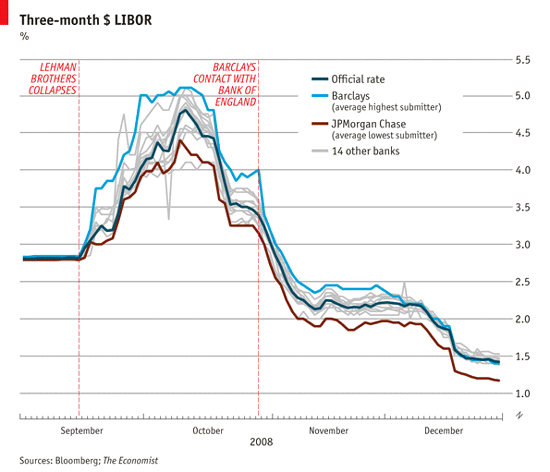
I am not much of a fan of seasonally-adjusted stats, although I know they are technically superior and now ubiquitos. I always want to see the 'actual' data. And I reckon you can 'see' the seasonality if you chart data (and look). I never really understand the impact of seasonality on the latest data point - it's a mystery to me. And it is compounded when you realise that the number reported last month has changed, as have the data for most previous periods. Most of our charts show 'actual', rather than 's.a.' And it seems I am not alone. The latest US jobs numbers are reported as 'weak' and 'weakening' - well they are on a seasonally adjusted basis, but not on an 'actual' data basis. Floyd Morris is scratching his head too. Here he is revealing the huge difference in those latest US jobs numbers:
On a monthly basis, by the way, there were more than 800,000 private sector jobs added - before seasonal adjustments - in each of the last three months. But the seasonal adjustments reduced the monthly average to less than 100,000.

3. A new industry: urban mining
'Urban mining' deposits are 40 to 50 times richer than mined ore, experts tell a recent conference. New PCs, cell phones, tablets, other e-products now use 320 tons of gold, 7,500 tons of silver per year, and rising. Here are the details, from ScienceDaily:
A staggering 320 tons of gold and more than 7,500 tons of silver are now used annually to make PCs, cell phones, tablet computers and other new electronic and electrical products worldwide, adding more than US$21 billion in value each year to the rich fortunes in metals eventually available through "urban mining" of e-waste, experts say.
Manufacturing these high-tech products requires more than US$16 billion in gold and US$5 billion in silver. Most of those valuable metals will be squandered, however; just 15% or less is recovered from e-waste today in developed and developing countries alike.
4. Rosy future?
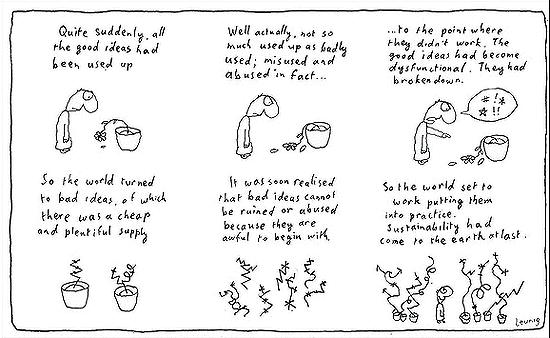
'Australia is a province of China; New Zealand a suburb of Australia' - you've no doubt heard that phrase before (here on interest.co.nz), pointing out how our fortunes are linked closely to what goes on in China. China is slowing, no doubt about that. So instinctively we think we are in for a rough future. But don't tell the experts in Australia; the Sydney Morning Herald has recently polled their economic 'experts' are they seem unusually optimistic about the future of Australia.
On average, our 22 forecasters predict Australia's gross domestic product will grow by 2.9 per cent in the coming 12 months, within the 2.5 to 3.5 per cent range forecast by the Reserve Bank, although slightly less than the budget forecast of 3.25 per cent as the year average.
They expect global output in 2012 will expand by 3.2 per cent, a bit less than the 3.5 per cent forecast in April by the International Monetary Fund. But many in the panel see global confidence returning in 2013, lifting prices for Australia's mining exports, and reversing the slide in the terms of trade.
Most disregard the forecasts of a further fall in commodity prices, and signals by BHP and Rio that mining projects could be put on hold. They say mining construction work for the next year or two is now locked in, and while prices may have peaked, the peak in mining investment is several years away.
5. ‘Leftist’ governments are bad for business
Although governments of the ‘left' are typically viewed by economists and the general public as being less business-friendly, formal evidence linking the political orientation of parties in power to their country's economic performance is decidedly mixed. However a recent prizewinning paper from Sasha Molchanov from Massey University and his co-authors Art Durnev and Jon Garfinkel more or less proves conclusively that they are. Here is a summary (.pdf)
6. Japan shrinks
Many nations have aging populations, but none can quite match Japan. Its experience holds lessons for other countries as well as insights into the distinctiveness of Japanese society. There will be spectacular changes, as Nicholas Eberstadt points out:
Within barely a generation, demographic trends promise to turn Japan into a dramatically- in some ways almost unimaginably - different place from the country we know today. ... there will be so many people over 100 years of age in 2040, and so few babies, that there could almost be one centenarian on hand to welcome each Japanese newborn.
In the aftermath of two “lost decades” of meager growth, a world economic crisis, and a devastating tsunami, the Japanese economy faces a future in which simply sustaining growth will be an increasing challenge. The working-age population is set to shrink by 30 percent over the next three decades, and even if older Japanese take up some of the slack, the country’s work force will almost surely be much smaller than it is today. Extreme population aging, for its part, stands to place mounting downward pressure on the nation’s savings rate - and thus, other things being equal, on investment.
Ballooning debt obligations will compound the demographic pressures on economic performance. Thanks in part to its approach to financing programs for the aged, Japan already has the highest ratio of gross public debt to gross domestic product (well over 200 percent) of the developed nations. Projections by researchers at the Bank for International Settlements imply that this ratio could rise to a mind-boggling 600 percent by 2040. (Greece’s public debt, by contrast, amounted to about 130 percent of its GDP at the start of its current default drama.) While Japan might well be able to service such a mountain of debt without risk of sovereign default (assuming the country’s low-interest-rate environment continues to hold), it is hard to see how a recipe for rapid or even moderate economic growth could be cooked up with these ingredients.

7. This is your brain on shopping, and it's not very smart
Because most of us aren't very good at maths, companies use that 'weakness' when they market their products. Read this by Derek Thompson and you will instantly see why you should upskill on the numbers front. Actually, its not actually the companys fault - if you only invested in a bit of effort you wouldn't be such a sucker. Take maths, logic and financial skills seriously - even if your teachers were too snooty (or incapable) themselves. (Read interest.co.nz regularly !)
(4) We're in love with stories. In his book Priceless, William Poundstone explains what happened when Williams-Sonoma added a $429 breadmaker next to their $279 model: Sales of the cheaper model doubled even though practically nobody bought the $429 machine. Lesson: If you can't sell a product, try putting something nearly identical, but twice as expensive, next to it. It'll make the first product look like a gotta-have-it bargain. One explanation for why this tactic works is that people like stories or justifications. Since it's terribly hard to know the true value of things, we need narratives to explain our decisions to ourselves. Price differences give us a story and a motive: The $279 breadmaker was, like, 40 percent cheaper than the other model - we got a great deal! Good story.
8. The war on selling
In case you missed it over the weekend, lawyer Brian Henry reminds the FMA that salespeople are never advisers and advisers are never salespeople. He wants to see an honest declaration of these relationships in the law.
When is a salesperson an adviser?
The answer is simple. Never!
The guidelines need to deal with the actual intent of the “adviser” and force them to tell the customer their true intent at the outset; that is, they are there with the intent of selling a product. They are not a friend and confidant. They are not an “adviser”.
9. Help managing
Inspired by what they are seeing in places like Kenya and the Philippines, the US Treasury is sponsoring a competition to find the best monile phone app ideas. Apparently Timothy Geithner was impressed with how Kenyans make remittances between each other. Is this an official effort to encourage an end-run around traditional bank payment systems? It could also be a regulatory challenge, but at least one regulator is front-footing it. Good on them.
But not everyone thinks you really need an app to be effective. Here is one comment we saw:
I use a simple excel sheet to track my income and expenses and it works fine.
Managing money is not about applications it is about our ability to curb our desire to have everything now and pay later. Oh, I have credit cards and I use them - wisely - no interest payments.
No matter what an app does it cannot stop someone from spending money because their desires overtook their wallet.
Here are my rules of spending:
1. Anything over $150 - wait 30 days
2. Anything over $100 - wait 96 hours
3. Anything over $50 - wait 24 hours.
4. Anything less than $50 pay cash.Of course this does not include groceries or fuel or consumables. It applies to durable goods.
Following these rules allowed me to use my car for 15 years and put 220,000 miles on it. And I paid cash for my new car.
The question to ask - can I do without this item?
10. The last laugh
The Colbert Report takes on Ron Paul and a NY Times reporter on the gold standard.
32 Comments
Hugh, that's not cheap at all and is simply market value.
Those earlier Linwood sections were well and truly above market value at the price that Trust had the option on them for - I believe the receiver is still struggling to off load them at below those "discounted" prices!
There are hundreds of sections on the market and every developer and agent in town knows that you can't sell a section if you tried at the moment unless it's out west or up north and going cheap.
Once the thousands of houses in the blue zone have insurance settlements sorted (eqc are delaying "waiting" for drilling results), then thousands of very cheap sections will come to the market.
Already sections in good areas are changing hands around $100k or much less in slightly less desirable areas.
Insurance is now available in most of ChCh for new builds and it seems likely that further earthquakes like June and December 2011 won't interrupt that. Yet we see no real uplift in building or investment activity, and CERA seem obsessed with wasting money again:
http://www.stuff.co.nz/the-press/business/7243623/Flash-marketing-of-ci…
How about talking to local investors and owners who already own the land, have the money and the motivation to rebuild yet are being ignored and bullied by CERA and co. Chinese fly by night developers (and painting crews for that matter) are not needed nor wanted.
Because only in the last month have the major insurers relaxed their restrictions on insurance for new buildings in parts of Christchurch.
There isn't a huge difference in price between ChCh and Rangiora or Rolleston sections at present and you can actually buy an existing site in an older area for significantly less than in the surrounding districts.
Purely the lack of damage and the relief of open spaces has pushed people out to semi rural subdivisions in neighbouring districts.
Re;#1 "Crime of the century "- I doubt it - it would be more interesting to expose how $trillions and $trillions of CDS contracts written against Freddie MAC & Fannie MAE debt never seemed to be resolved when they moved into US Government conservatorship status.
#6. What's the issue - there's/there'll be plenty of unemployed around the world who could move to Japan to fill in the gaps.
The Language is a killer, takes years & years to learn properly. Until then you need help with every little thing, filling in forms is a nighmare unless someone who is Japanese helps you. That is the biggest problem the Japanese will have in trying to get people to live in Japan, which is what they want to help out with this aging problem, but I don't think they realise it yet.
No 6.........really .....Japans biggest problem, aging and language barrier?. Come on.... how about 3 nuclear meltdowns in a society reliant on nuclear power. That society now has to work out how to survive in a smallish land area that will be seriously contaminated as this out of control nightmare periodically blows again and again. And if spent fuel pool 4 collapses?
Oh thats right, we are all in fairyland and we just pretend this horror story to end all horror stories just isnt happening.
Well said Belle.
Economics doesn't account Natural Capital - so it's just a wee tad blindsided sometimes.
Blindsided but muzzled. The silence is deafening
Blindsided is what we'll be thanks to Steven Joyce muzzling NIWA.
The irony is that the system they think they're defending, is already dead. Reminds me of the Monty Python "Bring out your dead". "I'm not dead". "Soon will be".
#5 The conclusion is not "Leftist governments are bad for business", as headlined. The conclusion was "companies within labour-intensive industries, polluting industries, industries with high profit margins, and highly leveraged industries are more sensitive to policies traditionally viewed as ‘leftist'".
That said, it would be nice to have had more justification for their two-stage regression "Use policies explained by part orientation". That sounds like they excluded all policies where "left" governements implement "right" policies and the reverse, making for a study where the exclusion criteria define the result. Particularly since the overall economy results including all factors, as reported, are no overall difference between left and right.
I can see how it might win a prize at an ecomics conference.
David:
Ad.5. Is it really what they written:
• Industries more sensitive to leftist policies perform worse
when left parties are in power and enact such policies.
• Results are robust when endogeneity is addressed
From the pdf, the endogeneity (error/ hidden variable concerns for those not used to number-speak) includes issues like control for the lagging of economic indicators.
If I try for a summary, 'Companies sensitive to the "Left" critera chosen did worse when a "Left" government enacted such polices [but "Right" governments enacting such policies were excluded], though none of this made any difference to the overall economy'.
Or another try at a summary "While it does not affect the overall economy, there are winners and losers from particular policies. For instance, polluting industries are badly affected by anti-pollution laws [but this study only looked at when such laws were enacted by the "Left"].
Now, I am more a general numbers analysis guy than a finance/econmics one, but the headline for #5 pretty clearly did not match the detail in the pdf.
Revealed: why Gordon Brown sold Britain's gold at a knock-down price
http://blogs.telegraph.co.uk/finance/thomaspascoe/100018367/revealed-wh…
#7 - (Read interest.co.nz regularly !) Sure do BH sure do, recommend it to all my pals!
@the "cartoon" graph under 4#
Saw this amusing letter today.
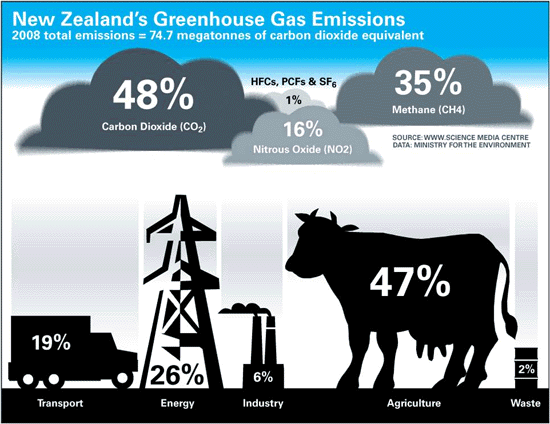
Australia’s tax on carbon dioxide now applies to big power stations, rubbish tips, steel works, cement plants, refineries and coal mines. But many of them have been given exemptions or compensation packages. Naturally they will pass all net costs onto consumers, but our government says that most voters will be compensated and will feel no pain. So it all looks like achieving a net nothing.
Carbon dioxide is produced whenever animal or vegetable matter is burnt, digested or rots. So when do we start taxing the big-time emitters such as termites? There are trillions of them quietly munching their way through timber, dead trees and grass. Then we have all the rice paddies, swamps and wetlands emitting that other dastardly natural gas, the Will-o-the-Wisp, methane. And who is going to chase India’s 280 million sacred cows with gas collection bags?
Mother Earth is also a huge “carbon polluter”. Will we have a “Red Adair” putting caps on Earth’s 1,500 active volcanoes? Or will BP be hired to drop blow-out protectors over the 139,000 sub-marine volcanoes?
It is obvious that the whole war on carbon is futile and will have no measurable effect on Earth’s atmosphere or Australia’s climate.
It’s just a wealth redistribution and control caper.
Viv Forbes,
Rosewood Qld Australia
That letter confirms that some people really ignorant on climate change science.
Ah -it's the Night of the Long Trolls.
Same Old and Same Old.
modern economy, total bollocks....it doesnt make anything....it just consumes, inifinite growth again....seems you are deaf.
regards
The New York Metro areas has more than 3 times as many workers as the Houston metro area but it can't keep up with the pace at which Houston is permitting new housing.
You usually see the short sellers entering any other market about the same time the economic analysis is saying things like this.
Your seriously trying to tell me that the only thing holding the NZ economy back is a lack of positive attitude?
Maybe NZ should take a leaf out of the North Korean handbook?
http://www.stuff.co.nz/world/asia/7242723/Mickey-Mouse-dances-for-Kim-Jong-Un
This ought to be enough to drag the country out of recession.
Well since we are into name calling, you really are an ignorant idiot....
regards
Hugh
Fact - they're not making any more land.
Fact - growth is exponential.
Fact - the last 'doubling time is from 50%.
Fact - some of us can see where it goes, and are addressing the problem. Some of us have developed incredibly cheap, incredibly efficient housing, which (unsurprisingly) provides a good level of comfort. You have been offered the opportunity to investigate - you chose to deride.
Fact - those who tout endless growth are lying. (The only question is whether to themselves, or purposely - but an untruth it is).
Fact - those who - despite requests - continue to call people 'names', just look stupid.
You might want to think about that.
"constructive discussion" well we cant have that as long as you day dream and not work within the limits of maths and physics....both of which you dont and dont want to understand, this isnt Hollywood, its real.
regards
Mist - solar PV is now more economic, and less hassle (no roof tank, no pump, no frost issues) than solar water.
We haven't the the energy lead-time to replace the existing stock, though, so retro fit will be a big part of the matrix.
Seriously? PV at about 10% would be a terrible waste to heat water . If you are concerned about frost look at Thermocell
Solar water is typically $7500 for a retro-fit....and all it does is water, PV cells are more flexible. The USA has banned or tariffed chinese panels into the USA so that huge production has to go somewhere else....hence I think we should see big price drops...The thing I dont like is its a complex technology....but as a transition path, Ok.
regards
Actually a better design principle is earthship.org....very low energy and input energy use, low water input / use and low effulent out....built cheaply as well.
My house is 68, its simple, fairly cheap to build, the problem is the margin ie profit isnt big enough......and the expectations of NZers....so you are right, we dont need McMansions, but that is what we want. As I sit here Im watching a house that is 6 or 7 years old get its entire front wall replaced because its rotten....damn stucco crap bites again.........looks like they are not putting on eves and weatherbaords, I'll give it another 7 years then.....no idea what the other three walls are like but probably as bad......
Just how removing the regs to get back to this helps I dont know....for instance 1970s and later have insulation requirements, those need to be retained, better EQ survivability needs to stay, etc. So removing regs makes a big difference?, I dont think it does....what you could easily end up with is shanty towns and I fail to see how that helps.
The problems of more sewage and more water reticulation etc come down to population and decreasing ppl per house....(I think I read its halved in 40 years)....
Every time its population as the biggest factor....
regards
A lot of Americans that I have talked to really dislike Houston. Subdivisions going on forever and you have to drive a long way to go for a walk in the park or buy some milk. There are few natural features such as hills or waterways which is one reason why there are few restrctions on where and how to build. There is also no real limit on how far the city can expand and I'm not sure it is a good example for New Zealand.
Hugh would never lets tfacts like this get in the way!
No 7, simple sales 101. I am in chemicals and I offer the Australian made product at around $3.50/kg and the Korean varaint at $2.80/kg. Gives the punter a choice. 80% go for the Korean product and the rest go for the Australian variane due to not being able to use the Korean material as it is not approved due to not testing it.
The quality difference is negliable, sometimes the Korean material is better quality by a shade.
No 7, simple sales 101. I am in chemicals and I offer the Australian made product at around $3.50/kg and the Korean varaint at $2.80/kg. Gives the punter a choice. 80% go for the Korean product and the rest go for the Australian variane due to not being able to use the Korean material as it is not approved due to not testing it.
The quality difference is negliable, sometimes the Korean material is better quality by a shade.
I can spare a week, if they need a LIVE-WIRE.
We welcome your comments below. If you are not already registered, please register to comment
Remember we welcome robust, respectful and insightful debate. We don't welcome abusive or defamatory comments and will de-register those repeatedly making such comments. Our current comment policy is here.