
By Bernard Hickey
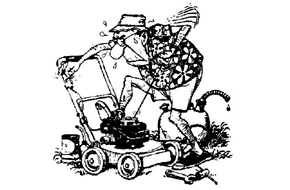
I have a reasonably cheap and modern four stroke lawnmower that I bought new five years ago from one of those big box hardware stores before the Global Financial Crisis when the New Zealand dollar was strong. It cost less than NZ$300 and didn't have all the bells and whistles.
This gorgeous spring weather around at the moment means I'm using it a lot.
It doesn't have an electric starter so I have to start it myself and have learnt over the years how to get it started with the least possible amount of pulling on the cord. It has a rubbery squeezy ball thing between the fuel tank and the engine that I have to push three times exactly to squirt petrol into the chambers. Too many squirts and the engine floods with petrol. I then have to wait for the petrol to drain out and try again. Too few squirts and I find myself pulling endlessly on the cord waiting for the engine to fire.
After 5 years of squirting, pulling and mowing I've worked out 2 and a half squirts is just right, rather than the 3 squirts recommended in the manual.
I dread the first mow of the spring because my carefully remembered number of squirts doesn't work. The engine is out of practice after months of not being used and no doubt some residual dust and corrosion change the delicate balance of chemistry and mechanics required for ignition. Every Spring it takes me as much as half an hour of squirting, pulling, waiting, adjusting and pulling again until it fires up in a cloud of blue smoke.
This is where the global economy is at right now.
Central banks have flooded the 'engines' with fuel, hoping to fire up economic growth and start cutting unemployment.
Firstly, they cut interest rates to zero or nearly zero and that didn't work.
In a sign of their increasing desperation to get the engine started, they started printing money to buy government bonds, effectively squirting money into the banking system to encourage lending.
But still the engine hasn't fired up.
Some believe the engine has had so much petrol pumped into the banking system that it is flooded and can't fire up. Economists describe it as the 'zero bound problem' where the closer interest rates get to zero the less risk banks and borrowers want to take on. Money tends to get hoarded in central bank deposits or in government bonds, failing to be pushed out into the real economy to build new factories, start new businesses and employ people.
Some are worried there's so much petrol squirted into and over and around the engine that when the engine does fire up the global economy will burst into flames in a surge of inflation or hyperinflation that could prove very damaging.
Certainly much of the petrol of printed money has spilled out of the printing economies such as America, Japan, Britain, China and Europe is surging into smaller economies like New Zealand and Australia who have open borders for investment flows and free floating exchange rates. This is pushing up their exchange rates and creating asset bubbles in these smaller open economies. It's a bit like squirting petrol onto your lawnmower and then over the fence into the neighbour's barbecue while he's cooking.
The question every policymaker in the world is asking right now is: why won't the engines fire up?
It's been almost six years now and economic growth is barely 1-2% in the developed economies, much less than the 3-4% seen during normal recoveries.
Many economists are now wondering if there's some structural problems in the engines that might need to be fixed.
Firstly, ageing populations in the developed world, and increasingly in China, is slowing growth down. As workforces get older, households start saving more for their retirements and taking less risk with their investments. This means there's less appetite to invest in new products or markets or infrastructure that might generate volatile returns.
No one nearing retirement wants to find out just before they need to draw down their retirement savings that their investment has slumped. Older savers opt for government bonds and guaranteed bank deposits. That pushes down investment returns, and, ironically, means those saving households have less money to spend.
Secondly, there's been a structural shift in income and wealth over the last 20 years from the middle and lower income groups to the higher income groups.
Those with higher incomes tend to spend proportionately less of their incomes, thus reducing demand for goods and services that generate economic growth. Those on middle to lower incomes topped up their spending power over the last two decades with debt, but now they have maxed out their credit lines and are repaying debt. That means they are spending less, which in turns creates a negative feedback loop of less investment, less employment, less spending and less investment.
Thirdly, a deregulation of the global financial system over the last 20 years has heightened financial market volatility, created 'Too Big To Fail' banks and shifted a chunk of profit share and income to a sector that has destroyed value rather than created it. This too has lowered the economic speed limit and helped stop the engine from firing.
It's clear now the engine needs rebuilding, rather than being flooded with more petrol.
That means a redistribution of income and wealth back to those who consume most of their income, a restructuring of debts that cannot be repaid with current growth rates, and a re-regulation of a financial sector that leveraged up the developed world and created dangerously large institutions with the capacity to blow up financial markets again.
The mower needs a new engine, not just more squirting and pulling.
------------------------------------------------------------------
This article first appeared in the Herald on Sunday. It is used here with permission.
31 Comments
Wonder what might have happened if the US Government had not rescued the banks in 2008 and let all the big investment banks go under...might have cleaned up the system better, paving for a regeneration more quickly. Now, it is just printing money and hoarding. Retail investors are out, too scared. Only Governments and large institutions are the players, which mean more concentration of wealth and power in fewer hands. Innovation and Enterprise have been killed..Only Greed and Avarice and Trickery are flourishing. Governments are clueless and the wealthy are dictating policies that suit them.
Smokey: interesting question, It was seriously considered.
PBS Frontline have done a 4 part documentary about the events surrounding the decision to bail out the "Too Big To Fail" banks. Episode 3 deals with the battle between Timothy Geithner (Treasury Secretary) and Larry Summers (Economics Advisor to the President)
The big item was the March 2009 battle between Larry Summers and Tim Geithner over what to do with the megabanks. Prior understanding was Summers and Geithner were two peas in a pod. Not always it turns out. According to Frontline, in March 2009 Summers, along with fellow economist Christina Romer, pushed for what was called "Old Testament Justice", meaning firing a bank CEO and or possibly nationalizing one of the megabanks. In contrast, Geithner, who it would appear is more of a protege of Bob Rubin than Summers, fought hard to treat the banks with kid gloves and use stress tests to help instill confidence back into the marketplace. Obama ultimately sided with Geithner, which contradicts earlier reporting that Geithner ignored Obama's instructions to dissolve Citigroup. Frontline definitely presents Summers in a better light and Geithner and Obama in a worse one.
see episode 3 to see how the decision to "go softly" and not exact "old testament justice" unfolded
http://www.polycapitalist.com/2012/05/video-review-of-4-part-frontline.html
Thanks Iconoclast..will have a look.
In my view Paulson and Geithner kind of took over the Government at that point and Bush being clueless, as always, did not have any say in what was happening...The SecTreasury and the NY Fed Chief then, did whatever they could to save their friends on the Wall Street..Buffett also played his part in supporting Goldman Sucks and took the chance to get a sweetheart deal for his $5billion..Buffett is the ultimate inside dealer/trader ever but has an aura around him. What he did after investing in GS is described well by Greg Smith in Why I left GS...They all hijacked the US Government then and every one in the world is paying for that even now, and will be paying more in the future.
And Dick Fuld was loathed by Paulson, who saw to it that Lehman was put down rather mercilessly....Paulson made sure that all rivals to GS vanised overnight leaving only GS and Morgan Stanley to be standing...and now they are reaping the rewards much more..
It was the ultimate inside play on Wall Street, to use a cliche'.
Sorry to come out again, but read recently that Buffett has recommneded Jamie Dimon to be next SecTreasury...says a lot, doesn't it ?
Interview with Buffett in which he opines on Jamie Dimon as a potential SecTres, along with his faith in the future of American capitalism. Butter wouldn't melt in his mouth.
And seeing the writing on the wall (pun intended) for Goldman and Morgan Stanley, Paulson cleverly made them turn into regular banks, eligible for free government funds..why he did not give that option to Lehman, is the question that has not been asked nor answered..
We would have plunged into a Greater Depression....I suggest you read up in the 1930s.
It wasnt nice.
regards
suggest you read up on America 1919/1920 and for more recent evidence look at Iceland
Sounds like you might be suggesting a revolution
revolution can mean many things/ways...in effect if its a massive change, yes.
regards
Foreign owned banks reckless borrowing is at the root of NZds economic problem - on all fronts farming, property etc..
tsb? kiwibank? they are all at it.
regards
u mean reckless lending? if so I would agree, along with the liscence to create money when they lend, and also charge interest on this created money, then yes. but rebuild gonna have to be more than structural
Year 2050
Hello grandpa Bernard. Hello. Can you hear me. Can you turn your hearing-trumpet up. I was just talking to grandma and she said something about a lawn-moa and when I asked her what a lawn-moa was she said to ask you because she didn't know a heck of a lot lot about them, but you were a one-time expert in these matters, that you knew an awful lot about them. What was a lawn-moa?
Grandpa Bernard: Well little fella, once upon a time, a long time ago, we used to live in suburbs, in detached houses on sections that had gardens and lawns. But that was a long time ago ... ZZzzzzzz
Was it before New Zealand became just like those other over-crowded island nations?
Bernard -- one of the Top 10 items you recommended this week was the latest piece from Jeremy Grantham titled "On the Road to Zero Growth". If his thesis is correct, more fundamental changes are called for than you identify in this article.
Hell, even just solely thinking about climate change (ignoring for the moment other factors like peak oil, resource limits, reducing hours worked per person), more fundamental changes are needed.
Unfortunately the people who are in positions to do the rebuilding are the same ones who have benifitted from the way it has always been
No change coming anytime soon.
Economy as an engine cliche #323524.
Basically banks in the US and most developed countries, instead of assuming risk on lending (which is what banking is all about) and reducing it by good practices, created and distributed more risks with their innovative products, crated parties and counter-parties (pun not intended), and roped in more innocent players like pension funds, universities, mutual funds, etc into the Casino they created...and in the process destroyed trillions of dollars of private wealth of those savers....The irony is Obama still does not get it, after 4 years as President. Or may be he got it, by campaign contributions from the same Wall Street players which helped his re-election ?
Bernard, To carry on your analogy, I assume NZ is the neighbour with the barbeque, which we have on hire purchase. It only partly works because of the neighbours squirting fuel at it; and in any case because the exchange rate with the neighbours is all wrong, it's usually cheaper to head down to the takeaway shop rather than fire up the barbecue.
Our house is heavily mortgaged to the neighbours. The only thing that works pretty well is the garden, with a sheep and a very productive cow, along with some fruit and veggies. The garden though is also separately very heavily mortgaged to the neighbours. That's okay though because the neighbours are now offering to buy it outright and reemploy some of our people albeit on pretty low wages to keep gardening it. Even there, if we run out of people, or our people want too much money or something, the neighbours send over some of their people to help out (even frankly if we're not sure we need them). Recently that's been really helpful, as some of our best workers have ducked next door to the neighbours on the other side to help them dig up their back yard and sell it off.
We haven't really worked out what will happen when the big neighbours with the stuffed up lawn mower find that their whole system is stuffed. For sure you would think they will stop squirting petrol at the barbecue, which means it probably won't work at all then. And they'll stop loaning us money for the takeaways and everything else. And pay us less for the veggies and milk; so they might well foreclose on the house and the garden. Am sure we'll still be able to stay in the house, because as the ANZ says, it's not moving. Can't imagine we'll be paid much though, and the lifestyle won't be much good. Low wages and high rent.
Maybe we should stop the petrol coming over the fence while we can; and get the barbeque working ourselves, partly by accepting the lower exchange rate that stopping the petrol will help cause.
Let's not do the analogy and focus on where NZ fits in the world as it is and what exceptionally low cost of capital might entail for joe doe working kiwi relative to his or her peers in other nations
Workers Of The World, Unite!... But First Consider This - courtesy ZH
The Fed, ....- [it] is making the balance between labor and capital progressively more distressing for current workers, as the Fed is effectively funding - thanks to no cost borrowings - corporate improvements in productivity and capital replacement, which in turn make layoffs and wage cuts the default decision by most corporate treasurers and CFOs.
The Prof. Fekete deduction - which Andrewj references periodically.
I don't think the new engine is going to have a heart Stephen.
From the ZH aticle
>>>
Because what few appreciate is that Marxism in the New Normal will not be a carbon copy of that from 150 years ago: instead the primary driver paradoxically of the next labor movement will be in response to the destructive policies (at least for workers, if not for corporate profitability and shareholders) of the central planners. That, and the fact that the entire Welfare state ponzi, now pervasive to all developed world countries, is on its last breath: a conclusion which even the simple workers of the world can appreciate.
Yet the truth is far more complicated, and as the above shows, while workers of the world may, indeed, soon be uniting once more, don't forget to reserve some of that righteous indignation not only for executive corner office dwellers, but for those in charge of government and of various central banks, whose actions over the past century (now that we are just 31 days away from the 100 year anniversary of the Fed) have led to a world in
which there are hundreds of trillions in unfunded, insolvent entitlements, as well as a central planner policy response aimed squarely at obliterating any residual negotiating position labor may have had.
>>>
Fekete
The day of reckoning for monetary insanity is on hand. The Constitution is there for
the protection of all. If we fail to preserve and uphold it, and meekly succumb to the
monetary hijackers’ and usurpers’ tactics, then we shall have only ourselves to blame for the
consequences.
I know it appears contradictory but low interest rates will destroy asset values in the end.
Bernard, you must know, in your heart of hearts that any change just ain't gona happen. This is all about globalisation which both National and Labour support.
Each day we have container after container of cars, TV's, smartphones, ipads, computers, kids toys, cloths, cans of food, frozen food, furniture, tools, etc etc unloading at our ports from all over the world but mostly China. This all adds to our NZ supply of goods and services.
Everyday we have money pouring into the country to buy our property (houses and farms), state assets, banks and government borrowing and so on. This all adds to our NZ demand.
In short our economy is made up of global supply and global demand, yes, right here in little old NZ, and that means the same old same old, just like Europe, until we get fiscal union and a common currency for the Asia region. That is what this is all about, and it's not going to go away just becouse you or i dont like it.
Its going to take a middle eastern type revolution to make a small dent in it and that's not going to happen either.
So we better all get used to it
Yep when you overdose on debt you tend to get a fairly nasty hangover, and most of the developed world still has a nasty hangover. Hangovers tend to pass with time, trouble is, some of the biggest economies in the world are still drinking and don't have any panadol in the cupboard!
Some large economies have very difficult choices to make, either cut spending and face massive social unrest or don't cut spending and risk an entire generation being impacted by a collapsed economy.
One thing for it, Hard Graft!! Do it the old fashioned way, earn more than you spend and do it for the next 5-10 years!
Sorry Bernard..'rebuilding' is a myth...'new normal' is here to stay...This is it.
I'm with 'Interest' at 9.44pm.
Hard graft. Might be fun as well, when we actually do it.
This is how I see it :
1/ for the last 30+ yrs the USA has had profoundly excessive credit growth.... Ironically it has been globalization that has enabled this to happen, without inflationsry pressures ie. the deflationary impact of manufacturing shifting to very low cost countries.
2/ This vastely excessive credit growth resulted in aggregate demand expand ing dramatically...far beyond what it should have been.
3/ Labour arbitrage.... not only has globalization had an effect on consumer prices it has had an impact on wage rate growths in western Countries.. ie. wages in real terms ahve been declining since the 1970s'.
4/ Now that we no longer have excessive credit growth ..because of consumers having far less disposable income and also being maxed in terms of taking on more credit .... we have a profound problem.
5/ there is a large gap between Global aggregate demand with excessive credit growth and what I might call "natural demand".. ( demand with consumers only spending what they earn ).
SO..... there is a massive output gap... but not in the traditional sense... The output gap I'm talking about is the difference between GDP with credit growth and GDP without credit growth.
The irony is that Global output actually has to shrink....BUT ... that would involve a severe recession/depression
The key question is..... Can we have a soft landing..??? We took 30-40 yrs to get into this mess.. maybe we can take 10-20 yrs to get out of it.... ( If our leadership can see the problem and come up with a plan )
I'm mainly talking about USA... but this applies to all western countries.
NZ is no different.... In fact NZ has the luxury of haveing one more credit cycle before our OCR is at zero and we have our own version of "QE"....
By the looks of it..... our leaders have learnt little and we are going to go thru another business cycle with pseudo GDP growth ... and expanding credit.... ie.. the debt hole becomes deeper.... The big problem is that the opportuinty for change that was there for NZ in the last GFC might not be so easy to make when NZ faces the next crisis.
Agree with the Analogy Critiquers, BH - far too mechanical.
As that old hippy Stewart Brand noted (paraphrase alert, book's at home):
Environmentalists argue that Nature is a gigantic ecosystem, and disturbance to any part affects all others.
Businessfolk argue that business is a gigantic ecosystem, and disturbance to any part affects all others.
And as for lawnmowers, consider a battey-powered reel. With a solar panel charger. My old one is 35 years old, still going strong. Needs the occasional Lead (Pb) battery but before the Peak Lead'ers start in on this gig, I'll just note that the Romans seemed to have plenty of it back in the day.
Refuse, re-use, recycle and I can't recall the other R's.
A good place to start the reformation - if it can be done by anyone other than Government local or national then government should get out of that activity. 4m people will always find better ways of achieving things than a few thousand public servants and politicians, add on binding referendums with the power of recall and some balance in favour of the average voter will push the process along.
We welcome your comments below. If you are not already registered, please register to comment
Remember we welcome robust, respectful and insightful debate. We don't welcome abusive or defamatory comments and will de-register those repeatedly making such comments. Our current comment policy is here.