
By Bernard Hickey
Reserve Bank Deputy Governor Grant Spencer gave an excellent speech this week explaining why the bank is seriously considering regulating to limit the growth of low deposit mortgages.
It was the bank's strongest indication yet it will intervene to cool an over-heated housing market.
Anyone thinking of borrowing more than 80% of the value of a property in the next couple of months should read the speech and know that window could be closed by the end of the year.
Banks are already closing the window.
They are imposing 'low equity premiums' on interest rates for mortgages with loan to value ratios of more than 90%.
Brokers have told me the 'loosest' banks in the market, ANZ and ASB, have significantly tightened their lending criteria in recent weeks to make it harder and more expensive for first home buyers and investors to borrow more than 90%.
The central bank has been crawling all over the boards and senior management of these banks for months, pressuring them to tighten up again after a burst of competition from the beginning of last year unleashed a surge of lending growth and turbo-charged the supply-constrained Auckland and Christchurch housing markets.
The Reserve Bank is of course right to force a re-tightening, but it may not be enough.
Even the bank acknowledges its proposed 'speed limits' on high loan to value ratio (LVR) lending is no panacea.
But, unfortunately, Spencer ruled out using the bank's 'blunt instrument' of a hike in the Official Cash Rate increase to whack the housing market.
This is where the Reserve Bank risks making the same mistake it has acknowledged making before the Global Financial Crisis and that inflation-targeting central banks all around the developed world made.
They kept interest rates too low for too long because the consumer price inflation measures they were targeting told them there was no inflation problem. That meant they ignored the creation of asset bubbles that could and did burst to devastating effect inside the American and European financial systems.
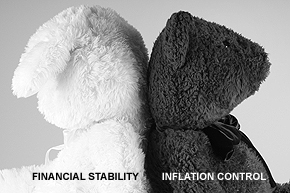
This is where a peculiar type of schizophrenia has taken hold.
Many central banks have split themselves into two separate parts: one that regulates banks to keep them safe, and one to run monetary policy to control inflation.
They have separate tools and believe the oil of prudential policy shouldn't mix with the water of monetary policy.
The Reserve Bank is still clinging to this schizophrenic dogma that allowed housing bubbles to inflate and burst all around the world.
It's time now for the bank to prioritise financial stability over its inflation target.
As has been shown in America and Europe, the financial carnage from a burst housing bubble is much more damaging in the long term to an economy than a temporary deviation from an inflation target.
The bank should use an OCR hike now to stop this housing boom in its tracks.
It may push inflation below the bank's 1-3% target band in the short run.
But it will help avoid a much more damaging deviation into deflation in the long run if an even bigger housing bubble bursts inside New Zealand's highly concentrated and still foreign-funded banking system.
------------------------------------------------------------------------
This article was first published in the Herald on Sunday. It is used here with permission.
33 Comments
Try somthing radical Bernard. How would it go if we stopped paying tax on interest earned and we paid tax on interest paid. That would change behaviours !!!!
Why would it change behaviour?
Though if its say 30% and I borrow at 8%, then the Govn's take would be higher this way? ie V 30% tax on 4% a depositor gets?
Everything else is a tax on profit earned though...Id hate to think of the tax hole opportunities that created.
regards
Yeah, the Productivity Commission pointed out that the fact that there is tax on interest earned, means at the end of the day that there is some tax impact on mortgage interest paid. This is one of the things that means that "housing" is not quite as tax-free as some people claim. Council rates is another reason.
Steven. Think about this. Nothing to do with the governments 'take' but the behaviour of individuals. Using your figures. What would individuals do.
You borrow money. Now: Cash going out at 8%. Future: interest payments are taxed 30%. Your cash will be going out at 10.4%. (Actually it's the bank gets taxed on your payments to it. And bank will put up it's price to you accordinly. Near enough)
You deposit money. Now: Cash coming in at 2.8%. Future: No tax on your interest. Cash coming in at 4%
Some people might see the light and decide not to be a borrower. And to be an investor. Just some people, and not completely, and would take a while to kick in.
But behaviours would change. You think not ?
How is the risk of default with the MUD bond handled? ie who is held liable in the final instance?
To get to $1000 / sqm how do you take the profit margins out of each clipper along the way? for instance developers want 100% margin, how do we get that to say 25%?
regards
Well credentialed there Hewey-the-wool-classer
Bernard Hickey
Massey University 1985 - 1989
Agricultural Economics
Economics
Maori Studies
History
Accounting
A farm boy, who was supposed to grow up to be a farmer or an agricultural economist but stumbled into journalism at Massey University.
Worked for Reuters in Australia, the UK and Singapore, as the business editor for the Dominion Post, the editor of the Independent.
Stints online. A dotcom with the National Times Group in London, Telecom's XtraMSN in New Zealand, and most recently head of digital for Fairfax.
Well travelled with an International Outlook
and yours are what BTW?
certainly nothing in math, no sign of anything technical or scientific, no peer reviewed work.... you have proved that time and time again.
regards
Not that anyone who is an apologist for the urban growth containment racket ever takes any notice of peer reviewed academic work anyway.......
http://www.performanceurbanplanning.org/academics.html
It is quite possible that Hugh, an old industry practitioner, might just know what he is talking about. It is painfully obvious even after a GFC, that the mainstream "experts" mostly do not have a b----y clue about land economics, and bumbling incompetents from the mainstream of economic beliefs who caused everything in the first place are still in positions of power and influence, while literally none of the people who famously "got it right" in warnings long before the GFC, have got to supersede the idiots in their jobs.
Feast your eyes on THIS list:
http://investorhome.com/predicted.htm
Anyone on that been promoted to head the US Federal Reserve, or into the Obama Cabinet? Why not?
Hugh's math about urban land prices has always struck me as exactly the kind of insight we need. The best land economists all are quite clear about this too. Why the mainstream "best and brightest" have to remain so out of touch with reality possibly indicates the extent to which the racket has captured "professionals" of all kinds.
If you are a highly qualified physicist and you do not understand the math of urban fringe land use conversion, then there is no point expecting anyone to listen to you on the subject of housing affordability just because your science qualification means you are meant to be quite bright. Possibly you couldn't lay drains as well as a low-IQ drain-layer who does it for a living, either. Stick to your specialty and stop wasting everyone's time.
Thats a list of "academics", who may or may not have a bearing on the subject or claims that are made by HughP. With 7billion ppl on the planet finding a few ppl who have simialr partisan views isnt tha hard.
Point is hughp's cliams have no standing in terms of meeting a standard of rigor that a real peer paper does...
So its politically biased opinion and nothing more.
regards
You just gave yourself away. Hugh, unqualified apart from "doing it" for most of his life, is "politically biased" - but so are the academics who you dislike......?????
Who are the qualified academics with peer reviewed papers on housing affordability that you are going by, seing you think it is so easy to find support for any viewpoint in this world of 7 billion people?
In any case, I thought at one time that you "got it", that rationing the supply of urban fringe land allowed the owners of the rationed supply to hold out for windfall "planning gain". I would have thought you would also "get it" about the difference between the impact of upfront fees in new house prices, or pay-as-you-go, on the price of all houses, and hence intergenerational equity.
This should not even need to be a matter of appealing to one's favourite academic references; it is logical, observable, and understandable to anyone with half a brain. What is it that "gets to" you to keep you forever coming back and obfuscating the issue? One can hardly be blamed for assuming you have land banks and/or investment properties, or being a paid troll for someone who has.
Scarfie is "eclectic" but I do not have a single complaint to make of him refusing to "get" a logical point. Explain something to him that has reality and logic on your side, and Scarfie will "get it". He'll add it to his stock of eclectic knowledge and will not be a pain in the a---- forever and a day recycling insupportable arguments. Mind you I don't come on this forum enough to see much of what he gets up to, but my encounters with him have left me with positive impressions.
Steven why would the default risk of bond holders of MUDs be any different from lenders to our local bodies. MUDs IMHO are just another type of local authority. They are both backed ultimately by local residents and the ability that they have to pay rates.
Because,
a) The instrument is 100% debt...so the impact is greater,
b) as probably is the interest rate, higher.
regards
Steven, there is no reportage at all of MUD Bond defaults being a problem anywhere. You really should start by finding evidence of such a problem and present it as a legitimate argument if you want to be taken seriously.
People from the USA who work with the MUD system all the time, look at our system and go "W....T.....F.....!!!!!!!! ....how the F---- can that possibly work.....?"
It is interesting if you read the explanation of the MUD system that Hugh links to above, how the Americans have thought through the effects of competing systems and seen the problems that they are avoiding by doing it the MUD way. They specifically mention the effect on housing affordability, the intergenerational equity issue, and so on.
Bottom line: bible-bashin' gun-totin' redneck hicks are a LOT smarter than we are, regardless of how deluded we are about our "intellectual sophistication". I quite happily lay my reputation on the line with the prediction that as long as the freedom to convert rural land to urban use, and the MUD system, lasts; the affordable "growth corridor" cities of the USA "own" the future of western civ.
http://online.wsj.com/article/SB10001424127887323549204578315714070017932.html
http://www.newgeography.com/content/003777-as-north-rest-its-laurels-south-is-rising-fast
http://www.spectator.co.uk/features/8946671/while-britain-stagnates-america-is-roaring-back/
Note my comment on the last item......
There is a very good defence of the MUD system by a true expert HERE:
http://www.macrobusiness.com.au/2013/03/a-better-way-to-fund-housing-infrastructure/#comment-224342
California
U.S. Bubble Economy Watch:
June 26 – Bloomberg (Dan Levy): “Kimberly Boortz began searching for a San Francisco condominium after seeing the heated demand for single-family homes in the city. Potential buyers would ‘elbow their way around’ showings, and only all-cash offers or bids well over the asking price would come out on top, she said. ‘There is insane competition in every part of this market,’ said Boortz… San Francisco’s median house price is poised to surpass $1 million this year after setting a record in May… Buyers have been making down payments of 35% in a market awash in wealth from tech workers and overseas investors, Mark said. Banks are offering loans exceeding $625,000 that are too big for government backing, known as jumbo mortgages, at interest rates only marginally above those for conforming loans… The San Francisco area had the biggest gain in home prices among 20 U.S. cities in the S&P/Case-Shiller index… Single-family house prices in April jumped 24% from a year earlier, compared with gains of 12% of the overall gauge, which was still the biggest advance in more than seven years. The median price for a single-family home sold in the city was $947,260 in May, up 2.7% from April and 32% from a year earlier… It topped the $932,350 record set in 2007… San Francisco condo prices set a record in each of the last three months, soaring 27% in May from a year earlier to a median $881,020… The peak in the previous cycle was $811,170 in March 2008.”
An extraordinarily unsettled quarter ends on a tenuous up note.
June 24 – Financial Times (Alistair Gray and Pilita Clark): “Insurers have issued a rare warning that the speed at which the oceans are warming is threatening their ability to sell affordable policies in a growing number of places around the world. Parts of the UK and the US state of Florida were already facing ‘a risk environment that is uninsurable’
oops....
Wonder if Chch is really on limited time, if re-insurance companies simply stop re-insuring, chch is bye bye, as is our housing market btw.
regards
So allow "sprawl" inland, instead of mandating intensification right in the path of the rising oceans - DUH!!!!
Like it makes sense to ban development in the general vicinity of Bombay Hill and forcibly "intensify" Parnell and Herne Bay.
Like it ever made sense to intensify on fault lines in Thorndon, on Tsunami paths in Kilbirnie Isthmus, and ban development in the Horokiwi area.
Low density and dispersion is just sensible disaster impact mitigation policy. It's not even worse for efficiency of travel either; you find me an example in the following data, of high traffic congestion delays in low density cities versus low traffic congestion delays in high density cities.
http://www.tomtom.com/en_gb/congestionindex/
The exercise will be a very handy little self-education.
Density data here:
Mind you it is well know that Al Gore owns expensive beachfront property..........
I think its gone beyond hiking now BH...just look at the Fed's "thinking about it" to realise that our RB might well ignite a fire it cant put out. Walking a tight rope IMHO.
regards
Hugh's analysis is quite correct. Housing affordabilty should be solved at a local level by making the supply of housing elastic. New demand for housing should cause more houses to be built rather than house price rises. The Texan rather than San Francisco solution.
But what should the Reserve Bank do if house price inflation continues to rise? If local housing conditions are getting worse not better. Does Wheeler believe the reassurances from the Beehive that the supply of housing will kick in soon. That with the Auckland Accord, the possibility of special housing areas and Local government speeding up the building consent process there is nothing to worry about.
Can the Reserve Bank make a technical economic decision that housing inflation risks the financial stability of the country. I am sure BIll and John whenever they meet our Monetary Guv will be hinting that is a political not economic decision.
I would not want to be in Wheelers shoes, he has pressure coming from al sides and no easy escape route. The best option is stick to the facts, if he sees a bubble and if it could get so large it endangers our financial sytem then he has a duty to pop it.
As the Productivity Commission correctly found, the urban land rent curve rises along its entire length due to growth containment distortions. Because the cost of land is higher nearer the urban centre, this has the unintended consequence of inflating the cost of higher density living nearer the centre even more than the cost of fringe McMansions.
Check out some RE sites for the evidence. Affordable US cities have fringe McMansions for $150,000 and CBD condos for $80,000. Dorkland, or Vancouver, or Portland, have fringe McMansions for $500,000 and CBD condos also for $500,000.
How clever is this?
Brendon:
From the Jan 2010 OECD Paper “Bird’s Eye View of OECD Housing Markets”:
Para 55. “Another concern is about the ability of monetary policy to thwart the development of a housing bubble without causing widespread damage to the rest of the economy. In a house price boom, prices increase strongly – often at double digit rates – and expectations of future prices are similarly upbeat.
Under these conditions, large policy rate hikes would be necessary to cool housing markets. High interest rates would crowd out sound and socially useful investments.
An additional difficulty for large countries and monetary unions is that housing market developments usually differ across regions or member countries. For example, during the latest housing boom, while prices were soaring in States like Florida or California, they were stagnating in many other parts of the United States. In the euro area, prices were skyrocketing in Spain and Ireland, but declining in Germany. Devising an appropriate monetary policy response to asset price developments under these conditions is not easy.”
Elsewhere in the paper, they suggest that inelastic supply of housing is responsible for this dilemma that central bankers are placed in.
Our own Don Brash made this complaint when Governor of the RBNZ back in the 1990's. Smart man.
He said what the problem was and the politicians didn't listen to him.
Is THIS what he should have done?
Bernard, welcome back from the Dark Side; all is forgiven. And I think I can (bold brag I know) confidently predict that the "new" LVR's won't work: I had loan approval authority over many millions worth of mortgages in the 1980's when prudential standards were de rigueur and they stood for next to nothing. A whole industry existed (especially among lawyers 2nd and 3rd rankings) to circumvent them- Family guarantors and all that mess!
Ergophobia
So what exactly is an interest rate hike? 0.25% or 0.50% OCR increase or lift in floating mortgage rate from say ANZ published rate of 5.74% to 6.25% or 6.5%. Don't think either would make much difference to the appetite to invest in housing in Auckland or Christchurch when the shortage of supply, serious lack of new builds, net migration gain etc are taken into account.
The LVR proposal will only impact on a small sector of the market. A typical Auckland investor couple in the their 50's may have a mortgage free family home worth say $800,000 to $1,500,000 - they could 100% finance the purchase of several rental properties as the LVR is calculated across the entire group of properties against which security is taken. So LVR restriction unlikely to impact on that type of investor - in fact it would assist them to get richer. A recent migrant with all cash will not be impacted at all and a wealthy family assisting one of the kids into a home will still be able to do that with provision of a guarantee. The only people who will suffer under an LVR restriction are first home buyers who do not come from wealthy families and perhaps couples post divorce who each do not have 20% deposit to acquire individual homes once they go their separate ways.
A first home buyer in Wellington with a $35,000 deposit buying a $350,000 home would need to save another $35,000 to buy that same home after the LVR restriction kicks in. There is most probably a panic to purchase taking place right now simply encouraged by the Reserve Bank media coverage of the possibility of LVR restrictions. That in turn is most likely pushing prices higher.
Does anyone seriously think that an LVR restriction or a 0.25% to 0.50% interest rate increase is going to cause a reduction in Auckland house prices when it is unlikely that even 4,000 new homes will be built over each of the next couple of years?
it seems the government both local and national have serious problems with first time Kiwi owners buying their own piece of NZ. Why else would they be penalising them at every turn? How incompetent can our leadership be?
At some point you are to say some ppl cannot buy otherwise you end up with NINJA loans.
regards
I always say that "home ownership" policy that does not increase the elasticity of supply of housing is not "home ownership" policy at all, but is "big finance" and "big property" profit increasing policy.
It is "supply" that determines how many people will be "priced out". LVR's and interest rates and subsidies merely determine the price at which they will be priced out, and the level of debt taken on by those not priced out.
Of course big finance and big property LOVE demand side subsidies and low interest rates and loose LVR requirements in conjunction with inelastic supply.
BTW I am agreeing with you and hope you see the logic of what I am saying.
If you understood the leverage that is the LVR then you would realise even a small amount of LVR chnage makes a big impact.
Steve Keen would be worth a read IMHO.
South Korea is a very interesting housing market to study.
Their LVR's have consistently been as tight as "close to either side of 50%" for decades, yet they still have a major problem with young people priced out of home ownership, and bubble price inflation.
As I say, it is "supply" that determines all this.
The advantage of having LVR's 50% and even tighter at times, is that national savings tend to offset debt, as there are so many young people trying to save their 50% against a rising target, and some of them never making it. It's definitely put the brakes on marriage and birth rates too.
Dear BH
The RBNZ wouldn't have to go down this track of raising the OCR if you didn't put out that scare mongering about house price few years ago. It was going to drop by 40%, then 30% then 15%. In some ways, you have contributed to the mess we are in now
We welcome your comments below. If you are not already registered, please register to comment
Remember we welcome robust, respectful and insightful debate. We don't welcome abusive or defamatory comments and will de-register those repeatedly making such comments. Our current comment policy is here.