

Here's my Top 10 items from around the Internet over the last week or so. As always, we welcome your additions in the comments below or via email to bernard.hickey@interest.co.nz.
See all previous Top 10s here.
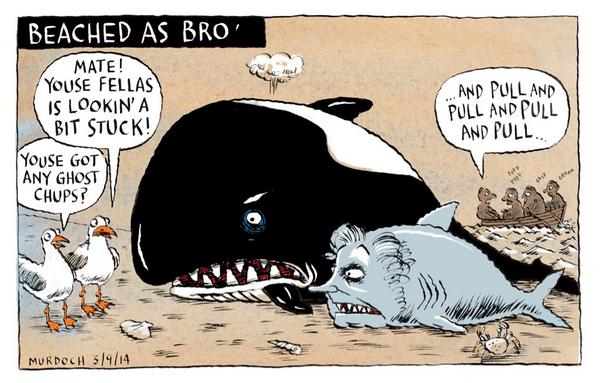
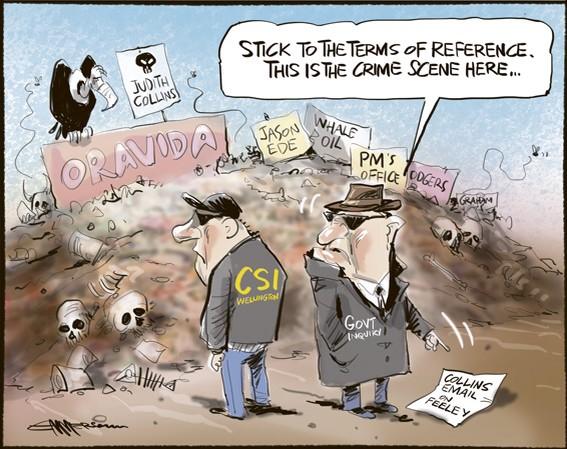
My must read is #6 on Dutch farming. I also hope you enjoy the political cartoons I've sprinkled through today. I needed a laugh at the expense of messrs Slater et al.

1. Renting apartments - Sometimes it's useful to look at the US housing market to understand some of the trends globally.
This CFA institute piece looks at the relative growth in building of what it calls 'multi-family' dwellings (we'd describe them as town-houses and apartments) relative to the growth of single family dwellings (which for us would be a house and land package).
It turns out multi-family dwellings are growing much quicker. Much of the growth is coming from rental property owners, rather than owner occupiers.
America's struggling low to middle income earners are less able to buy their own home, let alone an apartment.
So instead they're renting and a certain group that can afford it are gearing up to build and buy these apartments.
Meanwhile, rents are rising faster than incomes.
Not sure it's going to end well, but it's a thing over in America.
The chart below tells the story.
A secular movement towards multifamily housing led by demographics and changing preferences is a trend going forward. Further aiding this shift in our domestic housing “mix” is the relative looseness in multifamily housing credit availability compared to single-family credit, which remains much tighter than pre-crisis times.
The favorable financing environment is a great thing for the developers of multifamily housing, but the economic picture is a lot more negative for the average renter as rent prices continue to hit new highs with vacancy rates at multi-decade lows. Given that wage growth has remained anemic, renters across the country have been unable to keep up with rent increases, putting a strain on disposable income.
The investor community needs to wake up and stop waiting for a substantial rebound in single family housing, as multifamily housing has already rebounded and will exhibit most of the growth going forward

2. Remember Enron? - It doesn't seem like that long ago, but a few people hope we've all forgotten. Bloomberg reports a bunch of San Francisco accountants who formed a firm from the ashes of Arthur Andersen have renamed themselves AndersenTax.
I wonder if we'll ever see Hanover Property Finance or Bridgecorp Bank... Perhaps not in my lifetime. Mark Hotchin may have other views. And ways of disseminating those views.
The new identity is designed to capitalize on the defunct firm’s reputation for quality work -- before it was sullied in 2002 by charges of document shredding and obstructing a Justice Department investigation into book-cooking at Enron.
“Our issues with Enron were the mistake of a few,” said Mark Vorsatz, WTAS’s chief executive officer, who started the company 12 years ago with 22 other former Andersen partners. “Irrespective of Enron, we thought we were the benchmark in the industry.”

3. Cash sniffing device - This is purely for fun and because I know people love pet pictures on the Internet. I get all sorts of press releases in my in-box from ministers, but I hadn't expected this one from Nicky Wagner announcing the Customs Service had just employed the services of two new dogs.
They're specifically trained to sniff for large amounts of cash. It should remind us all there's plenty of dodgy deals going on out there in our clean little country. They can sniff for cash and drugs. Throw in truffles and these black labs would be worth their weight in gold. Not sure if they could sniff for gold though...
The movement of large sums of cash is often linked to illegal activities, so these dogs and their handlers play an important role in targeting the proceeds of crime and disrupting criminal networks,” Ms Wagner says.
Customs has five cash dogs working in Auckland (including Rajax and Xaria), one in Wellington, and one working in the South island. All seven dogs can also detect drugs.
More than $3 million in undeclared or concealed cash has been detected since the cash detector programme was launched in 2013.
Here's Andrew Baker and Xaria.

4. Bubble, bubble, toil and trouble - I can almost hear the sound of hand-wringing from Glenn Stevens across the ditch in Australia.
The Reserve Bank of Australia Governor commented yesterday that he's concerned about a potential housing bubble in Australia.
He's not doing anything about it, but he is worried. Although, at least he's not cutting rates any more.
Despite assurances from the country's big banks and a range of economists that current house prices and levels of household debt are sustainable, a growing group of commentators is warning of the risk of a correction, particularly in the hottest markets of Sydney and Melbourne.
"As for things that monetary policy should try to avoid, we are also cognisant of the fact that monetary policy does work initially by affecting financial risk-taking behaviour," Mr Stevens said.
"In our efforts to stimulate growth in the real economy, we don't want to foster too much build-up of risk in the financial sector, such that people are over-extended. That could leave the economy exposed to nasty shocks in the future. The more prudent approach is to try to avoid, so far as we can, that particular boom-bust cycle," he said.
"It is stating the obvious that at present, while we may desire to see a faster reduction in the rate of unemployment, further inflating an already elevated level of housing prices seems an unwise route to try to achieve that."
5. China's securitisation boom - Speaking of things ending (not) well, here's Rabobank explaining how China's local government financing vehicles are now rushing around borrowing in bond markets.
Sigh.
Here's the detail:
China is bringing local government financing out of the ‘shadows’ by allowing them to borrow from the bond market. That will bring down the cost of borrowing, hopefully, but won’t address the trajectory of debt (i.e., ever higher): in fact it will likely do the opposite.
At the same a Chinese securitization boom is underway, USD19.7bn in issuance so far in 2014 (backed by mortgages, auto loans, and railway loans). There’s huge further upside in that trend given how many loans Chinese banks would no doubt like to get off their books.
Luckily, economic history clearly shows nothing could possibly go wrong from shifting assets off of balance sheets into a slowing economy with a wobbling housing market,...right?
6. Those canny Dutch farmers - New Zealand has quite a few Dutch dairy farmers and the CEO of Fonterra is Dutch.
We could learn a thing or two from the Dutch. Here's an Economist piece explaining how the Netherlands is the world's second biggest food exporter behind America, which has 200 times Holland's land mass.
The Dutch are very good at using technology to sustainably increase productivity. It's no coincidence that Theo Spierings said last year that New Zealand was 10 years behind Europe when it came to environmental and sustainability issues.
Under pressure from government and consumers, new technology and improved farming techniques are cleaning up Dutch farms. The newest stables are built so that manure is instantly removed by underground conveyor belts. At 14kg per animal, annual emissions of ammonia—a measure of how effectively farmers deal with excess dung—are now second only to Denmark and far better than the European Union average of 25kg.
The newest machines developed in Dutch laboratories rely on hovering cameras to tell them which tomato plants need a dose of pesticides, reducing use by at least 85%. Some greenhouses have solar panels and are energy producers rather than consumers: carbon-dioxide emissions have been cut by excellent insulation which means excess heat can be recycled and stored for winter by warming ground water, or turned into power for neighbouring houses; over 10% of electricity in the Netherlands is produced in this way
7. Thinning out the middle class - Callam Pickering reports at BusinessSpectator on some MIT research into what robotics might mean for the structure of the workforce and wages in future. We should all aim to be bosses in future.
Rather than destroying jobs -- as is commonly reported -- Autor argues that robotics and computerisation has polarised the labour force by thinning out the middle class. The winners tend to be at the top of the income distribution -- alternatively the owners of capital -- while the middle-class has seen their opportunities and wages decline.
In practical terms, humans tend to be relative better at performing jobs at the top and bottom of the income distribution. Furthermore, new technology has enhanced productivity for some roles at the top end of the distribution, particularly for professional, managerial or technical positions.
But jobs across the middle of the income distribution have thinned. Autor finds that ‘middle-skill’ roles -- such as sales, office and administrative workers, and production workers -- accounted for 60 per cent of US employment in 1979. That share had declined to 49 per cent in 2007 and 46 per cent in 2012. A similar trend was apparent in Europe.
8. How might this end? - China's cash-strapped property developers, who are now slashing prices to clear inventory, are also now borrowing heavily offshore, Bloomberg reports.
One of the arguments made by China bulls is that China can handle its debt because it is mostly internal. I wonder how much longer that will be true for.
Homebuilders in the world’s second-largest economy got $5.9 billion from foreign banks, up 39 percent from the same period last year, according to data compiled by Bloomberg. Builder debt has soared to 128 percent of equity, the highest since 2005, according to a Bloomberg Intelligence gauge of 84 companies. New home prices fell in July in almost all cities the government tracks and developers are missing sales targets.
“Higher leverage on the balance sheet will give developers a higher financial burden,” said Agnes Wong, credit strategist at Nomura Holdings Inc. in Hong Kong. “That means that if presales are not going as quick as they expect it can translate into trouble more easily than before.”
Premier Li Keqiang is allowing builders to expand financing channels in a bid to stem the slowdown in an economy that derived 16 percent of its growth from property development last year, according to the World Bank. Sino-Ocean Land Holdings Ltd., whose free cash flow in 2013 dropped to a third of the previous year, led the borrowing with an $800 million loan.
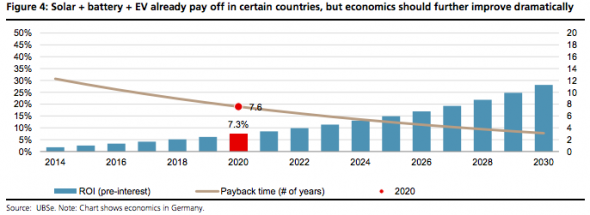
9. Here comes solar - Here's an FTAlphaville piece from a big UBS report on how solar power, electric cars and electric batteries are on the verge of being economically viable, which would reshape the electricity sector.
The analysts’ most controversial point is that solar really is on the edge of becoming economically viable (without government subsidies) due in part to recent complementary developments in battery and electric vehicle technology.
"Solar panels and batteries will be disruptive technologies. Solar is at the edge of being a competitive power generation technology. The biggest drawback has been its intermittency. This is where batteries and electric vehicles (EVs) come into play. Battery costs have declined rapidly, and we expect a further decline of >50% by 2020. By then, a mass segment EV will have almost the same sticker price as a combustion engine car. But it will save up to €2,000 per year on fuel cost, hence, it will begin to pay off almost immediately without any meaningful upfront “investment”. This is why we expect a rapidly growing penetration with EVs, in particular in countries with high fossil fuel prices."Thanks to EV-driven economies of scale, we also expect the cost of stationary batteries to drop c50% by 2020. Based on our proprietary analysis, battery storage should become financially attractive for family homes when combined with a solar system (and an EV). As a consequence, we expect transformational changes in the utility and auto sectors, which we discuss in this report."
10. Totally John Key talking in February about his regular chats with Cameron Slater. Just watch it to decide what you think about all this Dirty Politics stuff. Presented without comment. The context is that he was being asked how he found out about Winston Peters visiting Kim Dotcom's mansion. He denied it was the SIS and almost admits that Slater was the source.

We welcome your comments below. If you are not already registered, please register to comment
Remember we welcome robust, respectful and insightful debate. We don't welcome abusive or defamatory comments and will de-register those repeatedly making such comments. Our current comment policy is here.