
Offers for readers

The comment stream

Recent comments

Join the Interest community to be a registered commenter so you can:
- Edit your comments
- Avoid the CAPTCHA
- Vote on comments
Register Here

Already registered? log back in here ..

Forgotten your password? No problem! Click here

Finance sector jobs

Corporate Recovery Senior – Australia, Audit experience welcomed
Successful applicants will have the opportunity to work with this leading Australian Advis...more
Australia
Transaction Services Assistant Manager/ Manager – Melbourne
Think Global Recruitment is working with this exceptionally respected Australian Boutique ...more
Australia
Audit Senior - Australia
Sought after opportunity to move to one of the most beautiful westernised countries in the...more
Australia
Research & Master Trust Relationship Manager
Strategic and Senior Appointment...more
Australia
efinancialcareers.com

Reader poll

Who do you think should be appointed Reserve Bank Governor to replace Alan Bollard when he retires in September?

Choices

RBNZ will stop long recession, says JP Morgan

Posted in News

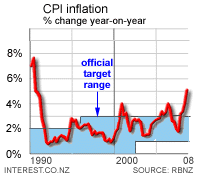
JP Morgan expects the economy will start growing again in early 2009 after a series of interest rate cuts by the Reserve Bank of New Zealand. It has, however, forecast New Zealand inflation will continue to rise to a peak of 5.2% in the fourth quarter, which will restrain the Reserve Bank from making bigger and faster cuts.

The forecast from JP Morgan is based on the expectation that the Reserve Bank of New Zealand (RBNZ) will make three 25 basis point cuts in the official cash rate (OCR) this year, including one each in September, October and December. This would leave the OCR at 7.25% by the end of the year. JP Morgan forecasts the OCR to be 6.25% by mid 2009, although it acknowledges that this will depend on how the economy responds to RBNZ policy changes.

JP Morgan said it believed the 2008 recession will be shallow and short-lived, forecasting GDP growth of 1.5% in 2009. However, the forecast indicated that the recession will get worse before the economy starts to recover, with recession in the second and third quarters this year. It expects GDP growth to stagnate in the fourth quarter.

"Our forecast calls for GDP growth to recover to 1.5% in 2009, thanks mainly to the forthcoming personal income tax cuts, lower interest rates, increased government spending, less drag from the housing market, and the anticipated positive impact on exports on weaker NZD, which has come under significant selling pressure in recent weeks," said JP Morgan economist Helen Kevans.

JP Morgan believed that although the RBNZ had embarked on an extended easing cycle of the OCR, the chances of cuts of 50 basis points were low due to the desire to avoid an inflationary plunge in the New Zealand dollar.

We welcome your help to improve our coverage of this issue. Any examples or experiences to relate? Any links to other news, data or research to shed more light on this? Any insight or views on what might happen next or what should happen next? Any errors to correct?

We welcome your comments below. If you are not already registered, please register to comment in the box on the right or click on the "'Register" link at the bottom of the comments. Remember we welcome robust, respectful and insightful debate. We don't welcome abusive or defamatory comments and will de-register those repeatedly making these comments.

10 Comments

Alex - can you tell

Alex - can you tell us whether their call is predicated on Australia/Asia growing moderately and there being no global recession, or did they not consider external factors?

Andy, The only mention of

Andy,

The only mention of the rest of the world is that there is also "speculation that the Reserve Bank of Australia will begin easing policy next month. Like the RBNZ, the RBA has the luxury of high interest rates as a starting point."

The forecast focusses what is outlined in Helen Kevan's quote in the above article.

The forecast acknowledges that if the $NZ were to fall more sharply than it has since the start of the year, the RBNZ may not be able to cut rates as steadily and for as long as possible.

Cheers

Alex

Is this the same JP

Is this the same JP Morgan ?

JP Morgan plans to write down $1.5 billion in mortgage-backed assets
http://www.iht.com/articles/2008/08/12/business/12jpm.php

JPMorgan Recommends Global Banks, Consumer Stocks (Update2)
http://www.bloomberg.com/apps/news?pid=20601086&sid=a1fU54dAVdLo&refer=l...

Quote:
Aug. 22 (Bloomberg) -- JPMorgan Chase & Co. strategists recommended that investors increase their holdings of global financial stocks and U.S. companies that rely on discretionary spending by consumers and sell energy and raw material producers.

We ``urge that investors continue to shift away from the consensus `inflation shock' trade,'' JPMorgan strategists led by Adrian Mowat wrote in a note to clients today.

The percentage of U.S. companies reporting higher-than- estimated earnings in the second quarter exceeded previous quarters and that trend should continue as inflation slows and the dollar weakens, they said.

The strategists advised investors to ``overweight'' global banks and U.S. consumer discretionary stocks and ``underweight'' commodity shares.
Endquote

JPMorgan shares tumble on widening 3Q losses
http://ap.google.com/article/ALeqM5j9ZZta-qQIdjUeAjEHJuCrI_mxdwD92H0T000

Is it the same company that is part of the US Federal Reserve ?

Secrets of the Federal Reserve
http://www.apfn.org/apfn/reserve.htm

Quote:
On the night of November 22, 1910, a group of newspaper reporters stood disconsolately in the railway station at Hoboken, New Jersey. They had just watched a delegation of the nation's leading financiers leave the station on a secret mission. It would be years before they discovered what that mission was, and even then they would not understand that the history of the United States underwent a drastic change after that night in Hoboken.

The delegation had left in a sealed railway car, with blinds drawn, for an undisclosed destination. They were led by Senator Nelson Aldrich, head of the National Monetary Commission . President Theodore Roosevelt had signed into law the bill creating the National Monetary Commission in 1908, after the tragic Panic of 1907 had resulted in a public outcry that the nation's monetary system be stabilized. Aldrich had led the members of the Commission on a two-year tour of Europe, spending some three hundred thousand dollars of public money. He had not yet made a report on the results of this trip, nor had he offered any plan for banking reform.

Accompanying Senator Aldrich at the Hoboken station were his private secretary, Shelton; A. Piatt Andrew, Assistant Secretary of the Treasury, and Special Assistant of the National Monetary Commission; Frank Vanderlip, president of the National City Bank of New York, Henry P. Davison, senior partner of J.P. Morgan Company, and generally regarded as Morgan's personal emissary; and Charles D. Norton, president of the Morgan-dominated First National Bank of New York. Joining the group just before the train left the station were Benjamin Strong, also known as a lieutenant of J.P. Morgan; and Paul Warburg, a recent immigrant from Germany who had joined the banking house of Kuhn, Loeb
Endquote

I am constantly amazed that anyone takes any notice of what companies like that say.

Come on, they are one of the major causes of the mess the world is in.

I think we should be getting our information from more reliable sources.

Steve

Yeah nice one Netwriter, it

Yeah nice one Netwriter, it is just such a great pity that hardly anyone will bother to read all of the info on the history of the US Federal Reserve. I have studied the entire history of the impact of currency and banking upon human development, it has been the common denominator in almost every human upheaval.
As for JP Morgan, it must be great having your own Banking, Brokerage houses, rating and analyst agencies, and controlling stakes in many media vehicles, starts to look a bit similar to an Enron type set up, only Enron did not have the immense advantage of being a central banker, it had to borrow from them, which the central banks gladly did of course, seems how they can create it out of freshair, thay had nothing to lose, but a cut of every dodgy deal done. You know what, they made a concerted effort to ridicule Social Credit around the world, that alone should make you look very carefully at it, but we waited, We were right, They were wrong, anyone continuing to sell the "Magic of the Market" is selling "Snake oil".
Good luck to you and your family

Hi Iain, I didn't used

Hi Iain,
I didn't used to be this cynical. But the more I read and understand, the more cynical I get.

Maybe they will spare a few minutes to watch this:

G. Edward Griffin on the Federal Reserve System
http://www.youtube.com/watch?v=ZWKlz2Z4Nlo

Steve

Nothing cynical about historical fact

Nothing cynical about historical fact netwriter, its just all a bit daunting when all the peices of the puzzle start to fit, then when you realise just how simple it actually is, if it were not so serious, its almost laughable.
Keep the chin up mate, I believe when fully informed, there is no way the average Kiwi is going to let it continue.

Iain, I know what you

Iain,
I know what you mean about putting the puzzle together.
The only thing more laughable is that there are loads of people who haven't even noticed the puzzle !
Fortunately I put the puzzle together (well enough anyway) about a year ago, so have avoided making stupid mistakes, and feel a little safer than I think most are.

The Chris Martenson videos pretty much just clicked everything into place nicely at the end.
For anyone who hasn't watched them, A MUST WATCH:
http://www.chrismartenson.com/crashcourse

(His Peak Oil one is just out)

Steve

Yep, and the same folks

Yep, and the same folks who the Fed recently brokered the deal with for Bear Stearns - noting of course (had it not been for Bear shareholders and their class action filing) would have been at $2.00 a share instead of the $10.00 eventually agreed by the shareholders.

Steve - thanks for the

Steve - thanks for the reminder to visit chrismartensons website, hadn't been there in a few weeks.

The peakoil video that Steve is referring to on Chris's website, is, I have to say, one of the best short primers on the problem I have seen in 10 years of researching the subject.

If you have 17 minutes to spare it might just change the way you view the world (I kid you not).

No worries Andy :) I'm

No worries Andy :)
I'm waiting for part2.

And yes, anyone watching it will I hope realise their world view is wrong.