

ANZ economists say they are seeing evidence of "typical late cycle" behaviour starting to show in the economy - but believe that this time around New Zealand can avoid the boom-bust pattern of previous cycles.
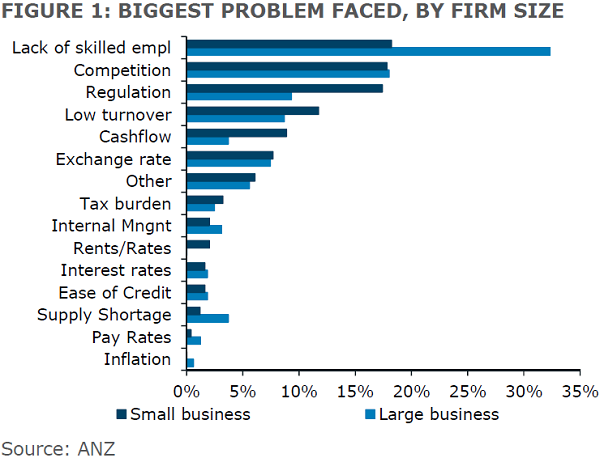
In their weekly Market Focus the economists cited as visible 'late cycle' signs: Rising household credit, deteriorating savings, housing market excesses, a tightening labour market with skill shortages and some signs of a pick-up in non-tradable inflation.
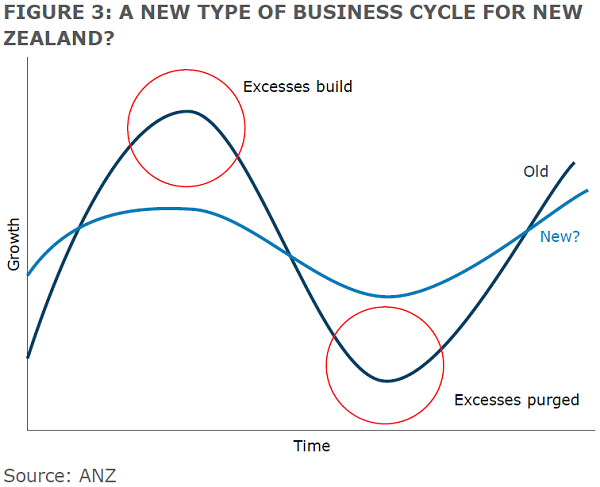
They pointed out that previously the New Zealand economy has tended to show "hi-beta" characteristics, namely big booms in the economy, but big falls too.
"While real GDP growth has averaged a respectable 2¾% per year since 1990, there have been peaks of close to 8% and troughs where the economy has contracted at a 2½% annual rate over that time. Big swings and a volatile business cycle have been par for the course."
They said that part of the traditional cyclical nature has reflected the fact New Zealand is a small, open, agriculturally focused economy, dependent on the global backdrop.
"But it also reflects the tendency for the economy to build up significant internal imbalances late in the economic cycle, which then ultimately require purging.
"Imbalances can make the economy even more vulnerable in periods of economic uncertainty. Recall that the New Zealand economy headed into both the Asian Financial Crisis and the Global Financial Crisis with weak structural metrics (a large current account deficit, deteriorating household saving, housing market valuation excesses, credit growth running north of 15%, and strong domestic inflation pressures), in effect making the economy far more susceptible to a turn in the international scene. In fact, the economy had already dipped into recession in 2008 before the full brunt of the GFC even hit."
So, given that backdrop, they posed the question of whether New Zealand was now heading for a repeat of the boom-to-bust economy.
"We would argue not," they said.
There will be "swings and roundabouts", they said, and the current strong momentum across the economy won’t last indefinitely. Natural handbrakes to growth (capacity and credit moderation) will eventually see things soften.
"Our point is simply that amidst all the cyclical indicators, close attention needs to be paid to structural ones too. It is when they get out of whack that pressure mounts for some purging. New Zealand has clear signs of deterioration in some areas, but not the breadth we’ve seen in past cycles, and on numerous levels, including policymakers and the finance sector, we are seeing important differences.
"This gives us more confidence that when a turn in economic performance does come, and it will, the ‘landing’ will be mild, unlike previous experience of rapid swings. Or put another way, it puts New Zealand in a far better position to handle swings in the global economy, which is where key challenges reside."
Key factors the economists have pointed to as making things different this time are:
►Despite the current housing market largesse, New Zealand's external position is contained, with the current account deficit, at 2.9% of GDP, below its historical average, net external debt, at 56% of GDP, far lower than its peak of over 80% in 2008.
►The RBNZ is "actively taking away the housing punchbowl" via LVR restrictions and the spectre of debt-to-income limits. With over 93% of new residential mortgage lending now done with at least a 20% deposit (compared with less than 70% in 2012), the financial system is sounder.
►There is little in the way of a shadow banking sector to be seen with household non-bank lending only $5.9bn, and growing at just 1.9% y/y. At just 2.4% of total household lending, it is down from over 9% in 2006.
►There is a shortage of housing, with the economists estimating a shortage of close to 20,000 in Auckland. Some of the areas where the market can be most vulnerable to a correction when the cycle turns (i.e. sections and apartments) are now where more supply is most needed.
►Banks are now restraining credit at the top of the cycle. "That’s a hard thing to do but entirely appropriate if boom-busts are to be averted." The financial sector is far more focused on making the numbers add up: matching deposit growth with lending growth.
►Inflation is low, and set to be for some time. The economists see little urgency for the RBNZ to lift interest rates, and when it does, it will be slowly. "The latter is key. Given the build-up in household leverage, even small movements in rates are going to pack some punch."
We welcome your comments below. If you are not already registered, please register to comment
Remember we welcome robust, respectful and insightful debate. We don't welcome abusive or defamatory comments and will de-register those repeatedly making such comments. Our current comment policy is here.