

 By Roger J Kerr
Just as some economists and interest rate market commentators were starting to pontificate that the RBNZ may have to commence raising the OCR earlier in 2013 than originally thought due to the bubbling residential property market, last Friday’s sub-1.00% annual inflation result has turned some expectations to future interest rate cuts.
While the RBNZ may control a good part of monetary conditions in New Zealand via interest rates and other macro-prudential measures, they cannot control it all as the exchange rate is determined by so many other external, uncontrollable factors.
The global financial and economic situation in recent years has produced an unusual predicament with monetary management in New Zealand with the exchange rate appreciating (tightening monetary conditions) when local interest rates are at record low levels (loosening monetary conditions).
Historically, low interest rates have produced a lower currency value.
So, households are currently enjoying the best of both worlds, record low mortgage interest rates, rising house prices and falling prices for the furniture and electronic gear to put in the house.
Will it last?
The RBNZ is unlikely to raise the OCR unless credit growth really takes off and/or the NZ dollar tumbles and we import much higher levels of inflation. Both seem unlikely.
One aspect of the monetary policy setting jig-saw is the changing nature of the banks’ own borrowing margins in international debt markets. Over recent years the banks have added “liquidity premiums” onto corporate borrowing margins as the banks’ own credit margins zoomed upwards.
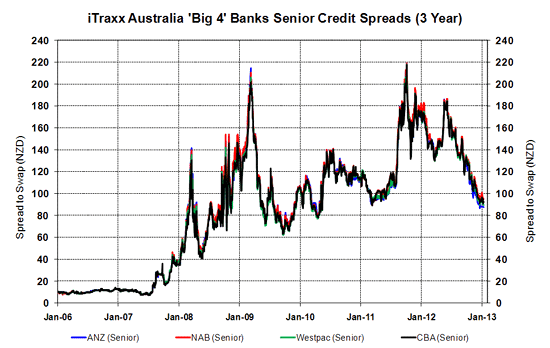
The last six months has seen the credit margins for the Australasian banks nose-dive as financial and investment markets stabilise in Europe.
Previously, the RBNZ justified the low 2.50% OCR with the reason that much higher bank cost of funds (credit margins) had not reduced end-borrower all-up interest costs very much.
That is no longer the case with bank offshore credit margins (see chart below) plunging from 1.80% to 0.90% over the last six months.
Note that for three-year bank cost of funds about 0.40% for the basis swap back to NZ dollar funding has to be added to the raw credit margin of 0.90% in the chart.
Nevertheless, bank borrowing costs from offshore have dropped 0.90% since mid 2012.
The end conclusion is that Governor Wheeler will just watch and monitor and not be forced to take any proactive monetary policy initiatives for many months yet.
That does not mean that term swap interest rates cannot increase, as fixed interest investors and borrowers in the US send US Treasury Bond yields higher.
----------------------------------------------------------
To subscribe to our daily Currency Rate Sheet email, enter your email address here.
No chart with that title exists.
Roger J Kerr is a partner at PwC. He specialises in fixed interest securities and is a commentator on economics and markets. More commentary and useful information on fixed interest investing can be found at rogeradvice.com
1 Comments
That does not mean that term swap interest rates cannot increase, as fixed interest investors and borrowers in the US send US Treasury Bond yields higher.
Your logic defies commonsense - the US Federal Reserve has just embarked upon a major term US T bond & note buying program - Japan's Abe, while stymied initially, may well sell Yen to buy US bonds in a similar fashion to the operation undertaken by the Swiss Central Bank In respect of the Swissy/Euro cross.
As they say 'never say never' - but I wouldn't bet your money to test it out.
We welcome your comments below. If you are not already registered, please register to comment
Remember we welcome robust, respectful and insightful debate. We don't welcome abusive or defamatory comments and will de-register those repeatedly making such comments. Our current comment policy is here.