
By Mike Joy*
 In the last century the ecological health of New Zealand’s lakes, rivers and streams have undergone significant deterioration.
These declines in water quality have accelerated over the last twenty years and there is little indication of any action to halt the deterioration.
Over the last few decades while many European countries halted declines and some even achieved improvements in water quality, New Zealand went the other way with unconstrained intensification of farming along with associated exponential increases in fertiliser use and increased urban wastewater discharges to rivers
The response from central and local government has been almost totally ‘hands-off’ apart from some attempt to control dairy shed waste.
This non-interventionist approach has led to the declines across all our ecosystems now becoming obvious by New Zealand’s slide toward the bottom of global environmental performance comparisons1.
We are now much much closer to the bottom than the top of global comparisons on environmental performance; this is contrary to the belief expressed by Prime Minister Key2.
While New Zealand embraced a free market approach over this time with the slogan ‘user pays’ applied almost universally it unfortunately did not extend to the requisite ‘polluter pays’ approach, thus distorting the market.
Over the last twenty years New Zealand’s analysis of the national water quality monitoring network has revealed significant declines in almost all measured water quality parameters3.
A 2004 study of more than 300 lowland waterways revealed that ninety six percent of them in pastoral catchments and all in urban catchments failed the pathogen standard for contact recreation. More than eighty percent of the sites in pasture catchments exceeded guideline levels for phosphorous and nitrogen4.
Now forty three percent of monitored lakes in New Zealand are classed as polluted5 (almost all lowland lakes) and groundwater nitrate levels are rising as well with thirty nine percent of monitored sites nationally showing increases6. Human health is also directly impacted with now an estimated 18 – 34,000 people annually contracting waterborne diseases7.
These declines in the health of freshwaters are for the most part related to agricultural impacts; excess of sediment, phosphorous and nitrogen as well as faecal pathogens8. The deterioration is matched by dramatic declines in freshwater biodiversity: now more than sixty percent of New Zealand’s native freshwater fish as well as the only freshwater crayfish and mussel species are now listed as threatened with extinction9.
The major driver of the deterioration in the health of New Zealand’s lakes, groundwater, rivers and streams is the uncontrolled farming intensification, mainly in dairy production. This escalation in intensity is driven by a farming system based on a strategy of low-cost production which in the absence of any central government leadership has inevitably led to many unsustainable practices10.
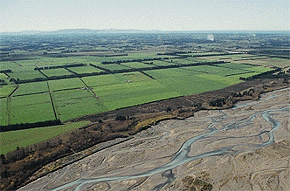
The main issue for freshwater from this intensification is diffuse-source nutrient and pathogen pollution of waterways from the intensified but “free-range” pasture based livestock farming model. This diffuse pollution is the run-off or seepage through soils of nutrient laden water due to high stocking rates. These extreme stocking rates are achieved only by increasing use of ‘off-farm’ feed supplements like palm kernel and fossil fuel derived nitrogenous fertiliser and imported phosphate.
Examples of the magnitude of intensification of dairy farming in New Zealand, between 1990 and 2002, the number of dairy cows in the South Island increased six fold, with an obvious massive impact on the quality of lowland streams. During the same period the number of cows in the Waikato River catchment increased by 37% and over that period Nitrogen levels in the Waikato River increased by 40% and Phosphorus by 25%11.
The response from the regulators to these obvious impacts has been virtually nonexistent during this time, not a single South Island council successfully introduced rules to control livestock access to such streams or to limit the intensification.
Despite being clearly in breach of the legislation (the Resource Management Act), the primary impact on water quality - dairy intensification was unrestricted.
The only exceptions to this has been in the Lake Taupo catchment where Waikato Regional Council limited farm intensity through a cap on nitrogen use to protect Lake Taupo and the Horizons Regional Council attempts to implement their ‘one-plan’ designed to protect the Manawatu River from further degradation.. In both these cases attempts have been made to limit intensification to protect freshwater quality and both met considerable opposition from the dairy industry.
Freshwater crisis
New Zealand now faces an unprecedented freshwater crisis.
The only solution is a dramatic reduction in dairy stocking rates in combination with technological improvements, but this to date, apart from the Taupo example, has been politically unpalatable and the only response from the government to the crisis has been a belated by 20 years and weak National Policy Statement on freshwater that will not address the problem12.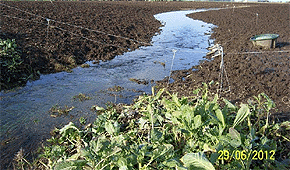
To date there has not been a charge or even any attempt to internalise the costs of the pollution of freshwaters in New Zealand.
The only cost for ‘out of pipe’ (point source) polluters is a one-off ‘consent fee’ which is essentially an administration charge required by Regional Councils.
The problem though is that for freshwaters the biggest pollution source in New Zealand does not come out of a pipe, it is diffuse and this pollution is not controlled at all.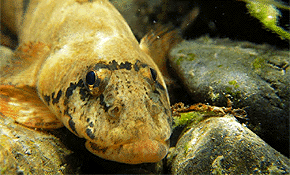
Diffuse pollution is sediment, nutrient and faecal contamination that makes its way into lakes and rivers through the soil via cow urine and washing overland land in rain.
The resulting excess levels of nutrient in lakes, rivers and streams has led to many ecological and human health impacts but these are not paid for by the polluters. In New Zealand diffuse pollution is only restricted except in the Lake Taupo catchment, where a cap and trade system was set up to protect this iconic lake from nutrient pollution.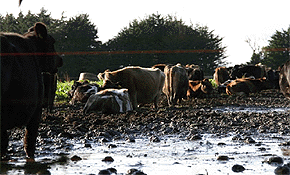
Apart from the Taupo example (and possibly Manawatu if it survives litigation) local authorities failed to use the ability they had under the Resource Management Act (RMA) to control the obvious impacts of farming intensification on freshwaters.
Instead they choose only to control the much less significant impact of dairy shed wastewater.
The reason for council’s failure to address the main impact on freshwater quality in New Zealand undoubtedly lies with the failure of central government to implement a National Policy Statement (NPS). This was despite a legislative requirement to do so decades ago, this would have given guidance to Regional Councils and confidence that they wouldn’t be picked off individually by the well resourced dairy industry. The NPS was finally put in place in 2011 but it has widely slated as too little and too late and unlikely to produce any improvement in water quality13.
Other than the NPS the only significant response from central government to the many freshwater issues was the negotiation of a voluntary code with the largest dairy company in New Zealand, Fonterra in 2003. This agreement, the Clean Streams Accord, was an agreement between Fonterra, Regional Councils and the Ministry for the Environment and required that farmers undertake a number of measures to lessen their impacts on freshwater.
The agreement at first appeared impressive but closer investigation showed many failings.
The failings include that the accord lacks any ability to enforce requirements, and the stream fencing requirements ignore the smaller streams where the most gain could be had. A further flaw is that all the monitoring requirements are for assessing whether the accord requirements are being implemented and no assessment of whether these are in fact improving water quality.
The result was that while the accord progressed stream fencing, it did not include riparian buffer zones and only happened on larger waterways, it did however serve to focus publicity on the continuing problems of dairy effluent management; and it did see the uptake of farm nutrient budgeting.
The down side however, was that it gave regional councils an excuse to continue to defer introducing rules to address the diffuse impacts of farm intensification.
So the result was that while the accord was a great public relations tool for the industry to suppress criticism there is no evidence that it has done anything to halt the decline of water quality.
In the last twenty years there has been no evidence of any protection of freshwater ecosystems outside of the conservation estate. This failure to protect freshwater ecosystem integrity has been clearly demonstrated by the declines in water quality and by the impacts on freshwater biodiversity. This loss of biodiversity is most clearly shown by the increasing number of threatened freshwater fish species shown in figure 1. These native fish communities are effectively the ‘miners canaries’ of freshwater ecosystems and their decline reveals failures to protect freshwater ecosystems over the last 20 years.
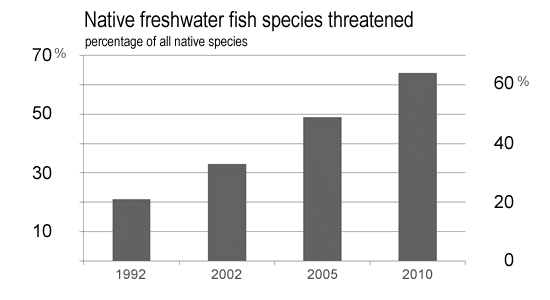
A recent analysis of data on the distribution of native fish in New Zealand14 showed declines in native fish populations accelerating in the last twenty years.
A robust and internationally used measure of the health of freshwater ecosystems is the fish the Index of Biotic Integrity (IBI)15 and it has been applied to a large database of freshwater fish distribution collected throughout New Zealand over the last forty years.
A trend analysis of these IBI scores clearly shows the decline in fish communities at all landuse types in New Zealand over the last 40 years. Figure 2 shows this decline especially in the last decade.
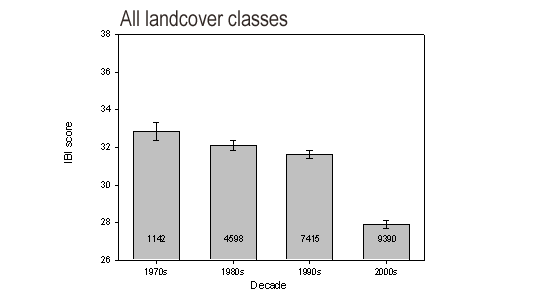
Figure 2. Average fish IBI scores for the last 4 decades over all land-cover types in New Zealand. Number in bars is the number of sites from the New Zealand freshwater fish database.
The declines in fish communities reflecting ecosystem health are even more obvious at freshwater sites in pasture catchments shown in Figure 3.
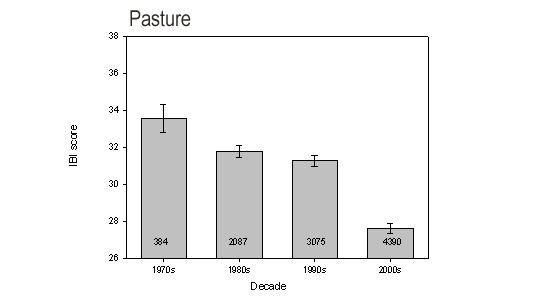
Figure 3. Average fish IBI scores at pasture catchment sites for the last 4 decades.
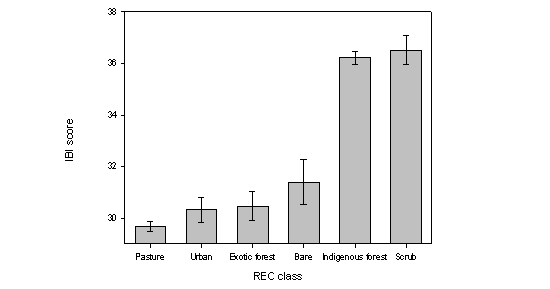
When the IBI scores for different land-cover types are compared the impact of different types of landuse on fish communities become obvious. The impacts of pastoral farming and urban effects on fish communities and ecosystem health are shown clearly when the IBI scores for all years at different land cover types are compared in figure 4.
Conclusion
The Resource Management Act (RMA) had noble ideals for the protection of the environment and sustainability in New Zealand.
Sadly over the following two decades those ideals were systematically diluted by a lack of enforcement and later weakening of the Act through the Resource Management Simplifying and Streamlining Act (2009). This legislation put emphasis on speeding up of the consent process and thus, less emphasis on the quality of decisions.
This weakening of the law combined with a failure to address the most pervasive impact on water quality - the intensification and industrialisation of dairy farming has resulted in New Zealand slide to the lowest levels of environmental performance globally.
The only indication of a future move to improve water quality in New Zealand is the involvement of Maori in freshwater management (the Waikato co-management example) and the economic value of tourism leading to moves to protect Lake Taupo by reducing dairy farming intensity.
------------------------------------------------------------------------------------
1. http://www.plosone.org/article/info:doi/10.1371/journal.pone.0010440
3. http://www.mfe.govt.nz/publications/water/water-quality-trends-1989-2007/index.html
4. Larned, S. T., M. R. Scarsbrook, et al. (2004). "Water Quality on Low-elevation streams and rivers of New Zealand recent state and trends in contrasting land cover classes. ." New Zealand Journal of Marine and Freshwater Research 38: 347-366.
5. Verburg, P., K. Hamill, et al. (2010). Lake Water Quality in New Zealand 2010: Status and Trends. NIWA, Ministry for the Environment.
6. Daughney, C.J. & Wall, M. (2007). Groundwater quality in New Zealand: State and trends 1995-2006. GNS Science Consultancy Report 2007/23.
8. http://www.mfe.govt.nz/publications/water/water-quality-trends-1989-2007/index.html
9. Allibone, R., David, B., Hitchmough, R., Jellyman, D., Ling, N., Ravenscroft, P. & Waters, J. (2010). Conservation status of New Zealand freshwater fish, 2009 in New Zealand Journal of Marine and Freshwater Research, 44:4, pp.271-287, available at http://www.tandfonline.com/doi/abs/10.1080/00288330.2010.514346.
10. Baskaran, R, Cullen, R, Colombo, (2009). Estimating Values of Environmental Impacts of Dairy Farming in New Zealand. New Zealand Journal of Agricultural Research. 52, 377–389.
11. http://www.niwa.co.nz/publications/wa/water-atmosphere-1-july-2010/how-clean-are-our-rivers
12. Sinner, J. (2011, June 29). Implications of the National Policy Statement on Freshwater Management, Prepared for Fish & Game New Zealand. Cawthron Report No. 1965, available at http://www.fishandgame.org.nz/.
13. Sinner, J. (2011, June 29). Implications of the National Policy Statement on Freshwater Management, Prepared for Fish & Game New Zealand. Cawthron Report No. 1965, available at http://www.fishandgame.org.nz/.
14. Joy, M. K. (2009). Temporal and land-cover trends in freshwater fish communities in New Zealand's rivers: an analysis of data from the New Zealand freshwater fish database -1970-2007.
15. Joy, M. K., & Death, R. G. (2004). Application of the index of biotic integrity methodology to New Zealand freshwater fish communities. Environmental Management, 34(3), 415-428.
------------------------------------------------------------------------------------
Dr. Mike Joy is a Senior Lecturer in Ecology and Environmental Science at the Ecology group in the Institute of Natural Resources Massey University Palmerston North. He researches and teaches freshwater ecology, especially freshwater fish ecology and distribution, ecological modelling bioassessment and environmental science. He is an outspoken advocate for environmental protection in New Zealand and has received a number of awards including “ecologist of the year” from the NZ ecological Society, and an “Old Blue” award from the Royal Forest and Bird Protection Society. You can contact him here »
23 Comments
While I am all for water quality as per my support in the previous article, dodgy science can do more harm than good. I am posting here in the hope to receive a report of your deeper analysis. There is certainly an effect and on the face of it dairy is the cause, but there could be some embarassment if it turns out it isn't.
This is the sort of denial crap logic we see so often over climate change.
mist42nz: Mike gives the results of his biological index system in the article, with the reference to the peer reviewed paper. I don't see what the science is in what you are saying, as you don't explain it, or point to any papers on why it is relevant at all.
Diffuse sediment is another water quality contaminant. NIWA has developed a way of analysing fatty acids in sediment to determine its origin. If you look at page 21 of chapter 5 of a sediment report for the Bay of Islands downloadable from this web page http://www.os2020.org.nz/browse-data-boi/dogetrecordbyid/da0292e5-89aa-… you can see the per cent sediment origins by pasture (cattle), pasture (sheep), pasture (sub-soil), native (broadleaf), pine (clear-fell), kanuka (scrub).
Since that report the technique has been refined further to be able to distinguish between more different types of farming and different stages of forestry. I can't access the 2011 conference paper on it here at home, but will try to find it when back at work on Monday.
Cheers
Pardon me for living.
The only people that can do that are town and city councils. No dairyfarmer is allowed to. Certainly not to my knowledge. And yes it is wrong. And I'm sure if they were made to correct their shortcomings, my rates would go up. And I'm a dairy farmer. No council has contributed to my $100,000 effluent system.
Dr Joy makes the mistake of focusing on selected elements of water quality issues. He avoids presenting his solutions as a balanced system plan for a total catchment. and his focus is on only one element of many that contribute to the alleged polution disaster unfolding in his analysis.
N leaching from pastoral intensification is not a function of animal numbers but is directly related to the amount of pasture crude protein produced for and consumed by grazing animals. The N flow contained in the excreta and urine is partitioned by the farming process as a portion to product. a portion to animal maintenance, a portion volatilised to air, a portion to soil utilised for plant growth and a portion leached below the root line or carried off with surface water providing the focus for Dr Joy's abhorrence. De-intensification by slaughtering a percentage animals from a catchment will not give the outcome he is indicating.
Society would be better rewarded by him putting his academic endevour into defining mangement practises that better manage and direct that N partitioning rather than claiming that destroying one element (livestock) by leglislation gives an ideal solution.
His selectiveness and failure to quantify nutrients discharged from licenced "consents to discharge" points carefully removes the intensification of the human component of water pollution from his equation leaving the weight of change he is demanding totally on livestock producers.
Seemingly the inability to accurately continuously measure the polluting elements in rivers and streams to provide guidence on if, where and when excesses are occuring is being replaced by computer modelling of derived data to support Dr Joy's emotive arm waving and dire warnings. That the economic welfare of producers and the country can be attacked by such an indirect, incomplete and error prone modelling system enforced by legislation is a monumental folly.
De-intensification by slaughtering a percentage animals from a catchment will not give the outcome he is indicating.
Why not? I'd have thought that fewer animals grazing the same amount of land would mean that pastures were able to be rested for longer periods and this would mean less erosion, improved growth, better cover/filtering, etc? And then there is the issue of irrigation (which enables intensification) without which much marginal land would likely not be grazed especially by the larger beasts. Seems to me irrigiation which allows for dairy conversion is perhaps more a contributing factor to the rapidly worsening problems.
Kate, dairy farming grazing rotation is all about maintaining pasture quality. So which is the lesser of the two evils - lower stocking rate that cause more supplement to b grown, which requires more fertiliser to b used, or slightly higher stocking rates, grass fully utilized by stock and only maintenance fertiliser required.
I don't believe it is coincidental that fertiliser use has fallen ( and it has to such an extent feet companies are resorting to selling stockfood& animal health remedies) at the same time stocking rates have increased.
Water quality measures have to be done on a catchment basis. Not a one size fits all.
Yeah I agree Cas Ob, to a point. But it use to be 100 cows to a paddock.... say a ha, now its 1000 cows on a bigger plot, with palm kernal to get there gums around as well. Its the same but different...and 1000 cows definately have a bigger impact on runoff. Small waterways get annihilated. You have to admit 10 cows out of the 100 walking into the water arent so bad. 100 well thats different. And all waterways are not fenced, never will be, cant be. Its the nature of the land that is now dairy farming. We went from dairy farming the flats to dairy farming anywhere and everywhere.
Up the road from me its all kinda swamp and wetlands all mixed in with a few flats and humps and hollows. Impossible to fence off the water. Yet it all drains into the mighty Waikato. Which is now a mass of weed. Hell one of the close Waikato lakes is a stinking hell hole with dead weed in summer. Surrounded by dairying. It never used to be like that, but with the conversions from sheep and beef it has all changed.
Yes, it has always seemed to me to be mainly about land use conversion from S&B or in many cases idle peat wasteland - to urban and/or dairy. As CO says - you have to look at it on a catchment basis .. and so many catchments are plain ecologically unsuited to these latter uses. Poor to no land use planning as envisaged by the do anything anywhere idealistically permissive RMA regime.
I dont get this thing where you reckon over fertilizing was done for in the 70s. It came to an end when it doubled in price about 4 years ago. Mist I recon there is some rose tinting on your spectacles.
Mist: Are you guessing or what? Prior to 1984 fertilisers were heavily subsidised by the government. When Lange-Douglas got into power, the first thing they did was elimiate all farm subsidies. What was the market response to that event?
I am sure you have been to Oz Mist. Cast your mind back, they know how to do the deferred grazing thing with no fert. Whats the saying.... some NZer tells an ozzie they use too many imputs, ie grains, the ozzie fights back with, you kiwis use more than us you use fertilizer.
I had a bit of a look recently. Saw what a future without fert looked like. Very yellow. And a bit brown. It didnt help their waterways any....haha they didnt have any. Just a few crevices that looked septic.
Well thats a duh moment isnt it... oh dear, what twats.
I wonder if any foreign tourists reading this would be able to sue NZ Tourism for false advertisng with their "100% Clean Green" slogan.
Two ways of reading the 100% Pure NZ slogan. Is it 100% Pure, NZ or 100%, Pure NZ as in 100% NZ, not anything or anyone else. Officials have never been able to tell me. Is whatever U want it to b. ;-)
Very evocative article
Im not going to dispute the science I'm not qualified to do so but what I will say is where to from here? Do we want to be able to swim in the local stream and catch native fish and have no intensive farming? Or do we want to remain in the first world and enjoy all the benefits of agricultural export earnings that we've become accustomed to?
Its that simple man affects the environment, we always have.
GWT - great point, from my experience in the dairy game I believe that we as an industry need to sort out the wayward ones amoungst us that;
a) have limited knowledge
b) have a) and are loaded up with "unlimited debt" by our lovely bankers
c) have fallen onto the Fonterra trap of producing "unlimited amounts of milk for an unlimited market" at any cost.
NZ Dairy farming is a very complex business, it requires competent operators and competent advisors that understand the dynamic and complex business that it is.
Increasing stocking rates and thus production has huge multiple dynamic effects on the business system.
NZ in the last 15 years has produced less University Agricultural Graduates than ever before.
The main crouse most Dairy Farmers employees do now is AGITO, which is great for your basic farm worker but thats it.
The industry has lost the wonderful network learning system it had 20-30 years ago *Discussion Groups" organised by local DairyNZ Consultants.
Typical intellegent Kiwi Kids dont want to go Farming as they dont want to be in a cowshed 10 hours a day (due to more cows/labour unit). Instead they go off to study engineering, law or business etc.
What happens with this change? We end up having to employ the "bottom end" and foreigners to operate our farms.
All of this has meant that the NZ dairy industry has gone several steps to far and now all farmers will pay the price as the only way to control the wayward ones amoungst us is via new laws, rules and regulations.
The writing has been on the wall for the last 15 years.
Typical intellegent Kiwi Kids dont want to go Farming as they dont want to be in a cowshed 10 hours a day (due to more cows/labour unit). Instead they go off to study engineering, law or business etc.
Had to laugh at that, got a son- inlaw who did engineering degree but then imediatley went farming!
Typical intellegent Kiwi Kids dont want to go Farming as they dont want to be in a cowshed 10 hours a day (due to more cows/labour unit). Instead they go off to study engineering, law or business etc.
Had to laugh at that, got a son- inlaw who did engineering degree but then imediatley went farming!
Joy's notes are essentially academic. He clearly has few to no links with iwi, and seems unaware of the significant pressure Southern iwi are exerting on waterbody quality, or the work being put in at local level by the commissioner-led Ecan.
Intriguingly, those unelected Commissioners have done more work in three years than the hapless, elecled ECan (commonly referred to as ECan't), manged in 19 years....
C-, I'm afraid. EDvidence of data collection, but failure to locate in a real-world context.
And where, pray tell, are the practical paths to achieveing Nirvana????
AWOL.
http://odewire.com/170441/scientists-investigate-water-memory.html
close the books for just a while and have a wee think...
We welcome your comments below. If you are not already registered, please register to comment
Remember we welcome robust, respectful and insightful debate. We don't welcome abusive or defamatory comments and will de-register those repeatedly making such comments. Our current comment policy is here.