
This is the third of our extended series on the New Zealand wine industry based on the Deloitte 2012 industry benchmarking survey.
By Tim Burnside and Paul Munro*
 This section looks at the distribution and sales activity of the New Zealand wine industry.
A common theme that has come through all of the surveys undertaken to date is the strong dependence of the New Zealand industry on exports and the Vintage 2012 survey is no different.
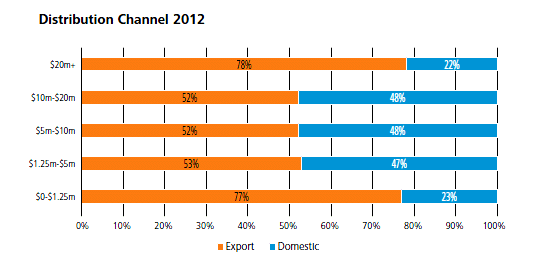
Consistent with prior year’s all categories have greater than 50% of sales being exported.
As this graph illustrates the smallest and largest categories have the highest percentage being exported with greater than 75%.
The remaining three categories are lower sitting between 50% and 55%.
The export sales destination graph clearly illustrates the $0-$1.25m categories dependence on exports to Australia, with around 50% of their exports entering this market, significantly more than the other categories.
It is considered this potentially explains the high percentage of overall sales being exported for this category. The relative ease of entering the Australian market, compared to the other major export markets, together with the incentives available through the WET rebate scheme, make this an attractive destination for selling, particularly for the smaller wineries.
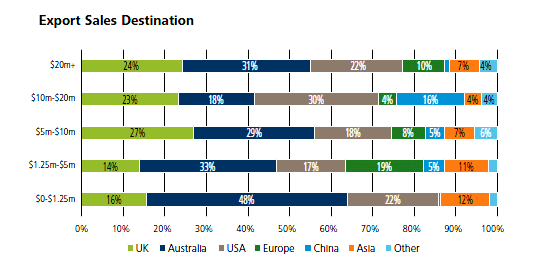
Consistent with last year, every category has a presence in the China and Asia markets, generally in line with the trends exhibited last year with the wider Asian market being more prominent than China.
When both regions are taken into account we have witnessed an increase in the amount of exports entering these markets compared to last year, which is completely in line with expectations. 8% to 20% this year compares to 6% to 11% last year and indicates quite an increase in the importance of these markets to the New Zealand wine industry. The general perception is that this will grow further in the future.
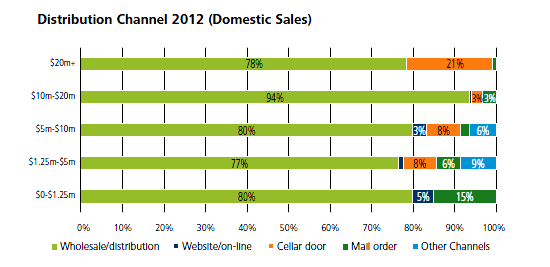
The third chart illustrates the distribution channels utilised by participants for domestic sales.
As expected and consistent with prior years the wholesale/ distribution channel remains the most important domestic channel.
Cellar door is generally the second most important channel for all categories with the exception of the smallest wineries where it is interestingly non-existent. This may not be representative of this category but rather a function of the specific mix of participants this year.
Website and/or mail order sales are quite low compared to the other methods but are certainly showing an increase on prior years
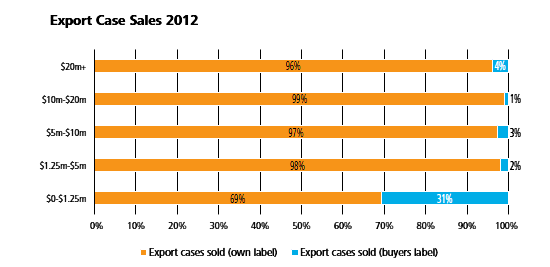
The chart above shows the split between export cases sold under a winery’s own label versus export cases sold under the buyers’ label.
Interestingly we can see that the smallest category sell over 30% of their cases under their buyers’ labels in comparison to negligible amounts for the larger wineries.
This gives reason to believe that the smaller players in the industry are more susceptible to adhere to their buyers’ terms in order to make the sales.
Deloitte perspective
The increased importance of the Chinese and Asian export markets comes as no surprise and is line with what is being witnessed throughout the industry. Media reports show that wine exports to Asia have risen five-fold since 2005, reaching nearly $100m this year.
We expect that this has the potential to grow significantly in future years, a view shared by many including NZ Winegrowers.
With the recent industry strategic review identifying the need to be present in growth markets NZ Winegrowers has recently opened its first Asian office based in Hong Kong, to complement the existing offices in London, New York, San Francisco and Melbourne.
While the new office will serve the whole Asian region, it would be expected that China will be its main focus, given sales into this market grew by over 50% in the last year. The presence of an office will be a positive step towards taking a collaborative approach to targeting this important growth market
Last year within this section we discussed the need for collaboration within the industry to ensure that the New Zealand wine industry received its share of the Chinese growth in demand for wine. It is pleasing to see that this is beginning to happen with the establishment of the NZ Winegrowers China office as well as jointly owned entities or joint marketing vehicles that have been set up to promote a number of New Zealand wines.
It is this sort of sharing and learning to piggy-back that will prove beneficial in the future and while this is beginning to happen we consider there is still plenty of opportunity for more of the same.
-----------------------------------------------------------------
Paul Munro is a partner in the Christchurch office of Deloitte. You can contact Paul here ». Tim Burnside is an associate director at Deloitte.
We welcome your comments below. If you are not already registered, please register to comment
Remember we welcome robust, respectful and insightful debate. We don't welcome abusive or defamatory comments and will de-register those repeatedly making such comments. Our current comment policy is here.