

- Fed was “transitory“ on inflation and are now “permanent” on inflation
- Japanese Yen FX market intervention, will others follow?
- NZ monetary policy not as tight as required
- Why the NZ dollar has been sold down further than the AUD and EUR
Fed was “transitory” on inflation and are now “permanent” on inflation
Yet another plunge of US equities on Friday 23 September and further skyrocketing of the US dollar value against all currencies underlines just how much the “fear” factor has ramped up with investors since the US Federal Reserve re-exerted their hard-nosed monetary tightening two days earlier. Investors are now much more fearful of a US and global economic recession. The longer the Fed hold their line the greater the risks increase of an unnecessary economic recession. The collapse of all major currencies against the USD is reminiscent of the panic in March-May 2020 period when the pandemic shock hit, and the world was short of US dollars. The Fed was forced by global events to change their stance then and may they well be forced to do so again. The Kiwi dollar spectacularly reversed back up from the 0.5700 level 30 months ago and stands to do the same again as the Fed are forced to back off.
A year ago the US Federal Reserve was heavily criticised for making a monetary policy mistake by believing for far too long that the increase in inflation at the time was merely “transitory” (i.e. temporary) and nothing to worry about. The inflationary pressures were coming from their own policy of 0% interest rates and printing money some 12 months earlier. As is transpired, they were too late in increasing interest rates in late 2021 and earlier this year. Now they are well through the monetary tightening cycle they appear to be running a high risk of making another monetary policy blunder of tightening too far (i.e. overcooking it) just when inflation is showing clear signs of turning lower. They risk sending the economy into an unnecessary recession. Fed boss Jerome Powell mentioned at last week’s FOMC meeting that gasoline prices were now falling back, and housing indicators pointed to a sharp slowdown. However, the message from him and the accompanying “dot-plot” interest rate forecasts was that interest rates needed to go higher still and stay higher for some time to bring inflation down. It appears that the Fed need to see the unemployment rate rise and job vacancies fall substantially before they believe the inflation risks have subsided. By that time the US economy may already be in deep trouble.
There is a good chance that they will realise too late that they have got it wrong again!
We remain with the view that the energy, food and rents components of the US CPI inflation rate will fall over coming months as fast as they increased over the first six months of 2022. The Fed will be forced to pivot, and thus a reversal in the USD’s fortunes could be a lot earlier than current market pricing suggests.
Japanese Yen FX market intervention, will others follow?
The Japanese monetary authorities have been threatening the markets that they would intervene directly in the FX markets to stop the “one-sided” depreciation of the Yen. They followed through on their threat with action last week, forcing the JPY/USD rate back to 141 from above 146. The sharply higher US interest rates and USD value will be severely damaging emerging market economies with US dollar debt to service and repay. The Brits and the Europeans cannot be happy with the increase to their already higher inflation rates from this latest bout of currency depreciation. Older FX market participants will recall the Plaza Accord joint market intervention by central banks in 1985 to stop the US dollar’s strength. They did the same again in the mid-1990’s with the Mexican Peso crisis. The pressure is about to build on the Fed to consider the global economy ramifications from an overvalued USD, yet another variable that forces them to pivot on monetary policy sooner rather than later.
NZ monetary policy not as tight as required
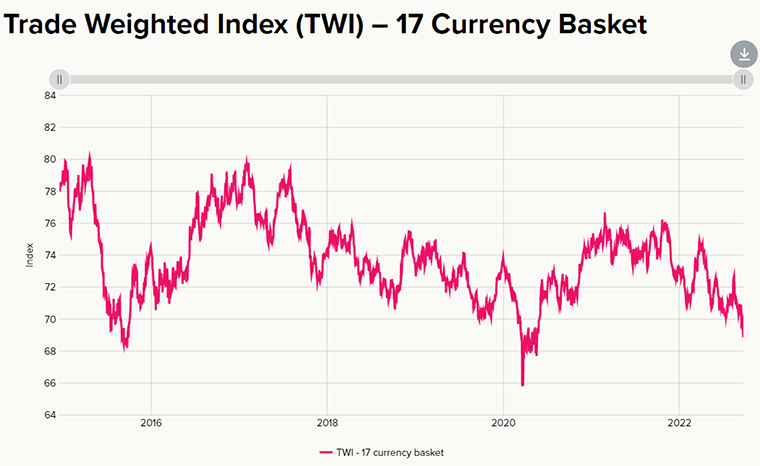
In their last monetary policy statement in August the RBNZ factored in a stable TWI currency value of 71.7 for their inflation and economic forecast period out over the next three years. Since than the NZ dollar has been sold down more heavily than many other currencies against the rampant US dollar on global currency markets. The two standout examples that evidence this is the sharp depreciation in the NZD/AUD cross-rate from 0.9000 to 0.8800 and the NZD/EUR cross-rate which has dropped from 0.6200 to 0.5900. As a result of the NZ dollar under-performance the NZ Trade Weighted Index (TWI) has fallen away to 68.8 on 23 September. The 4.0% TWI depreciation since early August and the even larger 10.8% deprecation in the NZD/USD exchange rate over the same period (0.6450 to 0.5750) has effectively loosened monetary conditions in the economy.
The TWI at 68.8 is approaching the previous record low levels witnessed in March 2020 when the world found itself short of USD’s when the Covid shock hit and in 2015 when dairy prices collapsed (refer chart below). The solace to our exporters who currently have FX forward hedged positions well above current spot exchange rates, is that these two previous spikes downwards in the TWI Index, were followed by an equal reversal upwards over the subsequent 12-month period.
The looser monetary conditions through the lower exchange rate mechanism is the opposite to what the RBNZ want at this time. The exchange rate depreciation pushes import costs upwards, thus inflation on consumer goods higher (including food). Therefore, when they report next on 5th October, the RBNZ must increase their June 2023 inflation forecast from the current annual rate of 4.50% to something well above that to reflect the much lower exchange rate value.
The RBNZ cannot just dismiss the currency depreciation as caused by US interest rates rising up to the level of NZ interest rates and therefore nothing to do with them. Their mandate is to get inflation back below 3.0%, therefore they have to take additional monetary tightening action with interest rates to stop the rot with the NZD depreciation.
Why the NZ dollar has been sold down further than the AUD and EUR
In our mid-week update commentary to our clients last week we listed a number of factors that were behind the NZD underperformance against the USD compared to the AUD and EUR. The NZD was being singled out for heavier selling due to: -
- Lower global growth forecasts for 2023. The Kiwi has some correlation to global GDP growth.
- Much lower GDP growth than Australia over the last year (+0.40% c.f. +3.30%).
- Ballooning overseas trade deficits as export volumes are hindered by labour shortages.
- The Ardern Announcement government having no new economic policy initiatives.
- NZ listed higher yielding dividend stocks no longer attractive to offshore investors as interest rates increase around the globe.
- The rest of the world perceiving that the Hermit Kingdom is not yet open again for business, investment, immigration and tourism (despite what Jacinda says!).
- The Ardern Announcement government has further estranged itself from the business community as the NZ Herald’s “Mood of the Boardroom” confirmed last week.
An additional source of NZD selling activity over recent months has emerged in the form of the NZ Super Fund being forced to reduce their NZD FX hedging on their NZ$57 billion investment portfolio, the majority of which is invested in international equities and bonds. The Super Fund operates a 100% FX hedge policy back to the NZD on both global equities and bonds (most local fund managers leave equities unhedged but have bonds 100% hedged). Therefore, when the value of their offshore investments reduces by $3.3 billion (as it has over recent months) they are required to reduce their bought NZD/sold USD hedge amount by selling the NZD. When equities ultimately recover back up, the Super Fund will increase their hedge amount to re-balance by being a buyer of NZD’s.
Daily exchange rates
Select chart tabs
*Roger J Kerr is Executive Chairman of Barrington Treasury Services NZ Limited. He has written commentaries on the NZ dollar since 1981.
We welcome your comments below. If you are not already registered, please register to comment
Remember we welcome robust, respectful and insightful debate. We don't welcome abusive or defamatory comments and will de-register those repeatedly making such comments. Our current comment policy is here.