

HOT TOPICS:   Gold   |   Unitary Plan  |    Mortgage rates

The comment stream

Reader poll

How many new houses will the Government-Auckland Council accord produce in Auckland over the next three years?

Choices
CAPTCHA
This question is for testing whether you are a human visitor and to prevent automated spam submissions.
1 + 5 =
Solve this simple math problem and enter the result. E.g. for 1+3, enter 4.

Join the Interest community to be a registered commenter so you can:
- Edit your comments
- Avoid the CAPTCHA
- Vote on comments
Register Here

Already registered? log back in here ..

Forgotten your password? No problem! Click here

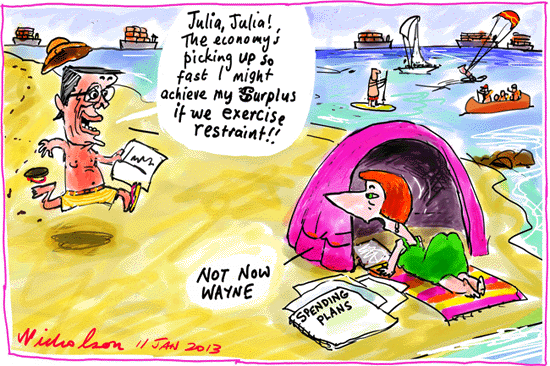
Friday's Top 10 with NZ Mint: Basel betrayal; banking a war front; a Simple bank; dodgy signature; cost and return; Pigovian taxes; Dilbert, and more

Posted in Opinion

Here's my Top 10 links from around the Internet at 10:00 am today in association with NZ Mint.

Bernard is on his summer break and will be back on January 22, 2013, from Wellington.

As always, we welcome your additions in the comments below or via email to david.chaston@interest.co.nz.

See all previous Top 10s here.
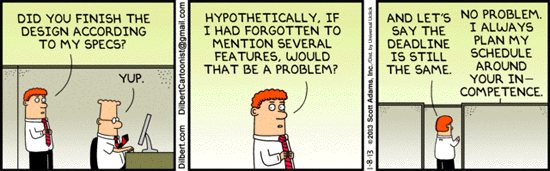
 

1. Betrayed by Basel 
British-American economist and critic Simon Johnson is spitting tacks about how and why the Basel III regulations got watered down.

He is now calling for the US to go its own way

The deeper problem with the Basel Committee is it overrepresents the euro-zone Europeans. Not only is the euro zone in great difficulty because of economic mismanagement, but its leaders are hoping to get out of their current predicament in part by relaxing bank regulation.

The idea that the Basel process is all about expertise – or smart people working out the right answers – is exploded by Sheila Bair’s book, “Bull by the Horns.” Read Chapter 3, in which she describes in convincing detail the fight over the Basel II agreement during the mid-2000s (and Chapter 4, which is more about how some United States agencies play against in each and on behalf their clients, the big banks).

What we saw before 2007 and what we see now is not officials applying some sort of optimization procedure or sensible independent thinking. Rather, this is about an industry that wants to take more risk because that is how it gets larger subsidies. And this industry is expert at playing the regulators off against each other, including across borders. The Europeans are again the patsy.

We need a financial sector that works for the real economy – not a continuation of the dangerous, nontransparent government subsidy schemes that have brought the Europeans to their knees.
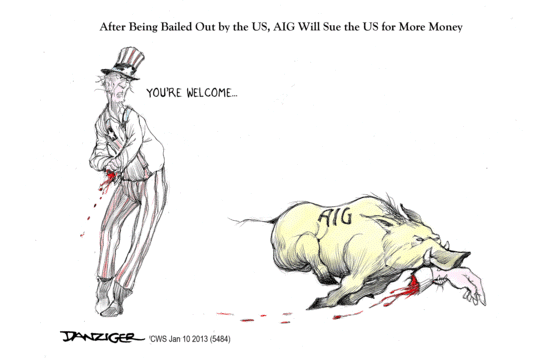
2. 'Typical' housing
Do you have a mental idea of what the "typical American home" looks like? Well, they do a big survey every two years, and the latest data is out for 2011.

The answer is that it is 170 m2, three bedrooms, 2+ bathrooms, two stories, on a quarter acre, built in 1974, with gas heating, air conditioning, and a garage. Details here »  I wonder how a "typical New Zealand home" would compare. Anyone have our data?
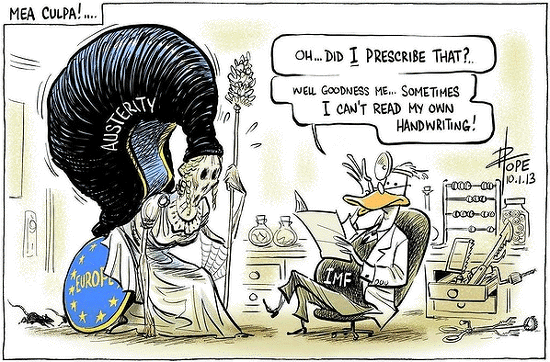
3. Its war
Iran is retaliating for the sanctions imposed on it by opening a new batttle front - by attacking American banks. More from the NY Times:

The attackers hit one American bank after the next. As in so many previous attacks, dozens of online banking sites slowed, hiccupped or ground to a halt before recovering several minutes later.

But there was something disturbingly different about the wave of online attacks on American banks in recent weeks. Security researchers say that instead of exploiting individual computers, the attackers engineered networks of computers in data centers, transforming the online equivalent of a few yapping Chihuahuas into a pack of fire-breathing Godzillas.

The skill required to carry out attacks on this scale has convinced United States government officials and security researchers that they are the work of Iran, most likely in retaliation for economic sanctions and online attacks by the United States.

​​

4. Today's raw market data ...
A quick holiday update:

as at 11:10am Today
9:00 am
Thursday Four
weeks ago
One
year ago
         
NZ$1 = US$ 0.8439 0.8398 0.8431 0.7940
NZ$1 = AU$ 0.7971 0.7988 0.8012 0.7700
TWI 75.60 74.64 75.31 70.92
         
Gold, US$/oz 1,658 1,656 1,696 1,660
Dow 13,467 13,387 13,151 13,149
Copper, US$/tonne 8,059 8,051 8,048 7,690
Volatility Index 13.67

13.81

17.06 26.04

5. Trying to be a banking disruptor
An Aussie software engineer is trying to wean people off having to use banks and is pitching his service to people fed up with them. He has discovered that you can do an awful lot with the transaction data being collected from your shopping, and this is the basis of his "better service".

Mr. Reich and a co-founder, Shamir Karkal, created Simple, an online banking start-up company based in Portland, Ore., that offers its customers free checking accounts and data-rich analysis of their transactions and spending habits.

Few entrepreneurs dare to set their sights on industries as large and entrenched as banking and expect to flourish. But Mr. Reich, 34, a professed data nerd who has built computers and tinkered with the innards of sophisticated cameras, holds a master’s degree in business and has a robust background in financial data analysis. He is confident that Simple’s minimalist approach — it promises not to charge any fees for any services — will draw fans and customers.

“Banks make money by keeping customers confused,” Mr. Reich said. “There’s no incentives to make the experience better.”
​​

6. Will this give you confidence in their currency?
The new US Treasury Secretary will be Jacob Lew. As such, his signature will be on all their currency notes. Now I have no doubt he is a very smart man, but really, he's got to be able to do better than the one he is currently using. This one is what he uses in his White House role.

7. Cost and return
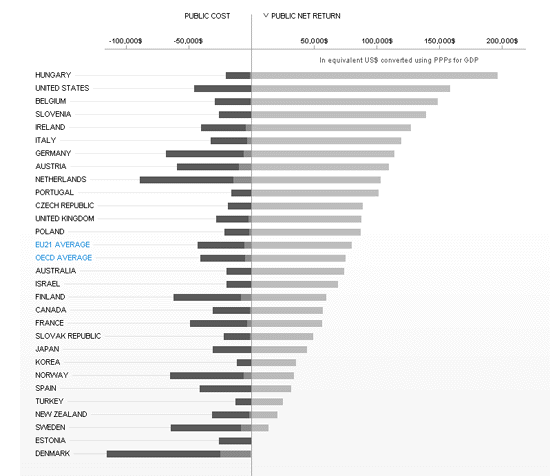
The OECD has a truly huge database on education costs and benefits across almost all first-world countries. But how to make sense of it? To solve the problem it ran a competition and this is one of the finalists. The winner is here »

This is intriguing for New Zealand - it suggests we have a low cost, low benefit system. Based on this data, we are not really getting our money's worth. Your view? Click on this graphic and explore. You can look at many things, although it does just focus on senior secondary, and teriary.
8. The price of certainty
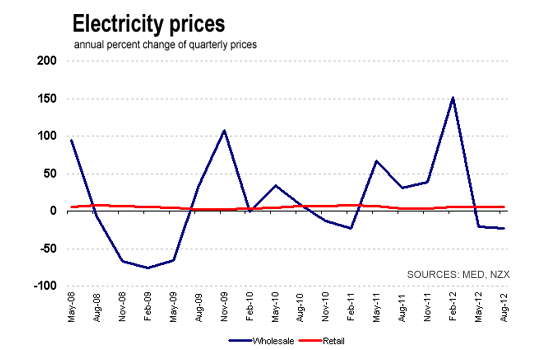
Retail electricity prices rose 5.6% pa in Q4 2012 according to the MED monitoring of all New Zealand power retailers. Lines charges rose 8.6%. Seemed high to me. We also monitor wholesale electricity market pricing on a daily basis, so I though a compaison between the two was in order. This is what I found.
9. Pigovian taxes
Adam Davidson would happily pay a congestion charge if it would only get other people off the road so that he could enjoy a less stressful journey. He explains on the NY Times:

According to an influential study by the I.M.F. economist Ian Parry, my hours on the road cost society around $10. Add up all the cars in all the traffic jams across the country, and it’s clear that drivers are costing hundreds of billions of dollars a year that we don’t pay for.

This is how economists think, anyway. And that’s why a majority of them support some form of Pigovian tax, named after Alfred Pigou, the early-20th-century British economist. Pigou developed the idea of externalities: the things we do that affect others and that the market is unable to price. A negative externality is like the national equivalent of what happens when you go to dinner with three friends and, knowing that you’ll pay only a fourth of the bill, decide to order an expensive entree. Pigou argued that there are so many damaging things that we do — play music too loudly, drive aggressively — and that we’d probably do less if we had to pay for them.

The idea of raising taxes to help society might sound like the ravings of a left-wing radical, or an idea that would destroy American industry. Yet the nation’s leading proponent of a Pigovian gas tax is N. Gregory Mankiw, chairman of President George W. Bush’s Council of Economic Advisers and a consultant to Mitt Romney’s 2012 campaign. Mankiw keeps track of others who support Pigovian taxes, and his unofficial Pigou Club is surely the only group that counts Ralph Nader and Al Gore along with leading conservatives like Charles Krauthammer, Alan Greenspan and Gary Becker as members.
10. Today's quote
"Your net worth to the world is usually determined by what remains after your bad habits are subtracted from your good ones." Benjamin Franklin

We welcome your help to improve our coverage of this issue. Any examples or experiences to relate? Any links to other news, data or research to shed more light on this? Any insight or views on what might happen next or what should happen next? Any errors to correct?

We welcome your comments below. If you are not already registered, please register to comment in the box on the right or click on the "'Register" link at the bottom of the comments. Remember we welcome robust, respectful and insightful debate. We don't welcome abusive or defamatory comments and will de-register those repeatedly making these comments.

32 Comments

As far as all this stimulus

As far as all this stimulus and austerity is concerned perhaps we should have looked elsewhere. What would people like Silvio Gesell have done to solve the global financial crisis?

For the European crisis, my guess is that he would have printed a second currency, and perhaps called this money the Euro greenback dollar.

These greenback dollars would have been freely distributed throughout Europe, perhaps more so in Southern Europe. There would be three simple laws covering the greenback
a) it cannot be used to repay debt
b) retailers must accept, when offered, at least 50% of the purchase price in greenbacks
c) customers must accept, when offered, part, or all of their change in greenbacks

These greenback euros would start off at one greenback = one euro, then every month they would loose 10 cents value. That is, after one month, one euro = 90 cents greenback, after two months, one euro = 80 cents greenback and so on. Ater ten months they would be worthless.

Silvio Gesell believes that as the greenback is continuing to loose value the velocity of turnover will be very high and so stimulate the economy.


Would it work?

MikeB - no. So many folk -

MikeB - no.

So many folk - and almost all economists - make the fundamental mistake of thinking money is either the problem, or that it can solve the problem. Money is never the problem, it's only a proxy itself, so obviously it can only be a proxy for the real problem.

The real problem is the inability to grow exponentially and forever, within a finite sphere of operations.

That goes for the planet, for NZ, and for the back paddock - the carrying-capacity is merely scaled. We are at the point where the next 'doubling' is impossible, physically, globally. Even if one more 'doubling was possible, you could pick your percentage and plot the cessation-point (3% doubles 24 years, therefore 2036, for instance). 

The fiscal system's fatal wee flaw, is that it is always well ahead of itself, in terms of underwrite. Think working-off a 30-year mortgage, even with no interest. So it was going to be in trouble growth-wise, much earlier. No amount of magic sleight-of-hand can alter the lack of physical underwrite, and untill that particular penny is dropped :) we aren't going to address what really lies ahead.

Speaking on the "doubling"

Speaking on the "doubling" and the back paddock, from someone who has back paddocks.

Unless there's a Norman Borlaug coming along every few years (and it took him many years to achieve his HISTORIC breakthrough) and in every sector.  Such "doubling is impossible.  Even now most good pastures, only produces marginally more than their maximum yields in the Medieval period.  This is because most of the plants tend to need the same nutrients, and what increases we get through insecticides and high-powered fertilisers we lose in sustainability and land damage through the increasing yield of plant growth and it's effect on its immediate biosphere.
  The increases we see are often reduction of handling losses, better usage of marginal crops (eg what wouldn't sell on a vegetable stall at an open market, can be processed into bags/group sales, and what fails there can be canned or frozen as pieces, and what doesn't make that grade can be sold as raw materials for processed goods (eg tomate sauce, juices).  We also see increases in yield as marginal land (such as swamps and river banks) were converted to productive use, fertiliser and (GrossProfit over FixedOverheads providing the yield increase)


http://www.abc.net.au/science/slab/rice/story.htm
For an easy to read idea of what happens in the rest of the world.
Government and population getting behind the producers (and manufacturers) providing equipment, research, resources to impliment those resources, reducing labour costs, subsidising not pushing debt burden on them - unlike NZ where we're losing profitability, being taxed to extinction, and reinvestment into manufacturing and production is penalised (ie speculation and bureaucracy - especially government bureaucracy, are the only growth industries).
You want to see a production yield??? Then first up you've got to stop grinding the production sectors into the ground to support the government/education/overhead sectors.


Reminds me of a scientific researcher (whom I used to go to school with).  To cover his private and government grants he fills in a YEAR, the same amount of paper work he had to do every WEEK in NZ.  He's currently in Kyoto.   NZ government needs to wake its ideas up, print money GIVE it to universities/schools and sectors that need capital growth (value add and local supply). GIVE it to sustainable development projects that give real future return (ie not f...ing social 'people investment' plans, but rail, machinery, electronics from drawing board, raw material, through to saleables.   eg The government pays good money every year for the secret to the catalyst for synthetic petroleum production whether they use it or not - print the blasted cash and GIVE it to NZ researchers and PAY for the labs to be built.  Sell max 49% of shares to NZ citizens, keep 51% of shares entrenched in the Cullen Fund. DO NOT give the money to the banks, we do not need more currency speculation or land loans, we need productive task for people to do, and production for them to enjoy.

"Inflation" of money is a misdirect. Don't be fooled by it.
Fiat "money" can be increased exponentially forever, it's just numbers.  It's the underpinning resources which cannot be exponentially (or even linearly!) increased.
The effect of this is that even though a country might look like it only has 2% growth, if much of that is in speculation or property investment or worse, from foreign imported goods - that last one means OTHER COUNTRIES have their inflation under control...not us!!!  (ie it means our currency is leaping faster than our inflation, causing "inflation" to look better than it actually is!!!)
 If those non-productive factors are favourable, and the inflation is at target, then the real value, the local economic production.....is trashed!!!!!!!!    ie 1 production + 1 speculative might = 2 inflation.... but 5 speculation - 3 local economic failure also = 2 inflation.   And we -know- speculation (eg property investment) is still rising!!

Mist - that's not so much

Mist - that's not so much bollocks, as deckchairs.


None of your assertions are causal - all are in fact secondary reactions to the major input-change.


Larger and larger amounts of fossil energy applied to all things, including agriculture.


That's it. All the 'economics' nonsense is reading what could happen - temporarily - atop that supply. You don't get it, and you don't get it in spades. Many many words but no sense.


PDK,  When you've done the

PDK,  When you've done the job for 5 years, get back to me.  Until then you don't have a leg to stand on.

The major function farming is finding is simply not enough cash (ie any capital, gets taxed to buggery, interest is high here, and costs of every especially repairs in enormous.)
  The result poor returns at the farmgate (or factory gate for manufactories) leaving little cash available for resources of any kind....jobs, paying back deck or your precious fossil fuel.

No way can an industry develop, or a business grow, let alone the doubled production, without those excess resources.  It's well known and undestandable, that steps from Hunter-Gatherer or subsistance-farming require excess resources - that means available-for-trade energy sources, and ability to free up labour.  In the modern world that means decent Net Profit after Tax.

Just to point out I am

Just to point out I am hearing you - better than most.

To use te ship analogy:

I hear you saying that if we keep the engines going at full noise, we're going to run out of what's stored on board (ie energetically efficient to use s fuel) and while biofuels might be theoretically possible it's not likely an effective system could be rigged in time, nor is it likely to provide the drive that most of the ship is designed to need.  And that you propose smaller ships, better routes (destination, lifestyle) and provision for alternate propulsion (sails, oars etc).  And to stop loading on more passengers, because just loading more crew to serve the passengers comfortably isn't going to make the ship miraclously run on nothing.

Also many people are running around saying it's old PDK and his fear of sailing off the edge of the world.

What I'm saying is, right now, those are the least of the our problems.  If our Very Important Passengers (and their multitude of navigators, captains, runners, marines, chefs, servants, room maintainence)  don't stop stealing the crews tools and spoiling their rations (by chopping a few bites of the best bits and tossing the rest) and interferring in their jobs, then that crew is going to be unable to function...and you'll never get to the fuel point ...or you'll reach it with no crew and a load of Very Important People who think they're on some going around in circles pleasure cruise...

Mist - close; step back one

Mist - close; step back one more cognitive pace........


That capital, that profit you crave, is?


Either issued debt (which relies on some future underwrite, or it's so much worthless paper) or it's real wealth, representing the doing of something, to/with something. In other words, real non-debt capital represents energy expended.


Which means your shortage of capital/profit, is actually a shortage of energy. There's a bit more to it, of course - farmers have been 'price takers' rather than 'price makers' for years, witht the exceptions of the co-op's, and ain't it a marvel how they get diluted?


We agree that there are a lot who expect income without doing anything to underwrite themselves real-time (a lawyer charging x dollars an hour, then expecting to buy a 'Beamer is a classic example - but all financial, legal, educational, health and a lot else incomes, are at the end of the day reliant on someone else doing something real. After all, they expect to buy something real with their 'income', don't they?


We all do it - but it could only be continued as a system while huge amounts of energy were thrown at it, in lieu of.


Gonna be interesting - whether we see a gradual saw-tooth descent over a decade or so (we're 5 years into the decline now) or a sudden failure of the fiscal system, under overwhelming pressure.

It's not a shortage of

It's not a shortage of energy.

It an overabundance of debt, without which the business would not exist, and it's what is demand for trade for real animals, real feed, real contracted labour, real not-made-by-me goods (eg fence posts and wire), it's real repairs to the motorbike and tractor when I have neither the time, skillset or equipment to do the task myself (eg reconstruct the gearbox in tractor).  And yes, real electricity to make the motors turn, and kept the refrigeration plant running.  These items are underwritten by energy, yes; but energy is no use to me, as I don't need the underwriting or the raw materials; I need the processed version - it's that added value, the difference between energy and useful fencepost, or energy and 100 hours of top level mechanics labour with all the tools, that I need.   There's Gigajoules in 10cu meter of cow effluent - but pouring it on my tractor won't achieve the needed result.   What I need is those resources and skills to process that energy, and time, that I don't have - and the medium of trade is money.  But if the government, bureaucrats and other "Very Important People" who add cost, but nothing to the GrossProfits, or worse act as extra expenses don't stop stealing that trade-able resource then those engines are going to crash (or the sails fray) well before we have to worry about running out of fuel.
  And the problem with Very Important People is that they think they know how the engines should work, or feel entitled to seize resources/tools of the crew, because they're "so important", and nothing else.


Many people don't expect real things for their income - information economy and all.  a movie, a nicer location, a bigger portfolio, a more expense meal/suit.  It's that in doing so they're cutting into those real resources (eg via inflation or through high taxation - an Egyptian poet could pay his taxes with a few words, where the farmer has to have a successful year or go hungry despite his years' labour).
 And the stupid part is that we are expect to overproduce real production, while doing it "on the cheap" (competition pushing price below sustainable quality, even threatening subsistance quality) and the "on the cheap" is like poor oil, it causes damage over time.  Chronic, creeping system damage that the "me, now" crowd and their graphs are not likely to notice.

It will go down like a house of cards.  We'll see a few outliers hit the fan first, then just like the GFC, a "too big to fail" will hit the fan, and with such a massive, unskilled, comfortable, demanding population, things will really go to pieces.
  Why?  Because in any system that employs checks and balances and levels of failure correction, it will even out any minor or acute corrections.  And people will keep pushing harder and for more, believing that the creaking system is working, constantly putting pressure on all the joints and seams.  And then the dam will go, several not-so-minor but not-newsworthy-emergencies-needing-attention issues will peak together, and that "freak" combo wave, coupled with the pressure and lack of understanding, and it'll break.   And it will happen, because with the way people are behaving and thinking they'll keep pushing and reproducing until it does.  (then they'll all be so shocked, and be running around saying "no-one could have predicted it"...even through it was their job to predict it, and the writing had been on the wall for years.


We can use technology, or we can reduce the population loadings.  But the former requires spare resources, and at this point in time those resources (time, energy, rawmaterials, skills) are being seized by bureaucrats, because They're So Important.  And technology only buys us time, if the underlying philosophies aren't dealt with.

Debt is an IOU, a promise to

Debt is an IOU, a promise to pay back with work/energy, or a good with work/energy in its making.

The debt has been taken out on the assumption of a return in a business as usual scenario.

Which is why I suspect so many ppl are unable to consider that there is no business as normal.  This is a human, cognitive dissonance that is over-powering it seems ( http://www.simplypsychology.org/cognitive-dissonance.html ).

Which leaves us with what happens when it becomes bleeding obvious that isnt the case.  At the micro level, the stupids that have bought yet more property, shares etc based on the assumption that there are bigger fools to sell to are going to be left with no where to go (just look atthe tulip mania or better the 1929 stock market crash for that outcome).  At the macro level, that means they and the lenders will be bankrupt, which means someone(s) going to be expected to bail them, the PAYEs by the look of it. Maybe it will be Iceland en-mass, debt jubilee seems the only way.

Then there are all the other aspects, energy and resource hoarding at National and personal level will be rife.  The onnly way this has worked out previously is cuba, the libertarians will be besides themselves at that thought......welcome to the long emergency.

regards


PDK.  I largely agree with

PDK.  I largely agree with your view on limits to growth.  But using it to explain everything is not always useful.

In particular I liked your paragraph.  "So many folk - and almost all economists - make the fundamental mistake of thinking money is either the problem, or that it can solve the problem. Money is never the problem, it's only a proxy itself, so obviously it can only be a proxy for the real problem."

But maybe sometimes the problem is too much consumption and not enough production.  Spending more than you earn might be just because of your poor decisions and attitude.   Not the limits of the planet.

Trillion dollar coins and similar daftness, are a spurious solution to a real problem.  Like your paragraph says.

You agree yet your next 3

You agree yet your next 3 paras say you do not, or certainly do not understand. The maths is very simple, expotential growth means an infinite resource, or a flat earth is needed. So when you say not enough production, what you are saying is, lets have a higher expotential curve.

Doesnt work, not for ever.

Take the biggest problem, china expects to grow at 10% per annum, that expotential function says its economy doubles every 7 years.  Where is the oil, raw materials, energy going to come from to do that?  Where is the second planet of ppl ready to buy?.  14 years from now where are 2 more planets? 

Our problem is we are now on the vertical bit of the curve and too many ppl either dont see it or dont want to, ergo there is going to be a big mess.

regards


You missed the point Steven. 

You missed the point Steven.  The exponential growth topic is the not only one in town. Thank you for the update on that one.  I don't argue with it but was suggesting there are other topics in addition. 

The USA has for years spent more tax than it gathers.  And has been warding of the inevitable. It's come home to roost.  Unreality in the discussion to the point where some talk of trillion dollar coins takes place.  And other such frappery.  Thus the discussion on Proxies etc that led off this discussion.


KH, with due respect it is

KH, with due respect it is the only one that really matters.  Its like building a castle on quicksand and keeping adding wings, its going to fall down, no matter what.

So sure lets take the US debt as an example. The entire debt is built on the assumption that the USA will pay the interest and capital back. That assumption is based on business as usual and cheap and abundant energy.   If you look at energy cost as a % of GDP when it rises to about 6% the USA goes into a recession, that was about $120~150USD a barrel in 2008.  Now we see oil at the $95~110USD mark, at that point there is little left for growth.  So really the crux is the US wont be able to pay it back, they have to default or print worthless paper, the only Q is when. Personally I would say within 5 to 20 years, hard to know really humans are involved....

In terms of the platinum coin its an artifical construct to get around an artificial construct (debt ceiling) that is being used by extremists (Republican party) to de-rail democracy.

In terms of the US debt, actually at its present level it is no immediate problem, it could actually be solved with some tax increases and simplification of the US tax code removing all the excemptions/dodges, then removing much of the prok barrel politics.  Instaeed right now the risk is flipping the world into a 1930s scale Great Depression, personally I'd like to avoid that if possible.


So many folk - and almost all

So many folk - and almost all economists - make the fundamental mistake of thinking money is either the problem, or that it can solve the problem. Money is never the problem, it's only a proxy itself, so obviously it can only be a proxy for the real problem.


That is a ripper PDK, worth keeping and repeating.

Nah - it doesn't work. In

Nah - it doesn't work. In Barcelona (or the rest of Spain), they print their own (unofficial) money there.  People just get wise too it and the markets separates into locals (who know where to get better value) and marks.  They'll vote with their feet and go to people promising not to give them junk money (or beat up people who try to offer them the junk grebacks)

the "poor man of

Yer right ! Why not try being

Yer right ! Why not try being a bit more positive this year?

 Off to Israel tomorrow, their economy is looking really good,  exports are now in excess of imports so no balance of payments issues

Have we had any mention or

Have we had any mention or discussion of the Trillion Dollar Coin yet?

http://m.theatlantic.com/business/archive/2013/01/everything-you-need-to...

Would be another great chapter in the US fiscal saga. 

Isn't that an episode of the

Isn't that an episode of the Simpsons?
Where the US prints a 1T note, and entrusts it to Monty Burns to fly to it's destination?  Perhaps Simpsons is the new Sci-Fi (sci-fi sets trends for technology)

#7 Reading the OECD

#7 Reading the OECD definition of net public benefit, NZ's figures are pretty clear explained by well educated students hitting a low wage economy. I suppose you could argue, as you do by suggesting we are not getting our money's worth, that we should not invest as much in our workforce. I prefer to argue that NZs economic incentives are all about capitals gains and minimum intelligence added bulk commodity production, rather than a productive value added sector, and the nation needs to lift it's game about where the incentives are.

Education from an economics

Education from an economics point of view is a funny good. An economics professor once told me in passing that education cannot be owned. What he meant was that a business might want to invest in upskilling a particular worker. But that worker is free to take those skills elsewhere, including competing businesses. This leads businesses to underinvest in productivity raising skills.

Individuals could choose to pay for their own skills, but they are taking a gamble on the market. They do not know what is being demanded and how many others will also be upskilling in competition with themselves.

The result is that for high skill industries to prosper their is some sort of partnership between business and government in the training of skilled workers. Thus the vision of where a country, state or other governmental area is headed is key.

For New Zealand this is a problem because historically we have relied on immigrants to supply us with our missing skills. And perhaps even more importantly our vision of what we are good at has been very farming based.

So it is no surprise that we have a low skill economy where we get very little return from our secondary and tertiary education investment.

This is depressing because our primary schooling is up there with the best. Our 15 year olds international PISA results are better than the other native english speaking countries and up there with countries like Finland and South Korea that have transformed their economies with high skilled industries.

The "minimum intelligence

The "minimum intelligence bulk commodity production" suppliers have been saying that for years.  However. One of 2 scenairos occurs: (1) It's successful and the industry and it's representatives decide they made all the wealth, write themselves big salaries and commission cheques, and buy expensive houses and imports and investment property returning little to the grassroots investment nor do they consume locally (except in minimum wage trades like restaurants/hospo) this is the fail of the trickledown which we're so familiar with, or (2) things get hard as the NZ companies are forced to actually compete and NZ trained and cultured employees are expected to Work and Earn through Cunning and Effort resulting in, again, 2 effects, they quit and join a competing economy that will pay them (without taxing/levying them to death) or it seems like work so they give up (which is what often happened in the Dairy and Power company mergers, you'd back what seemed like top employees, who when asked to compete to make the grade, took the redundacy instead... If you've ever hired a tradesman or real estate agent you'll know the story... "It didn't sell today"=="no-one walked in threw money at me and wrestled me to the ground to sign them".

Also you have to take into account that having wealth (and not working for the government/higher salaries commission) is nigh on illegal, at least strongly discouraged, in New Zealand.  This leaves very little capital after tax that can be applied to improving anything, and add the very high interest rates...

"When Matthew Fraher left for

"When Matthew Fraher left for Australia in 2000, he says, he was required to pay back as much on his student loan as his entire income, within a year."
http://www.nzherald.co.nz/nz/news/article.cfm?c_id=1&objectid=10858618

How is it possible to grow a $70,000 debt on a three year political science degree????

The dark art of deception and

The dark art of deception and mis-information.
Must have done at least 70 papers and triple degrees.

Of course, some people just can't make their mind up, enrol in a paper, get half way through, drop out and switch over to another subject, ka-ching, another course-fee.

And he brings up the hoary

And he brings up the hoary old "they got free education before the introduction of student loans - they "didn't pay a dime and they're having a go at us".

He doesn't explain what the $70,000 was for

Back then, In those days you were on a very short leash in the first year, you had to perform. Fail 2 papers, go up before the dean. A simple choice, leave or pay full fees. Back then, a lot of students WERE paying fees. Are the tertiary institutions as ruthless today as they were then?

My partners daughter is 25

My partners daughter is 25 year old. Did a 4 year BA degree (Hons). Has had a part time job since the age of 15. Paid her way herself without financial assistance from her mother. Paid her course fees as she went. Total cost just under $30,000. Graduated 2 years ago. Debt free.

While I took on a 3yr NZCE,

While I took on a 3yr NZCE, had a parttime job. then the boss demanded I do hours which conflicted with my course schedule.  and they demanded the old 110% or be fired. then the car brokedown, then I needed 4 new tyres. then I got transferred departments (from Drafting to Marketing).  Did the extra papers via correspondence, but the post lost an assignment so I failed a core paper.  Tried to do it locally, boss changed hours again, course HOD, who said "you won't need to make every class, since you've done most of it already"; suddenly became the bums-on-seats obsessor when the Polytech cracked down on truants (especially truants who passed their courses). NZQA then says my employment doesn't qualify for the Stage 4/5 requirements, and I'll need to quit my now full-time job and get "something in the industry".  I took the course because they have a 90+% hire rate for graduates.  They said they had lots of employers looking for candidates and plenty of industry contacts for those taking the course.  When you've paid your fees and are most of the way through the year, they drop the bombshell - the "employers" are anyone advertising or with a business, and the "people in the industry" are the students.  It's a course with a 90+% hirage rate...where 100% or the students have to be hired in the industry to complete the course....
  So finished Stage 3. Out on my butt. 4k in debt, 5k on student loans. no job. no qualification.
 
So tried retraining as a programmer (no job requirement for a Cert Business Computing). New Boss laid me off 2 months in (not his fault, things were going bad). Had to get new job. car and rent costs really adding up, hold out for 6 months, trying to get to all the "presentations" and "group meetings" assignments. Trying to make ends meet with own business.  Get programming contract, pays on delivery. get part-time "assisting" job, no pay but perks good. It's at retail outlet. Big Boss fires one friend, the other starts his own business, I'm taken on full time. Still doing programming project. Borrowed software crashes (couldn't afford hardware upgrades - remember "Stacker" program) entire project destroyed during backup process.  Hard copy takes forever to re-enter.  Project company Restructures, project now obselete. HOD on course who said "only need to make it to exams", backs down when course tutor refuses to allow me into exam room.  Then they restructure the course, those with a full years completion get a credit, those with partials have to pay $500/module to be "assessed".  Big Boss and me manage to sell the store to a new franchisee, who turns around and offers me half of the sod-all I was getting before, but with enforced full-time hours.  So out on my butt again. 2k in debts, 8k more in student loan, and not able to get rest of student allowance as my attendance was too low. Passed all the modules I was allowed to sit.  Big Boss was cool guy, gave me a computer motherboard and CPU as thanks for store sale.
Still no job though. 10k remaining in student loans, took 6 years to pay off.


So real glad your partners daughter got a good job, that paid enough to get by, and had suitable hours, and that people were emotionally supportive enough.  But please don't confuse it for the norm.

9.Pigovian taxes. I'm all for

9.Pigovian taxes. I'm all for it. Let's begin with taxing economists millions and millions, per year, each, for their "externalities".


9.Pigovian Taxes. Pigou was

9.Pigovian Taxes.
Pigou was an idiot.  To whit: 4 people go to dinner, one orders more than the others knowing that he'll get to split the cost (i.e. seeing all the advantage for himself)  but what Pigou ignored was in such cases the market DOES figure that in.  Because next time, it will just be a dinner for 3.
  The importance, is that with the market, such "Externalities" operate through choice.  Use the Imperialist power of taxation, and choice is removed, there is no way to use taxes or even the liberalists "buy your freedom taxes/fines" to even that playing field - this is due to the way the taxation is levied.  It targets the choice of someone with an advantage (perceived as a social debt, by other "diners") and destroys it, by making it undesireable/expensive/effectively "illegal".  By removing the advantage it does not repay the other 3 diners, it just makes all 4 poorer (they all end up eating government approved soup kitchens).  The social "advantage" that was being enjoyed is seized via Imperial fiat, and discarded into the mindless machine that is governance.  Even it was a financial windfall, say an inheritance that a frugal benefactor had hoarded over their life by not buying such externalities, then the governance machine, will remove it, and spread it amongst it's creaking thousands of wheels that it will be worthless...especially given that the power of creating such a windfall and spreading it is already plentiful should such a system be used for productive use instead.

The ONLY time such "Externalities" apply, are when cases like those touched on by the RMA or by the police/cyfs.  That is when ones' personal advantage (freedom) is used to materially/emotionally detriment others.   Despite what PIGou and others think, one person's advantage is not anothers loss.  However, another persons' loss is not a Right we wish to Extend to casual life.

#5 Are banks an

#5 Are banks an unnecessary evil.??

Firstly is their function able to be replicated through other means?

Can a more transparent and less self serving system be set up?

Can we structure a financial centre or money exchange that carries out the required function and benefits NZ more?

would NZ society be better off with such a system?

Answer ?.........

The difference between

The difference between entre­pre­neurs and man­agers (according to MIT brain scan research)- Managers use half their brain, entrepreneurs use all their brain.
http://www.networkworld.com/community/blog/why-entrepreneurs-innovate-be...