

Here's my Top 10 links from around the Internet at 10:00 am today in association with NZ Mint.
Bernard is on his summer break and will be back on January 22, 2013, from Wellington.
As always, we welcome your additions in the comments below or via email to david.chaston@interest.co.nz.
See all previous Top 10s here.

1. China data dodgy?
More and more analysts are having doubts about Chinese export data. A mathematical tool devised by an American physicist in the 1930s underscores doubts about the quality and reliability of Chinese economic data, according to research by an ANZ economist.
The results are based on “Benford’s Law,” which holds that in any series of numbers, certain patterns will be found only if the statistics are naturally generated.
The rule, created by former General Electric engineer Frank Benford, suggests patterns for the first and second digits in a numeric series and can be used to detect phony data, said Li-Gang Liu, ANZ’s chief economist for Greater China.
Benford’s work has already been adapted to show Greece should have been suspected of manipulating its data before the European debt crisis and that now-jailed financier Bernard Madoff was overstating investment returns.
The ANZ economists studied China’s annual nominal gross domestic product data from 1952 to 2011 to measure how frequently numbers from one to nine appeared as the first digit. While the 24 occurrences of "one" is higher than the 18 suggested by the rule, the economists said the statistics largely abide by what Benford’s Law allows. The same is true of industrial production data.
2. Abe wants inflation at 2%
Japanese Prime Minister Shinzo Abe is looking for a "bold policy leader" as the next Bank of Japan governor as he aims to end deflation in Japan and drive a recovery from recession. More from Reuters, via the NY Times:
Prime Minister Shinzo Abe said the Bank of Japan (BOJ) must set a 2 percent inflation target and make it a medium-term, not long-term, goal to show markets it was determined to pursue bold monetary easing to end nearly two decades of deflation.
The government is negotiating with the BOJ to issue a joint statement this month to make the central bank accountable for achieving 2 percent inflation, double its current price goal.
"The BOJ basically says it sees 1 percent inflation as a loose goal. That doesn't show it's responsible to achieve it and doesn't show its strong determination," Abe said told public broadcaster NHK on Sunday.
"The statement must say clearly that 2 percent is the target. That would lead to fundamental changes" in the way it guides policy, he said.
3. The middle income trap
The rise of emerging markets is prompting economists to ask how long their growth spurts can last. The answer is until per-capita income reaches $10,000 to $11,000 and, once growth resumes, about $15,000 to $16,000 as measured in 2005 dollars, according to three economists including Barry Eichengreen of the University of California, Berkeley.
The economists found countries tend to experience slowdowns at two different income levels.
Middle-income countries may find themselves slowing down at lower income levels than implied by our earlier estimates. Slowdowns are most likely in emerging markets with high old-age dependency ratios, strong investment rates and undervalued currencies that lower incentives to move up the technology ladder. These patterns will presumably remind readers of current conditions and recent policies in China,” it said. China’s per capita GDP was $7,129 in 2010.
Still, China has slightly higher average years of secondary schooling than the median and a greater share of high-tech goods to exports, suggesting less risk of a slowdown. Countries accumulating high quality human capital and moving into the production of higher tech exports stand a better chance of avoiding the middle income trap.
4. Today's raw market data ...
A quick holiday update:
| as at 11:10am | Today 9:00 am |
Friday | Four weeks ago |
One year ago |
| NZ$1 = US$ | 0.8363 | 0.8447 | 0.8463 | 0.7935 |
| NZ$1 = AU$ | 0.7941 | 0.7975 | 0.8025 | 0.7697 |
| TWI | 75.03 | 75.71 | 75.46 | 71.14 |
| Gold, US$/oz | 1,658 | 1,675 | 1,696 | 1,641 |
| Dow | 13,493 | 13,486 | 13,149 | 12,467 |
| Copper, US$/tonne | 8,071 | 8,117 | 8,001 | 7,966 |
| Volatility Index | 13.36 |
13.49 |
16.34 | 22.20 |
5. A Buffett guarantee
Batty Liu recaps her Bloomberg interview with Berkshire Hathaway CEO Warren Buffett in which he guaranteed that banks will no longer be trouble for the United States.
The banks will not get this country in trouble, I guarantee it.
The capital ratios are huge, the excesses on the asset side have been largely cleared out ...
6. Helicopter money
Central banks may need to allow a dilution of their independence during periods of economic stress.
That’s according to a paper titled "Helicopter Money: Or How I Stopped Worrying and Love Fiscal-Monetary Cooperation," by Paul McCulley, a former managing director at PIMCO and Zoltan Pozsar from the Federal Reserve Bank of New York.
When companies and households are cutting back, monetary policy will flop if it’s aimed at boosting private demand for credit. The solution is to embrace fiscal stimulus and have the central bank communicate that such measures should be encouraged until the deleveraging finishes.
The lesson here is that central bank independence is not a static state of being. Rather, it is dynamic and highly circumstance dependent: during times of war, deflation and private deleveraging, fiscal policy will inevitably grow to dominate monetary policy.

7. Class war abates in US
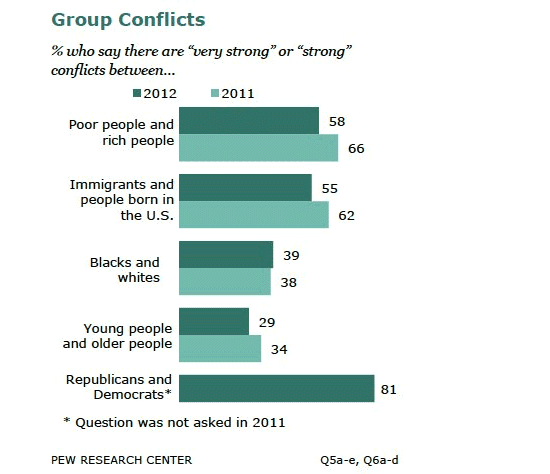
Here is a quick summary of changing US attitudes about conflict in society. Of note is that the 'old' vs 'young' contest seems to not only be waning, it is also not a major one there. It is well worth clicking through to the detailed reports.
Anyone got NZ data?
8. Will we benefit?
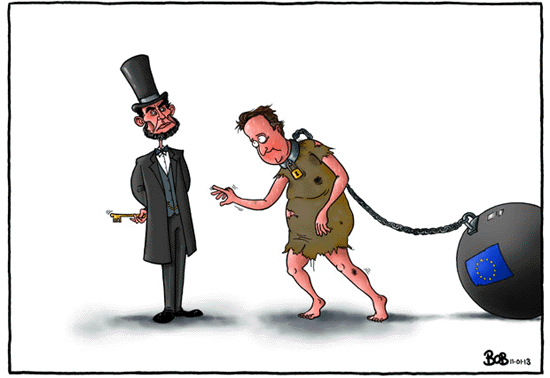
Beef production in the United States is expected to decrease 4.8% in 2013, the second largest year-over-year decrease in 35 years, trailing only the 6.4% drop in 2004. More from ScienceDaily:
The reason is a combination of mostly steady carcass weights and a projected 5 percent or more decrease in cattle slaughter, said Derrell Peel, Oklahoma State University Cooperative Extension livestock marketing specialist.
"Many analysts expect the 2013 numbers to be followed by a 2014 decrease of 4.5 percent or more," he said. "These two years would represent the largest percentage decrease since the late 1970s."
Choice boxed beef should move above US$200 per hundredweight in the next few weeks. Beyond that, Peel believes it will be a question of how much and how fast retailers can pass along the higher wholesale prices to consumers.
"It is not really a question of whether retail prices will go up but rather a question of how much and how fast," he said. "Beef demand remains the biggest unknown in the beef industry. Time will tell just how severe the squeeze will be on industry margins in 2013."
9. Pollution campaign
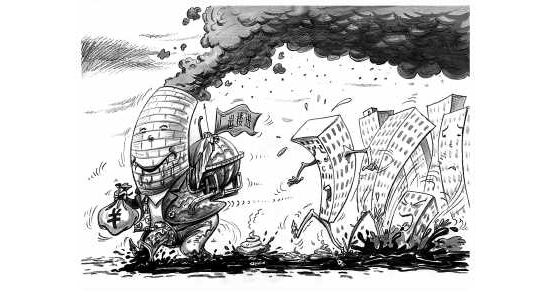
It might not be obvious why I have included this particular cartoon, but it is remarkable in its own way. It is from the Peoples Daily in China, and was used on their front page as part of their [very] new campaign against soil polution. Probably its a campaign against pollution generally, but the story focussed on the frightening legacy fast development has left all across China with contaminated soils and groundwater. A huge problem, and obviously the officials at the head of their government are ready to shame those industries doing the polluting. This cartoon illustrated a strong "Guest Comment" in the paper.
Polution in Beijing over the weekend has been unbelieveably bad. Someone suggested it would have been safer breathing a car exhaust directly.
10. Today's quote
"The safest way to double your money is to fold it over and put it in your pocket." Kin Hubbard
We welcome your comments below. If you are not already registered, please register to comment
Remember we welcome robust, respectful and insightful debate. We don't welcome abusive or defamatory comments and will de-register those repeatedly making such comments. Our current comment policy is here.