

A new look at the rate setting history of the Reserve Bank of New Zealand using the well-respected Mankiw Rule suggests our central bank may need to raise rates fairly aggressively through to the end of 2014.
The RBNZ has held the Official Cash Rate low for a long time. It has been at 3% or lower since March 12, 2009. It is currently 2.5%.
Some people think it should go even lower to stimulate an economy that they see as struggling.
Some think the focus should shift to "employment"; some to the "exchange rate", managing it down to help our export sector.
But it is Graeme Wheeler who will decide its future direction. He has given every indication that he will maintain a focus on managing "inflation" between its target bands.
Taking him at his word, a possibility opens up to forecast where the OCR might go in the future.
Every bank economist - and a few others - do their own forecasting.
But we were impressed by a Research Note from ASB's parent Commonwealth Bank Australia (CBA) who have tried to simplify the process by using a variation of the Taylor Rule. In fact, The Taylor Rule has been simplified even further by heavyweight Harvard professor, Greg Mankiw (pronounced MAN-Q). (HT to Martin R for the link.)
In 2001 Mankiw wrote a paper on monetary policy in the 1990s. In it, he estimated the following simple formula for setting the federal funds rate:
Federal funds rate = 1.4 (core inflation (y/y) – unemployment rate) + 8.5
Core inflation was calculated as the CPI inflation rate (excluding food and energy) over the previous 12 months, and unemployment was the seasonally-adjusted unemployment rate. The formula was derived by using the same coefficients for CPI and unemployment. The parameters in the formula were chosen to offer the best fit for data from the 1990s. Using the CPI and the unemployment rate to model the cash rate is logical because the Federal Reserve’s mandate is stable prices and maximum employment.
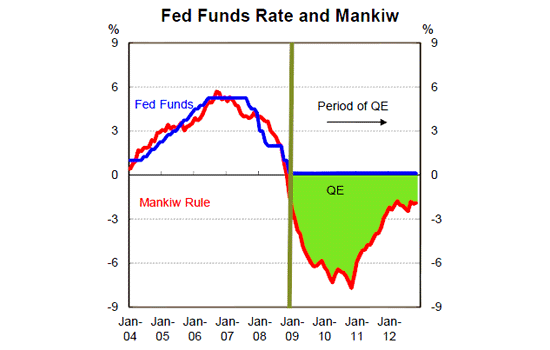
The CBA economists updated the calculations for the US and found the Mankiw Rule interest rate turns negative from December 2008. This is when the Fed began QE, which is exactly what the model indicates should happen if the previously observed relationship holds. Indeed, the US Mankiw Rule interest rate has been negative since December 2008, implying that QE should be the Fed’s course of action which is exactly what we have observed.
By any measure, the Mankiw Rule is a very good explainer of US Federal Reserve rate setting policy.
Then the CBA economists ran the same calculations for Australia.
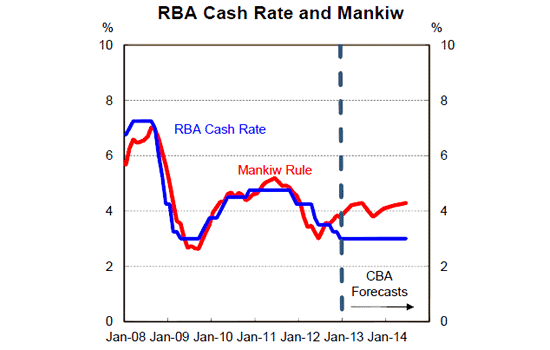
This time they also got a close fit between the Mankiw Rule model and what happened - but got a bit of a surprise when they added their forecasts for inflation and unemployment.
When they did that, the model suggests strongly that the RBA will raise rates to about 4.25%. This is different to popular expectations that Governor Stevens will lower them again soon.
So we decided to run the same Mankiw Rule model for New Zealand. This is what we found.
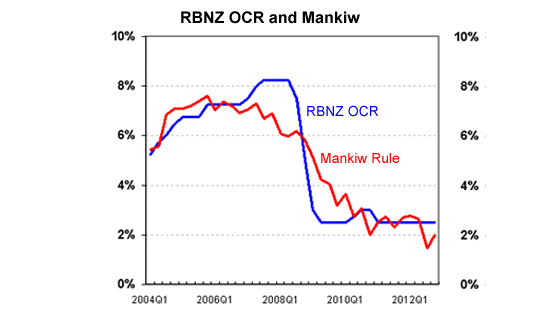
Again Mankiw explains the RBNZ rate setting decisions pretty well. Maybe Alan Bollard did not need to be as aggressive in his 2009 rate cutting, but Mankiw shows he was probably too late in starting the reductions. And he ended up where Mankiw suggests he should have targeted.
What we did next was add the average of the quarterly forecasts for inflation and unemployment from ANZ, BNZ and Westpac to the model. We use these forecasts because the are quarterly forecasts, whereas the other bank economists (while similar) only have annual forecasted values available online.
Now it gets interesting.
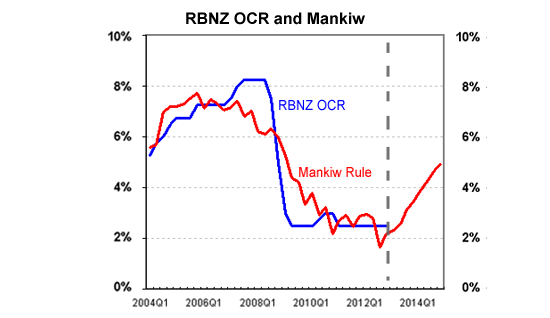
What we see is that while there is a current case for Wheeler to cut the OCR (probably all the way down to 1.5%), he may quickly then need to reverse course and raise it.
In fact, the Mankiw Rule suggests the RBNZ will probably need to keep raising it until it gets to almost 5% by about the end of 2014.
Your view?
Updated: Spreadsheet with workings attached
We welcome your comments below. If you are not already registered, please register to comment
Remember we welcome robust, respectful and insightful debate. We don't welcome abusive or defamatory comments and will de-register those repeatedly making such comments. Our current comment policy is here.