
 By Bruce Wills
I was left naked this week.
No I have not suddenly joined some farmers' naturist club but I am talking about my mobile phone.
In my rush to get to Wellington I was half way to the airport when I had a dread thought, felt my suit jacket then realised, I had left it on my desk at home. There was no time to turn around so for the past few days I have returned to an era before mobile telephony.
It is only when you go off the grid that you realise just how dependent we have all become on that little marvel of technology.
In my lifetime I have seen the stuff of Maxwell Smart and Star Tre become much better than that envisaged by science fiction.
Ironically, we seem to be returning to thin bricks these days, given 3G and soon 4G phones, will seek to maximise screen size for entertainment and the web experience.
Of course, I would have just liked to have a phone but since I was hundreds of kilometres from my SIM card that had to wait. It made me think that the old CDMA network may have had some redeeming features after all. Of course there will be messages, indignant ones at that, so if I didn't get back to you, sorry!
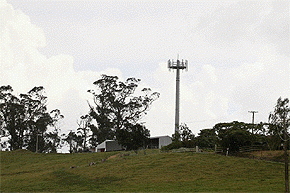
Wireless telephony and data is perhaps the answer to getting rural broadband out to where we need it most; in our tractors and in the field.
The brave new world of wired rural broadband is coming but is seemingly costly and far from rapid. In 2017 we may, if we are very lucky, be where Wellington was in 2010.
Just as our rural councils demand a fairer share of Road User Charges, given rural contributes over 50 percent but gets only about 30 percent back, broadband needs to start where economic activity starts.
I understand it will cost a rural school something like $300 each month just to connect to rural broadband. How many single teacher rural schools can afford close to $4,000 per annum for this? It also seems disproportionately higher than what urban schools will be paying.
Broadband is not just for us farmers but our local companies, communities and schools. Our children and our families deserve equality but if we want serious economic development that is distributed rather than just concentrated in a few select urban pockets, we need to unleash our full rural inventiveness.
The current ‘solutions’ seem far from ideal when the likes of Jeanette Maxwell, Federated Farmers’ meat and fibre chair, can almost see a cabinet but cannot connect to it. Her farm falls in the proverbial no-man’s land comprising a satellite ‘shadow’ created by Mt Hutt and weak mobile 3G, even with a yagi antennae. She has broadband of sorts on copper but it is not rapid or reliable.
With the move to e-filing and e-government along with the National Animal Identification and Tracing Scheme, Jeanette isn’t alone being technologically frustrated.
While my phone sits at my farm, the new features we have don’t quite make up for patchy 2G technology that is voice.
Dropped calls waste time and cost us money, but there is no slack cut for us in rural areas. There are holes in cellphone coverage something I know from driving around the Hawke’s Bay. If we can’t get 2G reliably then it doesn’t bode well for 3G or even 4G.
To us, rural broadband ought to be about breaking down barriers because the web makes the world smaller. It is also about productivity and new tools for us to become better farmers.
Frankly we have no conception of where things could head.
Somewhere, someone will be creating an application or program that will have that Eureka factor. It would be great to think it is a kiwi.
While fixed line broadband is great and will be welcome, the reality is that wide area wireless coverage is better as it delivers coverage in the field.
Another thing that strikes me is how close we are to going cashless. Aside from EFT-POS there is a big trend emerging towards stored value cards or cashless wallets.
A big issue facing many smaller rural centres is the loss of banking services and after the banks have left, even remote ATM machines are now coming under threat.
One potential solution for our rural communities is to move quickly in adopting cashless wallets. Indeed it may be driven by simple expediency with the loss of banks and cash machines but that comes back to having the internet; wired or wireless. The internet is the enabler.
I honestly never thought that leaving my phone would get me thinking so hard about where we are and where we could go.
We talk much about being a world leader on many things, so how about starting with technology coming out from our farms, orchards, forests and trawlers.
-------------------------------------------------------------
Bruce Wills is the President of Federated Farmers. You can contact him here »
16 Comments
Thought we were doing the right thing for the environment - decided to put in a soil moisture probe so we can use effluent irrigation at the best time for soil moisture conditions. Well, it is one of those theory and practice difference things. Sounds great in theory. Was assured we had good enough mobile reception for it to send the data to the web based app that we need to access - even though we told them mobile was crap. So went ahead and spent around $4k on a system and calibration of said system.
Had a few teething problems - as you do with technology at times. Then it worked well for a whole week - yay! Then vodafone upgraded their system. Since the upgrade the data is no longer being sent to web. Phoned the contractor a few times, finally got told - we are going to try a more powerful aerial. I've given them a deadline of end of next week - if it's not up and running reliably by then they can take the whole thing back.
The problem for rural folk with been 'the end of the line' for robust mobile and broadband, in our situtation, is that Regional Councils are looking to make technology like soil moisture probes mandatory. It's all well and good in theory, but when in practice our mobile/internet is worse than some third world countries, 'it just ain't goin' to happen in some cases'.
On arrival in China a few years ago the number of people with mobiles and no landlines really stuck out to me. Then the penny dropped - it was cheaper to install cellphone towers to get the population connected than running miles and miles of copper wire out to the populace. I can't understand why the govt has gone for a fibre roll out to the rural masses. Most rural people I know are very underwhelmed by it all - we can't wait 5 years, so when it does come, it is going to have to be priced right for us to take it up.
Mobile and internet in significant parts of rural New Zealand is no better than third world - unless you can afford to pay large sums of money per month. I was phoned and told I could get a better deal on internet and landline-$35 pm and 2gb. I currently pay $80 for 1gb on wireless at home and on the farm $120pm for 6gb . When I finally could get a word in, I said to the telemarketer - you do know we are rural? 'Oh, well in that case we can't offer you anything better than what you are getting'. How is a young rural (non farming family) family supposed to be able to afford internet at those prices?
You choose to live in the wonderful rural landscape, get over it.
Funny thing but you and the farmers whine about too much tax or not good enough prices for your produce but when in a free market you dont get it cheap enough you whine again and expect to be subsidised by others.
regards
Water well the urbanite is wrong, using potable water the water plants is crazy....bet he/she does that as he/she whines about you doing the same.
Compliance costs, yes I agree Im mystified why there should be effectively a compulsory requirement to have broadband, but then I think councils are all in la la land. They cannot be sustained, cant see them being here in 20 years and probably not functional in 10...
and no broadband isnt essential IMHO....though the rest if the family think so.....to me its like TV a luxury....
regards
I presume Steven you are all for Aucklanders to pay for all of their roading infrastructure and the like instead of the rest of us paying for it through higher petrol taxes.
Yes.
regards
steven I understand that you are IT competent. Please explain this for me:
On a mountain top there is a wireless transmitter enabling internet connection so long as you have line of sight and the correct aerial equipment. The area from mountain to sea is completely flat - no hills. Within this area are two small communities (9500 & 1500pop) surrounded by lifestylers and farmers. Why would the lifestylers and farmers have to pay more than those in the small communities for internet, off the same transmitter? I have never really understood why, people accessing the same transmitter for the internet, should have such a huge difference in cost of receiving the same service. What from a purely technical point of view would justify this?
From what you say here I'd assume its price gouging. The provider has a monopoly and is assuming lifestylers and farmers are rich enough to pay more. From an IT perspective, nothing to justify a price difference I can think of....but networking and wifi is not my area of expertese.
NB IT is like engineering non- ppl somehow expect anyone who does IT or engineering to know the total subject, you cant. Its simply to vast and complex for that...but our head networking techy might know, I will ask as Im curious as well.
NB I use 3g same price inside say Blenheim v outside....so I dont understand your situation.
regards
Thanks steven. Mobile broadband via a usb isn't an option due to lousy mobile reception. I am referring to wireless like what Orcon provided, though it doesn't offer any rural broadband anymore. It is different from usb broadband.
The price gouging to some rural communities is what I was attempting to imply in my first comment. That is what is unacceptable to me. Netsmart (www.netsmart.co.nz) will hopefully be available where I live soon - can't wait for it, so I can ditch my current provider. :-)
It can be frustrating to know that there is technology available to us especially in the fields of effluent management and water management that we can't use because of lousy mobile and/or internet connection. Ah, well, such is life I guess.
I had a chat to my networking guy and we know that 3g is directional (I didnt realise just how much so). So its possible that each pole/tower's payback would depend on the number of ppl using it. The townships could have directional service so 1500 using one tower would be cheaper for the provider than say 5~10 farmers using a tower in a different direction. But a farmer/lifestyler in the 1500s path should be using the same tower so should be the same cost/price...........
This same thing could apply to Orcon's service. NB My few contacts with Orcon has been they are un-pleasant price gougers and best avoided, they wanted a crazy sign up period for UFB and huge penalty if you wanted out, I declined.
Very line of sight....but interesting.....
http://www.netsmart.co.nz/broadband/index.cfm?page=coverage
regards
Thanks mist for the explanation-quite a bit more to it than I thought. Not sure how it all gets there. To be honest I was quite surprised Orcon supplied wireless to the area I live in, when I moved there. But then there are the two mills in Kawerau, Fonterra in Edgecumbe and the mill in Whakatane, so perhaps they are the ones who justified Orcon being there. The transmitter sits atop Mt Edgecumbe and I know that that is where we receive our signal from (had to top some trees in order to receive signal). My Orcon wireless is now a 'grandfathered service', and hasn't been available to new subscribers for some time. Will give them credit for being a reliable and stable service transmission wise. I'm loathe to connect to any 'landline' type service - water seems to get in to phone lines when we get a really good rain and knocks them out for a while. Friend on the westcoast found having sattellite internet a boon when their lines went down for around 4 days last week. At this time of year on the farm there is so much work re herd records to be uploaded they were grateful not to be relying on a 'landline' internet system.
While I agree with some of what you say, mist, there are some gaps. I live in HK and this is one of the most internet savvy places on earth. There is economy of scale of course - seven and a half million people - and we run three computers almost around the clock, xtra fast broadband, no data cap and pay about $2 NZ a week total.. It's virtually free. Economies that can tap into this type of communication tool at this level leave an economy like NZ's for dead.
The internet as an educational tool is now essential. Libraries that don't embrace it will go the way of the Dodo, already book issues are falling significantly. Local govt needs the net as much as central govt. Today it's indispensable. Farmers need it too for compliance issues and I'm sure will develop new inventive ways to use it productively. Cost and availability though are big issues.
From what was said I'd assume its the same transmitter doing the townships as outside so I cant explain it in iT terms....but yes if its rural v urban its the same kit divided by 2000 users of 20,000 users its just economics.....plus the location, cables and generator to backup the rural kit would make it more expensive to put in.
As far as I know most libraries these days do free wifi? I know say Blenheim's library does....
regards
The problem for mobile broadband in NZ is the lack of wireless spectrum and the density of subscribers in rural areas. I'm afraid that the economics are unlikely to ever stack up for rural folk that mobile (or fixed) internet will the same price as in metropolitan areas unless the government subsidises the network rollout massively. The government RBI initiative should provide some small improvement but based on the figures I've seen the mobile operators are unlikely to be investing in large scale infrastructure for rural mobile broadband - there simply isn't the return on investment.
I wouldnt say lack of spectrum but lack of payback......
regards
Shhhhhh, don't let Gerry Brownlee hear you, he'll call you a moaner. After all the government spent thousands of dollars on building you a cycle way. That's far more important than broadband. What more do you want?
That's rural's new "broadband system, each bike carries a packet to the end users and returns the empty.....so about a letter a day....
regards
We welcome your comments below. If you are not already registered, please register to comment
Remember we welcome robust, respectful and insightful debate. We don't welcome abusive or defamatory comments and will de-register those repeatedly making such comments. Our current comment policy is here.