
 By Bruce Wills
Assumption is a dangerous thing and we are all guilty of it from time to time.
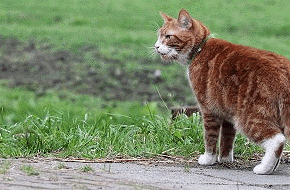
That includes Gareth Morgan looking sideways at my farm cats.
While our farm has three National Trust covenants, it is really only since 1080 knocked back possums that we have seen native birdlife ‘take off’.
Not that this has affected our cats, who seem more preoccupied with rats, mice, rabbits and sleeping.
Morgan assumes if you strike out cats then birds will flourish. That overlooks other introduced and more destructive predators like rats and stoats.
A Wellington ecologist, John Flux, actually studied his own cat for 17 years publishing a paper on it in the NZ Journal of Zoology. While there was some collateral damage, 54 native birds in fact, his moggy killed 221 mice, 63 rats, 35 rabbits, 4 hares and even, two weasels.
While the real toll will be higher, he told Campbell Live that what matters is the ratio; cats prefer small mammals.
Flux challenges the assumption about keeping cats in at night because that is when they hunt rodents. It also fits with what I ‘find’ on my farm.
Similarly, DCD (Dicyandiamide) based nitrification inhibitors arose out of the considerable pressure to introduce solutions for diffuse nitrogen (N).
The assumption of sustainability advocates was that farmers were being cheap and anti-environmental for not jumping at these inhibitors.
The reality is that Kiwi farmers prefer to be at the cutting edge, rather than the bleeding edge of technology.
Magic bullets are rare in any field of life; farming especially.
We still have much to learn about soil science and as my Vice-President, Dr William Rolleston noted, “the current pause in DCD use reminds us that we need to ensure the regulatory system is up to date when we use and then test for new products, even if they are considered safe”.
Solutions will come but the ones that work and have widespread adoption will take time.
Assumption has even popped up in the current Horizons One Plan.
The one that saw Gareth Morgan swallow a ‘Mr Angry pill’ then pour invective onto his blog about Federated Farmers.
New Zealand faces big challenges meaning we need big solutions; diffuse nitrogen being one example.
We need people like Gareth Morgan to channel their energies into making New Zealand a richer place in every sense of that word.
As farmers, we welcome creative workable ideas especially around meat and fibre which is not performing anywhere near its true potential.
In that respect our door remains open to Morgan as we hope his does too.
With Horizons One Plan, you may be surprised that I believe the Environment Court is right about farm working expenses increasing by 5–16.6 percent. But the Ministry for Primary Industries is also right when it says this will see farm profitability fall by upwards of 43 percent. We believe the Court and some of our critics have failed to appreciate the effect farm working expenses has upon farm profitability.
If we use DairyNZ’s DairyBase report in a good season, like 2010/11, a five percent increase in farm working expenses before interest and rent, reduces dairy farm profitability by 9.6 percent. If these expenses increase by 16 percent instead, profitability before interest and rent dives by 30.9 percent.
Once you start adding in the interest and rent most farmers pay, things look bleak slashing profitability by 20 percent and over 60 percent respectively.
Scarily, if One Plan had operated over the 2008-2011 seasons and a farm’s expenses had increased by 16 percent, it would have made a cumulative loss of 79 cents per kilogram of milksolids.
While extensive sheep and beef farms are not yet captured by Horizon’s nutrient loss rules, a policy track suggests this is more ‘when’ than ‘if’.
Plotting 2010/11 against Beef + Lamb New Zealand’s Taranaki-Manawatu report, means a five percent increase in farm working expenses drops sheep and beef profitability by 12.6 percent.
If farm working expenses increase by 16 percent, farm profitability goes down by a jarring 39 percent.
Given all farm incomes are market driven and variable, if we choose a poor season like 2008/9 and apply a five percent increase in farm working expenses to sheep and beef farms, profitability then falls by 26 percent. But if farm working expenses in that season had increased by 16 percent instead, farm profitability would have collapsed by 82 percent.
You see the impact upon intensive sheep and beef, arable farmers or vegetable growers has never been examined.
Horizons also never considered what the social impacts of One Plan will be on the towns and cities within it; that only came to light during the last Environment Court hearing.
While some may believe it “will not be the thing that drives farmers out of business,” that is not the Environment Court’s view and our analysis suggests why.
With Horizons at the ‘bleeding edge’ it could introduce a variation today in order to go back to 2010’s ‘cutting edge’ Decisions Version.
The real question should be, why not?
-------------------------------------------------------------
Bruce Wills is the President of Federated Farmers. You can contact him here »
4 Comments
You are spot on Bruce:
Assumption is a dangerous thing and we are all guilty of it from time to time.
So here are a raft of dangerous assumptions - this time from from David Carter - that you could really get your teeth into as you have a great example close to where you live with the Ruataniwha Water Supply Project:
"Reliable irrigation represents a major step in unlocking economic potential for New Zealand, having our tradable sectors growing strongly and delivering on the Government’s economic growth goals. “It will also be better for the environment, as these schemes will lead to more efficient water use, and can provide for the replenishment of aquifers and the restoration of stream and river flows,” Carter says.
http://www.interest.co.nz/rural-news/62828/new-crown-company-big-irriga…
Come on Bruce, Anders Crofoot, a Federated Farmers National Board member has made some very relevant comments, and even made them before David Carter's press release:
http://www.interest.co.nz/rural-news/62758/anders-crofoot-finds-gullibl…
For me, as a farmer, I do not wish to incur costs unless I know it will benefit our farm and the environment.
Just because it is printed doesn’t mean it is true.
Just because someone says it, doesn’t mean it is so.
Just because we see something doesn’t mean we should believe it.
Demand evidence before making decisions or publishing claims. This is why the media need to retain a healthy scepticism to claims, the same one it seems to show towards farmers.
So please Bruce don't go coy on me just as we get close to the mother lode of dangerous assumptions. And make no mistake, irrigation projects and the Ruataniwha in particular are built on a whole raft of them. O.K, not just assumptions but with a few big lies as well.
I can understand that the range and scale of dangerous assumptions for the Ruataniwha Water Supply Project may make it difficult to know where to start. I suggest that you initially limit your quest to Ruataniwha, leave the big lies to last and start with the one David Carter paragraph I quoted.
The unfortunate fact, BW, is that Councils of all descriptions are economically clueless. I've ranted about just this at length, but it's a structural issue without clear solutions.
And the essentially adversarial nature of the consents and hearings processes, do little to tease out middle ground on which compromises can be made.
When I say 'structural', I mean that the staff, their academic background, the culture in short, are the issue. Councils tend to attract staff with Good Intentions, who then discover to their delight that they actually have real power. And the temptation to use it runs into Lord Acton's quote, and corrupts them. Not in the back-hander, buy-yer-way-outa-here type sense (That would, actually, be a better way out...), but, worse, confirms their sense of righteousness and strengthens the determination to impose that on all and sundry. This was of course encouraged by the Four Wellbeings of yore, which words were calculated to enhance the felling of being On the Right Side of History.
The well-beings are goneburger, but the staff remain.....
In a business (my long-ago MBA kicks in) you would start off a change process by firing 10-20% of the staff - any staff, doesn't matter, point is to unfreeze the status quo and make actual Change possible. But needless to say that ain't gonna happen in LG.
And you cannot vote the staff out.
So we're stuck with economic cluelessness for the immediate future, from these institutions.
The main way out I can see (now that the LG Purpose has been re-stated) is to hold up the new definition
("In this Act, good-quality, in relation to local infrastructure, local public services, and performance of regulatory functions, means infrastructure, services, and performance that are— “(a) efficient; and “(b) effective; and “(c) appropriate to present and anticipated future circumstances.")
and argue that crashing your customers' profitability is not effective (even if done efficiently) and most certainly not Appropriate.
Might even have legs - a declaratory judgement would be interesting.....
Interesting, the numbers about One Plan give an idea how much the costs of farming are being externalised.
We welcome your comments below. If you are not already registered, please register to comment
Remember we welcome robust, respectful and insightful debate. We don't welcome abusive or defamatory comments and will de-register those repeatedly making such comments. Our current comment policy is here.