
By Gareth Vaughan
The Reserve Bank says it wants to increase the amount of capital the country's big four banks must set aside to cover potential losses from high loan to valuation ratio (LVR) home loans. Such a move could, in theory at least, make such lending more expensive for the banks.
The central bank today said it's reviewing the housing loan capital adequacy requirements currently in place for banks, and issued a consultation paper entitled Review of bank capital adequacy requirements for housing loans (stage one).
In the paper the Reserve Bank notes average housing risk weights for the big four banks are in the range of 25% to 31% compared with an average of about 38% for other banks including Kiwibank. However, the potential increases outlined in the paper would still see risk weights on housing loans lower than the 50% they were for all home loans up until 2008.
Housing loan requirements determine the amount of capital banks must set aside to cover potential losses from lending to the housing sector. The current rules were set in early 2008 as part of the Reserve Bank’s implementation of the international Basel II capital adequacy regime, replacing Basel I.
“The aim of the current review is to ensure that banks’ baseline capital requirements for housing loans properly reflect risk in the housing sector, particularly in relation to LVRs," Reserve Bank Deputy Governor Grant Spencer said. "The (Reserve) Bank is proposing higher capital requirements for high LVR loans."
“A review is timely right now given the Reserve Bank’s current proposal to introduce a macro-prudential policy regime. It makes sense to get the baseline capital requirements right before the macro-prudential framework is introduced,” Spencer said.
A key proposal in the consultation paper is to increase what's known as the Basel II 15% correlation. This is a measure of the way losses on mortgages will be correlated between what the Reserve Bank describes as systemic versus idiosyncratic risk. For example, a fall in house prices is a systemic issue whilst a marriage break up between two borrowers is a factor that will only affect their specific loan. The higher the correlation, the greater the portion of economy-wide risk in the portfolio.
The three examples cited in the consultation paper propose leaving the correlation at 15% for mortgages with LVRs under 80%, and increasing it as high as 25% on loans with LVRs of 90% and over, and as high as 23% on loans with LVRs between 80% and 89%. Increases of this magnitude would lead to an estimated average percentage increase in regulatory capital for housing loans of 23%.
ANZ Bank NZ, the country's biggest bank, had an implied risk weighted exposure of NZ$13.3 billion on NZ$51.5 billion of home loans as of December 31, giving a total capital requirement of just over NZ$1 billion, or slightly more than 2% of its total retail mortgage exposure.
High LVR loans 30% of new lending
Reserve Bank Governor Graeme Wheeler recently said bank loans where the borrower has less than 20% equity represent up to 30% of new lending. Credit rating agency Fitch recently affirmed its AA- credit ratings on New Zealand's big four banks - ANZ, ASB, BNZ and Westpac - but noted the proportion of mortgages with LVRs in excess of 80% were a potential risk to the banks' asset quality and profitability.
And recent analysis by interest.co.nz shows the country's big five banks, combined, grew residential mortgages where the borrower has less than 20% equity by NZ$3.3 billion, or 10%, during 2012. Across the big five, which includes Kiwibank, home loans with LVRs above 80% are up NZ$4 billion, or 12.5%, to NZ$36 billion since the Reserve Bank first mandated the banks break down their home loan books by LVRs in 2008.
In its consultation paper the Reserve Bank notes; "If economic conditions change for the worse, and in view of the current state of the housing market, there is a risk that borrowers most exposed to adverse changes in general economic conditions could all come under pressure at the same time, with a corresponding impact on the quality of banks' housing loan portfolios. This is an important motivation for reviewing the balance between systemic and idiosyncratic risk within banks' housing portfolios."
The central bank says it recently analysed data on banks' loss rate, by LVR category, from 2008 to 2012. It noted this period only saw a "mild economic downturn" so loss rates don't necessarily represent those that could be seen during a severe economic downturn.
"That said, while there was some variation across banks, the data implied that loss rates on high LVR loans generally increased more (in several cases substantially more) during the recent economic downturn than loss rates on lower LVR loans. In our view this provides good support for the proposition that higher LVR loans have more systemic risk than lower LVR loans."
The Reserve Bank estimates a 30% fall in average house prices would wipe out owners' equity in most high LVR loans completely.
Home loans regarded as less risky than other loans
The Reserve Bank describes its review of home loan capital adequacy requirements as micro-prudential policy. Separately, one of the four so-called macro-prudential tools the Reserve Bank is looking at is adjustments to risk weights on sectoral lending. Basically this means changing the amount of regulatory capital banks must hold against loans in case they go pear shaped.
The following comes from an article I wrote in February entitled; What to expect from the RBNZ's search for new tools.
Regulatory capital minimums on residential mortgages are lower than those on other lending such as business and farm loans, personal loans and credit cards. For example, a recent ANZ disclosure statement shows a 26% risk weight on retail mortgages, a 59% one on corporate (business and farm) loans, and 73% on other retail including personal loans and credit cards.
It's also worth noting the rules differ among the banks. The big four banks - ANZ, ASB, BNZ and Westpac - use what's known as the internal ratings-based approach. This means they build their own models to calculate their regulatory capital requirements and must then get them approved by the Reserve Bank. All other banks run what's known as the standardised approach where the Reserve Bank prescribes their risk weights.
For the big four, capital requirements are determined by multiplying risk-weighted assets by 8%. (See table below).
By increasing the risk weight on an asset class, such as home loans, banks' incentive to lend to that sector could be reduced because it should cost them more to do so. And if banks' pass their increased costs on to customers, the latter will pay higher interest on their loans. However, the Reserve Bank argues banks' own funding costs, their assessment of the riskiness of a loan or sector, and their competitive positioning are, and always will be, the most important factors setting loan pricing.
In terms of credit growth, let's look at what has happened since the Reserve Bank tightened the rules on the big four banks' farm loans in June 2011. It did this in the wake of falling dairy payouts and concern over loose rural lending by the banks. The changes mean the big four banks now have to apply risk weights of up to 90% of a farm loan instead of 50%. All other banks already had to apply risk weights of 100% to all farm loans.
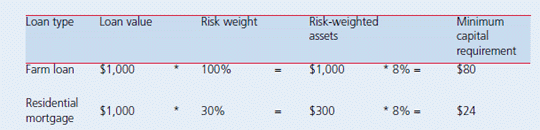
Note the Reserve Bank did initially delay the increases to farm loan risk weights after banks said the move would see farmers paying between 30 and 50 basis points more to borrow.
And what has happened to rural lending growth since June 2011? It's up NZ$2.6 billion to a record high of NZ$49.77 billion. The Reserve Bank warned in November's Financial Stability Report the dairy sector appeared more vulnerable to a sharp decline in the payout than at the time of the peak in dairy prices four or five years ago.
Submissions sought by April 16
Meanwhile, Spencer said the Reserve Bank would also review other aspects of banks’ capital holdings against housing loans. Any changes stemming from the review will mean changes to the Reserve Bank’s existing regulatory requirements for banks.
Submissions on the proposals close on April 16. Such a tight timeframe is unlikely to thrill the banks. However Finance Minister Bill English has said he expects to sign a deal with Wheeler by the middle of the year on the central bank's macro-prudential tools.
(Updates add further detail).
We welcome your comments below. If you are not already registered, please register to comment
Remember we welcome robust, respectful and insightful debate. We don't welcome abusive or defamatory comments and will de-register those repeatedly making such comments. Our current comment policy is here.