

By Olly Newland
 We are now nearing the end of the year … and now seems a good time to reflect on the year past - and indeed on the past three years since the Global Financial Crisis struck.
For most of us it is business as usual, although let’s admit there were many who were seriously hurt by events.
The collapse of many finance companies and developers, followed by high profile prosecutions seems clear evidence that parts of the ‘investment community’ had over reached themselves in their rush to get rich quick.
Through all this, the vast majority of the property market in NZ both residential and commercial, carried on - affected far less than anticipated in the main by events both here and overseas.
Unlike some other countries which had experienced a building boom of unprecedented proportions (e.g. USA, Spain, Ireland) here in New Zealand, being a small country, our construction industry was unable to be quite so reckless. With the exception of high profile extremes, and, sure, a downturn in the industry like others, our construction sector came through relatively unscathed.
There were also several other events in the NZ economy which “tightened” the market from a purely economical point of view:
First and foremost the terrible Christchurch earthquake and its aftermath wrote off up to 30,000 homes and commercial buildings, equivalent to three years production and more.
The building and construction industry will benefit greatly from this over the coming years — not withstanding the heartbreak and devastation caused to Canturbrians.
The leaky homes disaster has also taken thousands of homes off the market. This, combined with little or no new building, is causing increasing shortages and a substantial price push.
The lowest interest rates in history are the cream on the cake, and in my view low interest rates will be with us for many years to come – unless of course hyperinflation strikes. That is always a possibility, but seems unlikely at present, despite governments around the world feverishly printing money.
It is always a puzzle to me why people were prepared to throw endless amounts of money at the property market a few years ago when interest rates were 9%, 10% or 11%.
Now with interest rates at half price (in manner of speaking) some investors remain cowering under their beds.
Now is the time to invest
Because of the pressures I have described above the current period is, in my view one of the best times to invest in the property market.
Having said that, my strong advice is to only go into the market - either buying or selling - with sound advice from an impartial advisor well versed in property investment in all its forms.
Do not fall for the hucksters out there who promise you instant riches and to share ”secrets” and “strategies” only they know. A little digging reveals that these people are in many cases just front men for Real Estate agents or speculators themselves, who want to make a fast buck from the naïve. Check their backgrounds.
The figures set out below are, to me, proof positive that the market is alive and kicking … and the chance to make a profit is just waiting to be seized by the astute.
Indeed, just as I write this, Quotable Value has just confirmed what those of us in the business have known for months:
Property values rising across most of New Zealand
Wednesday, 9 November 2011National property values have continued to gradually rise according to the QV residential property index for October.
“Nationwide property values have been gradually increasing since the start of 2011 and as a result are now 1.2 percent above the same time last year and 4.4 percent below the market peak of 2007″ said Jonno Ingerson, Research Director QV.co.nz.
“While initially the upward movement in values was being driven by Auckland and post-quake Christchurch, many other areas of the country are now increasing also” said Ingerson.
“The Auckland City revaluation has now been completed and the capital value (CV) of every property updated. The QV residential property index is based on the ratio between sales price and these CVs. As a result of the changing CVs there has been a slight one-off adjustment to the indices for Auckland, making it appear as if values dropped slightly from September to October. The raw underlying data actually show that values have continued to increase, and the index next month is likely to once again show the upward trend we have seen in recent months” said Ingerson.
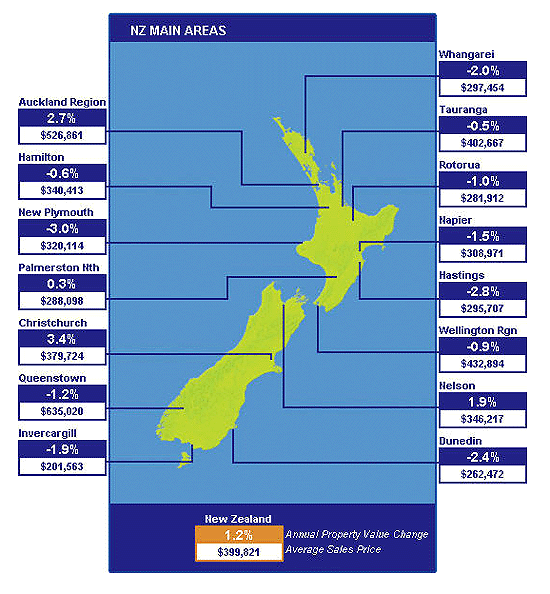
The rise (again) of the spruikers
There is a danger in a rising market and that is the strange phenomenon of people seemingly losing their minds. Perfectly sane and sober people suddenly get the urge to “get rich quick” and take reckless risks.
Property is a “big ticket” item. The simplest investment costs hundreds of thousand of dollars at least. Yet in many cases I have seen people throw these hundreds of thousands of dollars around (theirs or borrowed) mesmerised by the big numbers and going into some sort of trance.
These same people who baulk at paying a dollar more for a can of beans seem to think nothing of committing themselves to massive debt, personal guarantees and a major commitment … because they are dazzled by the hype.
One of the most reckless moves some people make is to believe the hucksters and spruikers who have reappeared lately promoting the notion that making money in real estate is a doddle and that anyone can do it with their eyes closed.
You have seen or heard the hype I am sure. ‘Come along to a free seminar and in just one day you will learn all the secrets of making huge profits in property’ etc etc…
Look carefully behind the motives of these promoters. In a recent advert one group appears to be merely acting as a front for a real estate agency. Their aim is to tuck you into some slum or rubbish property in some God-forsaken backwater.
Another group who give “free” advice is nothing more than a front for property ‘option dealers’ whose modus operandi is to secure properties by way of an option to buy, and then try to on-sell them for a profit. If they don’t on-sell, they drop the deal. Too bad about the heartache they cause to genuine sellers when the deals fall over — as many do.
Yet another group is a front for speculators who have bought some cheap rubbish, given it a quick spruce-up and then convince you that it’s a bargain at a jacked-up price.
These are all signs that the market is starting to froth again. There are many unscrupulous people out there willing to relieve you of your hard-earned money as a result.
The value of independent advice
Before signing anything get proper independent advice from your lawyer, accountant or authorised financial adviser — assuming they have some experience in the area. Yes, you will have to pay them, but the cost involved is nothing compared to the losses you could sustain with just one bad investment.
This applies to both residential and commercial property. Most people have had some experience with residential property but commercial is a completely different ball game.
While there is a little questionable comfort in that residential investments have a regulatory body to turn to in case of disputes (Tenancy Tribunal) there is no such thing in the case of commercial property. It’s a free-for all and can be dangerous at times without proper preparation, care and due diligence. With care and good advice it can also be immensely profitable.
Either way it is essential to get advice or, better, learn all about real estate investment from reputable independent advisers who are not clipping the ticket behind your back on some transaction in which you may be interested.
The market has come through the GFC remarkably well, as a whole, and I predict it will do even better in the years ahead.
A longer view
Getting into the market, and taking a long term view, together with prudence and care, will almost certainly bring you good profits, security and the most valuable of all – independence. One of the benefits of this approach is that you filter out the hysteria sometimes promoted as ‘market knowledge’.
For instance, I agreed with Nigel Mayson at the time (2009) and I agree with him now. His article is as pertinent today as it was then.
Shame on all you doom merchants
October 23, 2009 by Nigel MaysonI think I’m right in saying Gareth Morgan predicted up to a 40% decline in the property market? It was certainly a big number. Bernard Hickey predicted a 30% decline in house prices by 2010. From the market peak. He recently back-peddled and halved his predicted decline to 15%…..by 2012 this time. Kieren Trass said property prices could still fall by another 15%…..on the basis that overseas markets declined by up to 40%.
In May this year [2009]Treasury (with all their resources and intellectual horsepower) forecast that property prices would fall by a further 12%. They then admitted they were wrong and revised their outlook by saying they expected prices to in fact increase. Very wisely they didn’t commit to saying by how much this time!
The property market doomsayers assumed that the economic carnage seen in property markets elsewhere would be repeated here in New Zealand. Their predictions were not just wrong…they were woefully off the mark.
I have no doubt the rise in property prices and the increasing confidence is not only due to the facts I have mentioned above but also to the volatility of other forms of investments.
Those who have chosen to invest in the share market, in currency speculation, or in managed funds have suffered losses and gains and yet more losses at heart-stopping frequency. With a property - whether it be modest or grand - at least it’s solid. It will be there in the morning, it cannot run away or be stolen.
Shelter, after all, is one of the basic necessities of life, along with food and clothing. How can you beat that?
---------------------------
Olly Newland
November 2011 www.ollynewland.co.nz Used with permission.
235 Comments
Olly N warns about the rise of sprookers.........are you serious......the world has turned inside out....
Here are some hard numbers for investing in rental property, something Olly has failed to present.
- Avg Price 400k
- Avg rent $17k
- Insurance $900
- Rates $2080
- R&M/Depreciation $1000
- Deposit (@ 20%) = 80k (opportunity cost of cash deposit @ 4% = $3,200)
- Mortgage = 320k @ 5.65% = $18,080
- Tax offset from LTC (@ 22%) = $3,977
These are the baisic figures, and from them we can view the cashflow.
- Total expenses including opportunity cost of cash = $25,620
- Total revenue including tax offset =$20,977
- Required Capital Gain to break even = $4643 or 1.15%
- Avg Capital gain at the moment 1.2%
So you can make $200 per year have fun. I was looking at property in '07 when 7% CG's were the rage, and I worked out thats a doubling time of 10 years, so in 2017 houses would be worth 700k, and in 2027 1.4million, and I knew that was a ridiculous investment, counting on that scenario.
Most people I talk to who made serious money out of buying property bought 80's-90's. When houses were around 2.5-3x gross average earnings. Now houses are up around 6x gross average earnings, the real gain can only come if they go up too 7,8,9,10x gross earnings, which is unlikely, yet Olly may be right who knows, not me.
There are in my opinion much better investments out there. For starters most small businesses return on equity way over 20%, many in the hundreds or thousands. If you like using leverage you can trade CFD's with up to 500x leverage.
Heres some advice that I have taken from people who made money in the real world.
- Only borrow money if you have too
- If you are borrowing to invest you need cashflow to pay it back
- Work hard and work for your own business, so when you get older your business can work for you.
- Money and investing are only vehicals to get you where you want to go
What moron pays $400k to rent out at $325pw?
You may have noticed that an average house doesn't isn't the average rental.
Personally I would not be that happy paying $200k to get $325pw at the moment. Although I haven't purchased rentals this year because of the earthquake and the fact I've been tied up in insurance issues, now that these are starting to sort themselves out we are ready to spend some "replacement" insurance.
Just as an indicator in 2006 (near the market peak), I paid $190k for a property now rented at $525pw (in a prime university location). That's the type of property sensible investors buy.
My figures are sourced, yours are not, I'm happy for you to show me some figures. Olly hasn't put any figures out either just hot air. It's slightly sickening to me that someone would charge 325pw for a 200k house, but each to his own. I prefer honest and open dealings, which is why I'd never be a good property speculator.
skudiv, clearly you're not a landlord.
You must be seriously deluded if you believe that an average house attains an average rent. Also you obviously have no idea of real estate prices outside your immediate neighbourhood if you think that a $200k house couldn't rent for $325pw - in many parts of the country $200k well spent buys a very very comfortable house (in Dunedin you could get a good 60s house, in ChCh a renovated older house, in fact in ChCh a rough older house starts at low $130s now, and 1960s units at about $100k (would rent at $220pw ish)).
skudiv obviously you believe that unless the landlord is losing money, that he is being dishonest - what a load of codswallop - only 10 years ago I could buy a house in Dunedin for under $15,000 and rent it for $5 or 6,000 a year. In Invercargill you could buy at under $10,000 and rent at $5,000 a year. That was market price and market rent, everyone was content all round. Yes the market moved but there is certainly no dishonesty in the fact that one buys higher yielding property. These would not necessarily be old dungers either. In fact 10 years ago $12,000 in Invercargill could have bought a 2 level 1970s unit in a block of five. Ten years ago in ChCh $39,000 could buy a 2bdrm shs unit in a block in need of a tidy up.
I'm not trying to convince anyone of anything. But people "spruiking" nonsense numbers to make property sound bad really annoys me.
As I said, I wouldn't make a good landlord, if buying was cheaper then renting I'd be encouraging my tenants to buy. Great if there are deals to be had, put some figures out there. I have seen no figures from Olly, he is promoting capital gains as a way to get rich, which is a good road to the poorhouse when you have no control over the capital gains.
Before I get any more quotes about 10 years ago, here are som more facts about the last 10 years in property.
http://www.gecodia.com/New-Zealand-Real-Estate-Prices-Chart_a543.html
http://www.rbnz.govt.nz/keygraphs/Fig5.html
http://www.prendos.co.nz/house-price-index-declines
http://en.wikipedia.org/wiki/Real_estate_bubble
This is not spruiking, (In British English, a tout is any person who solicits business or employment in a persistent and annoying manner (generally equivalent to a solicitor or barker in American English, or a spruiker in Australian English). According to the American Bar Association, touting occurs when a person advertises, promotes, or otherwise describes a security for sale without disclosing that the person is being paid to do so.)
These are real facts, serious business here.
mist, you can check REINZ's sales database if you like. There were certainly dozens selling at those levels in 1999-2003.
$30k purchased quite a good house. The average house in Dunedin was about $80k at the time and those of you who know Dunedin and know the substantial (once grand) real estate that makes up a lot of the city realise that an average house in Dunedin can be something more than an average house anywhere else in the country.
My cheapest purchase was $2,500 for a fire damage multi flat dwelling in the CBD in 2002 (freehold). The cheapest livable as is house I bought was $13,200 in South Dunedin in 2001, we bought numerous ones around $20k in the Central City and Mornington.
I know of many sales in the "teens" in good areas with solid houses in that period. Certainly cheapees in South Dunedin, Caversham, Ravensbourne and other not so good areas were about in good quantities too. Large "mansion" type properties were selling as low as $70k at that time, and respectable land was often sold for low single digits.
I'm not sure if you know Dunedin at all if your comparing Caversham (Dunedin's grottiest suburb) with the likes of North Dunedin, but just to let you know the property I mentioned near the university is above George St opposite a Hall of Residence and has unimpeded views over the University area and a glimpse of the Harbour.
If people actually looked at the market at the time they would have realised it was incredibly cheap. The same goes for ChCh, we bought a tidy cottage in Addington for $36k in 2001. Houses routinely sold at the $60k level at that time.
Again the market is showing signs of properties being too cheap, but not to the extent of the 2001 nadir.
mist, the property was about 400m from Otago Uni, just off George St. It's a 5 bedroom villa and is currently worth maybe $320k on a good day ($190k was cheap when I bought it, realistically it probably should have been $230k but the owner just wanted sold). When I bought it, it was significantly underrented at $300pw and I put the rents up to $460pw immediately.
good points
property investment was a pretty good thing up till about 2005, and I congratulate those who bought in those earlier years and have done well
However now it is generally a lousy investment, save for the odd property here and there
And people who try and bully younger people, sometimes including their own children, into buying their own first home under these market conditions, are fiscal child abusers.
Time the young people wised up and started "occupying" the local council planners offices instead of the spots they are focusing on.
A reading list re fiscal child abuse:
http://www.aim.org/newswire/us-wealth-gap-between-young-and-old-is-widest-ever/
http://www.pewsocialtrends.org/2011/11/07/the-rising-age-gap-in-economic-well-being/
http://www.newgeography.com/content/00452-the-housing-bubble-and-boomer-generation
http://www.macrobusiness.com.au/2011/11/expect-the-revolution-to-grow/
v
Olly Newland is of course one of the generalissimos of the fiscal child abuse movement.
He talks about low interest rates being a "sweetener". Rubbish, they are the bait on the fiscal child abuse trap.
Doing a bit of simple maths proves that it is far more costly to the mortgagee and far more profitable for the banks, if interest rates are low and house prices high; rather than the other way around.
Baby boomers grizzle that they went through periods of mortgage interest rates of 18 to 23 percent. So what. It was still far cheaper for them to get a house at 3x a single income, financed at 20%, than it is for the young today to get a house at 6X a double income, financed at 6.5%.
When interest rates were 20%, inflation - and rises in incomes - were of course something like 15% to 18% per annum. So after a few years your mortgage did not look like much, did it? PLUS, interest rates came DOWN since then and these moaning hypocrites had the lot paid off in only a few more short years.
NOW, our young couple with a mortgage several times bigger relative to their incomes, have no such chance that interest rates will be LOWER for any significant part of the time during their lifetimes; in fact we are in such volatile times that a few percent points increase in interest rates and the bankruptcy of nearly every young household who bought their first home since about 2003, is actually quite likely.
And I have some more new terms to suggest:
"Fiscal child abuse deniers"
"Mortgage slavery deniers"
People in this category infest this site and it is time they started to incur the opprobrium they deserve. Earlier, more christian, more moral, more rational generations would be turning in their graves if they knew what we had come to. An elderly NZ academic recently commented to a friend of mine, "I am surrounded by zombies here at the uni". He said the single worst lie of political correctness, was "the rate of solo motherhood has no consequences for society". Close behind that, is the "evil anglo saxon imperialist, poor noble savage" treaty industry edifice of lies. He is not a specialist in housing issues, but I rate the "environmental hustle"/urban growth containment racket as right up there with these lies and irrationalities.
Must be many who listened to the 15%, 30%, 40% price decline hype and who are now kicking themselves, especially those who sold up and went renting only to see their former home rapidly increase in value through 2010/2011.
Olly was righ and the doom merchants were very wrong! Gareth Morgan - LOL!
Big daddies seem to be breeding.....Core inflation is 2%....average rise 1.2%.....so if you invested in property last year and it wasnt in the right area...oops..you lost money.....so there was no bandwagon to jump on.....
and again you fail to take into account risk.....never mind Italy's bond rate is around 7%....Greece is 28.4% that means a recession and a big one is just around the corner, eh?....probaly a depression....and in a credit driven event which this will be, PIs like you will be left living under bridges.....hoping the repo man doenst find them and take their kidneys....
regards
"...filter out the hysteria sometimes promoted as ‘market knowledge’ ".
This is one of several good advice points contained in the well-written article. Those who pretend to know for sure what the future holds (on both sides of the argument) are misleading others (as well as themselves once they start believing their own stories).
"...filter out the hysteria sometimes promoted as ‘market knowledge’ ".
@Alex13 - I agree. Check out some of the several "good advice" points contained in this so called "well-written article"
Olly: "and in my view low interest rates will be with us for many years to come "............ "in my view one of the best times to invest in the property market"
A sharp fall in house prices remains a risk to households' balance sheets, which have yet to be truly tested, the Reserve Bank warns in its latest financial stability report
http://www.nzherald.co.nz/business/news/article.cfm?c_id=3&objectid=10765124
Olly: "the market is alive and kicking … and the chance to make a profit is just waiting to be seized by the astute".QV said its residential property index was up 1.2 percent on the same month a year ago, but the market was still struggling to gain momentum.
"While there has been a slight increase in new listings in many areas, this has yet to translate into an increase in the number of sales," said QV research director Jonno Ingerson.
The housing market has been in the doldrums since the economy emerged from recession in mid-2009, and QV's index remains 4.4 percent below its peak in late 2007.
http://www.reuters.com/article/2011/11/09/newzealand-economy-housing-idUSL3E7M700220111109
steven ... core inflation is 2%....average rise 1.2%.....so if you invested in property last year and it wasnt in the right area...oops..you lost money
that's just illogical.
If property prices go up and the property was at least cashflow neutral, then how exactly was money lost?
Higher inflation just deflates the value of any debt, so real assets which produce income are the best hedge.
Just how many logins does Olly have at interest.co.nz? :-\
Crisis- what crisis? Much of the so called "crisis" is a media beat up. It suits them to manufacture headlines to sell news. Every day there is another "shock horror" story . It will be business as usual and the recovery in the property market. will steadily continue.
"Wall Street rallies as eurozone crisis eases
Nevil Gibson | Friday November 11, 2011
Stocks on Wall Street have bounced back from their biggest one-day fall in more than six weeks.
In the US, unemployment figures fell to the lowest level in seven months, while crisis fears eased in Europe.
Greece has named a former central banker, Lucas Papademos, as its new prime minister. He will head an interim coalition government.
In Italy, now the major cause of concern, 10-year bonds came off their highs amid trader talk that the European Central Bank was a buyer.
Italy’s budget bill is expected to be approved by the weekend and pave the way for Prime Minister Silvio Berlusconi to resign".
link:
http://www.nbr.co.nz/article/wall-street-rallies-eurozone-crisis-eases-ng-104116
Your ignorance is coming through.
You think a one day rally is evidence that a crisis is over?
If you do you don't have a clue
So you are saying a one day drop is evidence of a depression?
Somebody really ought to have QV on about their "Property values rising across most of New Zealand" statement. Outside of Auckland and Christchurch the real estate market is dead, there is a huge disconnect between buyers and sellers, nothing is being sold, and prices are well down in real terms. QV are supposed to be an impartial government owned entity but it seems to feel a need to hype up the market.
Impartial?
The sad fact of the matter is despite their early promise the nats have come to the realisation that they can't transform the nz economy and the only way to get the economy moving again is to spruik property. Hence so little action on meaningful planning, building and tax reform
I think you are wrong there fella - The RV on all our properties has gone down quite considerably, but the market in the Waikato is really starting to move. I can't guarantee what the properties are finally going for, but there are SOLD signs up everywhere - or is just desperate people forced to sell. If so, the whole province is doomed!!!
By this article, Olly is simply trying to shift people who go to Property Tutors to go to himself. Good on you for doing that Olly, those property tutor guys are crooks, anyone with a brain knows that.
Hugh, you are confusing the number of buildings written off with the number of people displaced.
Olly is probably about right suggesting 30,000 buildings need rebuilt. But because about 2/3 are probably still habitable the number of people dislocated is much lower.
Estimates of total costs are still too low, expect insured losses to creep well over the current $30b estimate.
NZ will be awash with cash in the next few years when the dust settles. Those who have full replacement policies and the tenacity to endure the insurance companies will find themselves in most cases much better off than they expect.
What a fabulous opportunity, Chris_J, for the country if it were able to engineer all that cash not 100% back into the property market, but, say 50%, into enterprise? That is the challenge for New Zealand. Take 'the cash' and repay individual debt; have a surplus to...even put into the bank to reduce our national borrowings...and set the country on the road to a better future. One not burdened with property debt, but one with more 'cash to burn' on progress.
Expect N/A a deluded National Party has decided to force those with damage under $100k (much of it uneconomic to undertake - especially on houses that are still livable) to be completed by Fletchers instead of paying out the cash. This means the money will just be wasted and stoke inflation.
Good work from Jonky and Gerry there.
Hugh, there's no dispute that at least 30,000 are uneconomic to repair. Possibly many more.
At least 30,000 need repairs above $100k. Possibly 10,000 more houses in the under $100k category are uneconomic to repair because of the age and overall condition of the property. I know of many properties in this category already being demolished.
With the leaky homes I would say 20,000 needing demolished is a low estimate. Probably 80,000 need work, and because of the cost, and the fact many of these properties are now dated and/or were poorly designed with low quality materials initially, that the vast majority will prove uneconomic to repair.
So there are probably at least 80,000 houses either leaky or shaken that aren't economic to fix and will most likely eventually need rebuilding - although many could have many years of use before demolition was required - but they are all very much going to be selling only at land value or close to it.
Hugh, I believe that current EQC estimates are that 30,000 houses are over the $115k cap.
Most of those will be uneconomic to repair.
We have 25 properties in the ChCh. So far 7 are confirmed total losses by the insurer (one of those a building with about a $600k replacement cost was initially assessed by eqc after Feb as under $115k!), we have another 5 that are likely to be total losses once assessments are completed. So that's 12 out of 25 for us, plus probably about 6 of the others are uneconomic to repair because they are on valuable land.
I'm not sure if you've actually looked around the city or looked through many properties but certainly I've found write offs in totally unexpected areas. Houses in Burnside, Bishopdale etc are write offs as well as those in the expected suburbs.
I went through a 60s house in Westburn recently. 2 chimneys down through the roof all the brick cladding shattered and moved, cracks in every room. Foundation ok. My estimate to replace cladding, repair internal and paint everything, would be $75,000. The property could take two townhouses, market price about $370,000. Land value would be $330,000. Take the payout and demo the house and you've got it below land value. The house was by no means a write off, but it certainly wasn't particularly economic to repair either.
I can tell you Hugh, that you would not believe what is being written off and the kinds of payouts being made. The payouts are not only above market value for the improvements but in many cases are above market value for the entire property (with the owner getting to keep the land) all simply because replacement cost is so astronomical. The going rate being estimated to replace an old bungalow or villa starts at $2500/m2 plus extras.
It may not seem like a property has a lot of damage but if an older house with brick chimneys and plaster linings has a broken or cracked foundation it will in most cases be a write off.
Gutting all the linings, removing the chimneys, new foundations, resiting, rebuilding the chimneys, relining and repainting will in most cases be more expensive that starting from scratch. The insurers know this, so they are trying to settle claims now at todays prices with replacement property rather than having to pay to build at inflated prices next year.
And as for commercial, take a look around the CBD redzone if you don't believe the scale of the demolition. 90% of many streets will be going or is gone. Colombo St will end up almost entirely vacant.
30,000 is a light estimate of the total number uneconomic to repair.
But remember everyones insurance is different. Many have only indemnity policies and won't be able to rebuild. Some owners didn't take insurance because it was too expensive, others couldn't get it because the properties were too old. Luckily we have full replacement and on some of the properties it is really a windfall - especially on ones with super-high land value and older rundown buildings (in one case we have a property which had an improvement value of perhaps $50k (although admittedly the property was returning $60k), full replacement looks like it's going to be $900k ish).
I've spoken to a number of QS's and building companies, and it's fairly unanimous that $2500/m2 is the money for building a timber weatherboard, solid timber floor, 3m stud house.
Lay out the costs CJ...I find your numbers are about 20 years ahead of the debasement programme!!!
Try this site for a better idea of costs.
http://www.tradebox.co.nz/pb_resource.asp?resourceid=41
Just remember to add the thieving govt gst on top.
Hugh, Wolly linked you to the wrong page, here are the 2007 (4 years old note) GST exclusive square metre rate estimates:
http://www.tradebox.co.nz/pb_resource.asp?resourceid=40
Personally I think the estimates are a little high, but note that a top end house is costed at about $4000-4350/m2 in today's GST inclusive dollars ($3400-3700, 2007, GST excl).
Realistic build costs (all up incl GST and all site standard site prep and drives, services, consents etc) in my honest consideration are:
Basic hardiplank 90m2 on particle board floor no garage - $1200-1400/m2
Standard brick and colourtile on concrete slab single level around 200m2 with basic fittings - $1300-1500/m2
Standard brick on concrete slab single level basic fitting around 110m2 - $1500-1700/m2
Good spec single level on concrete slab around 200m2 - $1500-1800/m2
Two storey standard 200m2 with basic fittings $1600-1800/m2
Two storey upmarket 300m2 with good spec $2200-$2500/m2
Premium architectural $3500/m2 upwards
For insurance rebuilds (replicas):
a single storey villa would be $2500/m2 upwards
A two storey high quality (Fendalton style, or inner city 2 storey style) would be $3000-3500/m2
Owner builders etc may be able to do some of this at up to 10% below the lower price if they really pinched. But it all depends on the complexity of the build etc.
New homes for under $150k will be small and most likely of the Keith Hay variety, or very modest rectangular brick on concrete slab - no whistles and definitely not even enough for a bell!
I do think we need a few Christchurch engineers and builders to come on to this thread, for a little reality. And too, people who have recently entered in to construction contracts here in Christchurch, Waimak and Selwyn over recent times. There are very few of them I know.
Hugh, I'm talking genuine numbers there. Go and talk to Stonewood Homes, Mike Greer, Landmark Homes, Orange Homes etc etc, pricing if very consistent with what I mention above.
The only standard build I've been involved in the last few months is about 225m2 (partly self managed) by a friend (I did the plans), that will look to come in in the late 200s at about $1300/m2 which is the ballpark of where I mention above.
I would love to find some builders who could build for substantially less, but it really just isn't possible.
Good luck with the engineers CJ...it'll cost you over $150 and hour...
"there are very few of them..." and why is that CJ?.....could it be that the costs are too high...that the loop is stuffed with grasping hands wanting a wad for being there...like the council?
Fact is people have decided the gst hike was the final straw.....they don't want to make the mistake they made before....don't expect to see a burst of rebuilding any time soon.
That's was Hugh's comment Wolly, not mine. I think it's pretty clear how much things cost nowadays, Hugh doesn't seem to agree. $150ph is a bargain, my boss was charging my time out at that when I was six months out of uni (just a shame I wasn't getting much of it).
My small family run building company in the Manawatu:
190m2: 4 bed, dble garage, two bathrooms, brick & tile = $199,500.00inc gst
200m2: same spec = $217,200.00inc gst
220m2: same spec = $238,500.00inc gst
Ready to live; no floor covering; no section.
We have constructed several hundred homes in the last 30+ years.
Hugh, depending on what Petrus is including it's pretty much in line with the figures I give above.
You can spend $10k on floor coverings, easily $10k on landscaping/drives, $10k on consents, enginneers reports, insurance etc, $10k to connect to services (depending what local connection charges etc are)
The price to build just the house all complete on a site can easily be $1000/m2 or less for larger basic houses. It's all the extras that add the cost.
You seem completely naive about costs or in total denial Hugh.
Hugh, you misunderstand my point.
You can build a house by itself of around 200m2 for about $1000/m2, HOWEVER that won't include the carpets/drapes, tiles, services, connection fees, consents, engineering fees, drives, fences, landscaping, etc etc, and of THOSE costs add to on average something like $200/m2 which puts the complete build at something like $1200/m2 (or in most ChCh cases more like $1300/m2 upwards.
I think I've argued the point enough times here, but you seem to not understand.
That's cheap but it doesn't include $10k for consents, 5k for floor coverings 15k for driveways , 10k to connect services and 'unexpected' foundation conditions presumably? That's another $200persqm easy.
That's also presumably supercheap fitout - 2.4m ceilings, gib everything, laminate kitchen benches, not enough powerpoints, 1 bayonet light fitting per bedroom etc?
The other figures were more realistic.
Hi,Bob - building consent fees included, consent drawing fees included. Allow $9,000.00 for floor covering, 75m2 concrete drive@$5,000.00
F&P appliances, mix of downlights & bayonet fittings, 2 x double powerpoints each bedroom - 4 to living room, 3 to kitchwen dining.
Fitout is not top of range - but a lot better than you suggest
Its not sensible to add sitework costs to house costs to get a median cost. Location,size etc can give very distorted answer if you do that.
petrus, so no consent fees or average site or enginneering costs incl in your price?
No landscpaing or floor covering cost, but what about service connections? (are they low PC sums or realistic)?
The prices I suggested in ChCh are about fair for an all in ready to move in cost (absolutely ready to move in no extra costs above the section price) in a standard new subdivision on the flat with what is now a standard rib raft floor or similar.
Most ChCh builders I've spoken to quote prices here are up over 10% on pre Sept 2010 prices, I expect your costs haven't moved up by that much? So I think the $1300 or on a good day $1200/m2 for a basic completed 200m2 house is about right down here at the moment.
petrus, what are you including in the price?
You exclude carpets, drapes, but are you also excluding tiles/vinyl? What about services, siteworks, enginneering reports, consents, drives, landscpaing etc?
Chris - check my reply to Bob. To that you could add for example: fencing-but how much? Letter box & clothesline say $500.00. Landscape-modest job,level & sow lawn $2000.00 right thru to complex & costly. Assumes normal site with no engineering report required - which is the vast majority of sites here. Appreciate that Ch'Ch will require comprehensive engineer design & additional cost -but not here!
Agree I did a lot of reserach into building a house, I looked at a large number of cheaper builds that were about 5 years old and they had really aged with wear and tear in that period, but in canterbury (before quake) the middle of the road, finshed house (not landscaping) was about $1350-1450 a sq meter, maybe get a basic house for about $1250. Most sub divisons you had to build minimum 185 living plus garage.
Hugh wants land to be $50K a site and houses $150K and thinks that this would occur if there was unregulated suburban sprawl.
Presumably unregulated sprawl will not reduce the construction price of the house - with $150K providing a 2.4 stud, brick veneer, tin roof 110sqm box with no garage if you're lucky.
The 50k site is more problematic. Sprawl requires new infrastructure with each house needing something like 15m of road and servicing (and the land to do the servicing, footpaths, berms and road on), development contributions, engineering costs, future maintenence. 50k would barely pay for that even if all the land was free.
Hugh P
"I'ts just a matter really of getting the land openned up, with proper infrastructure finacing in place -"
The problem is that (as per your article Expect the Revolution to Grow) real wages haven't increased since the 1970's (assuming not much different here). As Bob Robertson says "developers are being made, by the regulations, to build developments with all the bells and whistles for a market that simply can't afford it". So we have a significantly large poor population needing new housing with first world infrastructure which will have to be susidised. Meanwhile vested interests have pushed for population growth based on "needed skills" (such as electricians and gibbstoppers), the percieved benefits of economies of scale and the notion that a creative class will pull rabbits out of a hat.
I don't get it, other than I see two divergent strains: one doesn't see any resource constraints in the free market test tube and the other does.
In our instance Chris you are correct as, being RedZoners, we hope to sign a build contract before Christmas and the money, I believe, largely comes from overseas reinsurers. Those choosing to put replacement policy settlement offers towards an existing house, or house and land package, save insurers some money, and perhaps some of their own if they do not commit all of their land payout from the Crown towards their next home.
In our case persistence with our insurer is paying off, there are some decent people in the industry, although at times I had my doubts! However, of those people I know in the Red Zone, only one other is building a new home at this point in time (not in Chch), so perhaps there will not be a boom in new house construction in new subdivisions here.
Our situation is easy really = we have to go, no choice. For an owner-occupier or landlord with badly damaged house in "green" zones, the decisions can be complex and may involve some measure of forecasting, not easy in this city, The eastern side (on the flat) of this city, may end up being comprised of the cheaper rentals and the less affluent homeowners (sort of an entrenchment of what is was like pre-EQ, really). Good opportunities for landlords (whom I distinguish from PIs, although the groups overlap) especially if many owners on this side have made up their mind to sell up and leave, and take what price they can get.
The cash will, over a long period of tiime, be clawed back through higher insurance premiums.Just another form of borrowing, I suppose, although those without mortgages don't HAVE to insure. In our case, very glad we did, with a full replacement policy.
That's exactly the same sentiment I've heard elsewhere Crooked Thumb.
Do you mind if I ask what price per square metre the insurance company offered you to take replacement properties at? And perhaps also what price the insurance company is having to pay per sqaure metre for the entire build?
For our two storied 70s/80s house, initially $1600 psm (incl GST), the garage/sleepout a lower figure. All up for total claim and adding floor areas together, $1665. After getting a review, that total figure now over $1900psm.
For the new build we are able to increase the floor area about 10% ( we are combining two structures), retain 2 storey, and they will be paying about $1750 psm.
Each situation is different though, and we have been advantaged by having an expensive replacement cost for our paths, fences, kerbing and driveway, whereas the cost of these for our subdivision section is much lower (some is actually embedded in the cost of section), so we can apply this to increase the size of house and quality of fitout.
A general observation, the older your house, the better off you might be if written off and you have full replacement cover, but you might have to persevere to get your insurer to recognise the true replacement cost of older features that are no longer commonly available and used, but are available, at a price. Note I said, IF WRITTEN OFF, if you are classed a repair, you are much disadvantaged, and much more likely to be so if in Red Zone where you will probably be forced into taking RV as a payout. Very relieved not to be in that space ourselves, though it wouldn't have been the end of the world.
Not worried about you, Chris. Despite the hassles encountered along the way, you seem in your comments to display sufficient acumen to look at all the options and choose good ones from a business perpective.
Those prices seem about fair for a standard 80s house. If it was architectural I would have hoped for more, but you should come out all right in the end.
We are very fortunate for them to have considered most of our badly damaged properties as write offs. However it is very frustrating that a few are being considered repairs when they are really completely stuffed (from the quake) and I know full well any repair is going to cost the earth and take several years.
Good luck with the build, it's certainly refreshing to hear someone is actually looking to stay and rebuild in the city!
Hugh, your post made me re-read the classified and try to find which house and land packages you were referring to.
Be aware Mike Greer works on large volumes with a suprisingly low profit margin - being chiefly a builder most of the profit is actually in the build price not the "package".
Just looking at his offerings, 200m2 in Aidanfield on sections he paid $180-200k for selling for mid $500s means he's essentially selling a a 200m2 at $350k. That's $1750/m2 not the $1200/m2 you quote.
Now remember on many of these developments he's only selling options on houses that aren't built (he's really building to order) and on many he hasn't even put any money down on the sections. Section developers like getting him on board because it moves the sites.
In Pegasus, on the small lots which he paid about $90k for, he's selling a budgo 127m2 for $349k. That's over $2000/m2. Similar on the powerline sections in Delamain.
The cheapest normal houses he's got are in Kaiapoi and Wigram on what are about $170k sections, with 200m2 houses for about $450k up (these will be budget spec). These probably come in at around the $1300/m2 which is entirely in the range I gave above.
Enterprise homes are at almost exactly the same prices.
The figures in these packages is exactly where I quote above, and if you don't recognise current pricing reality and why prices are where they are, then your arguments can't carry much weight.
You can build a house for $150k, but it will be more of the style of the 1960s and 1970s bulk builders than the current type of 200m2 home built in the new subdivisions.
For $150k, you could get a lightweight metal garage for say $11k, primitive landscaping for $5k, service connections for $8k, consents for $5k leaving about $120k to build the house and carpet and drape.
So expect a rectangular box, possibly brick, no fancy foundation, 1 bathroom about 100m2 max with $50/m carpet a $700 oven, a $100 plastic toilet, no laundry tub, 1 plug in each room...
... you get my point?
Hugh, I don't disagree around $1200/m2 is possible. But if that's a complete price it's for one basic 200m2 house. Of course you can still build larger basic houses say with a big garage in a 300m2 floor area for perhaps under $1000/m2 all up, but the reality is most builds cost a lot more.
Dunedin is far from Detroit, that just demonstrates you don't know what you are talking about.
Detroit has "urban prairie" wastelands, Dunedin is actually a well utilised city with all the flat land well developed. Invercargill is certainly closer to Detroit because of the abandoned land out south but neither really compare to the total desertion of the Detroit central suburbs.
Dunedin's population has grown in the past 50 years, Detroit's halved.
To answer your questions briefly Hugh,
1) If development contributions were scrapped, more land was available for development and RMA issues fixed, I could see full size sites in developments similar to current standards at around the $120-140k.
If lower standards were accepted (such as more basic roading and no amenities) sections could be from around $100k.
But look were those savings might come from - normal sites can be developed from around $185k on the finge at present, take off about $25k from DCs, take off $10k from lower raw land values if more land were available, take off $15k from lower total outlay and therefore a lower developers margin and holding costs, take off $15k removing RMA cost and delays.
By far the biggest price reduction will be cutting DCs, and RMA hold up and compliance costs. Raw land cost is probably only around $30-60k per site at present depending on location and size of block, so the scope for lowering price from that allowing is small (especially for bigger developments).
2) The US has many materials that are significantly cheaper than what we use in construction (eg asphalt shingles, osb board, pvc windows), they also have massive manufacturing of these and other products which we don't have, so there is always a price difference. We also have GST at 15%. All up considering where the exchange rate normally is, US$500 is closer to NZ$900 normally, add GST and consider the extra for our material choices, the extra costs of building on difficult or unstable NZ terrain and it all doesn't look that unreasonable.
I believe that with some efficiencies NZ construction costs could be achieved at maybe $900 to $1000/m2 all up for a 200m2 house, but it is simply not possible to get a regular builder to go out and build a current standard house at that price level.
Getting a price at that level is not a regulatory thing. It is something that can only be acheived by a firm going out and designing a low cost product and sourcing the best value materials available.
Talking about it does nothing, it can only be done by example.
3) Your multiples (as I've told you before and many others have too) are complete nonsense. When interest rates were 15-20% in the 80s, multiples at around 3 meant that housing was less affordable than it is today. No disrespect but prices relative to incomes only is codswallop. Undoubtedly, you will now regurgitate a diatribe about Demographia trying to justify something that just isn't realistic.
If we had 30 year interest rates (obviously we don't but the US does), and those interest rates were 4% then a $300k mortgage for 30 years would cost (interest + principal) $330pw. If the interest rates were 8% it would cost $505pw and if rates were 16% it would cost $930pw. So saying house prices and affordability is not related to long term interest rates is rubbish.
Irrepsective of land prices, with construction costs where they are, current prices of used housing in places like ChCh is about right relative to that construction cost.
Starter houses in reasonable suburbs for low $200s in ChCh when 2 hard working (but relatively unskilled) 22 year olds can earn $70kPA between them, doesn't sound too unreasonable.
Hugh if you really want to change the world, you really need to lead by example, after all if you can build at $900/m2 when everyone is charging $1300/m2 you can't but succeed (and become wealthy in the process?).
Hugh, just because you say something a hundred times doesn't make it true.
Costs admittedly could be reduced but in no way by the amount you suggest. I develop and invest in property for a living (although I studied architecture, as well as maths and physics, I only do design work on my own projects and for a few people I know at the moment. As a graduate I also worked in funds management as an analyst), so I have a fairly good handle on actual costs.
There are ways to reduce cost, mostly that would come in the form of reducing levies and easing the RMA. Reductions as you suggest are not possible unless a very different product is produced.
I'm not at all sure what you want to happen. The reduction in RMA and levy costs could perhaps shave $70k off section cost, which would be good. But that's in essence mostly just less revenue for Government.
Reducing building costs is not realistic. It takes a certain number of hours and a certain amount of "stuff", so unless there is complete reform on how houses are built - which you would need to show how it could be done not just spuffle on about Houston - there isn't any way to significantly alter costs.
Even if you did, new starter family sized houses might get down to $320k at a minimum as opposed to about $420k now. Is that reduction really going to change house prices when $320k is now a budgo house on a block 30 minutes from town? Inner areas will always be expensive because of where they are.
If you want change, do what people that actually made change do - go out there and prove it. Prove your theory works. Unfortunately I'm not sure what your theory to reduce construction costs is. Is it a theory or is it hype?
Because if you had some sound principles that reduced cost I would consider doing it myself. But I've read the articles on your website, and there is nothing there that tells us how to build any cheaper, other than adopting a "Henry Ford" production model, which is really only going to chop out a tiny little fat, not reduce construction costs by the third or so you would need to bring your estimates into fruition.
Unless you can offer some worthwhile suggestions, I think you're wasting everyone's time.
Other than mass rezoning, what is your plan to make the structural changes Hugh?
Buildings and roads cost money, you don't seem to understand how much. Instead of addressing the areas where changes can be made, you spuffle nonsense about unrealistic construction and land costs.
Give us a realistic 10 point (or how ever many it takes) plan and let us know what you want down that will produce houses at the prices you suggest WITHOUT subsidies.
Hugh, you're giving grand statements about what can be acheived much like a politician - grand ideas, but when pushed for just what those ideas are you can't come up with anything.
Savings can't just be made from cutting regulation. Section prices are only one part of the cost cutting you suggest can be made. If there are ways to cut cost I would love to implement them (we have at least $5m in available capital, from insurance settlements and plenty of land too) but I've read articles on your website, I've read about the Levitts and all I can see is ideas without substance. (I recall the Levitts only saved about 10% from their bulk building). So what are your ideas to get houses built at lower prices?
Production efficiencies are not a golden bullet as this would only reduce costs by a small amount. Cutting regulation only cuts section prices and only by limited amounts.
Spuffling on about cutting regulation, and creating competition is just a whitewash to the answer of what needs to be done.
Give some valid ideas and the market will implement them.
So is it only rhetoric with no answers again?
Hugh, please publish some material on how construction costs can be reduced, that would be the most useful way to progress your ideas.
I am afraid that production efficiencies won't cut costs by a third, so you really need to (as Key might say) show us the numbers.
If you can't, it's simply not believable.
BTW thinking back, the first build I was involved with in 1994 cost about $800/m2 for 200m2 (reasonably basic build) all up everything included. Just how are we supposed to still be building at that level with 17 years of inflation?
Note: checking back at old price lists I have handy: a 1989 Lockwood plan book reveals the average price per metre was $750 to 900 excluding carpets/drapes (it is noted that prices are about 6% above conventional build cost). A 2007 Peter Ray Homes book gives the price for a 200m2 at just under $1000/m2 but with lots of exclusions (permits, site connections, engineering fees, reinforcing mesh! (perhaps that should have been included!!), floor coverings, heating) so all in around $1100-1150/m2 was the realistic price.
So lets look where prices were from those examples:
1989 conventional build $700/m2
1994 $800/m2
2007 $1150/m2
and today about $1300/m2 is about fair for a basic 200m2 build although $1200/m2 is acheivable if you do economise.
The question has to be asked Hugh, if no builders can come close to the $750/m2 you need to be building houses at $150k, just exactly how will the $150k 200m2 homes be acheived??
Hugh, the above doesn't need a reply, that's my final comment. Just show me the numbers when you have them.
Hi Chris, we've been away overseas for a couple of months and no action from EQC while we were away but this week when we rang to hassle them they said they're talking to our bank so that is promising. (We're the ones with the big 12 flat building).
Anyway my question is do you have any idea what extra cost the new blue green foundation requirements would add to the rebuild? We are just looking at the value of the extra benefits in our insurance policy vs taking the cash and there is probably around $300k difference plus the rent payments continue until it is rebuilt so it is looking like our best option unless they settle it in cash for the added benefits.
Also do you happen to know how much you'd pay for a surveyor, QS, architect, council fees/resource consent for rebuilding 12 flats on L1, project manager, engineers reports etc? Is there anything I've missed. Our policy covers all additional costs on top of SA. (We have replacement value limited by SA).
When you were paid by EQC did your bank insist on putting the balance after mortgage was paid off on fixed deposit which you aren't allowed to touch until your insurer releases it? What is that about???
While we were away someone has been in and stripped all the HW cylinders, pulled all the switchboards apart and taken all the useful bits from the heatpumps! Infuriating. We have had demolition people ringing us on our cellphones asking if we want quotes to demolish it- We think the council or someone must be telling them the building is going to be demolished but where did they get our number from? It's like saying to them go and help yourself!
Thanks!
Hi FCM, foundations costs are really site dependant but just as an indication, 10m piling beneath a concrete slab, with extra ribs and steel and mesh through it might cost $25,000 more for a 200m2 single level house.
A big 2 storey construction like yours, in Avonside could be anywhere from $50-100,000 extra I would imagine, although even that could be miles off as your site might either not need much at all or might need huge engineering works done for a building of the size of your one.
If you have insurance for building an exact replica (up to the fixed sum), and they are suggesting it won't cost that much it could be worth going done the path of finding what a replica would cost to build. If you have high skirtings, lots of detailing, solid timber floors and doors, slate roof, high 3.6m studs etc etc, the cost to rebuild will be astronomical. Remember all those materials are available, they are just horrendously expensive.
My feeling is that it would cost $3000/m2 (all up including all fees) to rebuild exactly what you had. I recall you had about 600m2, so that would be about $1.8m. A functional replacement of the same size might cost $1m all up.
10-12% of the build cost might be a fair estimate for all the professional fees and charges (engineering, design, project management, consents, etc) but given the demand for services and complexity of the project it's a bit of a stab in the dark.
Check out: http://www.consumerbuild.org.nz/publish/design/design-costs.php for independent advice.
EQC have only paid us about half so far (which only came off the mortgage). I understand that EQC can insist on leaving the money out of bounds, but if you need some access to the cash it could be worth asking you bank to advance a mortgage with the deposited funds as security (without the bank making a profit on their interest margins of course!).
In regards demolition. Whatever you do don't demolish until you have a resource consent from the council to reinstate your 12 flats. Existing use rights expire after 12 months, but there is also the risk that because they have not been in use since Feb 22 that the council could decline an application presented after 22/2/12 if they chose to. To be safe I would talk to council to see what they need for you to secure the existing use rights. I would seriously consider at least putting in a plan for reinstatement so you can hold onto both the existing rights and the savings in development contributions (which would be upwards of $150k for 12 new flats) - after all you could always amend the plans later.
We've also had demo contractors looking for work. Copper theives are hard to keep out (probably low-lifes rather than demo crews), but it's squatters who can cause the most problems if they get in (fires etc), so try and keep it secure, 6 foot paling fences help and only cost about $50/m.
If I were you, I would be very hesitant about getting the same 12 flats rebuilt as is, especially if you have a fixed sum limit, which means all cost overruns (and there probably will be lots) are your responsibility.
The safest option may be to take the payout and forgo the add-ons.
If you do rebuild, either building as a block of apartments (perhaps in a similar heritage style?) or as a mews of townhouses would be the best options (with council consent of course). In these cases each unit could potentially be worth $220-240k each (for a 50m2 unit), so economically it could be viable.
However it may not be worth your while and simply either fixing part of what is there (if any is salvagable), selling as is or building 3 standard houses may be more economic, quicker and easier.
Sorry CJ..missed that earlier one..re H's comment...I agree with you on the above..
I think the new build sector is dead. For those prepared to wade through the bog of bills and red tape to get their house, just be grateful the red tape doesn't demand you hire surgeons and airline pilots as well as engineers, and project managers.
And when you finally get to move into your new home....welcome to endless local govt tax with central govt tax on top...welcome to the insurance $ grab...do you feel happy at paying interest to a bank on credit you had to borrow to pay the govt the $35000 in gst they took off you..and are we happy that our rates valuation includes the gst component...hope so because you are paying rates on that gst component and the rates have gst on top of them.
Welcome to the great big fat home owning scam......and you could have remained in a renter and been free to move...you could still have that capital invested in aus earning some cash....you could be a renter and own a good fishing runabout to have fun in....well now you are stuck with the mortgage...trapped into the rates burden....listening to the neighbours dog bark all hours....mowing that crap bit of lawn....feel happy?.
Problem is Wolly, the Government will tax your interest, and inflation will shrink your capital.
If you need a roof over your head it's safer to own one than not, especially if interest rates remain entrenched at low levels.
Hugh Yes we are in the Red Zone. We anticipated that outcome and signed a conditional contract to buy a lot (in the green-grey zone, as it turned out) before the June land edicts. This was fortunate as "affordable" sections not too far out from the Metrop area were disappearing fast, not that (by your viewpoint) there were many/any in the first place. We paid $10k more than what the Crown offer for our Red Zone land will be, on a per square meter basis almost identical. Plus some costs normally incurred later have been embedded into the section price.
Why build? Apart from location advantages, it is the only way to get the maximum value of one's insurance contract - for us, a once in a lifetime opportunity to live in a new house without increasing our indebtedness, because our insurer will be paying for it.
I do understand that very few RedZoners will be able to buy land in or near Chch without commiting much more of their own money, so for this reason(among others) I am sympathetic to your arguments re land supply/infrastructure financing. We have no personal complaint, yet one aspect I do feel has been overlooked in the main, is that when buying a section in a subdivision one is paying upfront for a lot of the infrastructure, yet in the areas the Red Zoners are leaving, the CCC is collecting an insurance payout for infrastructure they are not going to reinstate. Bit of a cash windfall for them, don't you think?
Hugh Yes we are in the Red Zone. We anticipated that outcome and signed a conditional contract to buy a lot (in the green-grey zone, as it turned out) before the June land edicts. This was fortunate as "affordable" sections not too far out from the Metrop area were disappearing fast, not that (by your viewpoint) there were many/any in the first place. We paid $10k more than what the Crown offer for our Red Zone land will be, on a per square meter basis almost identical. Plus some costs normally incurred later have been embedded into the section price.
Why build? Apart from location advantages, it is the only way to get the maximum value of one's insurance contract - for us, a once in a lifetime opportunity to live in a new house without increasing our indebtedness, because our insurer will be paying for it.
I do understand that very few RedZoners will be able to buy land in or near Chch without commiting much more of their own money, so for this reason(among others) I am sympathetic to your arguments re land supply/infrastructure financing. We have no personal complaint, yet one aspect I do feel has been overlooked in the main, is that when buying a section in a subdivision one is paying upfront for a lot of the infrastructure, yet in the areas the Red Zoners are leaving, the CCC is collecting an insurance payout for infrastructure they are not going to reinstate. Bit of a cash windfall for them, don't you think?
Yes Olly did err but on the conservative side, The correct figure for the damage in Christchurch was over 3 times worse:
"100,000 homes damaged in quake
6:20 PM Monday Sep 6, 2010
Prime Minister John Key today said an estimated 100,000 homes were damaged by Saturday's 7.1-magnitude earthquake - nearly half of all dwellings in the Canterbury region.
Mr Key made the announcement at a press conference this afternoon, when it was announced the Government will give $5 million to the Mayoral Relief Fund for those affected by the quake."
link: http://www.nzherald.co.nz/nz/news/article.cfm?c_id=1&objectid=10671514
No Olly, now is the time to pay off debt. Investing is really out of the question for NZ as whole as we have already invested forgein money into each others houses causing the stupid prices we have today. We have a house price bubble and it is slowly deflating. Imagine a balloon being constantly pricked with a pin and these holes being patched with a band aid, eventually it deflates. That’s your famous housing market. A small movement up which is less than inflation does not mean a recovery.
"No Olly, now is the time to pay off debt. Investing is really out of the question for NZ as whole ..."
It may be so for you RV, but for many the question is not about debt vs. investing, but rather about the investment portfolio composition...
"Imagine a balloon being constantly pricked with a pin..."
There's no need to imagine anything - there is solid data out there and, depending on the area and property type, the trends are different.
There is for me obvious risk in a downturn....and big impact because its a big downturn....."depending on area" thats cherry picking....now you might find that comforting but for me if I dont see a healthy market overall, that suggests things bear very close scrutiny....and when you do the "solid data" points at extreme caution. Now if your actions in no way impacted my life, I really wouldnt care, you living under a bridge would be your own doing...but when you go bankrupt in the severe downturn and that in turn effects the banks, NZ and then me, I am not happy at what I see is your stupidity......
regards
Do you think one should care as to what risks are "obvious" to somebody spreading doom and gloom around as if they know for sure what the future holds?
Do you think one should care if the said doom and gloom merchant is not prepared to invest in RE depending on market trends in specific areas?
Do you think one should care how one's investment decision will "effect (sic) the banks" (or you, for that matter)?
Finally, do you think anyone cares how arrogant and rude your posts are?
So: According to Olly Newland there are 30,000 houses missing because of the earthquake and a number blighted by the leaky home problem. Let's call it 50,000 homes in total, nationally...to make Olly's point of a 'shortage'; look good. So how does that fit with his comment " With a property - whether it be modest or grand - at least it’s solid. It will be there in the morning, it cannot run away or be stolen." Try telling those 50,000 home owners, affect by those two mentioned disasters that have befallen them, that their home hasn't run away or been stolen! ( Insurance is a participatory risk-share business. It is not designed to 'replace' all; but to minimise loss) Property ownership in New Zealand is a HIGH RISK item that is not correctly priced, either on a cash flow basis ( rents do not compensate for the risk, nor will they as unemployment stays high and wages stagnate in a non-productive economy) or a capital basis ( the risk of ownership reflected in the current price does not take into account the natural and economic risks that are with us today, as they were in the past). NZ property prices will track much lower as the imbalances are worked through. They were on the way to doing that in 2008. Only the GFC 'saved' the ultimate correction. Take away the GFC and what has changed ...NOTHING!...well not for the better, anyway.Those who enter today's property market are likely to find themselves a lot poorer in the future...no matter who advises them on what, where or how to buy.
You said that 3 years ago, you said that 2 years ago, you said that last year etc....
Meanwhile in Auckland the equity has been piling up.
Thanks for the advice though.
I sure did SK. And over that 3 years my bank account, not a spread sheet based on some opnion of 'what a property is worth' has continued to pile up...each and every day. Yours would have done too, if you'd sold 3 years ago, or perhaps, not bought! Even your spredsheet ( if you have one) would tell you that. And guess what? My bank account will continue to pile up, as the excess income I gain from paying less in rent that it would cost me to own my accommodation; and the excess principal for the sale of my home 3.5 years ago coantinues to accrue. Frankly, I coudn't have done much better in the NZ property market since I entered it in 1993 and left in 2008. How about you?
3 years of putting your devaluing money in a bank, not only a negative strategy but also hideously boring.
How about me?
I think you probably have some idea - but mind your own business.
Two tranches left at 8.9% pa.a, the last maturing in May 2013; and a current running yield of 7.23% on the total - doesn't look like 'devaluing money' to me! Even if the CPI is taken at face value ( it's actually a lot lower as the GST increase gave a one-off boost) and tax, it's still a positive yeild. The secret to any asset buy, as I have metioned before, is to do so WHEN the market has corrected, not when it no longer makes sense. Property in NZ doesn't, and hasn't since about 2001, when rents covered all the outgoings. Since then it's been a game of chance based on " how far can we push this sucker until it bursts?' Those who departed about Nov 2007 - March 2008 have accummulated profits. Those who get out now, can do so with some sort of skin left on their backs; those who delay face oblivion.
N/A, I'm not sure who gave you an 8.9% 5 year fixed term (you are getting the capital back aren't you - it wasn't a Bridgecorp bond was it???) the average 5 year at the trading banks was 7.6% in May 2008 according to interest.co.nz and the average mortgage rate was 9.5% for 5 year so you did well if you got 8.9% at a trading bank.
Despite having perfect timing (in which case you may as well start your own hedge fund!), have you really made any extra money?
If you lived in the house you sold, how much rent have would you have paid to live in exactly the same house paid in the 3+ years? What is the house worth now? And what is the exact difference between the net of sales expenses price you acheived and the current price you would need to pay to buy the same house?
I suspect if you added all of those items together you would not be significantly better off despite the high interest rates you achieved. If you downsized of course you might be better off but probably not if you continued to pay rent in an equivalent property.
Off course if you were so brilliant that you knew you could beat the market (if you owned your house freehold), you could have just mortgaged it on a 6 month rate in May 2008 at 9.75% and put on the money on a term deposit at 8.9% (only costing 0.425% of the mortgage) then picked up a 5.95% fixed for 5 year at the start of 2009 and made a 15% profit on the value of the mortgage without having to sell your house (or you could have just taken it all to the casino!).
But seriously, if the equivalent rent (less rates, insurance etc) for your house was even just a miserable 4% of its value (not a downsized house but an identical one). Then earning an average of say 8% less tax at say an average 35% for the last 3 years means that you earned just 5.2% PA after tax. Hence you only save 1.2% PA or about 4% so far.
Now with likely selling costs of 5%+ and the fact that in a very good suburb you will probably pay the same if not 5 or 10% more than the market peak (if you managed to also perfectly pick that peak), then you are actually now down up to 15% on capital, but only up 4% on savings!
At best if the price was identical, you'd be even! But what a risk! And you could have made much more just gambling the money as I suggested above.
So N/A telling people how well you've done by selling, makes you look more monkey than a money wiz!
Didn't we go around this buoy last year Chris_J?! As I mentioned to you at the time, it's not about 'renting an equaivalent house' but a suitable alternative. And it was a strip of deposits with BNZ Prvate Bank, 1 through 5 years. Whats' the house worth now? Who knows...there's been an earthquake in that region, ( Ohoka) and although I'm told by the ex-neighbours "Its' fine" I couldn't say. But..yes..it was unencumbered...and freehold :) And yes...I did collateralise it and I gave up on that on principle, after I was asked to put up a 20% deposit to secure the loan...As I posted here, that made me laugh ( Cash to secure cash!). After all, my old day job would get stones thown at me at a OWS gathering these days.....
N/A, downsizing or renting for lifestyle reasons are quite different scenarios to selling the family home and renting to be better off financially. So I'm not sure why you try to suggest that this is the way to prosperity. In fact if everyone went out and rented, then rents would soar and everyone would become more impoverished. If you need a house, it's almost always better to own one than rent one.
I know people who tried your trick in the past and it seldom works out well. My dimwitted brother in law tried it in 2003, only to pay $50k more for a similar property when he realised the upswing wasn't just a 1 year event (he's now an executive in a finanical services firm in Sydney...).
Personally I think the Occupy Wall St protesters would like to throw stones at anyone who combs their hair, so don't feel too special there...
@Chris_J: I’d argue that all scenarios for property transactions are for lifestyle reasons? After all, we are all dependent upon income for our livelihoods; even if we speculate in property, as you do, or anticipate asset price adjustments, as I and others do. The reasons may be different, but the objective is the same - financial enhancement and prosperity. Even distressed sellers do so for lifestyle reasons; they have no choice. If ‘everyone’ went out and rented, rents would be higher than the cost of ownership, I agree. But I have long suggested that they should be – to cover the costs and risks associated with ‘the business’ of being a landlord. Rents are constrained by the capacity to pay, as you know, and not the costs to be covered. For that, and other reasons, I doubt that ‘more tenants’ in New Zealand would see nominal rents much above where they are today. But I’d suggest property prices would be lower to make the calculations work i.e. rents would be comparably higher on a ROA basis. You believe that ‘it’s almost always better to own than rent’. My suggestion is that “it was” and will be until we get change. That change may come about via higher living densities; lower wages (and so lower wage input cost to the building process) or lower material and land costs; likely it will be by a combination of all those factors. Add in the national (a pun, there!) need for more revenue, and the regulatory and taxation changes that are possible, and remaining a property owner, whilst the sums and outdated taxation practices are weighed against future changes, remains both high risk business, and past its use-by date.
In cash, make little, be highly liquid with virtually no risk V make little unless in the right area highly illiquid in a tight corner with significant risk....On the plus side for cash also in a depression and deflation cash is king.....its worth more every day and its tax free gains....its also highly liquid.....
Time and time again you only look at your [potential] winnings....and try to convince others....yet I see nothing that says you have adequately covered / allowed for risk you odnt even mention it........so you are gambling in an over-heated market.......that is for fools IMHO.
regards
Yeah really wouldn't want to have too much skin in the game at the moment. All good if you're diversified, if not, you're very vulnerable.
if the risk is global....and endemic, ie in everything and the "pro's" (read banksters) have speed (transactions) and inside trading knowledge, well diversified to me just means lots of opportunities to loose everywhere.....
Its like the NZ financial company sector fiasco.....ppl though diversifying risk was to put a bit with a few of them..........like oops.......
Honestly I cant see where to put my limited funds that is risk free much beyond deposits........I feel that if any sector can be shafted by the professionals/sharks and/or Govn it will be in the future........
So the Q is, how not to play the game at all....
regards
Buy Gold, gold is completely out of the game, you never sell it, banks wont accept it, and it never loses value. It's formed in the heart of a dying star, it's not geological, it's finite. All metals are, but gold is yellow and shiny, or silver. NZ mint sells em, and they are genuine.
Nope, gold useless....it makes nothing....capital appreciation if you are lucky and with every fool in it.....not for me......If I was investing instead of sitting on cash I would be looking for places other dont invest...ie gaps in the market/sectors.
For me I see a depression coming...5 or 6 years of drops of 10%....at that point it may well be being a PI makes sense.....buy "cheap" rent cheap...
regards
These comments jumped out at me...
But what really makes it dangerous is the breakdown in social equity. The pain of the post financial crisis adjustment is not being borne fairly because the young and the under- skilled are being sacrificed everywhere to incumbents who want their jobs, tax rates, and asset values protected – and who carry the required political clout to get their way. And lest those of us in the commodity belt start feeling smug, have a think about the exclusion of many of our children from home ownership. Family (two bedroom) home ownership in convenient suburbs now starts at the $750,000 level and the required deposit is close to $150,000. This is a level most cannot afford without parental support. We are thus building an ugly two tier society comprising those who have parents wealthy enough to support them into decent home ownership and those who do not. Again, the incumbents are victorious. Property values are supported by supply-side constraints which benefit existing owners, local bodies via rates and development levies, and a host of parasites who feed on the current system. Do not bet on this lasting the next decade.
I do agree.... a must read article
And if it continues, it's lose-lose. Good luck on enjoying a relaxed and comfortable retirement co-existing with an alienated and disenfranchised mob who know they're being screwed over on your behalf, have nothing to lose, and resent your very existence.
This is why BB should try to see past their own unearned institutional privilege before it's too late, and stop all the smug gloating, because that attitude will come back to bite you.
Ever heard the expression 'sowing dragon's teeth'?
Hugh... I agree with all that u have said above. ...and like u say it aint rocket science.
What is disturbing is that this seems so clear and obvious ...that one wonders why Politicians are not "getting it".
With the election coming up...we listen to what the political parties have to say... Sadly none can offer any leadership that is forward thinking, visionary and creative... It is the same old tired "trench warfare" strategies from the past... ( u were right in your view of John Key )
Your focus is on home affordability..and the supply constraints of home building.
It is my view that the disturbing trend of the concentration of wealth in fewer and fewer hands has much to do with Monetary Systems and Money supply.
Throw on top of that the impact of Globalization , particularly the impact this has had on wage growth.. ( or lack of it ) ...and we have a working/middle class that is almost an endangered species.
SO... To put NZ on a new path I would :
1/ remove the supply constraints on home building
2/ Remove the ability of Banks to create money....
3/ Address the issue that China is manipulating its' currency in order to maximize its ability to export. ... ie. they are subsidizing exporters. ( The Global Monetary system has serious structural flaws which has lead to HUGE growth of Global Foreign exchange reserves )
Just ordered a book on Amazon http://www.amazon.com/gp/product/0856832731/ref=oh_o02_s00_i01_details
By Fred Harrison
He talks about rent seeking... which is also part of what Terry McFadgen may be alluding to.
cheers Roelof
In related news, rottweilers have warned against large black and tan dogs.
"The group opposing a new charge on developers in Dunedin wheeled out its big guns yesterday, with a parade of lawyers, valuers, tax specialists, planners and builders to argue against the charge from every possible angle.
The Construction Industry and Developers Association (CIDA), set up to oppose the draft development contributions policy, took up most of the third and final day of hearings on the issue."
http://www.odt.co.nz/news/dunedin/185608/heavyweight-attack-plan
While Mr Robertson company Infinity dodged a bullet – it had no exposure to mezzanine finance and the finance companies which collapsed taking so many in the industry down – it hasn't been all plain sailing for the South Island developer.
The banking crisis in 2007 led to his banks calling, asking for money.
"That process went on and on and on – every three months another bank was asking for money back."
Now the problem is the more normal property industry laments – resource management regulation, councils and central government costs crippling the business of developing land, he claims. Prescriptive regulations are wiping more off his bottom line than the financial crisis, he grumbles.
He says developers are being made, by the regulations, to build developments with all the bells and whistles for a [local] market that simply can't afford it.
http://www.stuff.co.nz/business/industries/4497042/Property-developers-…
We have a globalised property market but locals don't want to pay for new infrastructure associated with population growth.
Energy Costs Will Rise ‘Viciously’ Without Atomic Power, IEA Outlook Says
http://www.bloomberg.com/news/2011-11-09/energy-costs-to-rise-viciously-without-atomic-power-iea-outlook-says.html
Olly Newland, 20 years after the sharemarket crash that cost him a property empire.
“We couldn’t conceive of a sharemarket crash that was so severe, especially as we were investing in property, not shares. We couldn’t conceive that the market could be so bad that it wiped all those plans out.”
Property seemed so secure. It was land, buildings, rental returns, it had intrinsic worth and, he explains, nothing was done without the finest professional, financial and legal advice.
“All the advice we got was based on the stock-market, the sharemarket of the time, not having a collapse. It may have corrections, that was fine, they were regarded as opportunities.” You can still sense his bewilderment. “Nobody ever took into account that the market could go and …”, he trails off, “… crash.
http://www.listener.co.nz/commentary/after-the-fall/
“The good days I miss, but it wasn’t worth it. When the bad days came, it wasn’t worth it.” Olly being quoted at the end of the article... am wondering if it will be worth it in 18 months time?
PS good digging FHB...
Oblivion - what a joker you are.
If you dont crack yourself up - you should listen harder!
I listen hard, all the time ,SK. Oblivion is where those who invested in Hanover Finance find themselves; or Feltex Carpets...they were 'safe bets' at the time, otherwise Mum & Dad investors; professional investors and traders woudn't have gone into that asset market.( 2 of the 3 asset classes of shares/cash/property) Where are New Zealanders funds now? Concentrated almost exclusively in...property...over prices property. That's not where I want to be...because I listened to what the market was telling me....3 and a half years ago..and it isn't telling me any different ,today.
Good article Olly - I think well balanced. Just one minor point, no residential investor should rely on the Tenants Tenancy Tribunal, as I have heard it called. We have had residentials for 7 years and for the first time this year had to go through the TT - what a crock! We had ex tenants who tried to get out of a Fixed Term by lying throughout the hearing - we lost and on legal advide went for a rehearing and then Appeal. The misgiving that unexperienced landlords take for granted is that it is like a court of law - you swear the oath and the Adjudictor gives the impression they are like a judge. What most 'green' landlords forget about is the part in the Residential Tenancy Act, that allows the Adjudicator to adapt 'evidence' to fit their judgement. After being told by the D of H that our tenants had no case, during mediation, we lost when the case went to the TT - don't ever rely on this path to resolve issues - that is my only advice.
However, always enjoy your articles Olly!
I got this article recently and it's reflecting the situation in Kiwi land - it isn't over yet people
The US Problem explained in simple terms !
Here is why S&P downgraded the US credit rating:
• U.S. Tax revenue: $2,170,000,000,000
• Fed budget: $3,820,000,000,000
• New debt: $ 1,650,000,000,000
• National debt: $14,271,000,000,000
• Recent budget cut: $ 38,500,000,000
Now let’s remove 8 zeros and pretend it’s a household budget:
• Annual family income: $21,700
• Money the family spent: $38,200
• New debt on the credit card: $16,500
• Outstanding balance on the credit card: $142,710
• Proposed spending cuts: $385
Wait, you are saying that Americans are paying each other using credit. How did this happen? Surely the national debt isn't actually the money supply. If it was it would be like the US is renting its money supply from it's financial system. Everybody would know thats not going to be a good idea wouldn't they?
So, as I have said before - if you want to make a quick buck - stay out of property - it could happen, like it did in the 2005 - 2007 era. If you want long term stability, put it into property. I found it funny how all you experts slate Olly for trying to sell his own product and the deify Gareth Morgan for doing the same thing.
More gloom.......................sheep prices drop in the Falkland Islands - we can expect another 30% drop in property prices here again then.
I guess the difference is that Olly is 'selling' a product that doesn't make mathematical sense, but Gareth is selling one that does.
Doesn't make mathmatical sense???? How come? Gareth Morgen sells pieces of paper telling you that you are part owner in something that hardly anybody understands?? Not much further than these collapsed finance companies or Blue Chip etc. Olly says invest in something that is material that you can see and touch and its value increases over years. Something that gets capital gain but it isn't taxed on this, where as GMI says invest in shares, bonds and some of these are FIFs that you have to annually pay CGT on in the form of FDR or CV tax - where is your logic NA?
A misunderstandiung on my part, frazcam. I assumed you were talking about Gareth Morgan's various published pieces, starting about 2006, regarding the mathematics of the property market ( the basis of this thread) and how they don't make sense. I didn't realise you were refering to GMI etc :)
No probs, there's a lot going on in here :)
As I posted yesterday
$10,000 invested in 2001 on a Western Australia mining company - it's now worth a cool 12 millions.
$10,000 invested in hundreds of thousands of other companies would be lucky to still be worth $10,000. I don't get it.
Ironic. I had a few thousand sitting idle in an Aussie back account in 2001 so I went into a stock-brokers in Perth with the intention of buying some BHP shares. He talked me out of it as he said mining was going nowhere and suggested I buy some shares in a company called Faulding instead. I shouldn't have listened to him.
So at 5.6% interest on an 80% mortgage, with CG falling everywhere except Auck,CHch and NSN this is a good investment how? The best answer to high prices is high prices, the best answer to low prices is low prices.
Long term - do the sums - not short term
Sounds like everyone's getting bullish housing again. Long term, I'd look at average prices, and say that house prices would revert back to the average.
OK, a particular property in Hamilton I know of - purchased in 1999 for $108,000. At it's peak in 2007 was valued at $310,000 and sold 6 weeks ago for $295,000. It was rented out for most of that time - just explain again to me why long term is no good? Average prices don't mean a stuff if an investor has only one or two properties to run/sell.
For starters we are talking about the future not the past, houses going from 3x gross earnings, to 6x gross earnings, now tell me they are going up to 9x gross earnings k. I also did the sums, up the top, think for yourself don't blindly follow an old man who made money when houses were affordable, now they are unnafordable, and he thinks they will become even more unnafordable.
You are talking about a market, and markets love averages, they are like magnets. They never sit at averages but oscilate around them. The liquidity and debth of the housing market makes it very slow and cumbersome, honestly there are better ways in the real world to make money then landlording it.
House prices are not based on multiples of income. They are now based on current loan servicability and loan availability (influenced by incomes & interest rates) - e.g. couple earns 100k together, therefore can afford to service 350k loan easily at 80% LVR at 5.7% - meaning reasonable middle class family home = $450k + extra premiums for extra income roughly. Slight downgrade on this equation due to current job loss paranoia and global bad news. As long as banks are willing to lend, and people have jobs then kiwis will keep buying & propping up house prices.
This time is different.....yeah right....
Past trend was 3 to 1....at most 3.5 to 1.....this is historically a mean point that bubbles have always reverted to.......so what you are saying is "this time is different" because you want it to be....based on no real justification of above 3.5 let alone to 6 to 1........
Now I can concur with you that in normal times its not to unreasonable to say that house prices are very sticky in a downward direction. What is pretty clear right now however is they are sticky in an upward direction also.....so we are seeing small gains or small drops about a 0%......the average at 1.2% is about or below core inflation....and we have a global melydown on our hands where we will see job loses....we will see deflation in more things then we see it now.....and the banks awful lending ratio/leverage will come to bite them....so loans are quite likely to be called in.....in the enxt few years....so house prices will be flat IMHO....if we arelucky and I think that is long past.
Pick yourself a bridge to live under.....you will be sharing it with more than a few other PIs IMHO.
regards
Well... as am not a PI etc, I trust that the bridge option won't be necessary...quite yet ... haha. Although itinerant global travel backpacking might be quite attractive under your doomsday scenario. Of course jet travel may be problematic as well. Also under a collapse scenario there will be no hiding place - if your mortgage repayments are similar to your rent then either option will still need to be paid under hard times.
My point was that a formula such as 3.5 x income = house price - as worthy and good as this may be - is not going to become a reality simply because we all collectively 'decide' its a good thing. If the banks will lend it, the vendors can get their price, the buyers are willing, then the price is arrived at.....
Totally agree with you MortgageBelt. So many people have stated matter of factly that house prices will revert to the historical mean, but fail to explain why. People just don't seem to consider that there are other factors that have caused the historical mean to work out at around 3 times income.
I'm not an expert by any means, but perhaps these other factors have changed in the last decade? Some of these things might include the higher number of households in which both parents are working, peoples' propensity to borrow more, the banks' willingness to lend more and lower average interest rates.
The net effect of all this might be that the "historical average" will now be at 4 or 5 times income - who knows? I would love someone to explain to us all why it must go back to approx 3 times income.
because it's affordable.
Olly is talking capital GAINS, with low interest rates, whatever measure you use, I see a lot of resistance to the upside, and not much support other then Olly's theories, which are just that. House prices gone up - buy houses. I'll tell you whats really gone up in price fish, $47kg for blue cod, I was stunned (I don't do shopping normally).
They're not giving anything away yet - esp real food! Personally, have outsourced food gathering to the wife .... firewalls you from inflation shock.
Are you sure you weren't looking at mullet then?
stunned ....... by the price
.
So at 5.6% interest on an 80% mortgage, with CG falling everywhere except Auck,CHch and NSN this is a good investment how? The best answer to high prices is high prices, the best answer to low prices is low prices.
That's nonsensical skudiv.
It's barely worth rebutting but...
...especially since you obviously don't understand that the main form of income from property is the rental and not the capital gain.
and as long as there is inflation and taxes, rents will rise and your savings will be taxed...
...so most sensible people can deduce that it pays to at least own your own home, especially when supply is actually negative (right now) and demand is consistently strong...
...but it's hardly worth arguing. So come back in 5 years time and let me know how much better off you are by owning no property...
I would never say don't buy your own home. Buying your own is a great idea, the macro reasons have nothing to do with buying your own home, there are far more negatives then positives, in that regard, you and Olly both could do with a look at those same macro figures in the UK etc. This is Ollies investment advice, buy now prices are rising, and some lame reasons why they are rising.
I had dealings with a dodgy businessman 18 months ago who told me that he had sold his home because he felt that the property market had reached it peak and he was going to rent until the market had bottomed out and then he was going to re-buy again. He said about 3 years should do the job and he was going to keep his money in the bank and bonds until the time was right. I didn't know at the time he was dodgy, until we were unfortunate to cross him at a later date. He owed a fortune and was just trying his best to move all his assets into another entity to stop creditors from getting at them.
I am so suspicious now of people who say that got out at the right time and are just waiting for the right time to dive back in. Highly successful businessmen and entrepreneurs don't have this amount of talent or predictive expertise - even Nostradamus would struggle.
Moving wealth about smells of something else to me.
I think getting out at the right time is a lot of luck myself.......at my level anyway.....I sold all my shares 18months ago and it looks like while I was on average 2 or 3 months late Im 15%+ up on today.....so I sold because I thought the fundimentals were/are so bad it just has to blow.....so no I dont agree on predictive expertese being in short supply, I think blinkers and greed are in far bigger.....and these irrational actions "spoil" and logical fundimental analysis....at least in the short term.....
regards
I am not a fan of shares, but if you were desperate to get your money out quickly, you shouldn't have risked it in the first place. If you weren't desperate, then I would probably have left it in there.
Olly Newland states:
" It is always a puzzle to me why people were prepared to throw endless amounts of money at the property market a few years ago when interest rates were 9%, 10% or 11%."
Well it's because of experts like...Olly Newland, Olly! People were cajoled into believeing that "property only goes up" and that paying 11% financing cost doesn't matter if they have leverage of 90% that has repayments made by 'the taxman and the tenant'. It was demand for debt that pushed those interest rates up and that, prior to the GFC, the RBNZ was trying to reduce by ramping up the OCR to 8.75% in an effort curtail property speculation. Now interest rates are being held down...and although less people are prepared to stick their necks into the property guillotine, Olly Newland is out there...again..with the 'property only goes up' line. What Olly may now realise is that it is immaterial what the interest rate' number' is. The only thing that matters is the inclination of the buyer to assume debt...and in a world of uncertainty economics, 'gambling' on leveraged property capital gains not in vougue. After all, leverage can make you a fortune in good times, but kill you in the bad.....
I think there will be a lot of very poor middle class PAYE PI dabblers who will get burnt very badly, very shortly.......
regards
Sounds like that's what you want is it?
Talking to me? if so, no I dont want it but its what I see coming. Certainly when I talk to PIs greed has over-ridden sense, they seem to be irrational. Personally I think experience is the best teacher.....and there will be a lot of lessons learned by a lot of ppl when Italy / EU goes boom.....hopefully we will all come out of this a lot wiser....
regards
spruikers...? Ole' Ollie as he makes another pass at my hip pocket....eet is zee bull heemself rushing mee weeth hees horns......eet wheel not end well for zee bull I am theenking.
I deal with people everyday who have had to make business and financial decisions and to be honest, when they make a decision they don't know until later on, sometimes many months later, whether or not it proved to be a good one. It is all about the calculation of risk. Most people who have taken a hit on the property market are those that geared themselves up to highly or haven't worked hard enough to see themselves through any decline. Undoubtedly there has been a fall in house prices from the heady heights of 2006 and 2007, but if you can service your debt through the hard times, there will still be good profits to be made. The NZ Tax regime does push investors toward domestic rental property. Commercial owners are different as generally they run the rentals as a business and hence have to pay tax on any profits from the sale of the properties. No investment is risk free. If any were, we wouldn't all be debating here, but we would be out there filling our portfolios. I serioulsy cannot understand people, with money to invest at the moment, not putting it into property. The rates are low and I agree with Olly, I think they will stay low for a while. There are also, the odd bargains out there to be had. Everybody who slates property only talks about short term gain - the old greed get rich quick - well that won't happen for long time.
" I serioulsy cannot understand people, with money to invest at the moment, not putting it into property."Perhaps the answer lies is in your preceding sentence....." The NZ Tax regime does push investors toward domestic rental property..." and the fact that there may be changes on the way after 26/11. Land Tax, Stamp Duty, Capital Gains Tax and Ring Fencing of Losses may all be up for review? After all, New Zealand has to raise its revenue from somewhere...where else is there?
"After all, New Zealand has to raise its revenue from somewhere..."
Actually , it doesn't. This is the false axiom that many accept as true. "New Zealand" (I presume that you mean the Government) needs to reduce its expenditure down to what is absolutely necessary. You might find that there will be no need then to "raise its revenue", but, to the contrary, there will be less need to borrow or possibly even enough room to cut taxes. But I am not holding my breath: such a direction would be politically unacceptable for the Nats and ideologically unacceptable for Labour.
As well as not understanding markets - you also do not understand politics.
So, SK, the Labour Party discussing Capital Gains Tax and The Greens, a Land Tax isn't politics ? Tell me what it is, then....
Investments are all about politics - with you there
Yep. Like Telecom shares. The Government gave heaps of warning that it was going to 'make changes' to the rules. "They wouldn't do that to our bluest of blue chips! Too many people have their super funds and savings tied up in Telecom". Guess what? They did ! And the shares went from $6.50, downwards pretty much ever since.! So: listen to what any political paty is saying today....they ALL have an idea on what to do to property. Even National, who 'started' with tinkering with depreciation.....
Yep.....the writing is on the wall for property......today anyway......but once the collapse has bottomed out, say 6 years from now. Then house prices will be very reasonable and should give landlords positive returns for moderate outlay....its not a bad way to make a living.....and im not sure how many other ways will be available for ppl, shelter is after all one of the essentials of life.
regards
A big question for me is how are the books going to be balanced.
Assume for now that the nats win the election and don't go near a cgt.
Also assume ongoing economic sluggishness and less than optimal gst, and increasing dole and pension pay outs.
So how are the books balanced? Asset sales are an option but politically risky. The only other viable option would be to reduce / remove wff entitlements. Arguably even riskier.
Other options? Increase taxes? Don't think the nats will do that.
Other than assett sales all the other options - increasing taxes, introducing new taxes, cutting benefits - will have negative impacts on property
How about reduced infrastructure spending? That means less work for engineering and construction and more unemployment
Matt, lets get realistic. The government's books are not going to be balanced. The nation's books are going to be even worse - even with PREFU's forecast of government getting to balance, the current account is approximately $15 billion in deficit i.e. the private sector is going to have to be increasing consumption using credit to drive the growth in GDP needed to increase taxation to balance the government's books.
The SOE sales will be the driver for infrastructure spending I suspect.....so in effect combined (read leveraged) with the awful PPP model which will rape us of operating $ will be how the leaky buildings will be fixed....it will cost us far more but the ratings agencies wont mind because they are right wing and intelectual morons....and we wont notice the pain immediately...like duh....
Same old same old National........
Increase taxes, well when we get to be like Greece we wont have any choice.....so small pain now or a lot later.........the voter like National will gamble the lot later wont happen.....hence why they are polling so well.....its blind faith gambling.......
regards
Oops timed out before I could write the rest. I agree with you on the politics thing wholeheartedly, however, I don't think Labour (Can't see the Greens being anything after FPP reintroduced) would bring in CGT or Land Tax. Phil Goff will be ditched after the next election and the Executive will distance themselves from any extreme policies put forward this time round as an attempt to reduce the gap between Labour and National. The thing iswith CGT is that the implimentation cost would be really high and all that will happen is that people will find ways to get round it.
Who would have predicted thought that National would take away Depreciation on Investment properties????
I'd have to say, I doubt anything than a National Government for the next term, either. But Goff & Co have 'got us all talking'. I look at it this way. New Zealand is pretty much alone in having one lever to pull on its property market, to move it up down or sideways - interest rates. That can bugger the rest of the economy. Australia, say, has other levers it can manipulate, as well, Stamp Duty, FHB scheme, Capital Gains and all sorts of National and State Land Taxes that it can move up and down, without affecting the 'real' economy to move...just property. Wouldn't NZ be better off it it had more tools to use if needed? And if so, when better time to bring them in when transactions are down ( fewer effected by SD) prices are stable to falling ( no CGT) and CV's have just been re- struck...mostly upping land value.
Yes.....the "we want the good old times back" brigade will win
By 2014 I think there will be a desperate scrabble for (tax) income....sadly I think for this reason alone ie introducing a CGT Labour has to win, a small start now will make it easier later.. Wont happen of course Labour and hence a CGT is toast......have they got us thinking? I wonder if its restricted to ppl like in here (whether for or against) who take time to look and read and think....most ppl I talk to over a coffee etc are still wrapped up in the past.....ie see things National's way......they simply want the good old times back....so things carry on as normal....its denial....
regards
I think you are wrong or have a bit too much wishful thinking...
FPP is a long shot at best......I hope MMP stays, it needs some tweaks, like I think the 5% threshold is too high.....for instance ACT with 1 constituancy MP and 2 or 3% gets 3MPs yet NZF with 3~4% get none.....I dont think thats fair....I cant see with 120seats that even 1% of the population cant get an MP....though that maybe too low.....3% though seems better...
In terms of green's well they poll 7 to 10% so in effcet FPP disenfranchises a large section of the voters....I dont think thats fair....but then its pretty clear both sides of the faithfuls dont like it.......MMP or similar seems to be quite common now around the world so I cant see FPP coming back....
Labour have clearly floated a CGT....I cant see it not coming in unless Labour does a U turn...so its just a case of when. The Labour "executive" / NZ will want to raise taxes somehow and clearly PAYE is suicide plus the public is getting p*ssed that some ppl pay no tax.....and we are in a huge deficit....so I cant see a CGT not coming in its an easy win for Labour....
"get around it" this frankly is a laughable excuse for not doing a tax on un-taxed profit....especially as it works in other countries.....
"take away Depreciation" PIs I think will become under increasing pressure....I think more tweaks will come whomever is in but that maybe moot when the EU falls apart.....
regards
Spruiker: One who promotes his own cause; one who toots their own horn.
"I have no doubt the rise in property prices and the increasing confidence is not only due to the facts I have mentioned above but also to the volatility of other forms of investments."
Crap, now I don't know if I should do what this article says, or the article is warning against itself.
There are no profits being made in property at present when you account for inflation, or very little (ppl I know are all making losses) yet big risks...so really sitting on the side lines is way safer and costs little IMHO.....if and its a huge if, prices start to rise walking up to a seller with cash and buying is quick and easy....getting out in a dropping and illiqiud market hard and expensive....even disasterous....bottoms of markets wont be 2 or 3 month affairs.....so i fail to see the need to jump in....
regards
Like the hippo wallows in the mud – dealing properties is part of NZculture – of course and why not including the greedy and unethical – the clever and stupid..
No room to move
"If current trends continue, and we go on building high-carbon energy generation, then by 2015 at least 90% of the available “carbon budget” will be swallowed up by our energy and industrial infrastructure. By 2017, there will be no room for manoeuvre at all – the whole of the carbon budget will be spoken for, according to the IEA’s calculations."
"The Guardian revealed in May an IEA analysis that found emissions had risen by a record amount in 2010, despite the worst recession for 80 years. Last year, a record 30.6 gigatonnes (Gt) of carbon dioxide poured into the atmosphere from burning fossil fuels, a rise of 1.6Gt on the previous year. At the time, Birol told the Guardian that constraining global warming to moderate levels would be “only a nice utopia” unless drastic action was taken.
The new research adds to that finding, by showing in detail how current choices on building new energy and industrial infrastructure are likely to commit the world to much higher emissions for the next few decades, blowing apart hopes of containing the problem to manageable levels. The IEA’s data is regarded as the gold standard in emissions and energy, and is widely regarded as one of the most conservative in outlook — making the warning all the more stark. The central problem is that most industrial infrastructure currently in existence — the fossil-fuelled power stations, the emissions-spewing factories, the inefficient transport and buildings – is already contributing to the high level of emissions, and will do so for decades. Carbon dioxide, once released, stays in the atmosphere and continues to have a warming effect for about a century, and industrial infrastructure is built to have a useful life of several decades.
Yet, despite intensifying warnings from scientists over the past two decades, the new infrastructure even now being built is constructed along the same lines as the old, which means that there is a “lock-in” effect — high-carbon infrastructure built today or in the next five years will contribute as much to the stock of emissions in the atmosphere as previous generations.
The “lock-in” effect is the single most important factor increasing the danger of runaway climate change, according to the IEA in its annual World Energy Outlook, published on Wednesday."
http://www.energybulletin.net/stories/2011-11-11/world-headed-irreversi…
Seem to recall Brownlee as energy "guru" being keen on "high-carbon infrastructure" fortunately the SOEs seem to be concentrating on renewables......problem is of course Peak oil and not AGW.....building expensive plants that will be obsolete in 5 or at most 10 years is stupid....but too few see that......
"runaway climate change" I think now is a given......4.5Deg C is society collapse and 6.5 is certain human extinction....so 100 years maybe 150 years and a new super warm period and bye bye food chain....bye bye us.
regards
All this analysis of property prices, rents etc is very clever. What the plebs need to know is that it is a case of un anchored (debt based) currencies looking for a perch. Also asset inflation isn't wealth creation it simply creates a charge elsewhere in the economy so those straining to pay rents or service a mortgage are grunting on behalf of smug property investors such as Rolls Royce owing Olly. Being smart on its own isn't justification for wealth.
Rolls Royce owing Olly.
Freudian typo?
" Being smart on its own isn't justification for wealth " ........ really ? ... then what is a justification for being wealthy .... sitting on one's arse , collecting all the " entitlements " that idiotic governments grant to you , providing nothing of value to society .
.... Olly provides alot of accomodation for Kiwis . They pay him a rental for his service . He got rich .
It really is that simple !
All of you....including OllyN...go read the link to the story on the drive to boost "motherland migrants".....understand there is a heap more behind this than first exposed.......this is IMO the leading edge of the govt policy to pork the property market...it is the beginning of the next period of bubble growth...predicted some time back...long established NZ govt solution to downturns....
Wolly - you may well be right, however it's my understanding that this is a regular(?) annual event, and I guess, what else would they say? It's a fact ChCh will have those needs. Just think Wolly, if Raf has his way it'll be that much easier to fund the rebuild and with less tax burden for the likes of you and I - can't say fairer than that, eh?
Enjoy.
Cheers, Les.
Brady said China had two propaganda machines, one directed at those in China and another focused on Chinese living overseas. Chinese in New Zealand were affected by this, as Chinese language media in New Zealand relied heavily on free content from Chinese media. "These papers are important, especially to new migrants to New Zealand," she said. "It's importing the propaganda line to Chinese-language discourse in New Zealand."
The Chinese Government was well aware the Chinese diaspora could be a haven for liberal thinkers and therefore a threat to the regime, she said.
Propaganda focused on promoting nationalism and encouraged a perception that China was unfairly treated by Western media, Brady said.
"It's de-politicising the message; encouraging people to make the connection with China their motherland, not worrying about political affiliations."
http://www.stuff.co.nz/world/asia/2402740/NZ-expert-tells-US-of-Chinese…
Last Election
From The Landlord Says:
Meanwhile the National Party released its immigration policy. You may wonder what this means for the property market. It is clear from research that immigration is one of the key drivers of house price growth.*
The logic is simple. If you import more people into the country, then you need more houses. Supply and demand means that prices are then pushed up, this is particularly so in Auckland.
While the latest immigration numbers show the number of people coming into New Zealand is starting to rise, the Nat’s policy looks like it wants to increase immigration levels even further. (Although it is unclear what sort of number they are targeting.)
This policy is, arguably, a plus for people who want house prices to rise. (But may be not so good for first home owners wanting to buy.)
My guess has always been that property investors lean heavily towards the right rather than the left. (This was made clear in an email newsletter I saw from one developer this week.)*
*http://www.stuff.co.nz/business/4622459/Government-policies-blamed-for-…
*That would be an interesting email..no???
Ireland's former richest man, Sean Quinn, was declared bankrupt on Friday. He amassed a fortune of 4 billion euros, before investing massively in the now failed Anglo Irish Bank, one of the biggest casualties of Ireland's property bubble.
At the height of Ireland’s real estate boom Quinn had bought shares of Anglo Irish Bank with risky financial instruments known as contracts for difference that allowed him to amass an apparent 25% stake in the bank, using borrowed money from Anglo. When the property market collapsed, the shares plummeted, becoming worthless when the bank was nationalized in 2009.
http://www.forbes.com/sites/edwindurgy/2011/11/11/former-billionaire-declares-personal-bankruptcy/
http://www.guardian.co.uk/world/2011/nov/11/irish-tycoon-sean-quinn-bankruptcyWell that just proves how right Olly has been all along.
Mr Sean Quinn initially sought Olly's advice but instead went against that advice and attended "get rich quick" seminars in Wellington and Auckland put on by a bunch of spruikers.
Bedazzled by all the noughts and promises of easy wealth, Sean forgot Olly's warnings about exercising prudence and instead plunged into silly schemes with tragic results.
Thus endeth the lesson.
.
New First home buyers now active in the market:
http://www.nzherald.co.nz/business/news/article.cfm?c_id=3&objectid=107…
Save hard at home with Mum & Dad for 2 or 3 years - then you've got a deposit.....
"(Tony Alexander) also noted people selling and buying again were much more likely to be downsizing rather than trading up. ( Spot on! Tony)........the third-biggest motivation for selling, behind (1) "needing the money" and (2) "leaving town", was (3) the break-down of a relationship." (Again, Spot on! especially Number 1...that's going to be more and more the case as austerity arrives in earnest on New Zealand's doorstep)
"Save hard at home with Mum & Dad for 2 or 3 years - then you've got a deposit....."
Yes. Save hard.
Save as much of that third world income as you possibly can, while paying first world prices for everything.
Save hard as the 105% no-deposit mortgage options disappear, and banks get tough, demanding ever larger up-front down payments faster than you can ever possibly accumulate the required amount.
Save hard, while struggling to pay off the student loan that just doesn't seem to want to go away, and while watching friends shoot the gap to grown up countries, where they earn more in a quarter than you do in a year.
Save hard, while watching smug and gloating baby boomers lock down all the property while pushing the prices ever higher and beyond reach. Watch their huge, distended bellies wobble as they rub their hands together, and chortle with glee.
Save hard, while listening to the pious sermons of your parents about thrift and frugality, sacrifice and self-discipline, as they plan their next rental property purchase, and their new cars and overseas holiday, and as they gripe about interest-free student loans and other abominations. Nothing for you, because it's the only way you'll learn the true value of money and hard work.
Save hard, because there's nothing else left for you, and you're going to need cash just to survive.
[Even though I wrote the above a couple of years ago, it's still mostly accurate today.]
"Save hard at home with Mum & Dad for 2 or 3 years - then you've got a deposit....."
I did that when I was in my early 20s and I brought my first home at the age of 22. And I've never looked back.
Of course I could have sat back and done nothing and after a while contemplated my lack of financial success at the same time as I built my bunker of paranoia and conspiracy theories, nursed myself on tales of banker’s that go ‘BOO’ in the dark, and moved to a small town with a lot of small people and wrote endless letters to the editor of my local paper warning people of the impending doom.................
The bastard's, they've kept me down!
Whe was that David B? The Seventies? That's about right for living at home till 22; going from parental home to matrimonial home, and 'saving'. And in those days you and your wife would have had an income of about $12k and bought a brand new brick and tile 3 bedders in a starter suburb for about $35k. That's not posssible today with an average 22 y.o's household income of about $75k with the average starter home at $350k. Never mind whatever student loans etc are still about people's necks.
Actually in the 80s the numbers were worse than now. Salary = $25k, Section = 20k, total house build = 100k. So borrowing was at 4 x income (not counting partners) and at 21% interest. So it is a lot easier now - decent salary for a new graduate with 2 years exp = 60-70k, reasonable starter house = 300-350k, interest rates = 5.6% - piece of cake (+ add partners income = 120k - then you have your miraculous 3 x income 'formula'.
That was' household income'...so the 80's probably were too much different to the 70's. And it's much easier to pay off $120k at 21% than $350k at 5.6%.....( it's a principal type of thing). The original calculations of 3X used to be 'the man's salary', aftre deposit of 30%, but it's all got a bit hazy over recent time.....
Early 80's actually, I brought the house in Feb 1984. I was single at the time, and I think my income was about $12k. The house cost $78,500 and it was in one of the better streets of my home town. Of course I had also been investing in the sharemarket since high school and had done reasonably well at that and that helped as well. I had countrywide building society saving's accounts' and it only took a couple of years to save up over $12k.
The cost of my house back then was 6.5 times my earnings. Much like today?
Okay.'84.so, Pre freeing up the financial markets here, then.And Pre the changes to credit lending standards ( they had firm LVR ratios back then from memory). So I'd have to assume that you have more than just 10%, or whatever the standard, deposit was ( well done form the share trading!). You could have bought a million dollar house back then if you had cash as well. It makes a lot of difference to the ratios what the deposit was. What was your salary to loan ratio? That's likely to be more of a telling factor.
Yeah, I was able to put $28,500 of my own money into it. But of course this wasn't Auckland, and that does make a big difference. Even back then the cost of housing and rental accommodation in Auckland, particularly in the better suburbs - although NOT Grey Lynn, Freemans Bay or Ponsonby, in those days they were all regarded as dumps (and still are in my view, ooops!) – was incredibly expensive and it seemed even then without justification. So it was certainly much easier to do it in one of New Zealand’s smaller cities. Having said that, I don’t think I could buy that house now at 6.5 times my earnings at that age. I think now it would be closer to 8-9-10 times.
Salary to loan ratio was 0.24.
Okay. So the LVR drops to 4 odd, straight away. And you're exactly right! You wouldn't be able to buy that 'same' house today, even at 6.5 time earnings...... see how 'impossible' the property market has gotten in NZ in the last 30 years. "We" did well from it; the next lot...are stuffed....and without buyers at the bottom, the pyramid collapses.
Well I'm not so sure about that, Nicholas. I'm a great believer that if you want something, then you make it happen. Sure I may not have been able to afford that house today, but then it isn't the only house in town to buy. This was and is a house in one of the better streets of my home town; it's not exactly regarded as first home buyer’s territory, so it may not be the best example to demonstrate that today's houses are less affordable than they were.
And I seem to remember that when I brought it, it was in the depths of a nasty recession that had knocked NZ house prices for a six (maybe Olly could confirm if he is reading this?) It was another motivating factor to buy at that particular time.
I do concede the point though that today, I would be unlikely to be able to afford that house if I was in my early 20s and saving up to buy a place.
Believe me I am no fan of the absurd heights that house prices have reached in NZ. They are in my view grossly overpriced, and the distortions are not only vertical but they are also horizontal. i.e., the price of house A in suburb B is grossly distorted with respect to the price of house C in suburb D. My fear is that there may not be a vertical correction in house prices, (i.e. an overall decline across the board) but there may be a horizontal one when people wise up (the fashion changes) that some houses and some suburbs are simply not worth that sort of money.
While we're playing 'what if', what do you think the delaying factor on that would have been if it had been ten years later, and you were starting working life with a large debt compounding at 6-7% and needed to pay that off before you could save substantially or even think of applying for a mortgage? Assuming for the sake of the exercise that you'd be on your own, with no family money to bail you out.
You were fortunate to be able to bludge off your parents. You do realise that's not an option for everyone? And did you not go to university or anything?
The bludging was only for a limited period, e.g. 1 or 2 years. Went to Uni @ 16, skipped 7th form, self-funded by holiday work & tertiary bursary (ok no loan needed).
Did the same myself at 21 - saved every $$ earned, moved back home from flatting, bludged off girlfriend for social expenses. Paid for a section over 18months - vendor finance at 18% interest!!! Then we married, combined incomes + Muldoons home ownership savings account, built a kitset shell - spent 3 years ourselves painting etc every weekend finishing it off, with cash. Fortunately, did not visit interest.co.nz, did not realise that 21.5% was a bit steep for a house mortgage, did not realise that house prices were stagnant after the sharemarket crash - just took a leap, had some fun - then had plenty of equity later on for when wife stopped work while had kids etc....
...and that's the difference, Mortgage Belt! Today people, even you ( your'e here, reading after all!) DO KNOW. That's part of' what's differen't, this time. Even 10 years ago, Olly Newland's etc advice went unchallenged...because the internet wasn't about. Today it is....buyers are much more aware of what's, what.
Tax was about 45 - 55% on marginal rates in 70/80s. Even with your student loan repayment, your wage/salary tax rate is still better today.
Well, the old proverb says that if a farmer keeps looking at the weather, he'll never sow his crops..... paralysis by analysis. Same in business - investing, etc
The farmers I know look at the internet of weather news; check the long range forcast from the Met, and assess the markets as to what crops to plant. I do the same with the property market in NZ ,and plant the right 'crop'; at the right time for the right market......
You had double the fortune of David B. Option to bludge of your parents plus meeting your life partner young. Couples are able to build finances up faster and their costs are split.
True - all advantages. Have to say though many of our contemporaries did not take these sorts of options even although possible for them - then they found it more difficult to get ahead financially later on. Also the point is that it wasn;t necessarily easy - still had to save hard, no consumer items, a sort of single-mindedness - like those who go into business.
True - all advantages. Have to say though many of our contemporaries did not take these sorts of options even although possible for them - then they found it more difficult to get ahead financially later on. Also the point is that it wasn;t necessarily easy - still had to save hard, no consumer items, a sort of single-mindedness - like those who go into business.
"Peter Thompson of Barfoot & Thompson agreed the first- home market was busy but said the $1m to $2 million market also showed great growth."
So the rich kids with dads help are jumping in - and the people who have the prize properties are also active. Where is the middle? Is this an example of the NZ middle class shrinking?
What uber spruiker Thompson neglected to mention is that the "$1m to $2 million market" used to be the $4m to $5 million market a little while ago.
Still, regardless of your opinion of whether to buy or rent, this does show that a recession can have a silver lining: e.g. the 20-somethings stay living at home, & then can save more - which they may not have if times were good & they wasted their early earnings on flatting & partying.
Personally, I think the age of 20-25-ish is one of the few times when you can live for free, earn reasonable $$ if you studied & got a good qualification, then get into a property - even if it's a section & build a small shell. IE you can plan & get started in ownership..... rather than waste your $$$ in your 20's & then wake up at 35 & you find that you just can't get a deposit together -
There's no one 'proper' way to do it, Mortgage Belt. Those 'sensible' 20-25 y.o people are just as likely, if nor more so, to 'wake up' at 35; look about and say " Hey! What happene to all the partying that I missed out on over the last 10 years that I was a morgtage slave.." And put the Mid-Life Crisis into action; divide the house in two ( which is still probably splitting the gross debts in half!), and still end up...with no deposit, each....Property should be bought when it's socially affordable at the macro and micro level. I'd argue..it's neither, in New Zealand..at the moment.
Glad I didn't listen to you when I was 25 Nick. I'd still be renting and waiting for the crash:)
At 35 I'm gonna wake up and be financially secure to be able to spend each day with the kids after school.....now that will be memories....not all the drunken parties in the 20s I missed
Does a mid life crisis also mean you sell up, rent and post dozens of times on the web per day? ;)
Let's just say, 28-29 yr old, that I'm comfortable with the advice I have been giving myself. As long as you are the same, that's all that matters'
Depends when you bought......provided the market doesnt crash more than 60% Im still ahead.....after that I will be losing my "nestegg" Also 15 years ago the market wasnt this over-heated.....anyone buying today at 95% is commiting financial suicide IMHO....even 80%...I look at younger ppl in work with $400k houses and 350k odd mortgages.....if that house goes to 200K....well Im still ahead....all the 28 to 35 yeard olds I know will be "dead".....and then there are the ones with 2 or 3 houses at the same leverage......I cant see that ending well....
regards
As the government tax take falls they will be forced to look at asset taxes as the Irish have done, or commit politica lHara-kiri and cut spending which would, in the long term be a logical solution but not one acceptable to a large percentage of voters, so lets go with asset taxes shall we.
If we got Government spending back to 2005 levels we'd be OK .... the low quality spendfest that Labour embarked on from 2005 til 2008 did the damage . And the Nats have actually added to that , albeit at a slower rate of increase .
...... you are right , it would be political suicide to slash the voters " entitlements " , so the alternative is to sell off the family silverware .
"low quality" do you seriously think for one moment National wouldnt be axing low quality spends left right and centre if it could?
Are you allowing for inflation? otherwise if we said 2~3% inflation per annum so 2005 to 2012 = 6 years or 12~18% "cuts"..... If not well I think you are on a Liberatarian bend when you suggest something so silly....
What was the un-employment in 2005? v today..? there is money so[pent before you actually do a thing.
Then lets look at where the money is being spent...its mostly going in actual handouts and not govn spending on itself, that is actually quite small as a %.
No the third option is tax increasing...and that has to go at assets, PAYE and GSt is already hurting now IMHO...that means a CGT and land tax look very probable in the future.
and why do you care anyway, you live abroad so pay no NZ tax...
regards
The only way to cut spending is to chop out one of the services like Health, education or WINZ.....sure you could do that but then the average voter will face bills of twice what they do now....in real terms that is a huge impact on GDP..... So say health, thats about 8% of GDP, to do that privately if the US system is an indication will cost 16 to 20% of GDP.....I odnt understand how that is "better" or a solution......
So the only thing left is tax and that means assets taxes I suspect....shares, property etc....so yes nothing else is untaxed and so naked.
regards
Would rents come down if govt rent subsidies were ended,and would house prices fall if working for famlies tax credits was ended. It seems to ne that rents and house prices are being held up by govt handouts,but then i'm not an well educated person and i could be horribly wrong.
You have it right ngakonui gold. Olly Newland himself harangued the Jim Bolger's National Government for the "Mother of All Budgets", because he blamed the subsequent property collapse on the fact that tenants who could no longer afford to pay current rental prices merely absconded to live with their relatives. Be assured that'll never happen again. The Accomodation Supplement is in effect a subsidy to the landlord.
The Accommodation Supplement is in effect a subsidy to the landlord.
And let's not forget at this election time that said distortionary benefit was first brought in by the Lange-Douglas LABOUR govt. in 1985 to subsidise the rents of low income earners (non-beneficiaries) in private rental accommodation.
And one of the senior members of that government now wants your vote. Don’t say you haven’t been warned!
I'm an anarchist BigDaddy. Do you presume I'd give my vote of favour to any of the clowns in Parliament? I haven't voted since I was 22 and I voted United Future then, more fool me. Delusions of youth.
There is an argument that rents are as high as the market will bear....if thats the case and I think it is, then yes I would expect that removing the subsidies would force ppl to move to cheaper accomodation, so yes Govn handouts are holding things up, the Q is by how much. Of course that cheaper accomodation would be in demand so its rent would increase a bit I suppose.....Those PIs who are pushing the upper limits because their debt is so high and then fund they had no tenants would of course go to the wall.....so mortgagee sales.....which means cheaper buys let out for lower rents....if thats correct Im having difficulty seeing the downside for most ppl......except our NZ economy is housing, if you kill the golden goose then we are in deep doo doo......The saying "be careful what you wish for" comes to mind.
regards
Yes and cutting back wff would also place downwards pressure on rents, that's why conservatives like the nats won't cut wff, because it would affect them and their cronies. So the unsustainable lolly scramble will continue and nz will keep sinking
Yes and cutting back wff would also place downwards pressure on rents, that's why conservatives like the nats won't cut wff, because it would affect them and their cronies. So the unsustainable lolly scramble will continue and nz will keep sinking
Labour and the Greens would bring in a Capital Gains tax if voted into power which is unlikely to happen. In my view, the National Party will form the next govt and they too would go ahead with the ringfencing of rental income losses. That means that we would no longer be able to offset losses from our rental property to reduce our personal tax.
That would be disastorous for a lot of us that are negatively geared. Ring fencing would have a rapid and widespread affect on our cashflow, reducing incomes and likely to force many of us to sell our rental property or increase the rents.
Happen this time, no I agree....but its certain in the future.
Listening to ppl around me those that are PIs save a lot in PAYE...and yes take that huge tax cut out and they will be screaming....sorry but the "increase rents" simply wont happen....not systematically anyway......
I would think PIs are switched on enough to have the rent set at the highest renters will stand now, I think kiwi's are pretty good and getting the top dollar where they can IMHO....adding another say 10%~15% is wishful thinking at best....therefore I expect that means selling at a loss for many....that will hurt the economy badly....the middle earners already pay hefty taxes via PAYE...add paying the bank back some 10s fo K and that will not be pretty....
regards
Ringfencing would only hurt PAYE earners not companies right? - companies would never accept not being able to charge expenses against gross income and generally seem able to get themselves more rights than people.
So wouldn't one just stop being a PAYE earner and become a contractor/company and therefore still be able to deduct expenses from income before paying tax?
Ring fencing simply allows rental costs to be offset by only the rental income No outside income sources, no matter where they come from, can be offset. eg: Rent ,in =$10k, Expenses ,out $15k Only $10k can be offset and the $5k balance is taken as a cashflow loss, but warehoused to future rental or property sale claims. Any overcap loss is quaratined to the future and can be claimed if, or when, a capital gain is made at the end. It also works best, obviously, with a CGT.
So if a company in the business of renting out houses has some houses that make a loss and some that make a profit the houses they wouldn't be able to deduct all of their expenses against all of their income like any other company can?
I guess it depends on how retsrictive the policy is. It can be either. Consolidated revenue looks the most likely to me. But that lends itself to manipulation, which is at the heart of most of our propety related problems. Regardless; it resticts the expenses claims to no more than the consolidated revenue, rather than allowing it to spill over into non property related income.
"...to have the rent set at the highest renters will stand now".....no steven....you set your rent right up to the level that winz will say is ok when the tenants ask winz for a rent supplement...which also goes by the term Landlords subsidy. That's way higher than the tenants can afford.....way higher!
No wolly you are mis-reading....and not all renters are WINZ many income earners rent....my overall statement stands....
regards
I read it again and I still point out the landlord subsidy distorts the whole market....rents are being determined by the amount winz are happy to fork out as a supplement (subsidy)...
and the 15% gst bashing for anyone game enough to cripple themselves with a lifetimes debt on a new house..is serving to boost the demand for rentals by tenants....the gst hike has been a blessssssssing for landlords and they know it.
but it still says that is the limit whomever is paying.....so if the PI puts up the rent 10% to cover losses the renter has to move out to cheaper accomodation....because WINZ wont pay anymore....of course it shows up just how shaky the PI's incomes are IMHO.....
15% GST is a different matter.....Im quite surprised that ppl are building at all.
regards
Not sure...I think winz determine what they will fork out based on market rents and tenant income etc....so leaving to one side the PIs...the landlord types as a group know jolly well they gain if they stay together on rents...they know how winz work out the amounts.
It's a win win for landlords and banks.....a lose lose for taxpayers and tenants unable to get the """"supplement"""""and it keeps winz staff employed!
Sod it...
Olly did not harangue the Bolger Government about the Mother of All Budgets. The property recession of the late '80's and early 90's was caused by the obstinacy of the then Minister of Finance Roger Douglas. Under his regime ( Labour of course-what else?) interest rates were kept at 15-20% for mortgages until Bolger jaw-boned them down around 1991-2. By then it was too late.
Now with the wisdom of hind sight and the fact that high interest rates suck the life blood out of the economy and make the system unworkable.
For capitalism to survive money has to be made freely available and if the rich get richer so be it.
BigDaddy,
Yes he did indeed. In his book The Day The Bubble Bursts. Read it. You'll see.
"Now with the wisdom of hind sight and the fact that high interest rates suck the life blood out of the economy and make the system unworkable."
There is no wisdom of hindsight. You're obviously under the misapprehension that the economic chaos of the late 1970s and 1980s was an unexpected event due to misguided economic policy. In fact it was no accident. It was completely premeditated and carefully orchestrated.
"A degree of controlled dis-integration in the world is a legitimate objective............and may be the most realistic one for a moderate international economic order. A........problem for the international economic order in the years ahead is how to ensure that the dis-integration is indeed on a controlled basis and does not rather spiral into damaging restrictionism.
.....the tasks for American statecraft will be great. What is being requested is that a form of collective leadership be developed in the management of the international economy to replace the individualistic leadership of the United States that has prevailed since World War II."
http://www.foreignaffairs.com/articles/31246/joan-spero/alternatives-to-monetary-disorder
www.newyorkfed.org/research/quarterly_review/.../v3n4article1.pdf
"For capitalism to survive money has to be made freely available and if the rich get richer so be it."
Well indeed you need money to be freely available if our society continues to have a complex economy, but I'd hardly describe what we have as Capitalism, when government economic activity consists of up to 40% of GDP.
The second gilded age like the first is not acceptable to the majority....so it will change....just look at the backlashes now....and this Depression hasnt really started yet especially in NZ and OZ.....
The gilded age has done the same to the economy as high interest rates.
regards
Man, property sure gets everyone going. 201 comments. Maybe Interest.co should be in 2 partitions: believers & non-believers? But where would the stirrers go?
........ the stirrers could go to Epsom , and have a nice cup of tea with two Johns and a hidden tape-recorder .....
Cafes welcome stirrers .
Cheaper Accommodation can always be found, I even know of some NZ travel lodges etc giving longterm rental options at great prices. Their biggest customers are ...............wait for it..................people with forced mortgagee sales
this is one camper who,s found some cheap digs--not from choice it would appear
http://www.odt.co.nz/news/dunedin/186222/property-guru-protester
The median price of houses sold last month throughout New Zealand jumped $9000 - but Auckland bucked the trend with a $10,000 fall.
Aucklanders appeared worried about the European political and economic turmoil, interest rates and the general economy, REINZ said.
http://www.nzherald.co.nz/property/news/article.cfm?c_id=8&objectid=10765788
At breakfast yesterday, FHB, the cafe had the r/e mags for Auckland scattered about. Between them all I'd say there was 1000 pages of property for sale...just greater Auckalnd! The Central Property Press must have had 300 pages...on its own! Now perhaps someone can tell me if that's normal, beacause the mags looked almanac sized to me.......
As the level of property sales has slowed down, sellers are responding by slashing heavily their asking price to attract a buyer.
The current slowdown in the Auckland area could trigger further median price declines in Nov.
Good old Olly, still selling reverse sell
Mirror mirror on the wall, whos the loudest spruiker of them all...
Oct - buy now buy now
Nov - buy now buy now but only listen to me
talk about Glad Wrap transparent
it is obvious that the Euro crises will force the RBNZ to act conservatively and the Ollys can feel justified in saying they are acting wisely by buying counter to market - so long as they only listen to Olly of course...
Olly does NOT sell property to anyone so "buy now" has nothing to do with anything.
It makes no difference to him whether the market is up or down or sideways.
This is quite unlike the Spruikers he talks about in his well written article.
They unashamedly use "get-rich-quick" sales pitches as a front to sell real estate to the gullible mostly in the slum areas of Auckland or back waters of Australia and the USA..
Run that line, BigDaddy, past Mr Newland, and see if option (2) would make no difference to him !
"It makes no difference to him whether the market is(1) up or (2) down or (3)sideways".
Who cares - in other news - Japan is out of recession.
"However, analysts said there were a number of threats to Japan's fragile recovery. . Growth in the fourth quarter is likely to slow partly due to the flooding in Thailand.External demand isn't likely to contribute much to Japan's growth in the future due to Europe's problems.This view was backed up by Hiromichi Shirakawa of Credit Suisse who said in a report that Japan's economy had "already lost upward momentum since August".
There are always threats to everything though arent there?
Always something to worry about - if you so choose.
Fact remains - Japan is out of recession.
"Fact remains - Japan is out of recession."
You have got to be kidding, right?
As someone who travels to that country on business at least twice per year, I can quite categorically state for the record that Japan is in no way "out of recession".
Yes, they are still almost infintely richer than Un Zullun, but then that's true of most non-African countries. (And the way this country is going, we may be begging Africans for financial assistance one day soon.)
But rich as it is, Japan is most definitely still economically becalmed.
You're going to have to find some other way to convince the last of the suckers to buy the crap houses you're trying to shift.
Oh Ollie you good thing !
It's 2011 and you are still "spruiking your wares" to the unsuspecting populace.
I love your spin ... "beware of the spruikers".. takes one to know one, haw haw
You never give up do you... but that what it takes these days, fortitude ol' boy.
Well, at least you are keeping the bankers of the world happy ... and increasing my rather large portfolio of banking stocks and so forth.... good on you ! that deserves another 'haw haw'
Yes, keep milking those punters of all the mortgage interest repayment money you can get ! Straight into my back pocket, yes spiffing stuff !
Heading up to the good ol' USA this week to meet up with my banking cohorts in New York, to discuss some strategies to keep the NZ residential property market "humming along" and grow those fat, juicy bank profits even more ..... absolutely faaabulous.
By the way ol' boy, your still not driving around in that delapidated old Rolls are you, why a man of your stature should have a least a 2009 Roller ..... damn fine machines.
Also where is my buddy Christov, haven't seen you in your penny loafers cruising the marble floors of the Auckland Club lately ? Greetings to you anyway ol' boy.
To the rest of you plebs, keep those payments coming in ! ...... damn fine stuff !
toodle pip
One problem with this article, where are the impartial advisors?
There is no such thing, especially in New Zealand.
Do your own research.
For your information Olly Newland is an Authorised Financial Adviser. As an AFA he is one of the few, if not the only AFA in the country that can advise on any financial product plus the bonus of property investment being a specialist subject.
The new regulations which came into force a few months ago severely curtailed many "advisers" and drove a good number of Spruikers out of the market. Unfortunately not enough of them.
AFA's should not be confused with Registered Financial Advisers who can only advise on very limited financial products.
Here's another from the oldest spruiker in the game. Only "listen to me" as I am da man and the only God of property investment. Ignore all the wrongs I have done, and trust me only as I am an AFA. Seriously?
Anyone else think BigDaddy has rather too intricate a knowledge of Olly Newland, what he said, when his book published it? Its across a number of threads now.
Olly Newland is again wrong, as Sean Hughes (FMA Chief Executive) said "FMA encourages anyone thinking about taking on debt for investment purposes to obtain independent legal and financial advice from a registered or authorised financial adviser." This is in the FMA's warning about the other property information spruikers PropertyTutors: http://www.fma.govt.nz/keep-updated/newsroom/latest-news/2011/fma-warns-potential-property-investors-with-no-income-to-seek-legal-and-financial-advice/
Hugh, you're giving grand statements about what can be acheived much like a politician - grand ideas, but when pushed for just what those ideas are you can't come up with anything.
Savings can't just be made from cutting regulation. Section prices are only one part of the cost cutting you suggest can be made. If there are ways to cut cost I would love to implement them (we have at least $5m in available capital, from insurance settlements and plenty of land too) but I've read articles on your website, I've read about the Levitts and all I can see is ideas without substance. (I recall the Levitts only saved about 10% from their bulk building). So what are your ideas to get houses built at lower prices?
Production efficiencies are not a golden bullet as this would only reduce costs by a small amount. Cutting regulation only cuts section prices and only by limited amounts.
Spuffling on about cutting regulation, and creating competition is just a whitewash to the answer of what needs to be done.
Give some valid ideas and the market will implement them.
We welcome your comments below. If you are not already registered, please register to comment
Remember we welcome robust, respectful and insightful debate. We don't welcome abusive or defamatory comments and will de-register those repeatedly making such comments. Our current comment policy is here.