
By Bernard Hickey
The Reserve Bank warned this week that house price inflation could spill over into wider inflation and endanger of the stability of the banking system.
It also said the over-valued New Zealand dollar was hitting exporters and jobs.
And then it did nothing. All it did was talk.
One fund manager jokingly referred to Thursday's statement as 'Open Mouth Operations.'
Financial markets have been watching the Reserve Bank's empty warnings for a decade.
They then chuckled and pushed the New Zealand dollar up by a full cent to around 84 USc.
Later that day another exporter decided to shut its doors and put another 192 people out of work.
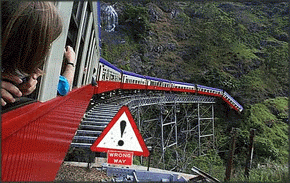
It's like watching an instant replay of a train wreck in slow motion.
Looking back over the last decade of Reserve Bank statements and actions is sobering.
Starting in 2002, mortgage lending growth and house price inflation were relatively modest, as was the New Zealand dollar at just over 40 USc. The Official Cash Rate was 5.75%. Then freshly minted Reserve Bank Governor Alan Bollard cut interest rates in April 2003 and the housing market began to stir.
A burst of competition between the banks and a fall in fixed mortgage rates powered by cheap foreign borrowing by banks started a fire under housing market. The foreign borrowing also started pushing up the New Zealand dollar.
It's clear that by 2004 this shift in behaviour had started changing the structure of the New Zealand economy.
The non-tradeable sector, including government, real estate and financial services, surged ahead and diverged from the tradeable sector, which includes exporters and those that compete with imports. Our current account deficit doubled between 2002 and 2008, driving a rise in our net foreign debt from 65% of GDP to 85% over the same period.
By early 2004 the Reserve Bank began to warn about the high currency and was noticing surprising strength in house prices.
It put up interest rates, which simply increased pressure on the currency.
By 2005 and into 2006 the Reserve Bank found itself painted into a corner by its single inflation target and its single tool of the Official Cash Rate (OCR). It even started investigating the use of 'Supplementary Stabilisation Instruments', including a mortgage interest levy and loan to value ratio limits.
Eventually it decided not to adopt them.
While it twiddled and stuck to the orthodoxy of the Reserve Bank Act, the housing market, the currency and foreign borrowing launched into the stratosphere. Even the Reserve Bank agrees now it missed the housing bubble and underestimated the effects on the wider economy of foreign borrowing. Yet still it stuck to the orthodoxy.
Fast forward to late 2012 and early 2013 and it is doing the same orthodox thing again under its strict new Governor, Graeme Wheeler.
Faced with a surge in bank competition, cheaper mortgages, faster borrowing and a blast higher in house prices in the second half of 2012, the Reserve Bank did what it has done for a decade - stuck to the script and read from it.
It is now looking at creating other 'macro-prudential tools' to help it break free of this Gordian knot whereby any moves to slow the housing market with the single tool of higher interest rates just hammers the rest of the economy.
These tools include limits on Loan to Value ratios for mortgages so borrowers would need bigger deposits.
It's an echo of the hunt for Supplementary Stabilisation Instruments in 2005 and 2006.
The Reserve Bank appears congenitally reluctant to try them.
A paper to the board in May even pointed to an IMF study showing countries with LVR limits had lower house price inflation and such a tool would be a useful add-on to the Official Cash Rate. Yet still the Reserve Bank dithers, saying last week it would put out a discussion paper by the end of March and was still negotiating a Memorandum of Understanding with the government. And still the Reserve Bank is reluctant to drop the orthodoxy.
Wheeler said in November and December that even if he had these extra tools such as LVR limits he would not use them because house price inflation and lending growth wasn't strong enough yet.
He also undermined the power of any of his currency warnings by saying he doesn't believe in currency intervention.
Fast forward to late January 2013 and house price inflation is at 10% again and lending growth has doubled inside 6 months. Banks are regularly offering 95% mortgages, discounting away legal fees, giving away free tablet computers and thousands of dollars of 'cash back'. The NZ dollar is near record highs. Unemployment is rising. The current account deficit is headed for 7% of GDP. Yet the orthodoxy still reigns.
As Karl Marx said: "History repeats itself, first as tragedy, second as farce." This economic policy trainwreck is nearing the farce stage.
-------------------------------------------------------
This item was first published in the Herald on Sunday. It is used here with permission.
We welcome your comments below. If you are not already registered, please register to comment
Remember we welcome robust, respectful and insightful debate. We don't welcome abusive or defamatory comments and will de-register those repeatedly making such comments. Our current comment policy is here.