
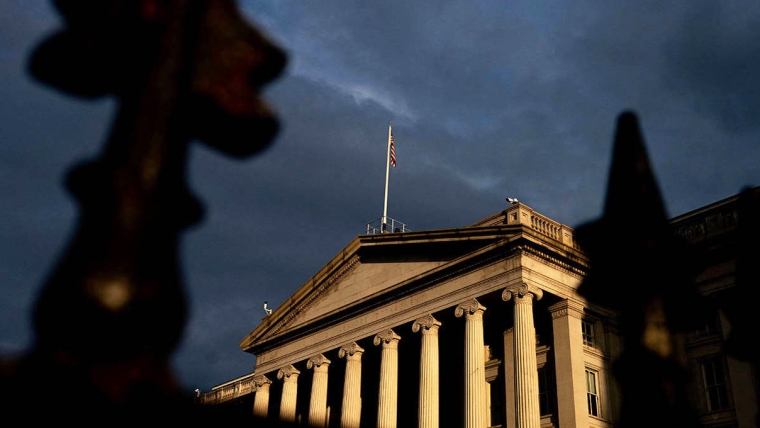
As we approach the end of the northern summer, often a volatile period for financial markets, all eyes are on the apparent fragility of US bonds. Some observers will say that sustained weakness is a sign that the US market is losing its role as the anchor of the global financial system. Yet there is little evidence of this happening. On recent days when US bonds have traded especially poorly, so, too, have other markets around the world.
Moreover, while the dollar briefly plummeted following US President Donald Trump’s “Liberation Day” tariff tantrum last year, it has since recovered and remained broadly stable. The implication is that the greenback is still extremely important to many other countries, especially those facing their own government refinancing and debt-servicing challenges. To infer a reduced global role for the US Treasury market, one would need to see other major bond markets emerging as the beneficiaries of dollar weakness, and that has not happened.
True, many commentators warn that those days are coming, and I have some sympathy for their argument. But, at the moment, we have only warnings, not observable facts. It is also true that the US cannot simply persist with such large fiscal deficits—as it has done through the first Trump presidency, the Biden presidency, and now the second Trump presidency—and face no consequences. If anything, weakness in US markets and dollar depreciation would ultimately serve America’s own interests if it forced greater fiscal discipline on US policymakers.
In the meantime, though, the more interesting feature of US bonds’ recent performance is that it has coincided with somewhat better inflation figures and the arrival of a new US Federal Reserve chair who clearly believes in the disinflationary implications of the AI boom.
Of course, the markets could be wrong; but they are often less wrong than those of us who closely follow them. They will often latch on to something that most commentators are missing. What might that be? Let us consider the most likely possibilities.
First, the markets may believe that the slightly softer inflation data are only temporary, and that forthcoming data releases will confirm this conjecture. But I am not so sure, considering that the recent softening was unexpected and markets usually respond to such surprises.
Second, the market’s behavior might have something to do with the new Fed chair, Kevin Warsh, who has brought a fundamentally different philosophy of Fed governance and communication. No longer can markets expect “forward guidance” on future monetary-policy decisions. They will have to figure it out for themselves. Warsh has even gone so far as to suggest that the market’s reaction to his first press conference—when financial conditions suddenly tightened—already did some of the Fed’s job for it.
Still, I am not so sure of this interpretation, either, even though I am a huge believer in the power of financial conditions as a leading indicator in the US economy. After all, it is equally, if not more, likely that the markets think Warsh is being too cavalier about the underlying risks to growth. Perhaps they simply do not share his optimism about the imminent productivity benefits of AI.
A third (related) interpretation is that AI hyperscalers’ increasing reliance on corporate bond issuances (rather than free cashflows) to fund their expansion plans has had a negative effect on Treasuries, whose yields must rise to compete with all the new hyperscaler debt. If the sharp increase in demand for credit is playing a role in markets’ current outlook, the benefits had better show up in corporate earnings. Otherwise, equity markets will start to wobble again. (Equally, if US bond yields continue to climb, demand for stocks may ease.)
The final, obvious possibility is that bond investors are reacting to the US government’s worsening fiscal position and the utter lack of executive or congressional leadership on the issue. Hardly a day goes by without some financial or political commentator touting the miracle of America’s economic performance. But if everything was so great, one would expect an improvement in the cyclical US fiscal position; and if the US economy was as “exceptional” as some believe, the structural fiscal position would also be stronger.
So, as we approach September (the worst month for stocks, historically), all eyes will remain on the performance of US bonds. Whatever happens in that market will not stay there.
Jim O’Neill is a former UK Treasury minister and a former chairman of Goldman Sachs Asset Management. Copyright: Project Syndicate, 2026. www.project-syndicate.org
We welcome your comments below. If you are not already registered, please register to comment
Remember we welcome robust, respectful and insightful debate. We don't welcome abusive or defamatory comments and will de-register those repeatedly making such comments. Our current comment policy is here.