


Rising mortgage interest rates appear to be having a bigger impact on housing affordability for first home buyers than declining house prices at the bottom end of the market.
The average of the two year fixed mortgage rates charged by the main banks has been increasing for the last nine months, rising to 5.45% in August from 4.49% in November last year.
Over the same period the Real Estate Institute of New Zealand's lower quartile sale price, representing the most affordable end of the housing market, declined to $575,000 from $616,000, a drop of $41,000 (-6.7%).
However, it was the increase in mortgage interest rates which had the biggest effect on affordability, pushing up mortgage payments on a newly purchased home in spite of the fall in purchase price.
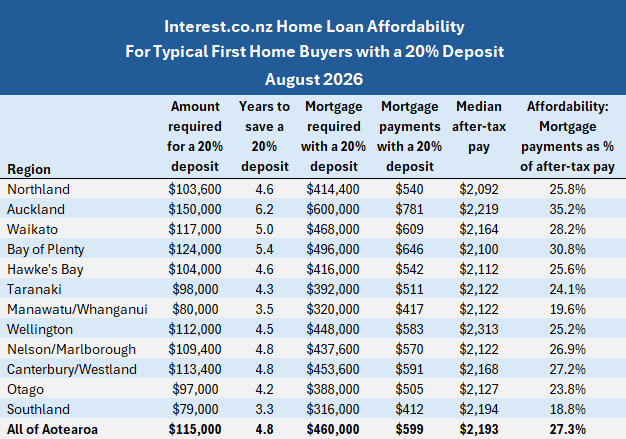
Interest.co.nz estimates the mortgage payments on a home purchased at the lower quartile price in November last year would have been around $575 a week, assuming a 20% deposit and 30 year loan term. At August's lower price the mortgage payments would have increased to $599 a week, up $24 a week.
That trend of rising mortgage payments on homes purchased at the lower quartile price was evident in most parts of the country between November and August, with the biggest increase occurring in Taranaki up $58 a week, followed by Northland $54, Southland $42, Canterbury $40, Waikato $31, Auckland $30, Bay of Plenty $16, Manawatu/Whanganui $9, Otago $6 and Hawke's bay $5.
The only regions where mortgage payments declined between November and August were Wellington, where the lower quartile price dropped $70,000 to $560,000 from $630,000, pushing mortgage payments down $4 a week, and Nelson/Marlborough where the lower quartile price fell $90,500 to $547,000 from $637,500, pushing mortgage payments down $25 a week.
While the effect of rising mortgage interest rates on mortgage payment levels have been relatively modest so far, helped by declines in prices at the bottom of the market, they are significant because most economic commentators are expecting the Reserve Bank to raise the Official Cash Rate at least twice and possibly three further times in its current monetary policy tightening cycle.
If current patterns hold, that will likely keep downward pressure on prices, the benefits of which are likely to be more than offset by upward pressure on mortgage payments, which will not be helpful for aspiring first home buyers.
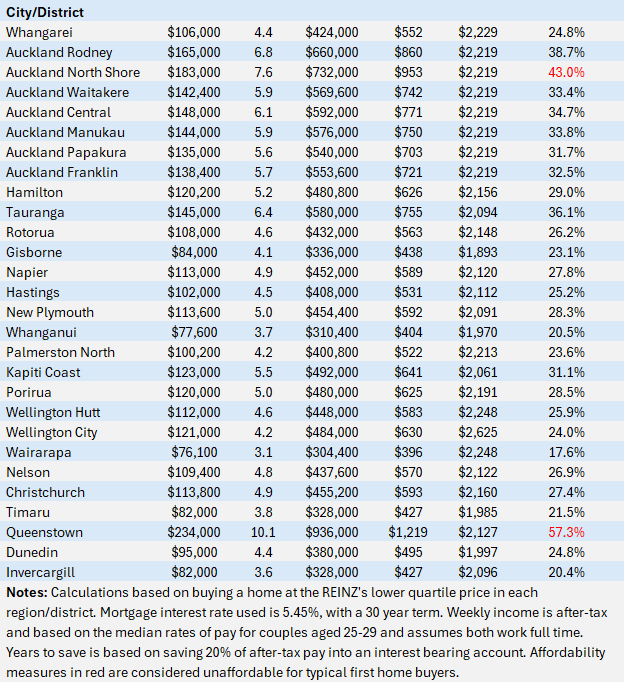
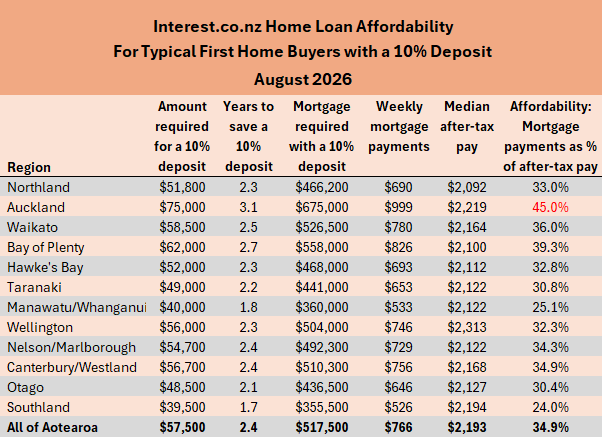
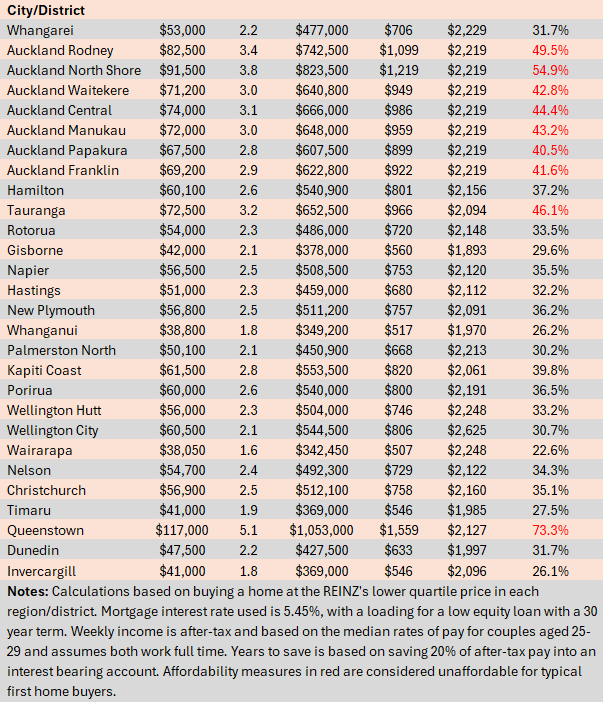
The tables below show the main affordability measures for typical first home buyers with either a 10% or 20% deposit, in most urban districts around the country.

We welcome your comments below. If you are not already registered, please register to comment
Remember we welcome robust, respectful and insightful debate. We don't welcome abusive or defamatory comments and will de-register those repeatedly making such comments. Our current comment policy is here.