
sign up log in
Want to go ad-free? Find out how, here.

Housing becoming more affordable for first home buyers even as interest rates keep rising

Property / analysis
Housing becoming more affordable for first home buyers even as interest rates keep rising
Young couple jumping for joy

Falling house prices at the bottom of the market saw affordability continue to improve for first home buyers in July even as mortgage interest rates continued to rise.

According to the Real Estate Institute of New Zealand, the national lower quartile selling price was $575,000 in July, down from $585,000 in June and $600,000 in May. That puts the national lower quartile price at its lowest point since January last year, with it now down $95,000 compared to its November 2021 peak.

The lower quartile price is the price point at which 25% of sales are below and 75% are above, representing the most affordable end of the housing market.

However while prices have been declining, mortgage interest rates have been rising, maintaining upward pressure on affordability levels.

The average two year fixed mortgage rate has increased for eight consecutive months, rising to 5.30% in July from 4.49% in November last year, keeping upward pressure on mortgage payment levels even as purchase prices have declined.

However, the latest drop in the lower quartile price has been enough to see the mortgage payments on a lower quartile-priced home decline slightly, even as the underlying mortgage rate has increased.

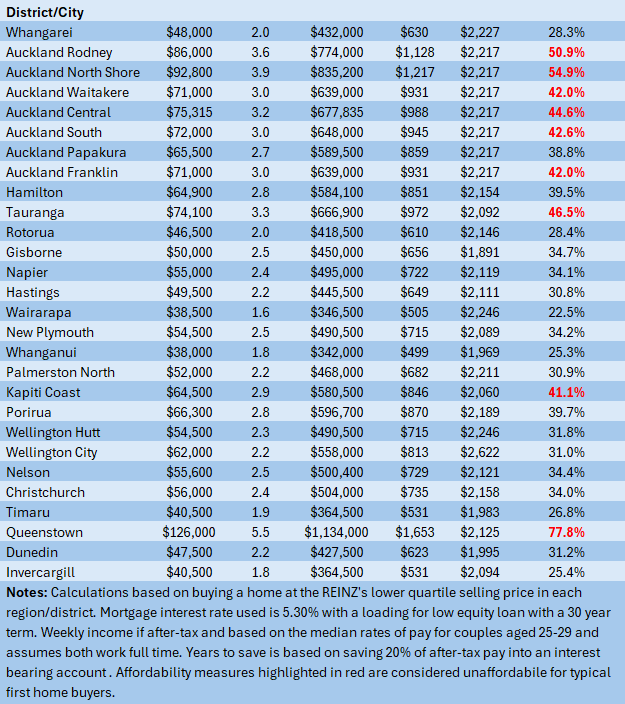
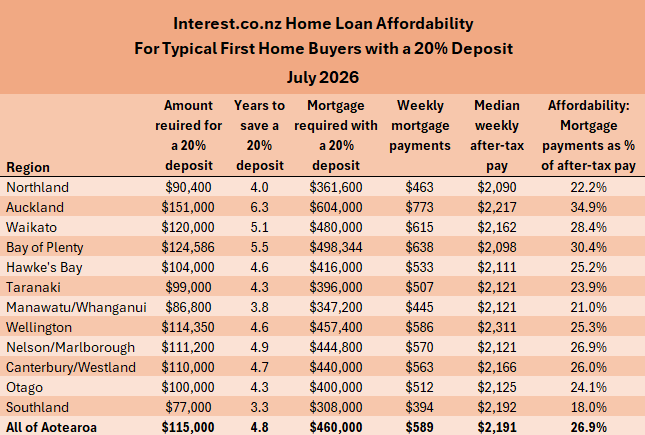
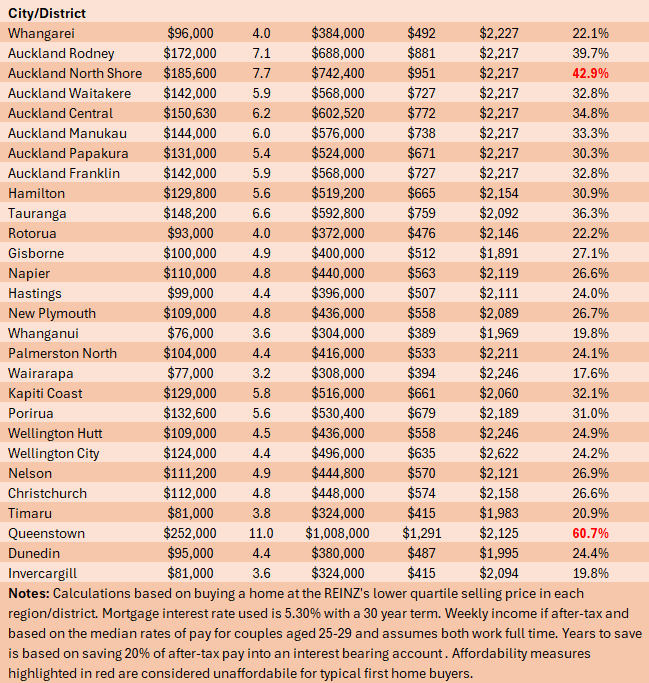
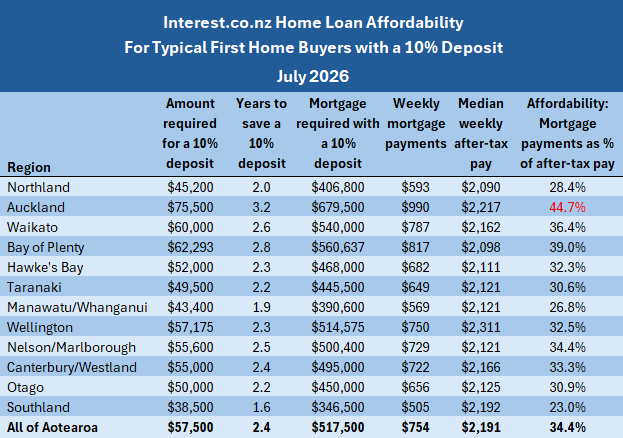
Interest.co.nz estimates the mortgage payments on homes bought at the lower quartile price with a 10% deposit have declined to $754 a week in July from $779 in March this year, saving the typical first home buyer $25 a week.

In Auckland, the only region where housing is still considered technically unaffordable for first home buyers with a 10% deposit, the lower quartile price falls have been even greater, down to $755,000 in July from $800,000 in April, a drop of $45,000 (5.6%) in three months.

That has seen the mortgage payments on a lower quartile-priced home purchased with a 10% deposit in Auckland decline by $46 a week since April, in spite of rising mortgage rates.

So what first home buyers are losing from rising interest rates, they are currently making up for in lower purchase prices.

The comment stream on this article is now closed.


We welcome your comments below. If you are not already registered, please register to comment

Remember we welcome robust, respectful and insightful debate. We don't welcome abusive or defamatory comments and will de-register those repeatedly making such comments. Our current comment policy is here.

15 Comments

The myth that kiwis just need to jump on the property ladder is dead and buried in a flat or declining market.  Instead the pendulum is now swinging firmly in the other direction.  

Because small price drops can wipe equity entirely when buying at 80-90% LVR.  The underlying math driving buyer behaviour has completely flipped.  

As sellers continue delaying reality, buyers continue to wake up

Up
9

We are now living in what ever is the opposite of a ‘be quick’ or FOMO paradigm. 
 

Up
8

Indeed.  The shift from FOMO to FOOP or the fear of catching a falling knife

Up
1

Now into FOGF?

Up
2

Tommy: [pauses and thinks] what, proper?

Best movie ever. so FOGPF

Up
1

Property is, and always will be, a good (long term) investment. If you have the deposit, and once the necessary due diligence is done, go for it. You will not regret it. 

Up
2

Commercial property sure. Also note TOP land tax is not applying to commercial.

Up
3

Indeed. When will the banks start of flush the interest only specu pretenders. 

Up
3

I agree with you.  In the UK, in 2012 first time buyers were unable to afford deposits, this led to the Government introducing Help to Buy, a package where they put up 15% of the deposit, the buyers 5%, on new homes.  It led to a housing boom, builders became multi millionaires, and prices rose by 50% over 7 years, thus rendering the situation worse for new first time buyers. Many of those who bought units via that method are now unable to sell due. 

The market is now dead, mainly due to mortgage rates of 5.5% compared with those crazy days (2008 - 2021) of 2.5%.   Youngsters cannot afford houses and are withdrawing, becoming angry, and looking to Government.

I am in NZ for the first time in 15 years and one senses a nation in economic trouble.  Housing has, as in the UK, sucked the life out of the economy.  I see lots of  expensive (and without a doubt, cold) houses, turn the corner and there are closed shops, run down retail areas, and I often hear that 'people are struggling'.  A friend tells me - wait till you go food shopping!

Meanwhile I am in a house with a value of circa $600k, not much in relative terms.  It is small, has masses of single glazed windows (why I ask) and so the place is very cold, it has a heat pump that the resident rations - 'its expensive to run', and I realise that were the person I am with to buy the place, with a 20% deposit, they would over thirty years pay $900,000 in capital and interest!

I am left thinking - it would not be so bad were the place cosy.  

Up
0

Buy. Do it up, replace and insulate. Kapow its... cosy, and you create some additional equity. Such work often doesn't trigger consent so  council dont put up the rates due to your work either. 

Up
0

In Auckland, the only region where housing is still considered technically unaffordable for first home buyers with a 10% deposit.

Auckland purposely structures its housing supply to be the most unaffordable they can make it.  They insert large gaps between new housing areas to increase sprawl and reduce connectivity.  

Up
1

And then Nat fast tracks approvals for new suburbs that will need to truck their shit away for years!!!


Up
5

Yep, just so long as building there is inefficient and/or bad for the environment - then Auckland will greenlight it.  The more remote and disconnected the better. 

Up
1

ACC does not want it to happen, National is using fast track RMA to override ACC

Up
4

People will only buy or live there if that's their best option. Which says a lot about how mismanaged the housing and land market has been in Auckland, by council.

Up
2