

sign up log in
Want to go ad-free? Find out how, here.

As US government financing challenges grow, watch for coercive US attempts to transfer the costs and risks to foreign investors, says David Skilling

Bonds / opinion
As US government financing challenges grow, watch for coercive US attempts to transfer the costs and risks to foreign investors, says David Skilling
banknotes on chessboard
Image: 123rf.com 122399339

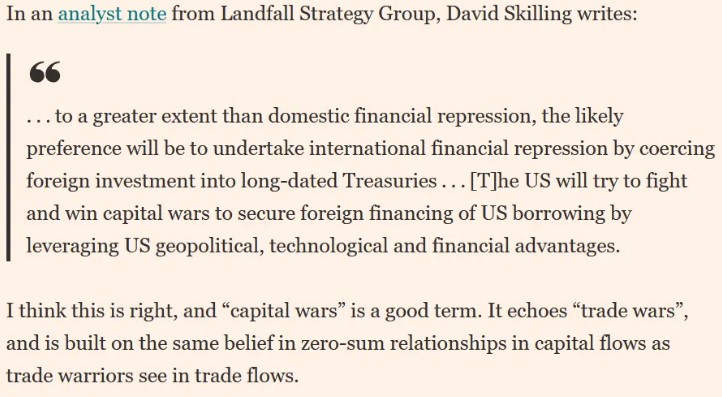
This post highlights a few selected arguments from my latest client note on capital wars. My central conclusion is that capital wars are more likely, and nearer-term, than widely expected. The note was discussed in a Financial Times column last week:
 

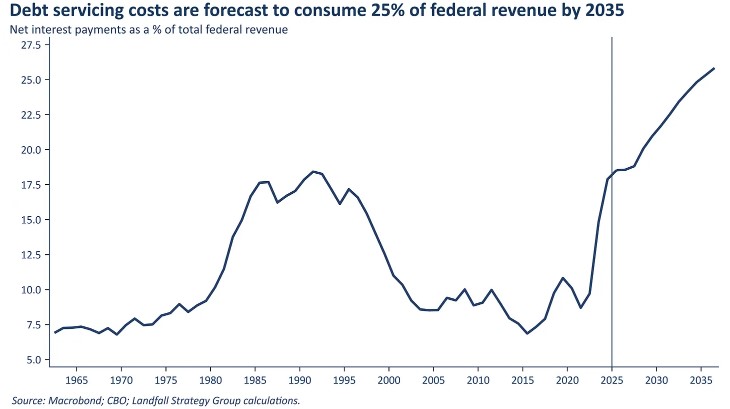
The rapidly worsening US fiscal outlook – total federal debt has just passed $40 trillion – makes unorthodox macro policy increasingly likely. Measures to induce or require the Fed or private sector financial institutions to buy US Treasuries (fiscal dominance/financial repression) are moving closer to the mainstream of the US policy debate as government borrowing requirements and debt servicing costs continue to rise. The US 10-year yield breaking above 5% this week to almost 20-year highs further highlights these pressures.
 

The US government financing requirement is growing substantially as foreign demand for Treasuries continues to weaken. Foreign holdings of Treasuries now represent ~30% of marketable Treasuries, down materially from ~50% in 2015. This reduction has been driven by a weakening share of foreign official holdings, such as by central banks, for both economic as well as geopolitical reasons.
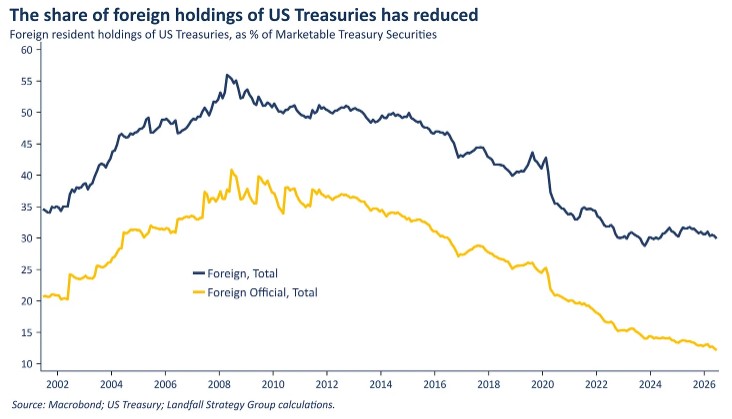
 

This softer foreign demand for US Treasuries is placing upward pressure on US yields. Fiscal dominance and domestic financial repression are plausible US responses to these financing challenges. But these policy measures come with domestic economic, financial, and political costs.


There is likely to be a strong US preference for imposing financing costs on foreign investors. A core organising belief of the Trump Administration is that the US has been systematically ‘ripped off’ across multiple domains. Its response has been to reset the terms of US global engagement: tariffs, military burden sharing, conditional technology access, and more.

This logic is likely to extend to measures to coerce foreign capital to finance US government borrowing, an international form of financial repression. There are already early signs. The US has required investment commitments as part of tariff negotiations with countries such as Japan and South Korea.

As US financing pressures grow, expect coercive measures to direct foreign capital into US Treasuries. Purchases of long-term US Treasuries could be explicitly linked to US security guarantees, access to advanced US technology, US swap lines, and market access.

Essentially every area in which the US has leverage can be exploited to allocate more of the costs and risks of financing the US government to foreign investors. Indeed, from Athens and Napoleonic France to the British Empire, history shows examples of fiscally constrained great powers using instruments of power – military, technology, finance – to extract resources from smaller powers.

These measures will create significant economic and geopolitical tension. Many current account surplus countries in Europe, East Asia, and the Gulf want to retain more capital to deploy domestically, supporting economic growth and financing strategic priorities: military spending, industrial and innovation policy, and so on. Capital wars are the consequence, as growing US demand for foreign capital intersects with a constrained supply of capital to the US and elsewhere.

There is much uncertainty as to how this will play out, and the extent to which the US can monetise its geopolitical, technological, and financial advantages to coerce foreign capital inflows.

But irrespective of the precise trajectory, implementing an extractive financing model would represent a rupture in the international financial system. Capital flows will become an increasingly important vector of global economic and geopolitical tension. Changing patterns of global capital flows will have first-order implications for US and global rates, exchange rates, as well as the geographic pattern of economic activity.

Capital wars are more likely and nearer-term than the consensus expectation. These capital wars are also likely to be much more consequential than the recent trade wars. Firms and investors should position for disruptively changing patterns of capital flows, both coerced and voluntary, as the global system shifts from the market state towards state capitalism.


Thanks for reading small world. This week’s note is free for all to read. If you would like to receive insights on global economic & geopolitical dynamics in your inbox every week, do consider becoming a free or paid subscriber. Group & institutional subscriptions are also available: please contact me to discuss options (more information is available here).


*David Skilling ((@dskilling) is director at economic advisory firm Landfall Strategy Group. The original is here. You can subscribe to receive David Skilling’s notes by email here.

We welcome your comments below. If you are not already registered, please register to comment

Remember we welcome robust, respectful and insightful debate. We don't welcome abusive or defamatory comments and will de-register those repeatedly making such comments. Our current comment policy is here.

6 Comments

Sounds like a geopolitical level 'protection racket'.

Pay us (buy our treasuries), or we will make life hard for you.

Up
6

The U.S. Treasury has been helping Japan defend the yen without having to sell large amounts of U.S. Treasury bonds from Japan’s reserves. That distinction matters because Japan is the largest foreign holder of U.S. Treasuries, and big sales would push U.S. yields (and borrowing costs) higher.

A key mechanism the U.S. is promoting is the Federal Reserve’s FIMA Repo Facility. Under FIMA, the Bank of Japan can pledge its U.S. Treasury holdings as collateral to the New York Fed and borrow dollars temporarily, instead of selling those Treasuries into the market. Japan then uses the borrowed dollars to buy yen in the spot market to support the currency. When the repo matures, Japan returns the dollars and gets its Treasuries back, so those bonds never hit the secondary market.

The U.S. Treasury’s role is to stabilize the yen in a way that limits Japanese sales of U.S. Treasuries, using:

  • Coordinated FX intervention (including euro sales for yen)
  • Access to the Fed’s FIMA Repo Facility so Japan can borrow dollars against its Treasury holdings instead of selling them.

This protects U.S. borrowing costs while giving Japan the dollars it needs to support its currency.

Up
2

A great piece, thank you David Skilling.

Up
5

Agree - except perhaps the slant that capital moves will outweigh physical.

I suggest the reverse is what we're seeing. 

Up
2

Surprise surprise, the bill comes due and they want the others at the table to cover their exorbitant meal as well as the taxi home, their rent, and lifestyle so-to-speak. 

Up
2

The Great Discovery of Extractive Finance

Skilling's article contains a rather extraordinary discovery - apparently, if the United States eventually coerces foreign countries into buying its Treasury debt in exchange for security guarantees, technology access, swap lines and market access, this would constitute an “extractive financing model” and a “rupture in the international financial system.”

Well, somebody should probably tell him that the extraction is hardly a new development.

What would be new is not the extraction, but the possibility that Washington eventually becomes sufficiently desperate to drop the polite pretence that the system is voluntary.

For decades, the United States has enjoyed the extraordinary privilege of issuing the world's principal reserve currency, running persistent external deficits and accumulating enormous quantities of foreign goods and assets in exchange for dollar liabilities. 

The dollar-centred financial architecture, U.S. military power, sanctions regime, Treasury market and global payment system have hardly operated in a vacuum. The entire arrangement has involved a considerable transfer of economic and financial power toward the United States.

And now, as Skilling himself points out, foreign demand for Treasuries is weakening - foreign investors hold roughly 30% of marketable Treasuries, down from around 50% in 2015, while U.S. financing requirements are rising sharply.

So the really interesting development isn't “extractive financing”. It's the prospect of extraction becoming explicit - that distinction matters.

The other amusing part is the extraordinary faith placed in the machinery supposedly determining the appropriate interest rate. The accompanying Atlanta Fed chart shows the actual Fed funds rate alongside various Taylor Rule prescriptions stretching back to the 1980s. 

It is precisely the sort of chart that makes monetary policy look wonderfully scientific - provided nobody asks the slightly awkward question of why there are several different “correct” answers.

https://indi.ca/rates-vs-straits/

As Indi rather gloriously puts it, Taylor Rule economics can resemble “Central Bankers... reading entrails” - an elaborate formula which gives the priesthood the appearance of possessing a method, even when the underlying economy stubbornly refuses to behave like the equation.

And that becomes farcically ridiculous when the problem confronting the Fed is not simply excess demand or an overheating economy, but physical supply constraints, energy disruption, geopolitics and an increasingly dysfunctional fiscal position.

As Indi's article points out, you cannot raise the Fed funds rate by 25 basis points and magically reopen a strategic oil chokepoint or produce another barrel of crude.

Yet this is the intellectual world we have somehow arrived at - use an interest-rate algorithm to solve a physical and geopolitical crisis, then use geopolitical leverage to force foreigners to finance the fiscal consequences.

The priests have their Taylor Rule - he Treasury has its debt auction, and when the congregation starts asking why the collection plate is getting heavier, apparently the answer will be:

“Buy more Treasuries or we may have to reconsider your security guarantees, technology access, swap lines and market access.”

That's not the beginning of extractive finance - it's what happens when extractive finance finally stops pretending to be voluntary.

SUMMARY - IMO this article is the most outrageous piece of claptrap central-banking/eCONomics that I have ever stumbled across in my entire life.

Up
1