


A becalmed housing market meant there was no change in affordability levels in September, with no significant movement in the main affordability indicators monitored by interest.co.nz.
- House prices
The Real Estate Institute of New Zealand's national lower quartile selling price was $575,000 in September, just $2000 less than in August, which was not enough to make a meaningful difference to affordability. However, it was the fourth consecutive month the lower quartile price has declined. That said, it's only down $15,000 (-1.0%) fromo September last year, so it's a very slow decline. The lower quartile is the price point at which 75% of prices are above and 25% are below, representing the most affordable end of the housing market.
- Mortgage interest rates
The average of the two year fixed mortgage rates charged by the main banks actually declined slightly to 5.42% in September from 5.45% in August. However that was due to some of the banks tweaking their competitive positions rather than a major shift in the market, and it wasn't enough to have any significant impact on affordability. The slight fall in September followed 10 consecutive monthly increases in the average two year fixed rate, which has slowly risen from 4.49% in November last year. So it's a slow but steady increase, with rates likely to resume their upward trend over the next few months.
- Incomes
Incomes are the final piece of the affordability puzzle, although they get far less attention than house prices or interest rates. Interest.co.nz estimates the weekly after tax pay based on the median rates of pay for couples aged 25-29, if they both work full time. This was $2195 a week in September, up by just $2 a week compared to August, so not enough of a difference to make an impact on affordability.
- Overall Affordability
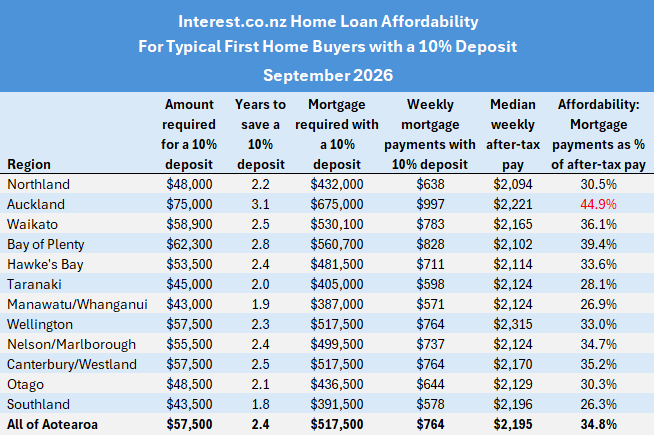
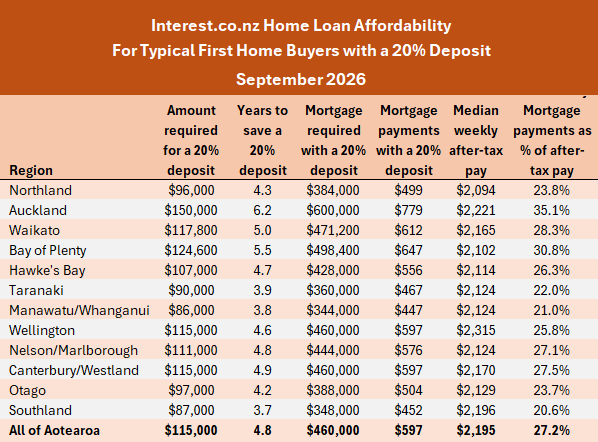
This measure combines all of the above data by tracking the percentage of the weekly income figure that would be eaten up by the mortgage payments based on the latest mortgage rate and house price figures and assumes the mortgage is for a 30 year term. Interest.co.nz calculates this figure based on buying a property with either a 10% or 20% deposit. This showed affordability improved very slightly in September, with mortgage payments taking up 34.8% of after-tax pay, down from 35.1% in August, if the property is purchased with a 10% deposit.
- Regional differences
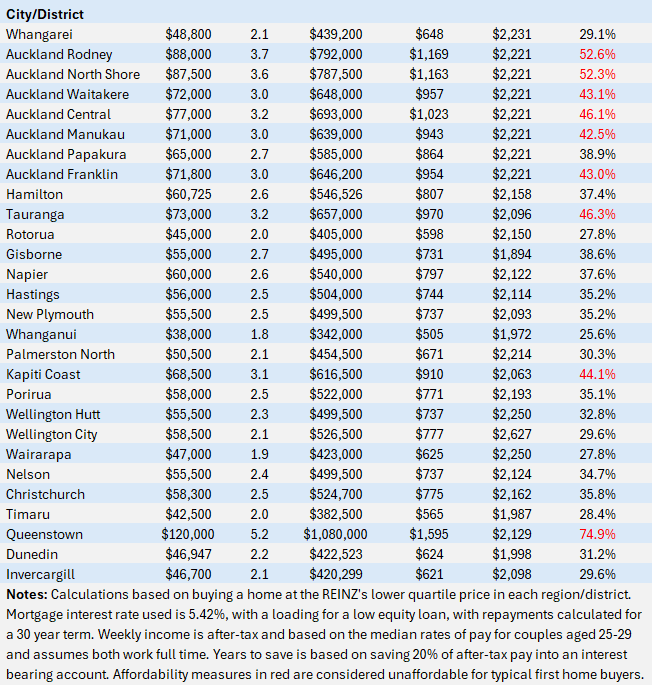
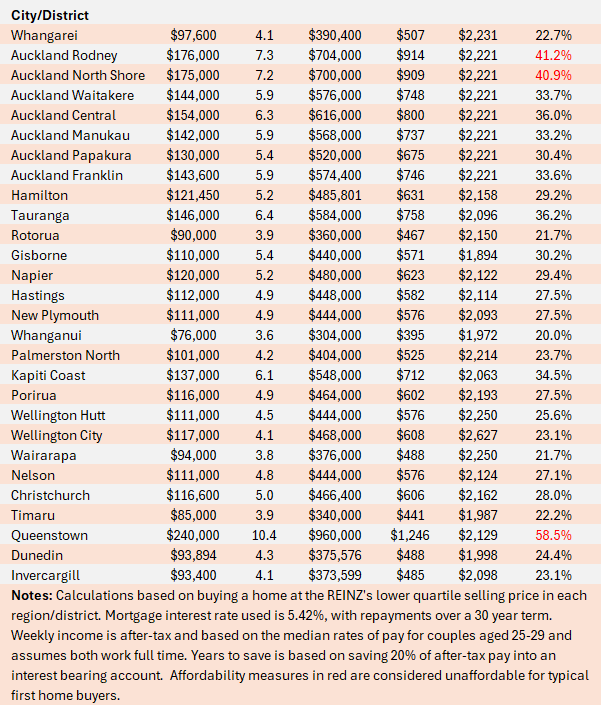
Interest.co.nz considers mortgage payments unaffordable when they take up 40% or more of after-tax pay. By that measure, the only districts in the country that are considered unaffordable for typical first home buyers with at least a 10% deposit are all of Auckland apart from Papakura in the south of the region, Tauranga, Kapiti Coast, Selwyn and Queenstown. All other parts of the country are well within affordable limits for typical first home buyers, provided they can scrape together a 10% deposit.
The tables below show the current affordability measures for all urban districts around the country, with either a 10% or 20% deposit.

We welcome your comments below. If you are not already registered, please register to comment
Remember we welcome robust, respectful and insightful debate. We don't welcome abusive or defamatory comments and will de-register those repeatedly making such comments. Our current comment policy is here.