

Two horror stories are keeping some investors awake at night. Both attempt to explain why government bond yields have suddenly spiked across several major economies.
The first is that high public debt and persistent budget deficits have finally triggered a "buyers’ strike" – with bond investors rebelling against profligate politicians by demanding higher yields. The second is that 1970s-style inflation is slipping the leash, threatening to eat fixed income returns alive.
Both explanations make for dramatic headlines. But while fiscal pressures and possibly reaccelerating inflation matter, neither explains this sell-off.
To understand why bond yields have jumped, we need to strip away the hyperbole and look under the hood of market plumbing. Because, once you examine the data, these popular narratives fall apart quickly.
Take the "buyers' strike" theory – a story running especially hot in the U.K right now. If markets were genuinely abandoning faith in British public finances, Gilts (U.K government bonds) would be performing terribly relative to interest rate swaps, which don’t carry the same government credit risk. Yet, Gilts are trading at virtually the same valuation relative to swaps as they were well before this sell-off began.
Likewise, if investors were scared of long-term fiscal insolvency, they would likely be dumping long-dated debt hardest. Yet, instead yield curves have flattened, meaning short-term bonds have taken the brunt of the hit.
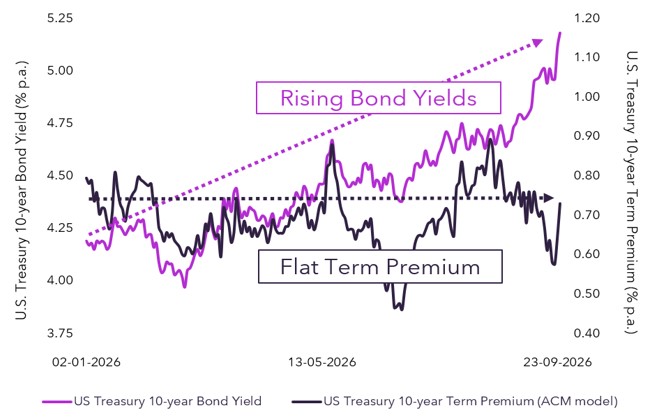
Term premium offers another clue. It’s the extra compensation investors demand for tying their money up in long-term bonds rather than rolling over shorter-term ones – reflecting uncertainty about the future. But, even as U.S national debt tops $40 trillion, this premium has barely budged while 10-year Treasury yields have surged.
Source: Source: Wedge, Federal Reserve Bank of New York – ACM Term Premia
The inflation theory fares no better.
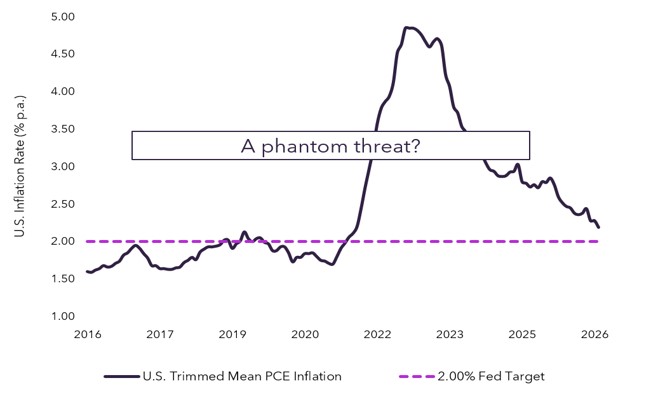
Sticking with the U.S., where the headlines are loudest, inflation has remained above the Federal Reserve’s 2% target for 67 consecutive months. But look beneath the headline inflation rate and the picture is far more reassuring. Core measures continue to moderate, while forward-looking inflation swaps also remain anchored below 2.5%.
Source: Wedge, Bloomberg
So if it isn't a global debt crisis and it isn't runaway inflation, what is driving yields higher?
The answer is far simpler and less headline-grabbing: markets are coming to grips with the reality that short-term interest rates are likely to stay higher for longer than previously anticipated.
President Trump’s recent commentary notwithstanding, a ten-year government bond yield is seldom a moral judgment on a country's public debt. It’s primarily a projection of what the market expects the average short-term cash rate to be over the next ten years.
Today, bond markets are simply adjusting to a global economy that refuses to stall, forcing central banks to keep monetary policy tight.
That isn’t a bad thing. In fact, a financial system where capital carries a real cost is far healthier than one built on free money. But the transition needs be orderly. Sharp spikes, like the current one in French government bond yields, show how quickly localised fiscal and political vulnerabilities can be exposed.
Setting aside country-specific issues like France, two far less dramatic forces are driving this bond market sell-off.
First, geopolitical conflict continues to disrupt supply chains, keeping commodity prices high. This backdrop of instability makes central banks naturally hesitant to deliver the rate cuts markets had earlier anticipated – with the inflationary ghost of 2022 still haunting them.
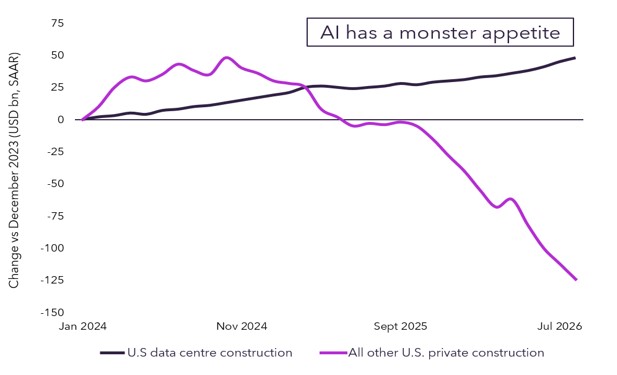
Second, the relentless AI infrastructure build-out. The massive capital expenditure pouring into data centres, power grids, and specialised hardware is injecting historic levels of stimulus into major economies, which is keeping underlying growth stubbornly resilient.
Source: Wedge, U.S Commerce Department
Is the market right to assume that AI-fuelled spending and deeply unsettling geopolitics will keep short-term rates elevated through 2027 and beyond? You can count me among the sceptics.
But either way, getting the diagnosis of the bond sell-off right may matter even more for New Zealand investors, business leaders and politicians. Because mistaking its cause risks the wrong response.
I’d argue, high global yields aren't a warning sign of financial doom. They are a return to sanity.
A world where capital carries a reasonable price tag is vastly healthier than the unnaturally low interest rates of the 2010s. Recognising this might be the best antidote to market panic.
David McLeish is the managing director and Chief Investment Officer of Wedge Management. You can contact him here.
We welcome your comments below. If you are not already registered, please register to comment
Remember we welcome robust, respectful and insightful debate. We don't welcome abusive or defamatory comments and will de-register those repeatedly making such comments. Our current comment policy is here.