
By David Mahon*
[Updated: This article was originally published on March 15, 2022. What follows is an updated version incorporating more recent events.]
China was surprised by Russia’s invasion of Ukraine. Putin misled Xi Jinping, telling him he would not invade. The Chinese Embassy in Kyiv was uncharacteristically ill-prepared to evacuate its nationals, and Beijing issued mixed statements in the first 72 hours of the crisis. Western leaders’ perception of the Russian and Chinese authoritarian regimes as one, with a shared aim to destabilise Western democracy, is mistaken.
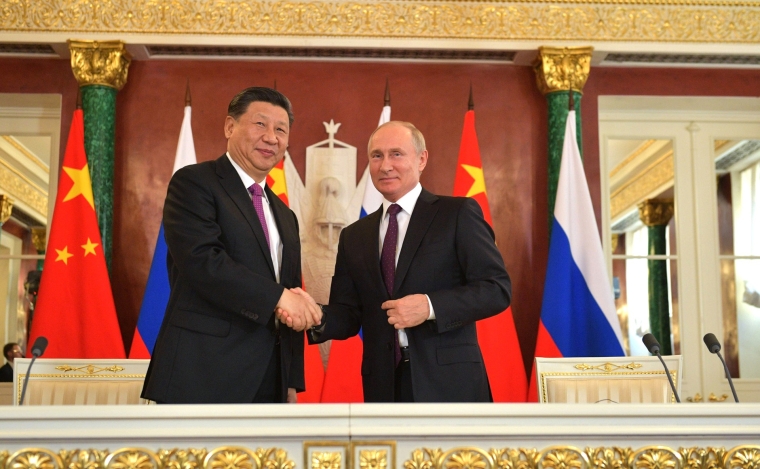
Russia is declining and China is rising. Putin wants to disrupt the global order, Xi wishes to join it and influence it. Putin and Xi are both the sons of communist revolutionaries, both rose to power through chaos they witnessed in their countries as young men, but they are different. Putin came to power in the ruins of an empire being looted by kleptocrats and corralling the key players, he enriched himself, allowing the state to remain energy export-dependent rather than using the wealth to diversify the economy. A small group of millionaires became billionaires and the middle class dwindled. Xi also came to power in a period when many in the political elite and the wider government were deeply corrupt and the Chinese economy faced instability due to surging internal debt. He moved against the kleptocrats successfully, reduced government corruption, reduced debt and guided the economy to a high degree of domestic self-sufficiency, based on consumption and investment rather than exports. The Chinese middle class continues to expand rapidly. Xi strengthened China while Putin weakened Russia.
The invasion of Ukraine places China in an ideological quandary. One of the first countries to recognise Ukrainian sovereignty in 1991, it refused to recognise Russian annexation of Crimea in 2014. China’s foreign affairs principles include that no nation should violate another’s sovereignty or interfere in its internal matters. In asserting these, Beijing is thinking very much of its own sovereign integrity. Its western borders have been the subject of territorial disputes, and Beijing is firm that Taiwan is an inalienable part of China. Although Western China watchers tend to agree that Taiwan is an Asian Ukraine waiting to flare up, the two situations are not linked. China will deal with the Taiwan question at its own pace, hoping to achieve a peaceful resolution.
That the US, while waging economic war on China and struggling to contain it is dealing with a proxy war with Russia in Europe, has given rise to schadenfreude in China, but there is more hope for a truce than a Russian victory.
China’s need to operate in the global economy is more important than any grievances it shares with Russia against the West. If Washington and Brussels could work with China to resolve the Ukraine crisis rather than demand China simply take their side, a ceasefire would be possible soon and the start of negotiations to end the war.
China does not trust Russia. In the early 1960s the two countries split over Khrushchev’s repudiation of Stalin and differences over the application of Marxist principles, the rift lasting until 1989. In 1969, Chinese and Soviet troops clashed on the Ussuri River, and scores were killed. The present crisis may help Beijing accept that it does not need Russia to stand up to US coercion as its economic strength makes it powerful enough to do it alone.
War’s economic wounds
If its trade with Russia were disrupted China would struggle, but it would manage. The Russian economy is weak and lacks diversity; with GDP of just over USD4 trillion (in purchasing power parity), it is smaller than that of Guangdong Province and depends heavily on China for industrial and electronic equipment and a wide range of consumer products. Sanctions against Russia are necessary, but they need to be selective or they will simply punish the ordinary Russian people who cannot influence their government’s actions, but suffer their consequences.
Ukraine and Russia supply 30% of the world’s wheat exports and 19% of its corn. China is facing one of the lowest wheat harvests in years and will certainly subsidise its grain importers this year, while Western consumers will face uncommonly high food prices. Developing areas, particularly Egypt, sub-Saharan Africa and South America will suffer real privation, probably famines.
Shaping public perception
Passing the Canadian and German embassies in Beijing last week, a local driver pointed out the Chinese characters written over Ukrainian colours on the walls of both legations expressing solidarity with Ukrainian people. ‘I agree,’ he said. ‘But I don’t remember any signs on Western embassies when Iraq was invaded. Are Europeans more important than Arabs? America wasn’t sanctioned back then either, was it?
Beijing and Washington maintain hard public stances toward each other. The Chinese media give greater weight to Putin’s conspiracies about Ukrainian atrocities, biological weapons and foreign military backing than the comments of European leaders, which often read as dubious afterthoughts. Many Chinese citizens have VPNs and can pass through the Chinese firewall easily to access international content. The trouble with propaganda (increasingly used by both authoritarian regimes and democracies) is that the propagandists often forget where they hid the truth they strove to distort.
It appears that China has begun to ameliorate its position toward Washington. More positive articles about the US are appearing in the Chinese media. It is encouraging that Biden had a two-hour video call with Xi on March 19th, although it is hard to know its substance, as Washington only reported that Biden threatened China with “consequences” if it aided Russia, while Beijing reported that the conversation was “in depth and cordial”.
China off balance
Beijing stopped recognising Russian-US dollar denominated letters of credit on March 8th. China will distance itself further from the spheres of Western sanctions on Russia, as there are rational concerns in Beijing that Washington will try to use the Ukraine crisis to sanction China as part of its longer-term aim of slowing China’s rise. It would help if China could be clearer that it does not support the invasion, perhaps while acknowledging Russia’s deeper security concerns and making it clear to Europe and the US that it is committed to continuing humanitarian aid to Ukraine.
China has an entente rather than an alliance with Russia, and is unlikely to give it military aid, but neither will it back NATO. Russia alone is responsible for this brutal, medieval invasion. Despite NATO’s strategic insensitivity at the end of the Cold War, and the fact that the consistent violator of the so-called global rules-based system in recent years has been its prime architect, the United States, this is not the time to litigate past transgressions, but to establish peace and stability in the present. China wants peace as much as the West. It is also alarmed at the prospect of facing an economic relationship with a more US-dependent Europe in which Washington will increase pressure on European companies to not deal with China.
NATO is galvanising, which may deter Putin from wider territorial ambitions. Putin has already created the opposite of that which his invasion set out to achieve. If NATO can remain steady enough, it should not simply try to reassert itself, but use its strength and unity to negotiate a long-term solution with Ukraine, Russia and Europe.
As the West adjusts to its loss of global dominance it is time to rethink the ramifications of aggressive Western cohorts such as AUKUS and the Quad, otherwise it will drive Russia and China closer, which is in the interest of neither the West nor China. China needs to put aside its chagrin toward the US and Europe and use its considerable economic power and political influence to help stabilise the environment upon which it and the global economy depend.
*David Mahon is the Executive Chairman of Beijing-based Mahon China Investment Management Limited, which was founded in 1985.

We welcome your comments below. If you are not already registered, please register to comment
Remember we welcome robust, respectful and insightful debate. We don't welcome abusive or defamatory comments and will de-register those repeatedly making such comments. Our current comment policy is here.