
Fletcher Building has returned to profit but expects its performance in the first half of its 2027 financial year to be affected by an “uncertain” economic, political and geopolitical backdrop. And for a third straight year there's no dividend for shareholders.
The company posted its results for the June 2026 financial year on Wednesday, reporting net earnings of $228 million.
It’s a big improvement on the $419 million after-tax loss for the June 2025 year, and the $227 million loss in the 2024 year.
Managing director and chief executive Andrew Reding described Fletcher Building as “significantly more resilient than it was 12 months ago.”
“We have moved at pace to improve our business model, and the strategic reset we set out last year is now starting to deliver tangible results. Our portfolio has been simplified with the divestment of the construction division and other non-core operating units, and we used the proceeds to strengthen our balance sheet,” he said.
Earnings before interest and taxes from continuing operations and before significant items, also known as underlying profit, came to $414 million in the 12 months to June, up $85 million on the prior period.
Net debt was $637 million, down $362 million from $999 million in June 2025.
The company reported $199 million in net earnings from continuing operations in the June year, up from a $330 million loss in 2025, buoyed by the gain on the sale of its construction division.
Fletcher Building sold its problematic construction division to French company VINCI Construction, part of the VINCI Group, for $315.6 million in January.
Fletcher Building said the improvement in net earnings from continued operations was “partially offset” by additional provisions for retained legacy contracts and impairments and valuation reductions relating to other businesses held for sale.
Vivid Living on the block
The company also said it's “actively progressing” with the divestment of its Vivid Living retirement village operations, following the Fletcher Building board’s assessment at the end of June that Vivid met the requirements to be classified as held for sale. No other details were revealed.
In terms of the residential and development division in the 2026 financial year, the company said the subdued property market impacted sales volumes.
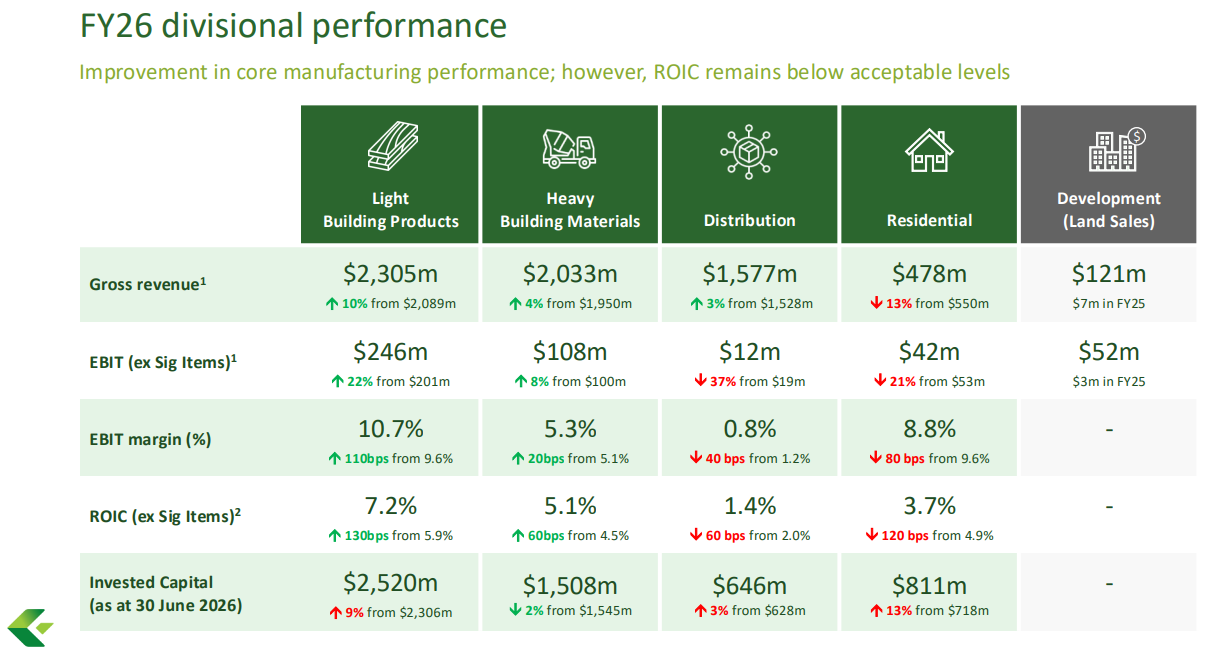
The division’s earnings before interest and tax (EBIT) came to $42 million, down from $53 million in the 2025 financial year and $100 million in the 2024 financial period.
A total of 536 residential properties were taken to profit in the June 2026 year compared to 666 in 2025, a drop of 130 units, according to the company.
Fletcher Building said Auckland was impacted by elevated market inventory and price pressure while Canterbury remained resilient, thanks to supportive population growth and pricing trends.
Previously contracted land settlement payments were $236 million in 2026. That spending is expected to drop by a significant amount, with approximately $110 million planned for the 2027 financial year and approximately $37 million in 2028.
In July, it was announced that the Government had agreed to pour up to $60 million into propping up Fletcher Building’s domestic cement supplier, Golden Bay , due to concern of it being left exposed to global supply chain shocks.
Fletcher Building said in its financial results that Golden Bay reported a “resilient performance” in the 2026 financial year, with earnings growth through improved manufacturing cost performance, particularly energy, and supply chain efficiency.
No dividend (again)
Fletcher Building’s board did not declare a dividend for the 2026 financial year, marking the third year in a row the company hasn’t declared one.
According to the company, the dividend policy will be “reset and communicated to shareholders once the group is generating positive free cashflow and in the “lower half” of the net debt target range of between $400 million and $900 million.
While market volumes “recovered gradually” through the second half of the 2026 financial year, Fletcher Building said the economic, political and geopolitical backdrop “remains uncertain” going forward.
This backdrop is expected to weigh on performance in the first half of the 2027 financial year and at this rate a “meaningful recovery” in underlying volumes isn’t expected until the 2027 calendar year.
“We acknowledge there is still more work to do to achieve our targeted returns on capital. However, the Group is now more focused, more resilient and better positioned to benefit once market conditions start to recover,” Reding said.
In its results presentation, the company said it plans to assess and execute on growth options inside core divisions during the 2027 financial year. This includes assessing its wider portfolio “for strategic fit and return on invested capital (ROIC) performance, while completing a strategic review of its residential and development division.
Below is the company's breakdown of divisional results:
We welcome your comments below. If you are not already registered, please register to comment
Remember we welcome robust, respectful and insightful debate. We don't welcome abusive or defamatory comments and will de-register those repeatedly making such comments. Our current comment policy is here.