
Australia may be a single country, but it comprises six states and two ‘territories’ that exhibit many marked differences, from geography and culture to politics and the economy.
The latest report on business confidence from Roy Morgan highlights one extreme example of the diversity.
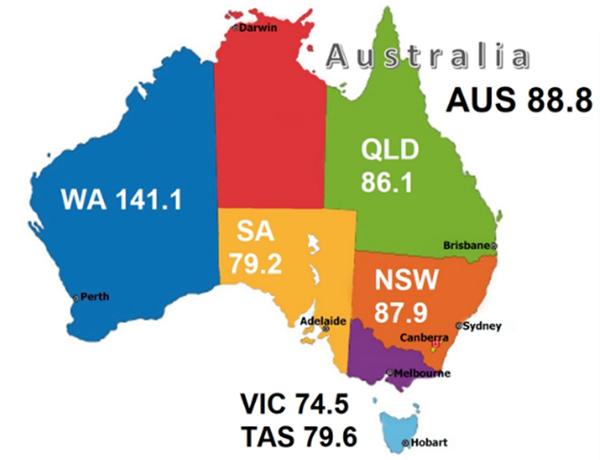
In June, business confidence across Australia was 88.8, the lowest figure in nearly three years and well below the neutral level of 100. Five of the six states recorded figures between 74.5 (depressed Victoria – no wonder they cancelled the Commonwealth Games) and 87.9 (marginally less depressed New South Wales).
However, one outlier defied the doom and gloom – Western Australia. It registered a positively effervescent 141.1. It has averaged 128 for the first six months of 2023, way ahead of any other state.
Business confidence in Australian states
Source: Roy Morgan
In the business confidence stakes at least, Western Australia looks like a different country. And perhaps it’s not surprising given the state’s bountiful resources. Australia’s so-called ‘mining boom’ seems to be a semi-permanent state of affairs and much of it is attributable to the iron ore and gas that is so abundant in Western Australia.
With a population about half that of New Zealand, Western Australia’s merchandise exports hit a record A$272 billion in the year to 31 March 2023. That was about 45% of the total for Australia. By comparison, WA makes up just 10% of the Australian population.
While the finances of most states are mired in red ink, the government of Western Australia is projecting yet another budget surplus this year, the sixth in a row. And with that comes tens of billions of dollars for investment in infrastructure.
Western Australia’s wealth is also reflected in individual wealth. The most recent AFR Rich List for Australia showed two WA iron ore magnates on top – Gina Rinehart with A$37 billion and Andrew ‘Twiggy’ Forrest with A$33 billion. (The latter has since announced that he and his wife, Nicola, are separating so expect a drop in his position next year.)
With much of the world, and Australia, struggling with economic uncertainty, Western Australia looks like the land of opportunity. And that makes it a magnet for immigrants, and therefore a potential problem for other countries.
Just ask the United Kingdom and Ireland which earlier this year endured an extensive recruiting drive for skilled workers from the WA government. Significant numbers of sought-after professionals, particularly in the medical area, have succumbed to the lure of 300 days of sunshine, a better lifestyle, and much higher salaries.
This is clearly an issue for New Zealand. There’s a long history of net kiwi migration to Australia. For many years it was measured in the tens of thousands before falling dramatically around 2015. The latest net loss of 13,400 people in 2022 suggests it may be on the rise again.
On the Australian side of the ditch, we read reports of a growing sense of malaise in NZ, an attitude of pessimism and negativity in many quarters. Talk of crises in health and education and of a crime wave. None of that will help the migration statistics.
Nor will concerns about the impending election.
The recent change to the immigration rules for kiwis moving to Australia could also have a material impact. Since 1 July, New Zealand citizens who have lived in Australia for at least four years have been able to apply directly for Australian citizenship. They no longer need to get a permanent visa first.
This new, easier pathway to Australian citizenship may make Australia, and Western Australia in particular, a more attractive destination for many New Zealanders .
The high cost of housing in Australia is often seen as a challenge for kiwis looking to make the move across the Tasman. Tales of stratospheric house prices in Sydney abound.
However, this is another area where there are marked differences across Australia. And another one where Western Australia shines. According to the latest CoreLogic figures, the median dwelling value in Sydney is A$1,074,000 but in Perth is just A$588,000. Not much more than half.
Significantly for potential immigrants, the dwelling value to income ratio is 8.8 in Sydney but only 5.5 in Perth.
And it’s not just Sydney house prices that are expensive relative to Perth. At NZ$995,000, the median dwelling value in Auckland is markedly higher than that in the WA capital.
That’s a dramatic differential for ambitious twenty-somethings keen to own their own home.
There are currently about 600,000 NZ-born people living in Australia, including approximately 85,000, or 14% of them, in WA. Kiwis constitute a greater proportion of the population in Western Australia than they do in any other Australian state except Queensland.
Given WA’s great weather, cheap house prices, robust business confidence, low unemployment, and on-going mining boom, the prospect of more New Zealanders heading west appears high.
Tourism WA’s current slogan is ‘Walking on a dream’. Western Australia’s appeal to mobile kiwis could well become a nightmare for the next New Zealand government unless it takes bold action to make the land of the long white cloud a more attractive place to live.
*Ross Stitt is a freelance writer with a PhD in political science. He is a New Zealander based in Sydney. His articles are part of our 'Understanding Australia' series.
We welcome your comments below. If you are not already registered, please register to comment
Remember we welcome robust, respectful and insightful debate. We don't welcome abusive or defamatory comments and will de-register those repeatedly making such comments. Our current comment policy is here.