


There was very little movement in housing affordability for first home buyers in October, but the size of the deposit can make a big difference to the size of the loan and the level of repayments.
According to the latest sales figures from the Real Estate Institute of New Zealand, the national lower quartile selling price was $577,000 in October.
The lower quartile price has fluctuated between $577,000 and $580,000 for the last four months, so there's been no real change there.
Mortgage interest rates went against their recent upward trend and actually declined slightly in October. The average of the two year fixed rates offered by the major banks dropped to 5.35% in October from 5.42% in September, although anyone hoping for a sustained fall in mortgage rates is likely to be disappointed.
Overall, the changes shaved about $8 a week from the mortgage payments for a lower-quartile priced home purchased with a 20% deposit, or $10 a week for one purchased with a 10% deposit. Given current cost of living pressures, every little bit helps.
Banks also promote low equity residential mortgages where the borrower has just a 5% deposit.
Low equity mortgages are not new and currently about half of all mortgages issued to first home buyers have deposits of less than 20%. The main benefit of a low equity mortgage is that it makes home ownership possible for buyers with less than the normal 20% deposit.
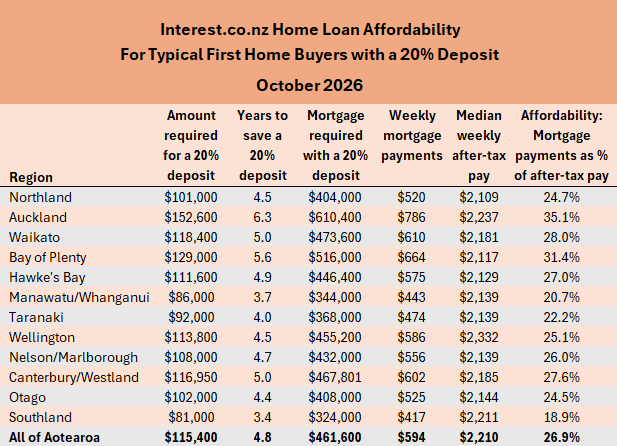
At the current lower quartile price of $577,000, you would need $115,400 for a 20% deposit.
Interest.co.nz estimates it would take a typical first home buying couple nearly five years to save that much money if they saved 20% of their after-tax pay into an interest bearing account each week.
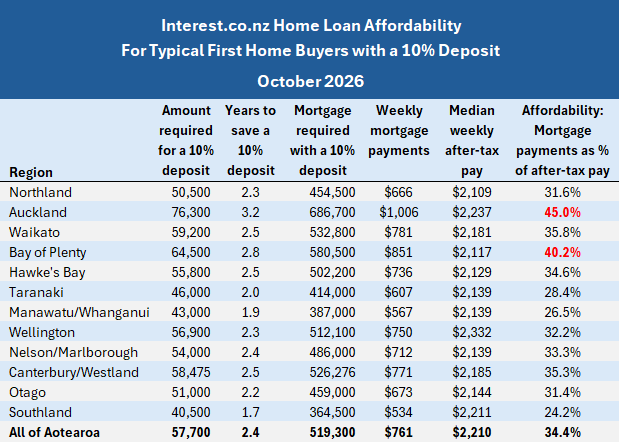
If the deposit was reduced to 10%, which means a mortgage for 90% of the purchase price, the buyers would only need to save $57,700 and the time needed to save that amount would be halved to 2.4 years.
The maths of a 5% deposit
Dropping the required deposit all the way down to 5% would reduce the amount of money required to $28,850, and the time needed to save that would reduce to 1.2 years.
In Auckland, the country's most expensive region for housing where the lower quartile price is $763,000, the difference a 5% deposit could make is even more stark, reducing from $152,600 at 20%, to $38,150 at 5%, while the corresponding time required to save that deposit drops from 6.27 years to 1.56 years.
So a lower deposit can look extremely attractive to first home buyers struggling to save a deposit.
But of course there's a catch.
Having a smaller deposit means the home buyer will need to borrow more and that pushes up their mortgage payments.
The mortgage required for a lower quartile-priced home purchased with a 20% deposit would be $461,000.
The mortgage on the same home purchased with a 5% deposit would be $548,150.
The same scenario in Auckland would push the mortgage up from $610,000 to $724,850.
And of course, the bigger the mortgage, the higher the mortgage payments, and on top of that, banks usually charge a premium for low equity loans to reflect their higher level of risk.
First home buyers, all starry eyed at the thought of home ownership, may not think too much about the risks involved, but it's top of mind for banks.
Someone buying a home with a 95% mortgage obviously has less equity in their property than someone with an 80% mortgage, and that gives them less room to restructure their loan should they suffer a serious financial misfortune, such as a loss of income or a sharp increase in mortgage interest rates that's not matched by an increase in income.
That puts low equity buyers at a greater risk of default, and the banks charge accordingly to reflect that risk.
The way banks structure repayments on low equity loans varies from bank to bank, but interest.co.nz estimates the mortgage payments on a home purchased at the lower quartile price with a 20% deposit and a 30 year term could be around $594 a week. The payments on the same property purchased with a 5% deposit could be around $803 a week, an extra $209 a week. That makes the payments on a home purchased with a 5% deposit around a third (35%) more expensive than one purchased with a 20% deposit.
That suggests that while a low equity loan may sound attractive, in practice their availability is likely to be limited to people with higher than average incomes, who can afford the high level of repayments involved.
They are unlikely to be much help to typical first home buyers on average incomes, particularly in higher priced regions such as Auckland.
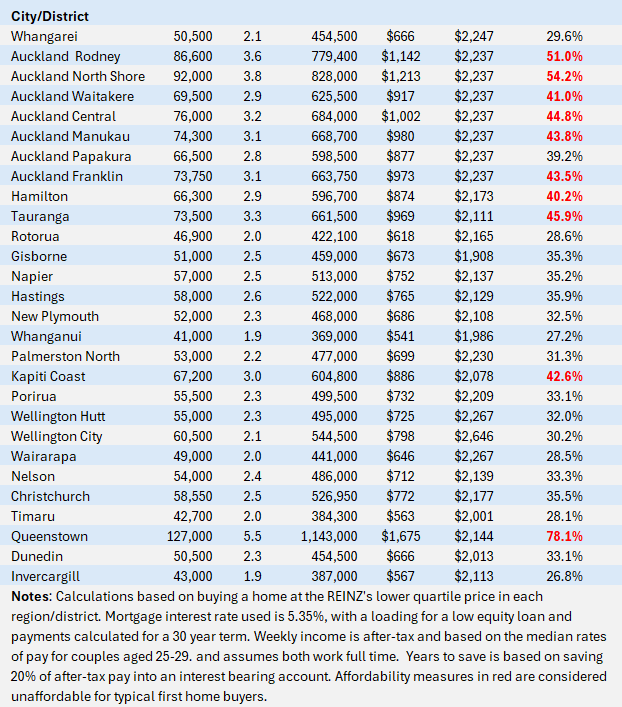
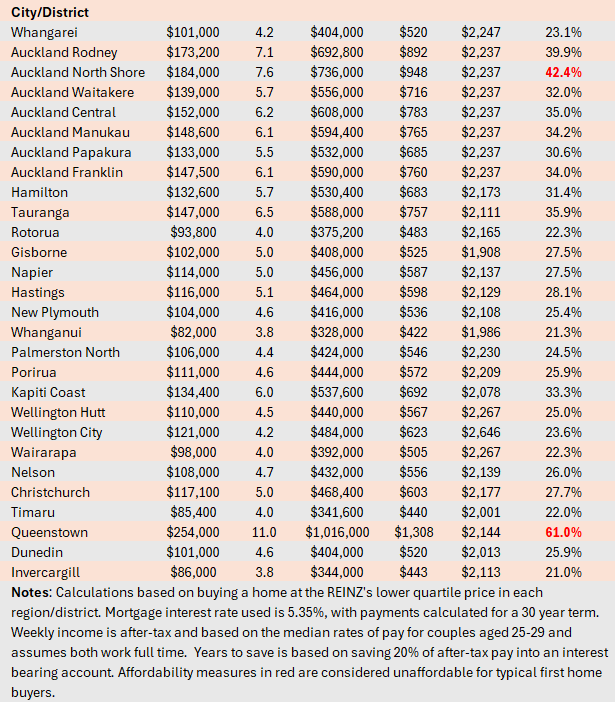
The tables below show the main affordability measures for typical first home buyers with either a 10% or 20% deposit in the main urban districts throughout the country.

We welcome your comments below. If you are not already registered, please register to comment
Remember we welcome robust, respectful and insightful debate. We don't welcome abusive or defamatory comments and will de-register those repeatedly making such comments. Our current comment policy is here.