

Against the backdrop of a soft housing market, banks' low equity housing lending is surging, both as a percentage of overall new lending, and within the big five home lenders' individual loan books.
Figures from the major banks latest general disclosure statements show ANZ New Zealand, the country's biggest housing lender, has 9.3%, or almost $11.9 billion, of its total home lending as loans where the borrower has less than 20% equity. That's up from 7.5% a year earlier and 6.2% five years ago.
Kiwibank's low equity, or high loan-to-value ratio (LVR), lending's up to $3.8 billion, or 11.2% of total home lending from 8.6% a year earlier. And at $8.8 billion, Westpac NZ's is 10.6% of total lending, up from 7.2% five years ago.
As Greg Ninness has been tracking, low equity mortgage approvals to first home buyers have grown spectacularly over the past four years. In July loans where the borrower had less than a 20% deposit comprised 49% of all loans to first home buyers by number.
And Reserve Bank new residential mortgage lending data shows during July, $1.261 billion, or 16%, of the total $7.853 billion worth of new lending commitments, was loaned with an LVR above 80%. That's up from 13% in July 2015, and 9% five years ago in July 2021, a time when the housing market was on fire, coinciding with a period when the Reserve Bank had removed LVR restrictions.
Despite this surge in high LVR lending, last month the Reserve Bank said housing risks were contained, therefore it was leaving its LVR restrictions on banks' housing lending unchanged.
LVR restrictions limit the volume of low equity mortgage lending banks can do. Or from a borrowers' perspective, they restrict the number of borrowers with small deposits that a bank can lend to.
The current LVR restriction rules, in place since December last year, are: For owner-occupiers, allowing up to 25% of a bank's new lending to have an LVR above 80%. For investors, allowing up to 10% of a bank's new lending to have an LVR above 70%. (Some loans are exempt from LVR restrictions, with the details here).
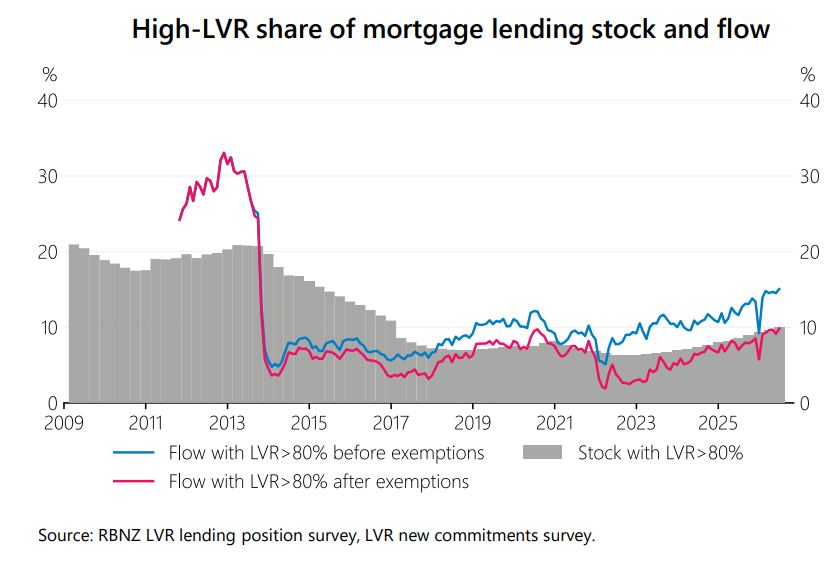
The Reserve Bank's restrictions place no limit on the proportion of the total stock of a bank’s lending that can be high-LVR. Rather, the LVR limits apply to the flow of new lending only.
"However, over time the flow of new lending becomes the stock of all lending, so the proportion of the stock that is high-LVR is affected by the proportion of new loans that are high-LVR," a Reserve Bank spokesperson says.
Where does the Reserve Bank get uncomfortable?
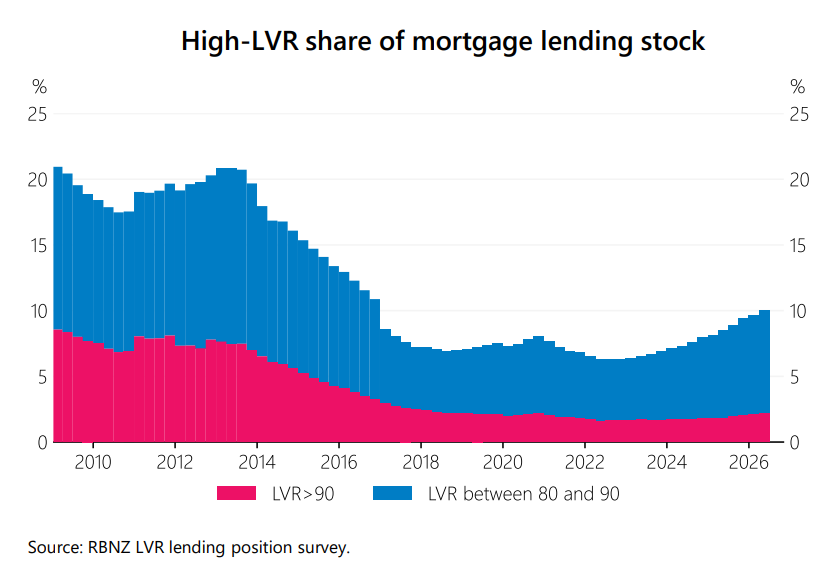
It's not clear, however, where the ceiling is for the Reserve Bank's tolerance of what percentage of total lending can be low equity lending. We do know that when a Reserve Bank under different leadership first introduced LVR restrictions, high LVR lending had been around 30% of new housing lending flows, and around 20% of total lending stock at the major banks.
With its financial stability hat on, it's hard to believe the Reserve Bank would be comfortable seeing those levels again.
The Reserve Bank decision to maintain the LVR status quo in August came against the backdrop of a weak housing market. The latest Real Estate Institute of New Zealand (REINZ) data shows the national median price was $760,000 in July, down 0.7% year-on-year, and down $165,000, or 18%, from the November 2021 peak of $925,000. Sales volumes fell 10% year-on-year to 6,090, and inventory was up 9% to 33,252. At 50 days, the national median days to sell was up two days year-on-year and was the fifth slowest July on record since REINZ records began in 1992.
Reserve Bank data shows total housing lending of $397.5 billion as of June 30, with lending with an LVR above 80% comprising $39.8 billion, or 10%, of that.
Low equity loans flying out the door
In August 2013, following much speculation and expectation, the Reserve Bank announced LVR restrictions, a tool from its freshly minted macro-prudential toolkit, would be introduced on bank's housing lending from October that year.
Initially banks were required to restrict new residential mortgage lending at LVRs of over 80% to no more than 10% of the dollar value of their new housing lending flows. In the early days it stayed comfortably below 10% as banks adopted an ultra cautious approach.
That was in stark contrast to prior to the implementation of the LVR restrictions in 2012 and 2013, when some banks had been pumping low equity loans out the door. In August 2013 the percentage of new housing lending flow that was low equity lending was 25%.
In some quarters during the run up to the introduction of LVR restrictions more than 70% of ASB's net home loan growth came from lending where the borrower had a deposit equivalent to less than 20% of the property's purchase price. At 30 June 2013 ANZ and ASB, the two biggest home lenders, had 21.5% and 22% respectively, of their total home lending as loans with LVRs above 80%.
In 2012, as banks ramped up low equity lending, Westpac had advertisements in Auckland for home loans "from as little as 5% deposit." Fourteen years later BNZ is also advertising getting people into a home with a 5% deposit.
Go direct to BNZ and you could get into a home faster with a 5% deposit.
Risks attached
Low equity lending comes with risks to borrowers, lenders and the financial system as a whole. For borrowers negative equity may be a risk because if the value of the property drops a borrower can end up owing more on the loan than what the house is valued at, complicating any sale or loan refinancing.
Low equity borrowers may face higher interest rates than borrowers with bigger deposits, and/or extra fees, or margins, banks charge for low equity loans adding significantly to the loan costs. Conversely, low equity lending is more lucrative for the lenders.
Rising interest rates or a borrower losing their job can also ratchet up pressure on the borrower to keep up with repayments. Such a scenario may result in a mortgagee sale by the bank, but a high LVR could mean the sale price doesn't cover the loan's outstanding balance.
As for the financial system, a sudden economic downturn, especially featuring a surge in unemployment, could trigger a range of loan defaults which could be magnified by significant volumes of home owners with a small amount of equity in their home.
Lessons from the GFC
The Reserve Bank has required banks to disclose their LVRs on residential mortgage lending since March 2008. That was during the Global Financial Crisis (GFC), when high-risk subprime mortgage lending and complicated financial products such as Collateralised Debt Obligations (CDOs) crashed the US housing market with international ramifications.
Banks, real estate agents, then-Prime Minister John Key and ex-Reserve Bank Governor Alan Bollard, weren't enthusiastic about LVR restrictions. Critics said borrowers would find ways around them, turn to finance companies, or they would lock first home buyers out of the housing market. Despite this, the Reserve Bank, whose Governor at the time Graeme Wheeler had witnessed the US housing market crash of 2008-10 whilst living there, pushed ahead.
Wheeler and the Reserve Bank wanted LVR restrictions to; help slow the rate of housing-related bank credit growth, help slow house price inflation especially in Auckland, reduce the risk of a substantial fall in house prices, and give the Reserve Bank more flexibility around the timing and size of any Official Cash Rate increases.
LVR restrictions remained in place until the Covid-19 pandemic, when they were removed completely from May 1, 2020. The Reserve Bank said it would do this for 12 months to encourage banks to keep supporting credit-worthy borrowers during extraordinary times.
However, with a Covid-era cocktail in place of historically low interest rates, job security through the Government's Wage Subsidy Scheme, a mortgage deferral scheme, enthusiasm from lenders to shovel money out the door, plus media stories and real estate agents inducing FOMO, or the fear of missing out, New Zealanders plunged into mortgage debt boots and all during 2020 and 2021. The value of new mortgages taken out during that period reached an annual rate of about $100 billion.
Thus LVR restrictions were reintroduced from March 2021 and have remained in place since.
Here to stay
When LVR restrictions were first introduced Wheeler said how long they'd be in place depended on how effective they were at restraining housing lending growth and house price inflation. They would be removed; "if there is evidence of a better balance in the housing market and we are confident that their removal would not lead to a resurgence of housing credit and demand," he said.
As it turned out, it took a global pandemic and fears of economic catastrophe for them to be removed. And even then it was only for 10 months as house price inflation topped 15% by the end of 2020, pushed towards 30% in 2021, and property investors filled their boots with high-LVR loans.
This led to the Reserve Bank acknowledging in 2023 that; "in uncertain situations there may be value in waiting before removing restrictions." And; "alternatively, [in future] more measured adjustments could be taken such as easing LVR restrictions rather than removing them altogether."
That suggests, barring some massive catastrophe, restrictions on banks' low equity lending are here to stay. And even in a catastrophe, removing them may prove temporary.
Additionally the Reserve Bank now has debt-to-income (DTI) restrictions, capping the amount of money borrowers can take on relative to their income, in its toolkit. Thus should the housing market go on a tear, DTIs could be ramped up in tandem with LVR restrictions.
| 2026 | 2025 | 2021 | ||||
High LVR loans | % of total loans | High LVR loans | % of total loans | High LVR loans | % of total loans | |
| ANZ | $11.9b | 9.3% | $9.1b | 7.5% | $6.4b | 6.2% |
| ASB | $8.1b | 8.5% | $6.9b | 7.7% | $6.1b | 7.8% |
| BNZ | $4.8b | 6.9% | $4b | 6% | $3.9b | 7.3% |
| Kiwibank | $3.8b | 11.2% | $2.7b | 8.6% | $2.1b | 8.7% |
| Westpac | $8.8b | 10.6% | $7.1b | 9% | $4.8b | 7.2% |
*ANZ, BNZ and Westpac figures as at March 31 in relevant year, ASB and Kiwibank as at June 30.
*This article was first published in our email for paying subscribers early on Friday morning. See here for more details and how to subscribe.
We welcome your comments below. If you are not already registered, please register to comment
Remember we welcome robust, respectful and insightful debate. We don't welcome abusive or defamatory comments and will de-register those repeatedly making such comments. Our current comment policy is here.