
By Alex Tarrant
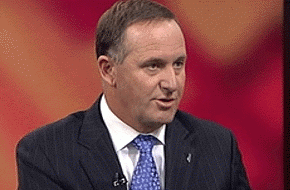
Prime Minister John Key is in the camp arguing that forcing banks to tighten loan-to-value ratios on property lending will do little on its own to stop rampant house price rises in Auckland.
The Reserve Bank is currently in discussions with the Treasury about using new 'macro-prudential' tools in its efforts to foster stability of the financial system. The ability of the Bank to impose controls on loan-to-value ratios (LVRs), capital ratios and bank reserve requirements is under discussion.
The Bank and government are adamant that the new tools are only to be used in the financial stability sphere of the Reserve Bank's mandate, rather than for monetary policy means.
That means the new tools would not be used to complement the Official Cash Rate if the Bank decided to tighten monetary policy in response to rising house prices or excessive credit growth.
But if it believed the stability of New Zealand's financial system was at risk, the Reserve Bank says these tools could be used to force banks to strengthen their balance sheets, by reducing high LVR lending and forcing the banks to hold back more capital for every loan they make.
Where the Bank may use the tools in response to housing market activity was if it believed rising prices posed a risk to the financial system.
Opposition parties argue the Reserve Bank should be using macro-prudential tools alongside the Official Cash Rate for monetary policy means. They point to use of loan-to-value ratio controls in Hong Kong and Singapore as examples of attempts to use the tools to control housing market activity.
Former Reserve Bank Governor Alan Bollard said in an exit interview with interest.co.nz in September that LVR controls would be the least desirable new tool for the Bank to use if it wanted to affect house prices.
"I can remember the 1970s and you can't Bernard, that's why," Bollard told Bernard Hickey.
"Those sorts of direct interventions (were used) and they ended up with lots of distortions, and they ended up with people finding other ways to get money, and that's where some of our current crop of finance companies came from, ways to get around bank regulation in the 1970s," he said.
Current Governor Graeme Wheeler told Parliament's Finance and Expenditure Committee in November that macro-prudential instruments were designed much more for obtaining financial sector stability.
"It’s when asset bubbles build up, it’s where credit grows at excessive rates that feeds through to asset prices and the like," Wheeler said.
“That’s when you want to be deploying those sorts of instruments.”
Wheeler told the Committee that when other countries had deployed LVR controls, first-home buyers were often exempt, so that they mainly captured people trading up or buying second-homes.
Key agrees
Speaking to media on Monday afternoon, Prime Minister John Key indicated he was of the same opinion.
"Any consumer can effectively go around that [LVR controls]," he said.
"All historical attempts to stop that haven’t been very successful.
“You can certainly protect the banks’ balance sheets from over-exposure to the property market, but the capacity of someone to go to their friend or lawyer or some other institution to get that other piece of equity that they don’t have, is always real."
Put to him that he didn’t seem much of a fan of LVR controls, Key said:
“I wouldn’t characterise it that way. What I would say is, I think the fact that the Bank is taking a much more hands-on, conservative, prudent view of being able to manage that is absolutely the right thing to do, just as they’ve been looking at...[banks'] capital ratios.
“All I’m simply saying is, that is one element of the equation, and it is always possible for people to go around that," he said.
This article was first published in our email for paid subscribers this morning. See here for more details and to subscribe.
We welcome your comments below. If you are not already registered, please register to comment
Remember we welcome robust, respectful and insightful debate. We don't welcome abusive or defamatory comments and will de-register those repeatedly making such comments. Our current comment policy is here.