
By Kenneth Rogoff*
Is China booming or stagnating? On one hand, its export industries—including electric vehicles, solar panels, and virtually the entire range of manufactured goods—are the envy of the world, and its tech and AI industries are second only to the United States, with Europe trailing far behind. On the other hand, as I have written many times, China is now in the sixth year of a full-blown, Japan-style real-estate crisis. Could China be booming and stagnating at the same time?
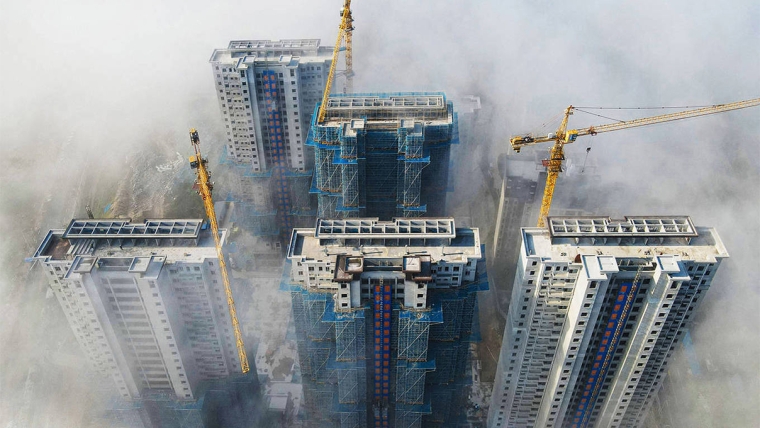
In a recent Brookings paper, the International Monetary Fund’s Yuanchen Yang and I explore the striking parallels between today’s China and Japan in the 1990s, especially in residential and commercial real estate as well as related infrastructure. In both cases, the collapse of the speculative frenzy left a massive construction overhang that can take years to work off. China is still in the middle of that process.
Stunningly, China has built more square meters of residential property per capita than either the United Kingdom or France, despite still being a much poorer country. Its road and railway networks are on par with those of the world’s most advanced economies and, in many ways, far superior to America’s.
But the Chinese economy is also deeply unbalanced, like a bodybuilder who has bulked up only his torso. Consumption, the primary growth engine in advanced economies, remains weak. Eastern China has marquee cities that are well on their way to rivaling their Western counterparts, yet in many smaller cities and rural areas, home to at least half of China’s population, living standards fall somewhere between those of Latin America and South Asia.
The fear now is that, with its housing bubble having collapsed, China may never escape the so-called middle-income trap. When Japan’s real-estate crisis hit, it was already a very wealthy country, with per-capita income rivaling that of the US. Thirty years later, its per-capita income is closer to Italy’s, which in turn is below that of Mississippi, the poorest US state. And China today is nowhere near as rich as Japan was in the early 1990s.
Between automation and AI, the most dynamic parts of China’s most dynamic sectors are not creating enough jobs. Youth unemployment has gotten so bad that authorities no longer publish the figures regularly. Even under the best of circumstances, it would be difficult to replace the sagging real-estate and infrastructure sector, which, as Yang and I show, accounts for nearly one-third of demand once both direct and indirect effects are included.
Still, it would be wrong to assume that China’s real-estate crisis necessarily constrains its ability to compete geopolitically or economically. If you speak to businesspeople or attend tech conferences, you will hear that China’s economy is dominant and innovative. China is not a democracy, and its leaders can allow the dynamic tech and export sectors to flourish even as the rest of the domestic economy takes decades to work off the overbuilding binge. It is entirely possible to imagine 450 million Chinese people flourishing in a dynamic economy dominated by tech and manufacturing, while the other 950 million get by at a much lower standard of living.
Faced with such a divide, most Western democracies would be overwhelmed by pressure for redistribution, as European countries already know well. But that need not be the case in China, particularly if the government believes that national security and the country’s global role depend on bolstering its frontier sectors. And 450 million people is still more than the US population and on par with that of the European Union.
Whether such an outcome is possible, of course, remains to be seen. Since Xi Jinping became president in 2013, the Communist Party has paid considerable attention to regional disparities. But the economic forces that concentrate activity in major hubs, together with the strong desire to assert power internationally, may ultimately trump the pressure to reduce inequality.
The great economic historian Angus Maddison, writing in the late 1960s, argued that—contrary to the views of many economists, including Paul Samuelson—the Soviet Union would never fully catch up with the US. Nevertheless, thanks to its rich scientific tradition, the USSR could still compete at the technological frontier and achieve military parity.
One major difference between the Soviet Union and China is that China has bent over backward to integrate with the US, both in trade and in science. Despite US President Donald Trump’s trade war, it is clear that today’s challenges, from climate change to rogue AI, cannot be solved without extensive cooperation between the two superpowers.
So, as paralyzing as China’s real-estate crisis has been, and even though excess construction will likely hold down growth for years to come, the dynamic core of its economy will keep thriving, so long as the country remains politically stable—and doesn’t succumb to the temptations of imperial overreach.
*Kenneth Rogoff, a former chief economist of the International Monetary Fund, is Professor of Economics and Public Policy at Harvard University and the recipient of the 2011 Deutsche Bank Prize in Financial Economics. He is the co-author (with Carmen M. Reinhart) of This Time is Different: Eight Centuries of Financial Folly (Princeton University Press, 2011) and the author of Our Dollar, Your Problem (Yale University Press, 2025). Copyright: Project Syndicate, 2026. www.project-syndicate.org
We welcome your comments below. If you are not already registered, please register to comment
Remember we welcome robust, respectful and insightful debate. We don't welcome abusive or defamatory comments and will de-register those repeatedly making such comments. Our current comment policy is here.