
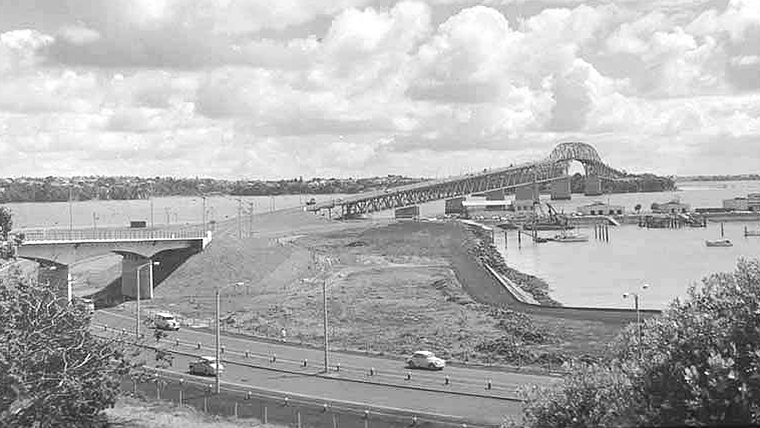
The Government plans to begin building a second Waitematā harbour crossing in the central city this decade, bringing it forward from the 2040s and designing it to link up with the light rail project.
Prime Minister Chris Hipkins announced the fast-tracked crossing in a speech to Auckland business leaders Thursday morning, hosted by the Auckland Chamber of Commerce.
The speech was understood to be an attempt to win back support in some of Auckland’s more central suburbs and among more well-off voters. Wayne Brown’s mayoral win last year was widely interpreted as a rebuke of the central government.
In a press release, Transport Minister Michael Wood said the city’s residents and businesses had made it clear that congestion was the biggest barrier to success.
“We want an unclogged, connected, and future-proofed transport network so Aucklanders can get to work on time, and don’t need to wake up earlier just to get their kids to school.”
A second Waitematā Harbour crossing would be designed to ensure there were options for all types of transport: cars, buses, trucks, light rail, cyclists, and pedestrians.
There are five possible plans for the crossing – both bridge and tunnel options — all of which include a new walking and cycling link and a light rail connection in the city center.
An “indicative business case” will be developed by the end of the year, with hopes of having a detailed design sometime after 2026 and construction to begin in 2029.
Tunnel options are likely to be more expensive than a second bridge, but is understood to be seen as a better long-term investment with lower maintenance costs and more opportunities for housing intensification on the North Shore.
The most expensive option would be building a light rail tunnel from downtown Auckland to Smales Farm via Belmont and Takapuna, as well as a road tunnel to replace the Harbour Bridge as State Highway 1. Some lanes of the existing bridge would be used for walking and cycling.
Building a second bridge for light rail, pedestrians, and three traffic lanes would be the cheapest option — although still estimated to be over $15 billion — and also the fastest to build. However, it would be the least resilient option and have a larger environmental impact.
Other options include building both a tunnel and a second bridge — which pedestrians would share with either cars or light rail. Two of these options envision the tunnel becoming SH1 and each carry a ball-park cost of $20 billion.
The government is asking for feedback on the five options and plans to decide on the preferred option in June this year.
We welcome your comments below. If you are not already registered, please register to comment
Remember we welcome robust, respectful and insightful debate. We don't welcome abusive or defamatory comments and will de-register those repeatedly making such comments. Our current comment policy is here.