

Here are my Top 10 links from around the Internet at 10 past 3 pm, brought to you in association with New Zealand Mint for your afternoon reading pleasure.
I welcome your additions and comments below, or please send suggestions for Monday's Top 10 at 10 via email to bernard.hickey@interest.co.nz.
I'll pop any surplus suggestions I get into the comment stream under the Top 10.

1. Just how involved are New Zealand's gangs in property developing? - This story from David Fisher at the NZHerald got me thinking a bit.
I wonder how involved gangs and methamphetamine have become in the New Zealand property market in extorting developers and or tenants.
Any experiences or thoughts?
HT Hugh via email.
Lynne Carter had it all. A $6 million Auckland waterfront mansion, a Ferrari and other luxury cars, her booming property development business and a lovelife that was the talk of the town. Then a week ago, Carter, 45, was arrested and locked up overnight after a bizarre display at Dunedin airport. It led to charges, which, on Friday, were heard in the Auckland District Court.
Carter is accused of methamphetamine possession and fraud. Sitting at the rear of a crowded courtroom, filled with those accused of drink-driving and vandalism, she told the Herald on Sunday she planned to deny the charges. Carter's apparent fall has brought comparisons with the crisis that struck the life of millionaire businessman Mark Lyon. Both were leaders in their fields until the twin shadows of methamphetamine and gangs fell across their lives.
And this from an unidentified emailer...
Could it be that a piece of the puzzle in the New Zealand property market which is often missed by the above board, legal analysis that people like us do is the pervasive presence of extra legal activity with criminals extracting large rents by extorting money off developers?
2. An Irish bailout - One of the pieces of background noise on global markets in the last couple of days has been problems in Ireland with huge new bank losses and a blowout in borrowing costs for Ireland's sovereign debt.
People are worried it may default under the weight of all the bank debt taken on by the government. Bloomberg reports the European Central Bank is now buying Irish government bonds.
European central banks bought Irish government bonds today, according to two traders who witnessed the transactions, following a week of speculation about the health of the nation’s banks that sent the securities plunging. The central banks made light purchases of Irish debt with maturities no longer than two years, the people said, under condition of anonymity because their trading is private.
The ECB returned to the market in afternoon European trading to buy more 2012 Irish notes, one person said. Borrowing costs rose at an Irish debt auction today even as central bank Governor Patrick Honohan said the premium investors demand to hold the nation’s bonds instead of German ones is “ridiculous.”
The European Commission this week approved an injection of as much as 24.5 billion euros ($31.5 billion) into Anglo Irish Bank Corp., the lender nationalized in 2009 as the property boom collapsed. That’s more than the 22 billion euros Finance Minister Brian Lenihan had said the bank might need.
“The ECB buying allows the Irish government to take a little longer to get its house in order, or dig its own hole,” said Ciaran O’Hagan, a fixed-income strategist at Societe Generale SA in Paris. “We have yet to see concrete evidence of progress in reining in the budget deficit.”

3. How much is laundered here in NZ property? - Bloomberg reports on a Credit Suisse study on hidden Chinese income and wealth which says there may be US$1.1 trillion squirrelled away in various places. I wonder how much of that ends up invested in New Zealand property. A Remuera real estate agent told me this week that half of the buyers of the multi-million mansions in Remuera are Chinese.
China’s households hide as much as 9.3 trillion yuan ($1.4 trillion) of income that is not reported in official figures, with 80 percent accrued by the wealthiest people, a study showed. The money, much of it likely “illegal or quasi-illegal,” equates to about 30 percent of China’s gross domestic product, the study, conducted for Credit Suisse AG and published last week by the China Reform Foundation, found.
The average urban disposable household income in China is 32,154 yuan, or 90 percent more than official figures, according to the report. Most of that extra cash is going to the wealthiest families.
4. Unintended consequences - Greek teachers are resigning in droves to ensure they get the current pensions before a much tougher regime kicks in, Bloomberg reports.
More than 11,000 Greek state-school teachers have asked to retire before changes are made to the pension system, raising the threat of a shortage of educators for the new school year.
Teachers are opting to leave under present rules before an overhaul of the state pension system kicks in. Prime Minister George Papandreou’s plan, which raises the retirement age and cuts benefits for state workers, is part of conditions attached to 110 billion euros ($142 billion) of loans from the European Union and the International Monetary Fund to help Greece avert a default on its debt.

5. China's coming property bust - Forbes' Gordon Chang reports from Beijing on why he thinks the property bubble there will burst, despite the optimism of the developers... HT Hugh P via email.
With the economy starting to soften, many in China expect Premier Wen Jiabao to start the money flowing again by relaxing the lending restrictions he put in place in April to cool the property sector. So, despite the enormous overhang of residential units in China, the betting is that construction will pick up soon. Accordingly, the mood in the property sector is maximum bullish, with China property stocks recovering almost all the ground they lost since April. There are, however, three problems with this rally.
First, Premier Wen can reintroduce stimulus spending and still keep his lending curbs in place. To maintain the loan restrictions would be sound policy, and although he has made more than his share of mistakes recently, it’s not wise to bet he will commit another enormous blunder. S
econd, faith that Beijing can prevent a market collapse is misplaced. “The market is bigger than the government,” independent economist Andy Xie writes. Property developers are forgetting that the central government can only delay--not avoid--a final reckoning in the property sector.
Finally, we have to remember our friend, the cab driver in Shenzhen. To make him lose hope in owning his own home is extremely bad politics.

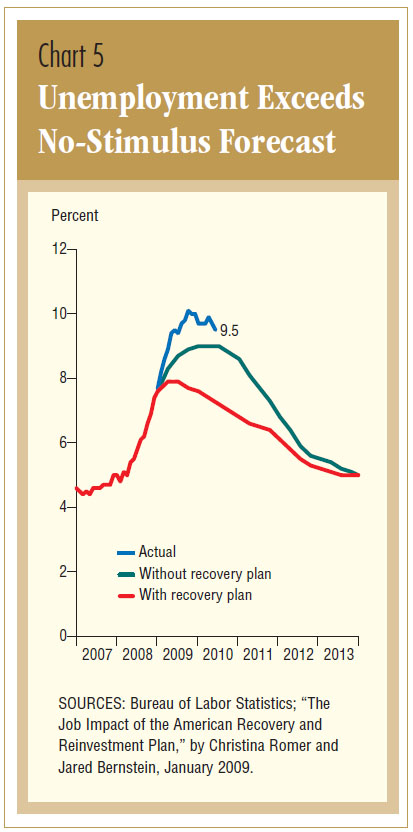
6. Just imagine if there had been no stimulus - The Dallas Fed has written a paper wondering if fiscal stimuli actually work. It accidentally included a chart (right and below) used by the Obama administration in early 2009 which projected unemployment without stimuli.
HT Troy via email.
The projection was actually lower than what has turned out. The projection of unemployment with the stimuli was much lower and so far off the mark as to be laughable. Here's ZeroHedge's take on the stimulus vs no stimulus debate.
All assumptions about "alternate worlds" hypotheses are always flawed, starting at the very top, with the guarantee that the world would have ended if the TBTFs were left to fail.
Newsflash - it wouldn't, and the economic situation would likely have been far better now, had we taken the bitter pill at the proper time two years ago, reset the system, and started afresh.
Instead we are now preparing the latest stimulus which is Obama funding the digging of holes all across the country (soon to be used as a terminal repository for worthless US currency).
7. Just walk away and don't pay - This New York Times piece on 'strategic defaulters' gives an insight into how American borrowers are thinking right now. Morality is long gone. A sort of tired cynicism has set in.
Fewer than 5 percent of these clients said they would continue paying their home equity loan no matter what. Ten percent intend to negotiate a short sale on their house, where the holders of the primary mortgage and the home equity loan agree to accept less than what they are owed. In such deals primary mortgage holders get paid first.
The other 85 percent said they would default and worry about the debt only if and when they were forced to, Mr. McCain said.
“People want to have some green pastures in front of them,” said Mr. McCain, who recently negotiated a couple’s $75,000 home equity debt into a $3,500 settlement. “It’s come to the point where morality is no longer an issue.”
Darin Bolton, a software engineer, defaulted on the loans for his house in a Chicago suburb last year because “we felt we were just tossing our money into a hole.” This spring, he moved into a rental a few blocks away.
“I’m kind of banking on there being too many of us for the lenders to pursue,” he said. “There is strength in numbers.”
8. Pricing in a dead economy - How do you know when investors have given up uttlerly on the prospect of any sort of economic growth in the United States?
One way is to look at what inflation adjusted Treasury bonds are trading at. Right now US 5 year TIPS (Treasury Inflation Protected Securities) are trading at almost zero %. The 10 year TIPS are at 1%. HT Felix Salmon at Reuters who cites Scott Grannis here.
Cheerfully buying 5-yr TIPS with a guaranteed real yield of zero only makes sense if one has very grave doubts about whether the economy can generate any real growth at all in the coming years.
Felix makes the following conclusion.
I don’t think that the TIPS market is pricing in zero real GDP growth over the next 5 years. But I do think it reflects worries over stock-market valuations. A stock-market investor only gets exposure to the economy’s performance via investing in equities if p/e ratios don’t fall, after all, and I can easily imagine a scenario where the economy grows modestly, or enters a shallow recession, while stocks fall significantly.
So my feeling is that this is the “there’s nothing else to buy” trade: a desperate lunge for safety in a world where everything else — including stocks and property — looks decidedly risky.

9. The political stability of Europe - Michael Moran has a good look around Europe's political system in this piece in the Global Post. He makes an interesting point about the turbulence ahead. We all are watching the November elections in America, but what about Europe? He looks in depth at the big 5.
Something other than leaves will fall in Europe this autumn. American attention, no doubt, will focus on Barack Obama’s date with an angry electorate this November. Yet across the pond, governments of the right, left and center in Europe appear ready to crumble, their positions eroded by a wave of austerity, high unemployment and government debt, plus a smattering of nasty corruption scandals.
Consider the situation in Europe’s five most important countries. These five economies represent nearly three-fourths of the GDP of the European Union. Put another way, combined they produce as much economic activity every year as the United States did in 2004.
Their crushing national debts aside, having this degree of political instability in an economic pillar that large has to make you wonder about the future of “The West.”

10. Totally relevant video - This video from a helicopter of a mob in Atlanta, Georgia scrambling for application forms for public housing is startling. People are now talking about a depression in America. With scenes like this it's not too hard to make the jump. HT Blair Rogers via twitter @bmr789
Visit msnbc.com for breaking news, world news, and news about the economy
We welcome your comments below. If you are not already registered, please register to comment
Remember we welcome robust, respectful and insightful debate. We don't welcome abusive or defamatory comments and will de-register those repeatedly making such comments. Our current comment policy is here.