
National will aim to get 46,000 people off welfare over four years and into work, and a further 11,000 working part-time in a package estimated to cost NZ$130 million a year week.
The changes to the party's welfare policy announced in Hamilton today focused primarily on sole parents.
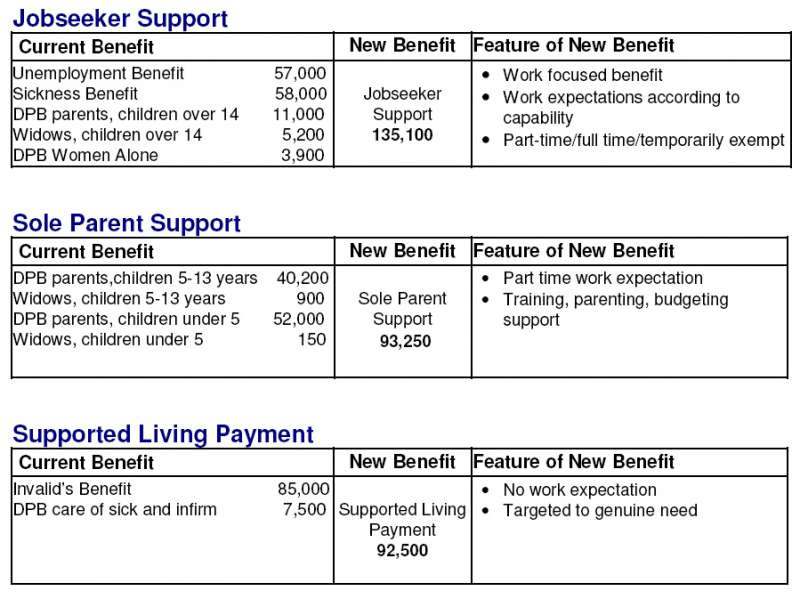
Prime Minister John Key said the new benefit system would consist of only three main benefits as existing ones were lumped into three categories: Jobseeker Support, Sole Parent Support, and Supported Living Payment (see graphic below).
The goal of getting those 57,000 beneficiaries into some kind of work was on top of the Pre-elction fiscal update (PREFU) forecast of 20,000 few people on welfare by 2016, Social Development Minister Paula Bennett said.
Strong signal
"I believe that changing benefit categories, and asking more people to make themselves available for work, sends a strong signal about the degree of change we are seeking – not just to beneficiaries, but also to case managers at Work and Income, and to the general public," Key said.
"It will help to shift people’s attitudes and set genuinely different expectations about being available for work. It is also part of the new investment approach we are taking to welfare. If we can spend money in the short term to reduce dependency in the longer term, it ultimately saves the government, and therefore taxpayers, significant costs," he said.
Social Development Minister Paula Bennett said the NZ$130 million a year price tag over the four years from July 2012 would lead to expected savings of NZ$1 billion over that period as beneficiaries entered work. The costs would be made up of new and reprioritised funding for more childcare, extra staff and IT costs, Bennett said.
Dole, sickness, sole parents with youngest child 14 or over
Jobseeker Support would be the biggest benefit category with 135,000 beneficiaries, focussed on getting people currently on the Unemployment Benefit or Sickness Benefit, and sole parents whose youngest child is 14 or older, into work.
"Everyone receiving the Jobseeker Support will be expected to be available for work, either full-time or part-time as their capacity allows. The only exception will be for people who cannot work for the time being, because of sickness or injury, and who will therefore get a temporary exemption," Key said in Hamilton.
This was quite a different approach from the way the Sickness Benefit, in particular, currently worked, he said.
"We are going to work more actively with people towards a target return-to-work date, and we are going to introduce much more comprehensive work capacity assessments to get a better picture of what people can do and to determine what the right obligation is for each person," Key said.
"The new approach recognises that most people will recover their health and ensures they receive the right help and support to be employable again," Key said. And it also recognises that work can be a key part of getting well," he said.
Sole parents would also be treated differently under the new benefit system. Sole parents whose youngest child was 14 or over would be required to be available for full-time work, and would fall under the Jobseekers Support benefit.
"There is no over-riding reason why these sole parents can’t work full time – and in fact a great many outside the benefit system do. The age threshold is also a fair one, because when children are 14 they can be left without parental supervision," Key said.
Sole parents with kids under 13
Other sole parents would go onto a benefit called Sole Parent Support, which would require sole parents on this benefit having to be available for part-time work when their youngest child was five years old, which lined up with the age most children started school.
"Other sole parents, while they won’t face work obligations, may be required to undertake pre-employment activities that will increase their likelihood of getting a job in the future," he said.
Parents who had an additional child while on a benefit would receive a temporary exemption from their existing work obligations, but that would only last for 12 months.
"Part-time and full-time obligations will remain at 15 and 30 hours a week, and we will introduce more flexibility around these targets," Key said.
"For both jobseekers and sole parents, we will provide more support earlier on, particularly for those groups most at risk of long-term benefit dependence. This support won’t be fully in place in year one, but will build up over time," he said.
Too sick or disabled to work
The third benefit would be called the Supported Living Payment, and would be for two groups of people: those who are permanently and severely disabled or terminally ill, and who currently receive the Invalids Benefit, and people caring for someone who requires the equivalent of hospital-level care, who currently receive a benefit called the DPB – Care of Sick and Infirm.
People on the Supported Living Payment would not be expected to make themselves available for work.
Details after election
The extra requirements on parents would generate a greater demand for childcare for pre-schoolers and school children, Bennett said. The government would look at ways to help people with these costs, with officals currently working on details. However the details of any compensation would not be released by the November 26 election, Bennet told a press conference in Hamilton.
The numbers
(Corrects week to year in first paragraph)
(Updates with video of Key announcing policy, 'the numbers')
We welcome your comments below. If you are not already registered, please register to comment
Remember we welcome robust, respectful and insightful debate. We don't welcome abusive or defamatory comments and will de-register those repeatedly making such comments. Our current comment policy is here.