

Here are my Top 10 links from around the Internet at 10 to 2 pm, brought to you in association with New Zealand Mint for your reading pleasure.
I welcome your additions and comments below, or please send suggestions for Thursday's Top 10 at 10 via email to bernard.hickey@interest.co.nz.
I'll pop any surplus suggestions I get into the comment stream.

1. Has Old Man Hubbard really run out of money? - Fran O'Sullivan writes in the NZHerald that Allan Hubbard does seem to have a few shekels to pay high priced lawyers, lobbyists and PR people.
You'd have to wonder how stellar they are, judging from the quality of the support from the supporters behind Hubbard. They seem mired in their own internal battles right now. I'm not so sure this is a 'careful social media strategy'.
But Fran seems to think there are greater and wiser heads at work well behind the scenes.
Hard to see how wise and great they are, given they seem so deep behind the scenes, but here's the interesting detail.
Behind the scenes a stellar team has been deployed on what is probably the biggest reputation management exercise mounted on behalf of a single Kiwi businessman. The "Hubbard team" does not come cheap.
Russell McVeagh's Tim Clarke who is the "go to" Wellington lawyer who has been investigating a potential legal challenge to the Government's decision to impose statutory management.
Long-time public relations expert Sue Wood who has a backroom role. Wood is not prepared to speak publicly about what she is doing on behalf of Hubbard and is also keen to ensure that other Hubbard teamsters - such as Clarke - stay off-limits to media. But the former National Party president is understood to have been instrumental in the careful social media strategy that has been employed to ensure Hubbard supporters' maintain their rage against the Government for putting the founder of South Canterbury Finance into what is effectively a commercial strait-jacket.
Public law practitioners Chen Palmer. The Wellington-based lobbying firm recently circulated a letter to Commerce Minister Simon Power on behalf of 71 Hubbard investors asking him to terminate the statutory management of the Hubbard companies. The letter was copied to all other Cabinet ministers.
2. Gold at US$2000/oz? - Famed commodities fund manager Jim Rogers tells CNBC gold should be at US$2,000/oz in the next five to 10 years.
He also likes sugar, agriculture and rice.
"Agriculture has a wonderful future for the next 5, 10 and 15 years," he says.
3. They're actually saying it in public now - The President of the Federal Reserve Bank of Chicago, Charles Evans, told the WSJ in an interview he wanted the Fed to aggressively buy US Treasury bonds and to target inflation higher than 2%.
Oh boy. Open the gates of money printing hell right now.
It seems a sure thing that the Fed will announce a massive new round of Quantitative Easing on November 3, shortly after the mid-term elections.
Cue competitive devaluations, currency and capital controls, followed by tit-for-tat tariff wars. That or a complete rewrite of the global currency system along the lines of Bretton Woods or the Plaza Accord.
"In the last several months I've stared at our unemployment forecast and come to the conclusion that it's just not coming down nearly as quickly as it should," Mr. Evans said Monday in an interview with The Wall Street Journal. "This is a far grimmer forecast than we ought to have," he added.
As result, he said, he favors "much more [monetary] accommodation than we've put in place." The comments are significant because Mr. Evans tends to reflect the broad center of gravity at the central bank. His prescription for aggressive action, though not uniformly held by his colleagues, suggests a shift in the mood at the Fed.
On the heels of remarks by Fed Chairman Ben Bernanke and New York Federal Reserve Bank President William Dudley, it is likely to reinforce a growing conviction among investors that the Fed will restart a bond-buying program when it meets Nov. 2 and 3.
It also suggests Fed deliberations are going beyond resuming bond-buying plans to contemplating new strategies for talking about inflation and for communicating the Fed's stance to the public.
4. And the Japanese fire back - The Bank of Japan cut its official rate to zero % and announced a US$60 billion programme of money printing, NYTimes reports. Anyone wonder where Japanese investors might want to put their money if they want to avoid more devaluation of their own currency and actually want to receive a return (any return).?
Couple of guesses. Brazil? Australia? New Zealand? Are we ready for this?
Check out the comments below from the unnamed American officials. It's now a big joke. It's extraordinary now for the Americans to be lecuturing anyone about not engaging in competitive devaluations.
Some sort of end game is approaching. The November G20 talks look crucial.
Although American officials, at the Federal Reserve and the Treasury Department, declined Tuesday to comment on the Bank of Japan’s interest rate decision, a senior Treasury official suggested that Japan’s efforts to devalue the yen were a source of concern. It “will be something that we’ll want to discuss this weekend,” when finance ministers from around the world gather in Washington for the annual meetings of the International Monetary Fund and the World Bank, said the official, who spoke to reporters on condition of anonymity under ground rules set by the Treasury.
The official said the United States expected big economies to abide by commitments they made in September 2009 at the Group of 20 leaders’ meeting in Pittsburgh, to support the “rebalancing” of the global economy. In practice, that means that export-oriented surplus economies like China, Japan and Germany should foster domestic demand and encourage imports, while debt-burdened deficit countries, like the United States, should trim their trade and budget deficits.

5. How fake money saved Brazil - This is a fascinating piece on NPR.com describing how Brazil changed its currency to solve its inflation problem. HT Troy via email. I had no idea of the story of the real. A cracking read about four drinking buddies who changed Brazil's economy.
It essentially shows how money is a psychological concept. When that breaks down people hunt for other things such as gold, which of course hit a record high again overnight of US$1,342/oz.
The four friends set about explaining their idea. You have to slow down the creation of money, they explained.
But, just as important, you have to stabilize people's faith in money itself. People have to be tricked into thinking money will hold its value. The four economists wanted to create a new currency that was stable, dependable and trustworthy. The only catch: This currency would not be real. No coins, no bills. It was fake.
"We called it a Unit of Real Value — URV," Bacha says. "It was virtual; it didn't exist in fact." People would still have and use the existing currency, the cruzeiro. But everything would be listed in URVs, the fake currency. Their wages would be listed in URVs. Taxes were in URVs.
All prices were listed in URVs. And URVs were kept stable — what changed was how many cruzeiros each URV was worth. Say, for example, that milk costs 1 URV. On a given day, 1 URV might be worth 10 cruzeiros. A month later, milk would still cost 1 URV. But that 1 URV might be worth 20 cruzeiros. The idea was that people would start thinking in URVs — and stop expecting prices to always go up.
"We didn't understand what it was," says Maria Leopoldina Bierrenbach, a housewife from Sao Paulo. "I used to say it was a fantasy, because it was not real."
Still, people used URVs. And after a few months, they began to see that prices in URVs were stable. Once that happened, Bacha and his buddies could declare that the virtual currency would become the country’s actual currency. It would be called the real.

6. Inside and outside - Inside America markets are trusting the US Federal Reserve. Outside America markets believe a great devaluation is beginning. Caroline Baum at Bloomberg has a nice summary of the madness that is a declining US dollar, rising US stocks and falling US Treasury yields. Interestingly, the S&P500 measured in gold actually fell overnight, rather than rose as suggested by the Index.
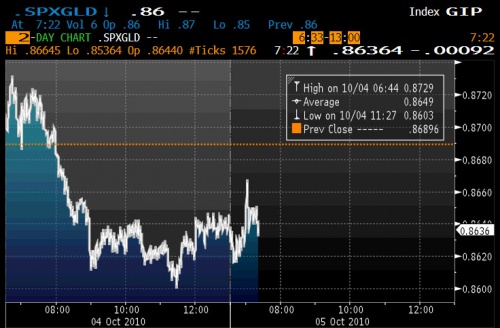
Here's Baum.
While stocks and bonds have been savoring the benefits of QEII, the message from currency and commodity markets is altogether different. The dollar has been sinking while gold sets new highs almost daily. Commodities overall have embarked on a bull run, just as in late 1993, when a jobless recovery finally kicked into gear.
If deflation -- that is, persistent, 1930’s like deflation; not a CPI decline of 1 percent -- were a threat, you would think folks would want to hold the currency, which buys more when prices fall. Instead, the currency market is forewarning of too many dollars in circulation.
7. New Bretton Woods? - The mood in global financial markets is turning febrile as it becomes clear a big shakeup in the Global Financial architecture is required. The G20 meeting in November looks like being the first real opportunity to talk about a new Bretton Woods or Plaza Accord.
8. Foreclosure moratorium? - There is growing talk in America about completely shutting down foreclosures across the country for 90 days in the wake of revelations of 'Robo-signers' of foreclosure documents causing mass injustice, Zerohedge reports. The really interesting development is that title insurers are stopping covering titles. The banks face being wiped out by this, forcing a second bailout by the US government. The CNBC video below is instructive.
And here is Gretchen Morgenson at the NYTimes with all the wretched detail.
The byzantine mortgage securitization process that helped inflate the housing bubble allowed home loans to change hands so many times before they were eventually pooled and sold to investors that it is now extremely difficult to track exactly which lenders have claims to a home. Many lenders or loan servicers that begin the foreclosure process after a borrower defaults do not produce documentation proving that they have the legal right to foreclosure, known as standing.
And Zerohedge.
CNBC's Diana Ollick confirms various so far unfounded rumors, that the government is planning to institute a 90 day foreclosure moratorium as it deals with the realization of just how big and pervasive the mortgage problem is, and even worse, will soon be. It is so bad that even a typically ebullient Larry Kudlow is forced to note that this is the "housing equivalent of the credit financial meltdown" and that "this is going to go on for ever."
The biggest issue that is now developing, as we noted last week, is the fact that title insurers (firms such as Fidelity National, First American, Stewart Info and Old Republic) are refusing to insure mortgages in foreclosure or otherwise, uncertain as to who actually owns the title.
And for all those who believe this will merely keep prices artificially high, we have very bad news - the problem with the title insurers walking away on fears of lawsuits is that no lender will be willing to write a mortgage without title insurance, meaning that suddenly the up-front component of home purchases will either necessarily have to surge, or home prices will have to plunge by a like amount, as there is simply not enough equity (read money) to cover the resulting debt deficiency.
Alas, this mess is just starting, and as people realize how bad it is, it very well may lead to a total collapse in the housing market
9. Causing chaos - Joseph Stiglitz is reported by Reuters as saying the US Federal Reserve and the European Central Bank are causing chaos on global markets.
He's right there.
A "flood of liquidity" from the Fed and the ECB is bringing instability to foreign-exchange markets, forcing countries such as Japan and Brazil to defend its exporters, Stiglitz told reporters in a conference at Columbia University. "The irony is that the Fed is creating all this liquidity with the hope that it will revive the American economy," Stiglitz said. "It's doing nothing for the American economy, but it's causing chaos over the rest of the world. It's a very strange policy that they are pursuing."
Stiglitz reckons government spending is the solution. I'm not so sure on that. I don't think it's our solution.
"Lowering the interest rates may help a little bit, but that's much too weak to address the problems facing the United States and Europe," Stiglitz said. "We need fiscal stimulus."
10. Totally irrelevant video - Stephen Colbert talks about Germany finally paying off its debts from World War I debts. 'We world war won it..."
| The Colbert Report | Mon - Thurs 11:30pm / 10:30c | |||
| We World War Won It | ||||
|
||||
28 Comments
Bernard - what made you choose Dilbert as the daily cartoon. It is interesting how much wisdom is expressed!
Cheers. I used to work in big corporates where these cartoons are simply documentaries rather than cartoons.
I don't work in big corporates any more.
Haven't had a teleconference or a corporate meeting for quite some time. Happy about that.
cheers
Bernard
Thanks - you have also been spared the phenomena of "webinars" no doubt. It must be hard to really appreciate how much fun you are missing out on!
Re # 2 - I like Sugar and I like Rice too.... but I don't think Jim Rogers will be having to wait 5 years for 1 USD = $2000/oz Gold USD.
Re # 3 & 4 - at least I can still feed my self and extendend family - I can still home kill a mutton?... Can't I ?
Re # 5 - "money is a psychological concept" - Yes, but, if you think about it... not really.
Anyone wonder where Japanese investors might want to put their money if they want to avoid more devaluation of their own currency and actually want to receive a return (any return).?
Welcome to New Zealand !!!
No Billy they won't.....so don't excite yourself for no reason.....why..? not long to wait...two big guns fired....printers lined up...... and some interesting and desperate policy changes in the wings from the BOJ.......
And if they did, Billy, what would we do with it? Add capacity to those thriving export oriented industries? Invest in more technological R&D? Or just borrow it; pay the inerest back out 'to Tokyo'-interest earned from whatever productive capacity we still have left, and get back into buying and selling non- productive 'assets' to each other. Then, when the money is called back to Japan, like when it gets all peaceful, then how do we replace the 'investment' capital? I know! We sell of whetever we have, to whoever we can, from wherever they come , and get to rent a 'home' in NZ for ourselves- that's if we can afford the rental payment, that is!
The Fiat Currencies are in crisissays David Gelland from Casey Research, who captures the action quite nicely.
http://www.creditwritedowns.com/2010/10/the-fiat-currencies-are-headed-into-crisis.html
"There’s a global race to the bottom underway for the world’s fiat currencies. In their efforts to save their economies from the extraordinary levels of debt they and their predecessors have run up, the misguided politicians now believe that the best approach is to devalue their currencies against those of their trading partners. This in the hopes of gaining a competitive commercial advantage for their export products on global markets."
cheers
Bernard
Re# 6 - "Interestingly, the S&P500 measured in gold actually fell overnight, rather than rose as suggested by the Index." ...
Neither has the recent surge in US Stocks been a positive surge when measured in terms of Oil (Expressed in USD)...
What will be interesting though, is what the price of Oil (when measuresed in post QEII terms) will do to the country that represents 4.5% of the Worlds Population, YET REPRESENTS 24% OF THE WORLDS OIL CONSUMPTION?
Hey fat boy!... want to trade that SUV in on a bike?
I love it, the US Banks are now experiencing their ultimate stuffup, with problems with their mortgage paperwork. Were they not the same banks that allowed the merchant banks to cut up, slice dice and package the sub prime home mortgages into tradeable securities?
The US banks own greed has now dealt them the Joker card and the joke is on them. I do forecast that they will not have a bailout this time round, they may have to just wear it if the Courts continue to find against them.
Here's what the Hubbard supporters are saying about the Grand Conspiracy against their man.
"Allan was planning to raise adequate funds on matching terms of 1 to 3 years so all loans
would be funded by investments on the same terms as the loans."
Hmmm. Pity he hadn't done that before making the loans.
"In contrast to Grant Thorntons’ opinion that Aorangi advanced $24Million to Te Tua, the
reality is that Mr and Mrs Hubbard voluntarily introduced the Te Tua assets to Aorangi
Securities in 2009. This was specifically to strengthen the Aorangi balance sheet, a
decision made entirely at Allans own discretion. The benefit to Aorangi was primarily the
Te Tua Trust cash flow of approximately $200,000 per month of principal repayments,
which Aorangi was receiving prior to the Statutory Management.
The $40Million capital invested in Te Tua was by way of $15Million of retained capital
profits from it’s former commercial property investments with the additional $25Million in
capital being a loan to Te Tua from Allan Hubbards own funds. This was prior to Allan
voluntarily introducing Te Tua into Aorangi. There was never any investment or loan by
Aorangi to Te Tua."
Oh dear. That money is moving around at a great rate of knots.
And then they bring in the fabled PwC report, without quoting from it.
"In Grant Thorntons’ opinion their ‘valuation’ of the unlisted shares appears to have led them to believe that a portion of HMF funds are missing, when in fact there are no missing funds.
Grant Thornton have applied a ‘cash’ basis for accounting rather than the, widely adopted
standard practice, of ‘accrual’ accounting which is what Allan Hubbard had been using. This
has resulted in a significant difference between Grant Thorntons’ calculations and PWC’s."
We'll see
cheers
Bernard
Robert Reich points out that Goldman Sachs is threatening to leave Europe if the regulation gets too tough. Let's hope they don't come here in earnest...
http://robertreich.org/post/1245725732
Blankfein told a European financial conference that while Europe remains of vital importance to Goldman (with less than half of the bank’s business now generated in the U.S.), the introduction of “mismatched regulation” across different regions would tempt banks to search out the cheapest and least intrusive jurisdiction in which to operate.
“Operations can be moved globally and capital can be accessed globally,” he said.
cheers
Bernard
PS Another reason for capital controls. We need to stop this sort of regulatory arbitrage. The squid cannot be trusted.
BNZ now own 80 % of Goldmoney Sacks business in NZ . ........... the Vampire Squid has exited NZ in earnest . We're too much of a basket case , even for them , the Calamari Whizz-Kids .
Three years ago, I did an op/ed in the ODT saying they'd need a new Bretton Woods, and why.
The problem is that the folk who gather to talk about it, haven't the slightest clue what the problem is.
And - if Copenhagen is any guide - they'll opt a fiscal-advantage stand-off, rather than accept (and adapt to) the Limits to Growth.
So given the inevitability of QEII what is a bloke to do here?. Reading zerohedge and others it is a very messy world now and looking worse. Leave the few pennies in term deposits and go for safety ? Any guesses as to the impact here for savers and investors.?
Go where for safety?....stay in aus$ or Kiwi$ Brett or into aus commodities but beware the china story and a repeat of the big 08 plunge. Gold may well rise a good deal but is exposed to manipulation and do not buy paper promises as in goldcorp crap. Stay away from longer term deposits and be ready to pull loot overnight from finance companies...the GG is running out very soon and the EGG is for much less cover. Kiwi property is dangerous....stay out....ditto aus.
Most important...get out of debt. Be ready to buy quality shares on any huge collapse.
According to one of those spammy sell you a subscription to their stockpicking publications , Chile is the place to invest all your dosh ........... Or was it chilli ? Bugger it , hedge your bets by investing it all into a Chilean chilli farm .............
........... if their stock picks are so crash hot , so gonna make you 427 % in the next 6 months , how come they're trying to sell me their priceless wisdom for just $US 29.95 per month ?
A Gummy Bear special!....sell the same poo to a million suckers at that price having already set a long position on the stock...flog it on the up and go short...then issue a free warning to clients to bail out NOW!....double the fun
Don't you just love the free market...fleece the greedy!
Gummy the Chilean Stock Market has been the success story of the past two years. I have a 300% record there. and as long as the US mkt remains in the shadow the Chilean mkt. is the right place.
Re. 2 on commodities - worth a watch. Interesting to note that he is very bullish on agriculture commodities over the next 15 years.
Good news for NZ?
On the surface yes, but my concern is that all this international money on the sidlines flows in agriculture and in particular floods into investment into countries like Brazil, will this result in a global glut of commodities and a consequent sharp drop in prices?
How will Fonterra do against the rush of competitors from Sth America?
Why, if NZ is deemed to be a commodity country and we have record high prices, is our economy sinking into a possible double dip recession?
With peak oil worries, trade protectionism and environmental concerns, will we see a move back to localised production?
Any thoughts?
I hear estimates of the storm that hit 10 days ago, are as high as 4 million lambs and 1million ewes, from the central north island to southland.
We have a structural problem in rural NZ that is going to result in a systemic failure, this just speeds it up a bit. Exports will be down.
Andrew your statement offers a good chance seeking better solutions with input coming not only from the farming community – great !
Here is another scary story:
Give Us All Your Money If you thought the bank bailouts were over, you thought wrong. http://www.newsweek.com/2010/10/04/banking-s-new-bailout.html#
Isn't it quite simple why China is gonna be in control globally. They have an administration that is totally in control of the people, economy, industry and direction. Their population, in general follows or faces a future behind bars or worse???
How can any democratic western/eastern economy compete when the lifelines of the elected puppets depends on how Mum, Dad, the kids are faring on election day.
Just take another look below at David Cameron's reversal on election day promises. Remind yourselves of the same stuff that happens in every democratic country a few months beyond next election day.
Wolly is a ranter but often right.... What is the answer???
http://www.bbc.co.uk/news/uk-politics-11481223
Have you read the new set of regulations that the CFTC will enforce on US traders ?. IMO the US is geting it all wrong by the hour, now every US trader account being held abroad will be forced back to the States as of October 18th, margins will be limited to 50:1, FIFO rule for all, and "no hedging". Amerikansk's are closer and closer to China. What is next ... Restricting the hours that you are alowed to trade ? Desperate country making desperate decisions.
Why we are going nowhere!
http://www.marketoracle.co.uk/Article23277.html
"The premise of Keynesian economics is that large federal deficits, when accompanied by falling interest rates, will produce economic recovery. The Washington Establishment has bet the farm on the accuracy of Keynesian economics. So, for that matter, has the Wall Street Establishment. But, so far, all that the deficits have accomplished, and all that the expanded monetary base has accomplished, is to halt the rate of economic decline. It has not restored confidence, and it has not restored long-term economic growth.
This is not just true in the United States. This is true all over the West. Western central banks expanded their monetary bases in 2008 and 2009. In other words, they brought in the kegs and filled them with powder. Their commercial banks have also pulled the fuse out of the new, vastly expanded powder kegs. This has kept a great explosion of prices from taking place. For this, we should be grateful. But it does no good to tell an unemployed man that he ought to be grateful."
This is what you must do to survive..." look for alternative investments that will enable you to escape the depreciation of money that will inevitably result from a successful policy of monetary inflation"
and remember...the RBNZ has a policy if causing 3%pa monetary inflation....30% every decade!
We welcome your comments below. If you are not already registered, please register to comment
Remember we welcome robust, respectful and insightful debate. We don't welcome abusive or defamatory comments and will de-register those repeatedly making such comments. Our current comment policy is here.