

Here are my Top 10 links from around the Internet at 10 past 11 am, brought to you in association with New Zealand Mint for your reading pleasure.
I welcome your additions and comments below, or please send suggestions for Wednesday's Top 10 at 10 via email to bernard.hickey@interest.co.nz.
I'll pop any surplus suggestions I get into the comment stream

1. 'Leaky homes often worthless' - Quotable Value's Glenda Whitehead has written this interesting analysis of how to value a leaky home in Auckland. She indicates that often the only value left in any property is the value of the land. She gives an example.
"The above example, in which the Market Value is equivalent to the land value, is from our experience, not uncommon in the Auckland market."
What are you seeing?
The big issue at the moment is a logjam of rebuilding activity waiting for a deal between the banks and the government.
Currently the central and local governments have agreed to pay up to 50% of the cost of repair or rebuilding, but the owner still often needs to borrow the other 50% using 'existing lending criteria'.
This is the problem. Many can't afford to borrow more because they either don't have any equity left or don't have enough income to service the extra debt.\
So someone is going to have to take a hit?
But who?
The taxpayers or the banks.
2. What the Chinese would say - Thomas Friedman at the New York Times speculates about what Chinese diplomats would be saying about America if Wikileaks got hold of their cables. Sort of entertaining. Here's the best bits.
Americans just had what they call an “election.” Best we could tell it involved one congressman trying to raise more money than the other (all from businesses they are supposed to be regulating) so he could tell bigger lies on TV more often about the other guy before the other guy could do it to him.
This leaves us relieved. It means America will do nothing serious to fix its structural problems: a ballooning deficit, declining educational performance, crumbling infrastructure and diminished immigration of new talent.
Finally, record numbers of U.S. high school students are now studying Chinese, which should guarantee us a steady supply of cheap labor that speaks our language here, as we use our $2.3 trillion in reserves to quietly buy up U.S. factories.
In sum, things are going well for China in America.
3. China's insatiable demand for diesel - The FT.com has an excellent piece on how power shortages in China's red-hot (and cleaning) economy are forcing many factory owners to fire up their generators, sucking up yet more diesel.
This is helping to drive up oil prices globally towards US$100/barrel.
4. Oil at US$100 a barrel and petrol at US$3 a gallon? - What would that do to the political and economic landscape in America? It wouldn't be good. Here's CNN with a look at the oil price.
And the Fed's role in this. No wonder Bernanke isn't popular in the land of SUVs and four car garages.
Part of the problem is that the Federal Reserve may be fueling (pardon the pun) the rise in oil with its controversial plan to buy $600 billion in long-term Treasury bonds. Fed critics argue that this quantitative easing program, the second since the onset of the financial crisis two years ago, may weaken the dollar further and lead to higher commodity prices.
.png)
5. 'We just make it up' - The Wikileaks scoops are starting to get really interesting. This one picked up by Reuters shows how one Chinese leader has no faith in the middle kingdom's own GDP figures. Here's the detail. HT David via IM.
China's GDP figures are "man-made" and therefore unreliable, the man who is expected to be the country's next head of government said in 2007, according to U.S. diplomatic cables released by WikiLeaks.
Li Keqiang, head of the Communist Party in northeastern Liaoning province at the time, was unusually candid in his assessment of local economic data at a dinner with then-U.S. Ambassador to China Clark Randt, according to a confidential memo sent after the meeting and published on the WikiLeaks website.
The U.S. cable reported that Li, who is now a vice premier, focused on just three data points to evaluate Liaoning's economy: electricity consumption, rail cargo volume and bank lending.
"By looking at these three figures, Li said he can measure with relative accuracy the speed of economic growth. All other figures, especially GDP statistics, are 'for reference only,' he said smiling," the cable added.
6. What would happen to Australia and NZ if China's growth halved? - Leith van Onselen at The Unconventional Economist is doing some excellent stuff on the Australian economy and housing market. Now he asks the big question: what happens if China's growth rate halved to 5%? HT Hugh.
If China's growth slows considerably then Australia's Terms of Trade could crash as increased commodity supply meets diminishing demand. And if this happens, then all the positive effects on employment, incomes, growth and the Government's fiscal position received by Australia over the past decade would unwind.
To make matters worse, Australia's banks, which have borrowed heavily offshore to inflate the housing bubble, would once again find it extremely difficult to roll-over their maturing foreign borrowings. Only, unlike in 2008, the Australian Government might not be in the position to guarantee their debt given the significant other drains on the budget from diminishing tax receipts and rising welfare payments.
Obviously, any contraction of credit would also have a devastating effect on house prices.
He then goes on to talk about NZ.
Any meaningful slowdown of the Chinese economy would, therefore, adversely impact New Zealand both directly and indirectly via slower Australian growth, and would translate into a contraction of aggregate demand, higher unemployment, and a worsening Budget bottom-line.
And because New Zealand has even higher external liabilities than Australia - predominantly due to offshore borrowing by the banks to fund housing - it would be equally if not more exposed to a liquidity crisis.
Once again, I hope that the bears are wrong and the China growth story continues. Otherwise the Trans-Tasman economies face an extremely challenging period ahead.
7. The Fed's US$120 million printer error - We all know the Fed is printing money to try to get the economy going again. But it's also printing money badly. Fastcompany reports that the Fed printed 1.1 billion new US$100 bills and found afterwards that every one of them had a slight crease in them that made them useless.
Each bill costs 12 cents to make so it cost the Fed US$120 million to incorrectly print US$110 billion. Spreadsheets are much easier. HT Troy.
The Fed had triumphantly announced the forthcoming bills back in April, touting advanced features, including color-shifting bells and a blue security strip that is woven, rather than printed, into the paper. There appeared online a video with heroic music and an involved interactive feature that allowed people to check out a virtual incarnation of the bill. Then, in October, the Fed quietly announced that it was having "a problem with sporadic creasing of the paper" and would need to delay the release date on the bills slightly. But only now have CNBC's sources been forthcoming about the extent of the problem.
The bills all came out looking normal, they say. But upon closer inspection, many of them contained a small crease. When the edges of the bill were tugged, smoothing the surface, it revealed a blank, unprinted strip across the face of the bill.

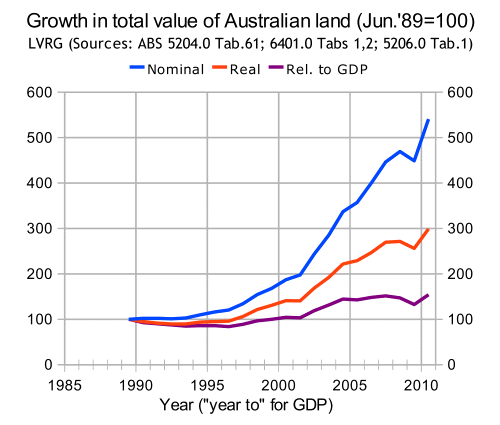
8. Australia's over-valued land - Gavin Putland at Land Values Research Group in Australia has produced an excellent chart showing how Australian land prices have risen relative to GDP in the last decade. It's clearly a bubble. HT Hugh.
Between mid 2009 and mid 2010, the total value of residential land rose from 180% of annual GDP to more than 210%. In those 12 months, where did Australia find an extra 4 months GDP to pump into land values? Nowhere. Buyers paid higher prices on a sample of sites, and that sample was deemed to be representative, notwithstanding that the buyers paid too much.
Does that mean the ABS values are wrong? No. The task of the property valuer is to measure the behaviour of the market, not to second-guess it. Discerning when the market is ripe for a “correction” is the task of economists, whose past form is not encouraging.

9. 'Many of the nation's billionaires are on the warpath' - Vermont's leftie senator Bernie Sanders tees off in Congress about income inequality in America. The top 1% earn more income than the bottom 50%. The top 1% earn 23.5% of all income. HT Eric.
This sort of radical talk might get a run on in this environment. Worth watching. This is a senator, albeit off the reservation, talking here.
I agree with everything he said. Do we have similar problems here?
10. Totally bizarre video - 'I have a bad case of diarrhea'. What is it about the Japanese?
112 Comments
Here's Bryan Gould at NZHerald with a very good piece on free trade and the risks of the TPP.
http://www.nzherald.co.nz/business/news/article.cfm?c_id=3&objectid=106…
Well worth a read/HT John via email
This is an international agreement of an unusual type - one where individual corporations have the same rights as governments. Those rights could include exemptions from domestic obligations in fields like health and safety, or concessions on tax treatment, or preferential treatment when it comes to awarding contracts, or relief from attempts to protect the local ownership of assets. Even if our own Government - perhaps a government of the future - wished to change domestic law in these respects, foreign corporations could still enforce their rights under the "free trade" agreement.
There is no reason a trading relationship should not benefit both parties. There are many situations where free trade is appropriate. But we would be foolish to go on believing the free trade label is the only safeguard we need.
cheers
Bernard
and we would be stupid enough to sign up?
Oh yes we would......
What's stopping a govn canceling / revoking the FTA?
regards
Here's Bernie Sandeers on the Fed. This is a corker. He should be president in the US, this bloke is great.
http://www.huffingtonpost.com/rep-bernie-sanders/a-real-jaw-dropper-at-…
wow rp...top link...a must to read for all.
The most revealing in this speech are not the sums and banks etc. but in my point of view:
"we have begun to lift the veil of secrecy at one of the most important agencies in our government" What????
The Fed is NOT an agency of the government, it is about as "Federal" as "Federal Express", as somebody put it so succinctly. That the Fed has this incredible power despite the fact that it is a private organization of bankers shows where really the crux of things is buried.
Also try this:
Rare CBS interview: Ben Bernanke 100%certain of economic recovery.
Just like in 2007.
On December 23, 1913, the Federal Reserve System, which serves as the nation's central bank, was created by an act of Congress. The System consists of a seven member Board of Governors with headquarters in Washington, D.C., and twelve Reserve Banks located in major cities throughout the United States.
The FED is a group of "private banks" that have been "appointed" by the US government to control the US currency and inflation. Like you say That's as federal as it gets. It's a good loop hole for the FED to use when the shit REALLY hits the fan ( not far off now) "100%"
agree entirely...this is the most disturbing aspect of the whole thing...a bank run agency now has the treasury (an ability to print money at will)...no prizes for guessing what'll be the main thing they want to do
No 9 you must listen to.....
Hopefully you people are starting to understand, why I’m writing article explaining why we have to change NZ’s culture and economic future.
Number 10... you...! must listen to ......if you are to gain any understanding of information outflow controls at the RBNZ....and the conclusions to a constipated economy.
LOL, too true
Re (9) you've allowed that communist streak of yours to run around in the open again Kim Jong (and Mr Kunst).
So Eric Watson earns more than me: big deal. Doesn't mean his life is any better than mine; I have the money to buy everything I need, and both Mr Watson and I get through the toothpaste tube at the same time and that'll be the case no matter how much more he earns. But to do what you advocate here, forcibly take the earnings he has earned through risk taking and entrepreneurship and giving it to me to even us up just takes both of our freedoms completely away, and puts us living in the jail of Nanny State. Left alone we are both free, pursuing our happiness, whereas we both are the losers under the hairy armpit of Nanny telling us how to live our lives, and taking our money to patronise us so.
And to counterweight the silly statistics you quote in this item, consider this:
http://cafehayek.com/2010/12/on-the-tax-burden.html
Quote:
In 2008 (the latest year for which accurate data are available), the bottom 95 percent of income-earning households in the U.S. – a group that surely includes “middle-income taxpayers” – paid 41 percent of the revenue taken in by Uncle Sam from the personal income tax, while the top 5 percent of income-earning households paid 59 percent of this tax revenue. And looking only at the top 1 percent of income-earning households – surely “the wealthy” – they paid a whopping 38 percent of federal personal income tax revenue.
In 2008, for the typical household in the top one-percent of income-earning households in America, the percent of its adjusted gross income that it paid in federal income taxes was 23.27. Middle-income households paid less. For households whose earnings put them in the top 50 percent, but below the top 25 percent, of income earners, the percent of their adjusted gross income paid in income taxes was, on average, 6.75. For households in the bottom 50 percent of income-earners, the percent of their adjusted gross income paid in income taxes was, on average, 2.59.
So guess who are actually having to pay for the jail of State anyway. And what a pity the majority of this tax money is being criminally squandered on making the increasingly violent, increasingly unsustainable, welfare State even bigger. Best to leave people with their own money, and create the right incentives for a free and prosperous society don't you think? And don't worry your neighbour might have more than you, because to 'fix' that you destroy the civilised society completely - as is happening.
As I say more and more: go rent a movie called The Lives of Others, and see if you really want to live in the world you advocate.
The world has gotten grossly unfair, simple as a society we choose the conditions of the society and ppl are deciding it needs to swing back somewhat...if as an extremist you dont like it then you are free to leave...
regards
Sorry ,Bernard , but I couldn't watch all of Senator Sanders speech .............. Geeeeeez , he's a fool ! ........... And a Senator . A-f*cking-mazing !!!! How many years do we have to listen to this " War on the Poor " , or " War on the MuddleClass " rubbish .
Rich folks are individuals . It isn't a gang , meeting behind closed doors , planning secretly to take more money for themselves ( Sorry Iain , but it isn't so ! ) .
Do the Cullen thing , the " Rich Pricks " envy tax , and see the consequences ............ He was too stupid to think that the wealthy would begin using rental investments and negative gearing , to skirt his attack upon their income .
Rich folks get that way by creating massive wealth for humanity , as Bill Gates did with Microsoft . We're all the beneficiaries of his innovation . Head down the path of " Soak the rich " , and you stymie innnovation . Entrepreneurship dies .
Sleeping under palm trees near Manila you really should wear a P - helmet - Roger.
Not every person earning below $ 20'000.- p/a is a criminal either.
...man...they have over 20% real unemployment in the US, people getting cut off unemployement benefits (have to live on the street), mortgagee sales everywhere, and are printing money monetizing their deficit because the country is broke....why, when people are fighting for their survival, would you want to give the wealthy tax cuts. Bernie is right on, the US is in a war on its own people
Yep....what they (the rich) dont seem to understand is they are a minority....they can be kicked out....its known as a revolution....they have had one to free themselves....looks like there is a risk of another.
The call for tax cuts to continue are an abomination, if Obama cant see that he's doomed...
regards
Good morning GBH...I see your in good GRRRRR form on this beautiful day....number ten is a must to see....simplistic yet so profound.
P.S. out of concern for your ex-landlady I left you some advice on that "Why something is brewing" blog thingy.......anyhoo may happiness invade your day.
The politics of envy , is a universal theme , Count . ............ Remind me , what's the incentive to invent , innovate , struggle and strive ? ............. Money ? ......... Or the happiness that some Cullenesque plonker took all your profits and re-distributed them via a bureaucratic monster , to " the poor " . ............. And " the Poor's " incentive to do anything but sit by idley , waiting for their " entitlements " to arrive ?
Loved # 10 : Ever wandered around the malls of Tokyo ? They mangle English , to give shops bizarre names , " Good Chicken Hot " being a ladies' shoe store .
[ Sadly for the mad landlady , the hot action for me was somewhere else ........... With a lovely lass , older than me own mum ! ]
Try talking to inventors many invent for the love of inventing....ditto many other endevours, it actually seems to be only a small % that only live for money.
Its not a Q of taking all profits and never has been....typical extremist answer, its black or white all or nothing, the real world isnt like that.
regards
on the topic of entrepreneurship, what proportion of our politicians are true entrepreneurs (building up a large exporting company from nothing) and what proportion are just businessmen who joined an already large organisation that held a strong or mopnopoly market position?
for example are bill english (ex treasury?) g.brownlee (builder/baker) and pm key (merril lynch) the right people to lead and nourish an export based economy?
are there any others we might be better off listening to?
G Brownlee a builder is probably stretching it - he was a woodwork teacher.
fair call but he definitely knows his way around a bakery
Gerry was indeed my woodwork teacher, in the distant past. Gave me the cane too, the bugger!
We and America had very high tax rates on the very rich through the 1940s, 50s and 60s. It didn't harm economic growth or innovation or stability. In fact, quite the reverse.
cheers
Bernard
Prove it Bernard ! Prove that assertion that the massively high marginal taxes of the 1940/50/60's didnt inhibit growth and innovation .
Meebee you confuse the enormous economic and inventory re-build after WW 2 , with good governance ? The stimulatory effects of the war pulled the world out of the 1930's depression ( a government & central bank created event ) ............. And the decades of growth were the result of a war caused by ...............some stupid governments , principally one in Germany , aided by some fools in France , Italy , and Japan .
I don't recall much in the way of innovation in 1960's New Zealand . It was a dull , sombre time ..... Huge government bureaucracies .... Union strikes . ...... Few available goods or services............. Hardly an era that proves your assertion correct !
I don't want to go back there either.
But NZ did at the time have one of the highest standards of living in the world, it did run current account surpluses and extraordinarily low unemployment.
cheers
Bernard
It was a golden era for NZ & Australia , providing for Britain's food needs , in the aftermath of the war . But when the UK shut us out , by joining the EU in1970 , the chill winds of reality struck home .
Australia grew and prospered ......... NZ entered the " wildeness decades " ........
Energy ie oil was very cheap, ditto raw materials like iron, copper....so there was a huge margin....those are all but gone, certainly they are not cheap anymore.
Otherwise yes I agree, higher taxes dont seem to have hurt and certianly the tax cuts of the Reagan and Bush years should have un-leashed huge wealth and providence....did they hell, so there is certianly no case low taxes for the rich are good.
regards
sorry tribeless but your libertarian ideology has had a 30 year run and it's been a disaster. libertarianism is just as much of a fanciful ideal as communism. it's all very good on the page but in practice it is full of holes.
I'd like to know exactly where libertarianism has had any kind of run. Central bank-inflated property bubbles, exploding government debt and the rampant growth of the welfare state don't add up to a libertarian society as far as I'm concerned.
yeah that's kind of my point kleefer.....any time someone comes up with a brilliant ideology it doesn't get a decent run because people (largely out of fear i suppose) run interference in order to protect their own turf. human nature is a real impediment.....
Then how can you argue that Libertarian ideology is a disaster after it had a 30 year run ............. If governments and central bankers persisted in running interference , on the market mechanism ?
Libertarian...during the dark ages maybe where whoever had the biggest sword made the rules....fortunate that we have progressed since then....mostly.
Cheap credit inflated bubbles brought to you by Alan Greenspan....the attempts to move to more and more free markets has resulted in total corruption of them.....Govn debt is exploding as it tries to contain the mayhem de-regulation has unleashed....
regards
Greenspan is an Ayn Rand groupie himself.
Kleefer-you're up the kleek
so many folk start with what they want to be the truth, then work backwards....big mistake.
The moves - worldwide - in the early 80's were indicative of one thing - private vultures eyeing off the commons, because there were not enough opportunities left out there.
Just after we went through 'overshoot' in 1980. Which you won't have heard of.
Have you noticed that global longevity - rising YOY forever - peaked in 2007, a year after oil peaked? Worked out that energy was keeping us alive longer, and that depletion is starting to show at the margins?
But your kind always deny that there are limits. They come from it as I stated in that first sentence.
You can, of course, address depletion of resources and energy, in a libertarian manner. It would boil down to who had the biggst gun.
Me, I'd like to think we're capable of a bit better than that.
There has never been a libertarian society, not even close, just as we have planned economies not free ones.
Tell me Vanderlei, what do you think a libertarian society is?
@ tribeless and gbh
don't get your knickers in a twist ladies.
since the 1980's the predominant policy influence has been a mix of libertarian/chicago school/hayek/rand/free market ideology. regardless of how brilliant these ideas are the way they have been filtered through the existing political climate has led to a disaster.
personally i like personal freedom and free markets but i am also aware that people become greedy, paranoid and selfish quite easily. bill gates and microsoft are a perfect example - they saw a niche, filled it, enhanced productivity for millions and got deservedly rich but then engaged in anticompetitive actions. compare them with the financial industry that in the last 3 decades has grown enormously but basically hasn't produced anything useful since the introduction of the atm 3 decades ago. (tongue in cheek with that last assertion you two - i can see you've got your pedantic hats on today.)
gotta go now. nice sparring.
since the 1980's the predominant policy influence has been a mix of libertarian/chicago school/hayek/rand/free market ideology
That's just so off the mark. Keynesian, that's the only 'policy', and all the central planning that embraces - no free markets anywhere.
(We were moving toward freer markets under Douglas - the unsound money aside - and that was the only thing that saved us from bankruptcy, plus the deregulation that did occur set us up for the more than decade long commodities boom, and one of the most competitive rural sectors in the world - low economic returns on land price aside - that unfortunately a later Labour government complelely squandered, using it to make merely a bigger State, and so future problems of the unsustainable State, as we have now.)
Free markets since the 80's: God I've heard it all now.
Typical fundie, if its not hard core Libertarian its keynesian, or communism....there are in NZ only about 1000 "libertarian" voters.....thats a non-event.....even destiny church can swing around 10k voters....most ppl are far more reasonable shades of grey...
Free, certainly freer than they were to make a huge mess...I hate to think jsut how big a mess "really" free markets could have unleashed if this present state of jsut a bit freer.
No thanks I'll step back a bit and clap in some real regualtion.
regards
I'm sympathetic to libertarianism, but the idea that no society is even close is wrong.
I mean, why not Somalia? It has had no government at all for quite some time. Shouldn't it be the wealthiest country in the world, being anarcho-capitalist libertarian?
If you say it's not libertarian because it is run by warlords... well then, won't all power vacuums respond in kind?
The problem is that most libertarians are clear that government is bad, but have no idea how to replace it. Libertarianism is just theoretical.
That being said, small government is better than large government. Incentives matter. Freedom to choose is important.
Many things are much better done coercively, as a group, including prevention of theft and fraud, military defense, but also prevention of pollution, and dare I say it: operation of a central bank.
Thankyou well said, I totally concur...
While some things are best done by a Govn, health for one seems to have 1/2 the impact on GDP and does more for the people. Consider in NZ we spend 8% of GDP and do 100% of the ppl who live longer than Americans, thats 8% of GDP not going into administration and not being lost and covering everyone. So for me its pretty conclusive Govn provided services can and do work....Trying to claim anything else is plain stupid and ppl will just laugh you off...you wont have any credibility....
Beyond that I think there is a danger that Govn can get too big and smother and over-regulate....and business ppl and especially small ones can and do innovate, save money and make a positive contribution to public services let alone doing their own thing and bringing in money.
For me its simple, Socialism and big Govn doesnt work, libertarianism and no Govn wont work, somewhere in the middle is a reasonable balance...
Im also pretty sure big companies dont work either, in fact I think they are worse in performance than an equivalent sized democratically elected Govn.....has Telecom been good for NZ? I really doubt it....would 50 telcos all with their own masts on every hill top work? no....5 maybe....
regards
BREAKING NEWS: Obama's capitulated giving tax cuts for everyone (including the top 2%) for two years - but he's also throwing in benefit extensions. How big is the deficit now?
So the tax-payers get to keep more of their own munny ........ The munny that they went out and worked for ............. The munny that belongs to them , not to the frigging government ...................... Wow ! That's a novel thing to do . [ GBH in a sarky mood this A.M. ]
Agree'd!
Personally unlike ppl in the real economy who really did go out and work for it, (and now 20% of them are not) Goldman S and their ilk didnt they are just parasites....and no they dont deserve it IHMO.
This is where you lose me everytime, you simply assume that because someone earns a lot the "work" was positive and a net benefit......this simply isnt the case....
regards
Lets remember that Eric Watson and co didnt just get rich through entrepreneurship and risk taking. They screwed plenty of people. And the issue is that they actually dont care that they did. You may say that people who invested in Hanover etc are stupid, but what about the ethics of those who rant he operation they did? This is the attitude of the growing population of oligarchs screw everything and everyone in my way. The concept of society and social responsibility is far from their minds.
When talking about who pays the tax burden, perhaps it would be good to define who the top income earning households are, as I dont think they include the wealthiest individuals.
Re entrepreneurship and innovation, these flourish in an environment where they are encouraged - by things such as R&D tax credits! These help the little guys, those putting their life into something when they are on the breadline because they believe in it. I cant see how giving something like Fonterra a hand is going to help foster innovation and entrepreneurship in NZ - they make milk powder for crying out loud - its a commodity!
Having a handful of mega large businesses at the top may appear on paper to be more economically beneficial, but the actual impact on the rest of society is not matched - and this is the environment where innovation and entreprenuership is stymied.
Yep
regards
Link 9 is very good! Funny that it's thought of as socialist... The rich acquire/accumulate wealth at the expense of the middle class. People are out of work in the US because the rich (who own business) have outsourced nearly everything except the service sector and defence/aerospace manufacturing. The outsourcing only makes them wealthier, with the unexpected spinoff of no "real jobs" left in the country. Why shouldn't they pay more tax? They wouldn't be in the position they have if it wasn't for the system in the first place.
The result of their outsourcing is what we now have as a result in the states (and to a degree here in NZ). Some of these bizarre libertarian ideals that society can function without any state mechanism, running at the mercy of rapant capitalism are a bit far fetched as capitalism is self serving.
I am sure I'll now get flamed as a raving commie, but it more that I'm just disillusioned. (ie. oil companies not paying tax on massive profits...)
That makes two of us Tailslide.
..that makes three of us.
Yeah me to - 4
And me 5.
Furthermore I still wonder if the Wall St vampire squids would be ripping off the system as much as they are if the fear of communism was what it was 30 years ago.
6
regards
The rich create wealth ! They do not take it from others ............ A lucky punter who wins Lotto , gets rich at the expense of the poor and the muddleclass . But most winners of fortune blow the dough anyway . Folks remain poor for many reasons , most of them of their own construct .
Roger my old coconut - you definitely had better days.
People create wealth. In the end it needs to be distributed. How is another issue.
cheers
Bernard
Outsourcing and not manufacturing at home has proven to be disastrous events for western society. Often companies cannot be blamed for such steps. Government should legislate and protect human capital and what the education system created.
PM - this is unfortunately not happening in this country. Entire segments of NZindustries are missing and therefore NZtalented human capital is leaving the country - what an economy !!
No wonder why NZ remains to be a low wage country.
NZ will remain a " low wage economy " as long as big government exists , and sucks the life-blood out of the marketplace .
Russia / Cuba / North Korea : Take your pick , Walter . Which outcome do you choose for NZ ? Hickey's call for distribution of wealth leads down those paths . ........... And the Sam Morgans or the Weta Workshops of the land will easily relocate to more benign foreign jurisdictions .
If they leave , who remains to be bled dry , to prop up the government and it's clamorous hoard of " poor " , awaiting their " entitlements ".
Roger read 2:49pm
Roger - you are mixing up “success stories”. People with entrepreneurial skill are clever enough to keep their workforce by paying good money. Most entrepreneurial skilled business people are driven by enthusiasm and hard work - business success - not by greed. Greed money in today’s world is the problem and needs to be legislated by government. The banking system, cooperate, weapon and drug money are a clear indication.
Walter : Can you define " Greed " ?
And would your definition match that of the government's definition of " Greed " ?
Are not politicians themselves greedy to remain in power ; or greedy to take as much munny from the tax-payers as they can ; or greedy to feather their nests with super-generous retirement packages .
A bit hypocritical of them to accuse others in society of greed . Particularly when those others are business creators and employers . And I thought that you were in favour of business , thrift , and enterprise , W.Kunz !!!!
Roger, how do you stop "Wall Street Behavior" ruining the world ?
http://en.wikipedia.org/wiki/Greed and read 2:49pm
As I wrote many entrepreneurial business people aren’t driven by greed but by other means such as innovation and creation. Wise business people reinvest to improve their business, including good wages for staff members - even distributing money into their community, new projects, etc.
Yes - Sam Morgan is a good example for that.
As Wall Street shows, often "The Greedy" do not even run their own businesses.
Roger I ask you again, how do you stop "Wall Street Behavior" ruining the world ?
What is your idea of stopping criminals such as bankers, drug and arm dealers making greedy money, striping the world of it’s wealth ?
Hello Walter : Got half-way into replying to someone when the missus came and pulled me off
the computer , because she wanted to come
into the city for Xmas Shopping . I blew my load
on some tinselly crap made in China . And I thought , " Kunts
right ! Why can't we manufacture this shit in NZ ? "
........... wot was the question , again ?
Roger, you shouldn’t criticise/ complain when you don’t have a convincing answer to the problem.
That is because I dispute your argument that there is a problem . " Wall Street Behaviour " is what , exactly ? And it is " ruining the world " , how ? The world looks very far from ruined , where I live .
If you epatiate your question or point , I reckon I'll make up something on the hoof !
I know Rogie, Loburn is a very peaceful low- burning place, like so many small NZvillages.
And you and me growing veggies we are quite safe in front of a tui or two.
I reckon a diet of rice , fish , prutas & gulay would do you a power of good , old chum !
And given the massive Asian appetite for seafood , why did the previous government halt expansion of the NZ Aquaculture industry ?
The world looks very far from ruined , where I live . It is all good.
NZ Aquaculture industry ?
Walter, do you consider manufacturing to provide high-wage jobs? I may get it completely wrong but to me manufacturing makes me think of factories, shift-workers and low wages.
Personally I'd think that NZ would be much better off developing new technologies and having more people working in high value-added jobs like engineering. Hubby and I started a software development business (after working as employees for a dozen years each) and believe me, if more people did the same the average NZ wage would shot up. Plus we get to work from home, spend plenty of time with our 4 little kids and our set-up/day-to-day costs are very low. Oh, and did I mention that not finding work is a non-issue? I mean, seriously I just don't get this obsession with manufacturing (I welcome a detailed argument on that). But then again, I'm just an engineer.
Elley - you didin't read my many previous articles - pointing to high tech/ skillful job = human capital of modern days such as technicians / engineers - not slaves !
....again please people read and understand my comments in context with my many other articles.
That's right Walter, because with 4 little ones and 2 businesses I don't have that much spare time :)
But I did check out the definition of manufacturing jobs here : http://useconomy.about.com/od/glossary/g/manufacturing_jobs.htm "Definition: Manufacturing jobs are those involved with the production of new products from raw materials or from components. Manufacturing jobs are usually in a factory, plant or mill but can also be in a home, as long as products, not services, are created. "
And to me, it doesn't sound like high wage jobs.
Also if you check out seek.co.nz and select manufacturing, the sub-classifications that come up also don't say anything about engineers, or technicians, which doesn't surprise me in the least. On the other hand, there is "Machine operator", "Assembly & process work" etc. I have nothing against all these things, we need people to have diverse skills, but to me manufacturing just doesn't equates to high wage jobs, that's all.
Elly - I was born and bred into manufacturing ABB Switzerland – please.
http://www.abb.com/cawp/abbzh254/ec72bb280fd24d47c1256b5700522f3a.aspx
OK well, my husband actually worked for ABB after Alstom Power became ABB Alstom for a short while. He worked in an R&D centre with a whole lot of other engineers. And that's definitely not what I call manufacturing, and I guess that's why it was called an R&D centre. The actual manufacturing (making of the actual products developed by the engineers) was made in factories by factory workers, elsewhere (no idea where).
Bernard : If people create wealth , why does it need to be distributed ? And by who , the government ?
TradeMe being a case in point . Do you want to take Sam Morgan's $ 200 million gain ? He created a website out of nothing , and built it into a business that benefits multitudes of Kiwis , and continues to do so , after he has cashed out . His money is his , well earnt . No one has a claim upon his efforts .
Roger - you are mixing up “success stories”. People with entrepreneurial skill are clever enough to keep their workforce by paying good money. Most entrepreneurial skilled business people are driven by enthusiasm and hard work - business success - not by greed. Greed money in today’s world is the problem and needs to be legislated by government. The banking system, cooperate, weapon and drug money are a clear indication.
The problem – governments are often part of these systems – and governments are part of the society.
Now in a democratic system - it is up to us to change that - shrink the government and vote for uncorrupted people.
Tut tut. I am no economist but even I know that money makes money to the degree that it will tend to being amassed and controlled by fewer and fewer persons. It is the duty of governments to keep a balance in society.
Sadly it seems that none of the 'isms' really work due to human foibles.
Yes it is well earnt, but there is still a responsiblity to pay for his share in society. He himself has stated he pays nothing and feels bad about that.
People create wealth. In the end it needs to be distributed
Incredible. And you mean re-distributed, Kim Jong.
Soviet Union, China, North Korea ... in the end, apart from the very rare bright patch, it appears we've learned absolutely nothing.
Yes - Tribeless and Western societies (e.g. America) are currently exactly moving to such proportions, because GREED isn’t legislated, but roaming wild.
Remember Nicolae Ceauşescu
please read my comment 2:49pm
Yes and thats where the concept of society and social responsibility come in.
Reminds me of what a nutter I used to know said; that poor people are poor because of their own choosing and that if they wanted to be rich, they could be.
Agree'd!
The "Rich get richer" because they buy assets which provides an income, which is reinvested to buy further income producing assets.
As Gummy says, there's a different mindset between the rich & the poor.
The guy who created trademe, he was wealthy?
No....I believe he started with a laptop and an idea......he's now still having ideas....
regards
Hehe, once the Chinese start building airoplanes en masse the US can say goodbye to aerospace too...
I've looked on at the situation in the US, and in the western countries for that matter. Something has to give; if we're not already at the peak levels of extraction from our environment, we're very near it. There are limited resources to go round. If anyone is going to have better lifestyles in the future, it's going to be at the expense of someone else. With flat or decreasing resources there is no way everyone can end up better off. The rich will 'play the game' to make sure they maintain or improve their position, simply by exploiting others. Globalisation and controlling the government (as in the plutocracy that is the US) are great ways to achieve this. Of course this means the less skilled at the game will end up with poorer conditions as each year passes. Eventually, when there are enough people with nothing to lose, they will revolt. Riots and civil war. IMO it's just a matter of when.
Of course if those making the mega-profits were taxed more it would help delay the day of reckoning, but by what method is that going to happen in the US? It cannot without something radical such as someone overthrowing the government, and anyone with the means to do that is already helping to run the show now.
As Chris Martenson puts it, the next twenty years will be nothing like the last twenty.
Bit left field, but this ties in with that view...
CNN: Oil at $US100 a barrel....
it's not just higher fuel prices we face but fuel shortages. Where there is rationing, hoarding and hours of queuing at service stations. And the whole economy tanks again
A supply shortfall of almost 5 million barrels is forecast for this year, widening to 9.2 million by 2015, according to the latest in a string of similar reports published this year.
Independent oil economist Mamdouh G. Salameh projects this gap between supply and demand will be too big to reconcile even with prices soaring beyond the record $US147 per barrel ($2.20 per liter for petrol) we saw in 2008.
In other words the theory of mainstream economists that higher prices will always draw new oil production from the ground is simply not working. We are staring down the barrel of oil shortages.
Prediction: even tho this is all standing out like dog's bollocks, and numerous mitigation steps can be taken now, our illustrious government will pretend its not a problem until the said rationing and other extreme measures are required.
Oil only got to $147 a barrel because the global economy has "mass" or inertia to keep going it took that price to break it.....then we saw $40....same will happen again only this time it wont take $147....$100 will probably do it....as that $147 was 6%+ of GDP, US GDP is now far lower....6% is about $100....
If you look at the 5 year graph,
You can see that oil climbed up to $147 from way lower....this time we have hovered around $75 for a longer time period....now its starting to climb....I suspect what will happen is another meltdown within a year or 2 at most.....
Economists are kooks, money is a proxy for energy.....for them its throw more $s at it pl will pay ....they miss the entire point....energy invested to get energy is the real equation. Once it gets much below 10:1 to extract oil....ie 1 barrel to get 10....then we are in serious trouble....
JK will probably say its was "something funny going on" again...or a black swan..oh how un-expected....hello close your eyes and keep walking and sooner or later you break your nose....
regards
Fascinating Michael Hudson piece on the US deficit commission. HT Stephen
http://michael-hudson.com/2010/12/adam-smith-critiques-the-deficit-redu…
In view of the conspicuous absence of true free market conservatives, it is clear that President Obama selected members of the Bowles-Simpson commission to provide a rationale – or at least a rhetorical cover story – for turning the U.S. economy into a neofeudal economy increasingly indebted to creditors, enjoying their revenue and “capital” gains (mainly land-price gains that John Stuart Mill’s generation called the “unearned increment”) at the top of the economic pyramid.
It won’t work. It will drive the economy further into debt, shrink the fiscal base and further polarize the economy between rentiers (for whom John Maynard Keynes proposed euthanasia) and wage earners.
The Irish problem is far from over. HT Hugh. There's the parliament vote on the budget tonight and then...
Bondholders in Allied Irish Bank are preparing to sue the Irish state over losses they expect to be forced to take, in a move that may imperil attempts by the government to raise fresh funds next year.http://www.telegraph.co.uk/finance/financetopics/financialcrisis/818270…
cheers
Bernard
And China is set to tighten monetary policy with a rate hike this weekend, DJ reports.
http://online.wsj.com/article/BT-CO-20101206-714753.html
China's central bank may raise interest rates around this weekend, before the release of inflation data for November on Monday, the state-run China Securities Journal reported Tuesday, citing analysts.
"Given the central bank set a precedent by raising interest rates right before the release of the consumer price index (previously), there's a 'sensitive policy window' before and after this weekend," the report said.
China announced an interest rate hike, the first in nearly two years, on the evening of Oct. 19, two days before the release of CPI data for September.
cheers
Bernard
I'm glad some commenters here have their heads working properly still.
This rich vs. poor argument is a tired one. It's poor vs. rich. The rich are not taking from the poor, the poor take from the rich via progressive taxation. Taking less != giving.
Fair: everybody pays the same amount for the same services... say $10000 each.
Nearly Fair but kind to the poor: The poor get a break, nobody pays more than say 20% of what the earn. Everybody else pays a little more to make up the shortfall.
Unfair, no longer about preventing harm to the poor: everybody pays a fixed percentage.
Beyond unfair (unfair squared?), purely about misplaced anger: The richest pay a higher percentage than the rest of us.
The richest people got wealthy by providing value to society. Their wealth is already bought and paid for. There is no basis whatsoever for anger (presuming fair behavior, I'm quite aware of plenty of unfair but legal behavior, which should be attacked head on, not by singleing out the wealthy).
By defining society as rich and poor, and vilifying rich, there are by definiton always villians. Doesn't that seem like a bad definition?
Geetings Ant
The richest people got wealthy by providing value to society...
The rich got rich by good fortune: Ever read "Fooled by Randomness"?
Plenty of potentially rich men and women out there that did exactly the same things but were at the wrong place at the right time.
The rich generally had good role models in their young lives.
The rich generally had good nutrition in their young lives.
The rich generally have high native intelligence, a portion of which is genetic.
The definition of rich is not bothering to look at the price tag in the supermarket.
The richest people secure society's value by looking after those who can't look after themselves.
And guess what? They still don't have to look at the prices in the supermarket.
Ant
I'd like to think you are simply niave but I fear not. Statements like "The richest people got wealthy by providing value to society" really do make me wonder. Also simply because something is legal does not make it ethical.
I've met a lot of 'rich' people and not one of them ever got that way because of their humanity in fact quite the opposite. Anyone who thinks that Eric Watson 'earns' the eqivalent of the income several thousand people needs a dictionary.
I particularly like the jejune use of the word 'fair' as though acquiring assets in such a disproportion to your fellow human beings can be done by being 'fair', no it is done by being focused bordering on delusional
Neven
Statements like "The richest people got wealthy by providing value to society" really do make me wonder.
Has there ever been a more successful and self-serving propaganda campaign? I doubt it.
I agree with what you are saying. Legal != ethical.
I too have known a number of rich people, and most of them by and large are progressive liberals and very much humanitarian, both wanting the best for society, and also hard working and very respectable people. Yes, certainly, they are selfish and IMHO don't know when to quit.. Generally they feel superior and feel that having the assets controlled by them is better for society than having them controlled by people who are unproven. While I find some of this distasteful, they are doing no harm, I can't find fault with them.
But I often hear about this evil dastardly wealthy person, who I have not yet had the ill-fortune to meet, who makes thousands of times more than other people, and does so through legal but unethical means. And I could not agree more with your sentiment as to those people.
My conclusion is that what we need to be on guard about what it is we villify. We should not villify wealth, but rather the unethical means of acquiring it.
Coming from a different culture I feel I’m surrounded by slave drivers or living in 1887. Bloody hell is this New Zealand ?
Get back up that chimney , and start sweeping , you dirty little urchin !
I hope the NZChief - our PM doesn't agree with that.
Per piece above .....Chinese GDP figures are "Man Made " .
I knew it and I have written this before on this blog . I do not trust the figures coming out of China , they don't make rational sense . I did not need Wiki leaks to tell me this.
Quite simply if China grew a compounded 8% P.A. as they claim , it would double China every 8 years? ...... its impossible , quite apart from infrastructure not coping , agriculture is in decline , there is not enough space for all this growth and there are not enough consumers on the planet to absorb such a run up in production of manufactured goods.
Their GDP growth figures , by extrapolation mean that Shanghai will double in size every 8 years as will all the other cities ....... Bollocks!
Even if they have grown at 8% in the past , its not sustainable. If nothing else , the one child family policy of the past generation will cuase a slowdown in growth eventually.
The reality is that Chinese GDP growth properly measured by our standards is more like 4 to 5% which is still spectacular.
Also , China has had a 'hidden inflation' problem for a while now . Its still one third the size of the US economy but has twice as much money in circulation . Under-reporting of inflationary trends , low domestic interest rates and a managed currency have masked whats really being going on over there .
for about 20 years from 1953 to 1973, Japan clocked up compound average GDP growth of about 8% p.a., more or less. but it did not continue at that pace. it couldn't. 20 or so years of that is the limit, imho. then it must moderate to lower levels. China is in trouble and CHina will be the ultimate trigger for whatever is coming next.
Paul McBeth at BusinessDesk reports High Court Associate Judge Hannah Sargisson as describing May Wang as "evasive, disingenous and so commercially irresponsible as to be a threat to the commercial community."
http://business.scoop.co.nz/2010/12/07/may-wang-undermines-insolvency-regime-judge-says/
Yikes.
The bankers and farmers relying on OIO approval for the Wang/UBNZ bid to protect their valuations may be waiting a while...
cheers
Bernard
Huh !..... Based on the good judge's summation of May Wang , she ( Wang ) would have had a very successful career in politics .
Yep. Cant see that deal going through some how........
you guys are so negative.
she had a float in the christmas parade so she must be a fine upstanding member of society
"Under questioning from MPs on the Treasury Select Committee, Stephen Nickell, a member of the Office for Budget Responsibility (OBR) and a former Bank of England rate-setter, said a collapse of the single currency was "a possibility".
Asked more broadly about the sustainability of currency unions, he added: "The general consensus is that sooner or later they fail for one reason or another – but that doesn't mean to say it always happens."
His comments came as deep divisions in the eurozone threatened to drive Spain, Portugal and Ireland into more difficulty."
time to short the euro
And the RBA left its official rate unchanged at 4.75%. Looks like the strong Australian dollar and the banks' bigger-than-OCR hikes in mortgage rates is helping the RBA do its inflation fighting work.
"Following the Board's decision last month to lift the cash rate, and the subsequent increases by financial institutions, lending rates in the economy are now a little above average. The Board views this setting of monetary policy as appropriate for the economic outlook."
FAIRFAX has lost it's head . Chief Executive Brian McCarthy has quit , just two weeks after an appalling presentation to journalists , highlighting his vision , his plan for Fairfax's future .................... The plan appearing to be to continue saving money by cutting costs ( fewer journalists and fewer production staff ............. As ever ! ) . But McCarthy had no cogent idea how to increase the firm's revenues , let alone to staunch the flow of advertising revenue from their newspapers to the internet .
And those us who have been within the fortress walls are not at all surprised by the failure of Fairfax's siege mentality , are we Bernard , Gareth !
Good morning Bernard : A story overnight to warm the cockles of your heart : Nouriel Roubini has predicted that the US housing market is double dipping , and that a further $US 1 trillion will be lost by the banks , investors , Fannie & Freddie Mac .
Dr. Doom admits to being greatly influenced in this view , by a paper put out in October by UBS analyst Laurie Goodman . She believes that as many as one in five mortgage holders may lose their home .
Wow ! Wotta way to start the day ............. Enjoy , big guy .
Gummy,
Great to see you're joining me on the dark side....
Saw that too. I'm a big fan of the Roubini
Here's the story
http://dealbook.nytimes.com/2010/12/06/dr-doom-predicts-another-1-trillion-in-housing-losses/
cheers
Bernard
Bernard old bean, any chance of having a table to show tax rates going back say to the 1960 period so the comments about pensions can be better balanced. My contention is the young of today think rates have always been where they are today.....!
Bernard - #9, indeed, worth the time to watch it. You ask, "Do we have similar problems here?" Maybe, see last paragraph in my comment here:
" ... I think your'e right, we could actually surpass Auz, if we were led to. Considering one aspect of the overall problem - it's multi-causal. So, granted an efficient functional fix on any one of the following causes could be useful; I think these seem to be, land supply, immigration, taxation, public sector spending, monetary policy. Of course there are lobbies of support against change in any one of these areas, so my suggestion is make incremental, but significant, change in ALL to deliver appropriate change overall. To get there means selling the benefits clearly and showing the vested interests that it isn't just their particular interest that is shouldering the impact alone. Unless of course they are part of that small group of people that benefit from the status quo - that is, constrained land supply, unrestrained immigration, nil effective land/property/capital gains taxation and pro-cyclic monetary policy - who could that be, Roger? Does that group have so much power? Maybe they do, which is surprising in a one person, one vote democracy. Unless of course NZ suffers from a deliberate 'economic apartheid' and/or the same 'government capture' situation as the US - do we?"
A "small group" that wouldn't make up more than 5 to 6% of our population. However, they have similar interests in regard to benefiting from asset ownership, as approximately 60% of our parliamentartians. That is, at least approximately 60%, as defined under the pecuniary interests list, which doesn't mention indirect interests.
Funny that, eh?
So ... Fran O'Sullivan, nice article, 'Ten ways to beat our snowballing debt'
http://www.nzherald.co.nz/business/news/article.cfm?c_id=3&objectid=10692767&ref=rss
But get real - turkeys won't vote for Christmas any more than NZ parlimentarians will vote for many of the more significant policy ideas you repeat in your article.
Cheers, Les.
We welcome your comments below. If you are not already registered, please register to comment
Remember we welcome robust, respectful and insightful debate. We don't welcome abusive or defamatory comments and will de-register those repeatedly making such comments. Our current comment policy is here.